

Four key lessons that we can and must take out of 2025
It was a long and difficult year as President Donald Trump and his administration sought to push America into authoritarianism. But, they are losing — and we can get through this.

As the year comes to a close, the most blunt reality is that the second Trump administration is less than one year old.
And yet, there are already signs of aging. The edges are frayed. President Donald Trump’s desire to rule as a tyrant and not as the head of the executive branch in a government of limited and divided powers is being challenged — and those challenges are showing how weak he is.
The year, though, has undeniably been long and difficult. People are dead across the globe because of this administration’s actions; American research in science and health fields has been dramatically changed; immigrants have been under nonstop attack; transgender people have been under nonstop attack; the value of diversity itself — the pluralistic society that has been one of America’s greatest strengths — is being challenged.
The federal government itself has been altered in a way that will change the trajectory of this nation for the coming decades or longer.
And it’s not over. Trump, his sycophants, and those who are using his claimed powers to advance their own goals will continue seeking and acting to expand Trump’s would-be authoritarian powers in 2026. As they have done throughout 2025, they will do so with an almost outright lack of concern for whether their acts are legal or even constitutional. They will cause more harm — both physical and otherwise — to people within the United States and across the world.
But, despite it all, they are losing. Trump is losing in several key ways and on several important fronts. Much work remains, but we have learned what we need to know to get through this.
There are four key lessons that we can and must take out of 2025.
1. Pushing back is essential — and it works.
Those who have been targeted by Trump’s authoritarianism have shown that they can give in or fight back. From Kilmar Abrego Garcia to WilmerHale, pushing back works. People sent away are returned to the U.S. Clearly unconstitutional vengeance is stopped.
I’ve been discussing this throughout the year. It is fundamental to how we get through this moment. And it’s not just about the Trump administration, although that has been the focus. Here at Law Dork, one way I push back is through coverage decisions. In the latter half of the year, I wrote five times about the September 8 shadow docket decision allowing the Trump administration to racially profile Latinos in low-wage jobs as part of its extreme immigration enforcement efforts. Of the justices in the majority, only Justice Brett Kavanaugh wrote — an opinion that led to the stops that resulted being called Kavanaugh stops. In the months that followed, I wrote about the other justices’ silence, Kavanaugh and Kavanaugh stops, and the shadow docket’s use in the case.
Just 106 days after the Kavanuagh stop order, Kavanaugh dropped a footnote in his concurring opinion in the court’s December 23 order rejecting the Trump administration’s efforts to deploy National Guard in Chicago — another example of how pushing back works — to talk about immigration stops, which were not at issue in the National Guard case. He wrote:
The Fourth Amendment requires that immigration stops must be based on reasonable suspicion of illegal presence, stops must be brief, arrests must be based on probable cause, and officers must not employ excessive force. Moreover, the officers must not make interior immigration stops or arrests based on race or ethnicity.
In other words, without directly pointing to it, Kavanaugh acknowledged that what he wrote on September 8 might not have given the Fourth Amendment its due — something that many others, including at Law Dork, noted that day, but, even so, a 100-day turnaround at the Supreme Court is significant.
Pushing back works.
On the other hand, capitulation — see Paul Weiss and CBS News — does not work. Legacies and institutions are sullied, if not destroyed.
2. The courts, particularly the lower courts, are helpful.
Even when the U.S. Supreme Court has effectively reversed lower court orders on the shadow docket — which has happened often — the effect has generally been weeks or even months of averted harm. At the least, in other words, lower courts regularly slow down Trump’s efforts.
Although that might seem insignificant, my experience having covered death-penalty litigation over the years taught me that in addition to the delay itself — a person stays alive — the time secured through delay can be used to continue pursuing other avenues of relief.
It also has had a very tangible effect in Trump cases this year. In firing cases, to give just one example, those delays have meant paychecks for federal employees who the Trump administration was seeking to fire.
The district courts have also forced the Trump administration to go on the record. The Justice Department’s responses to lawsuits — and, at times, Trump administration officials’ declarations — have been key ways that the public has learned about what the administration is doing this year. I’m reminded of the Trump administration’s Labor Day weekend effort to send children to Guatemala — and a Trump appointee’s ruling that blocked the administration’s effort. Even where those cases don’t succeed, the public is more informed and that’s important.
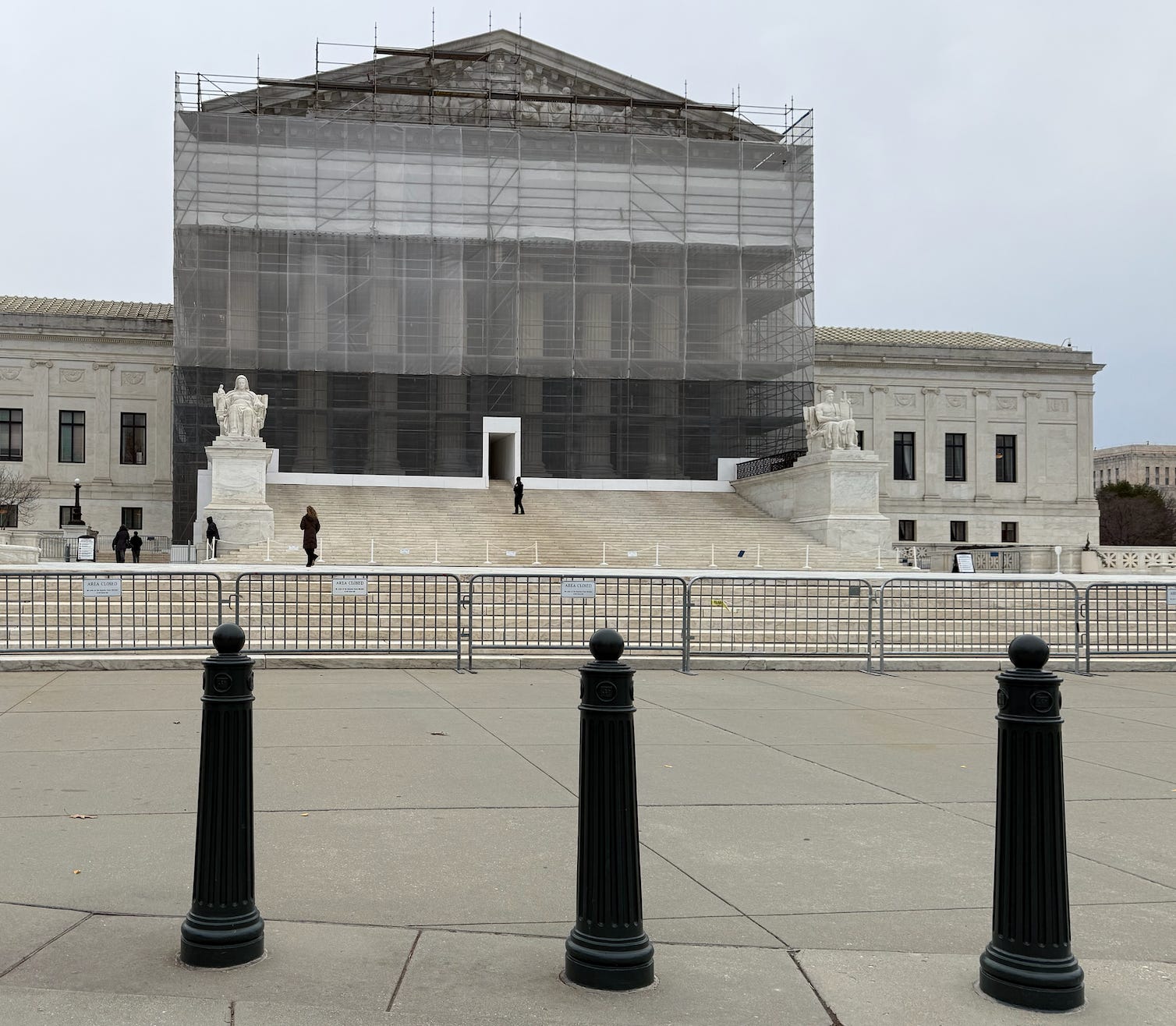
3. Even the U.S. Supreme Court — this Supreme Court — has some limits.
Given the lopsided 6-3 right-side imbalance of the Supreme Court and the extent to which Trump administration actions advance long-term conservative legal goals, however, many decisions of the Supreme Court have been and will be siding with Trump and moving the law — and the nation — further right.
Nonetheless, there have been consistent signs that the justices — at least six or seven of them — have some limits.
Even when the Supreme Court closed off one route for challenging the Alien Enemies Act proclamation early this year, another path — habeas corpus — was reinforced by all nine justices. Its use later led to further pushback from the Supreme Court in the one district where a district court judge had not blocked AEA removals during litigation. The Abrego Garcia order at the Supreme Court — requiring that the Trump administration “facilitate” Abrego Garcia’s return — had no noted dissents. And, as the year came to a close, a 6-3 court made clear that Trump’s effort to send troops into American cities was an “exceptional” action that would be viewed skeptically.
As we go into 2026, this is going to be important. In three key Trump cases already on the Supreme Court docket — over tariffs, his effort to fire a Federal Reserve governor, and his executive order seeking to end birthright citizenship — the Supreme Court will be deciding whether statutory and constitutional law matters in America. Whether — and how — those limits hold will be key to understanding where we’re at and how we will be able to move forward.
4. The people matter.
This one is simple, but it’s ultimately the most important.
Whether it’s people protesting on the streets, people filling out their ballot in the voting booth, people observing immigration courts, people serving on juries, people helping their neighbors, or people acting in any of the hundreds of ways people make a difference each day, the need for the “consent of the governed” has been on full display in 2025.
The need for that consent will remain in 2026, and the need to speak out when the government acts contrary to that consent will be all the more important as cases move forward and rulings come down, as Trump and his administration try to do more, and as the midterm elections approach.
To you, and to 2026.
I really needed this post today. Thank you, and wishing you a happy New Year.
One is guardedly hopeful. Especially when there is no leadership after Trump … worse than no leadership under Trump. No matter what the Project 2025 Boyz want, without a figurehead it may very well sputter back into the unacceptable racism and bigotry it always was.