

Supreme Court, on a 6-3 vote, rejects Trump's effort to deploy National Guard in Illinois for now
More than two months after DOJ asked for "immediate" relief, the Supreme Court said no on Tuesday. Also: A Kavanaugh note on Kavanaugh stops.

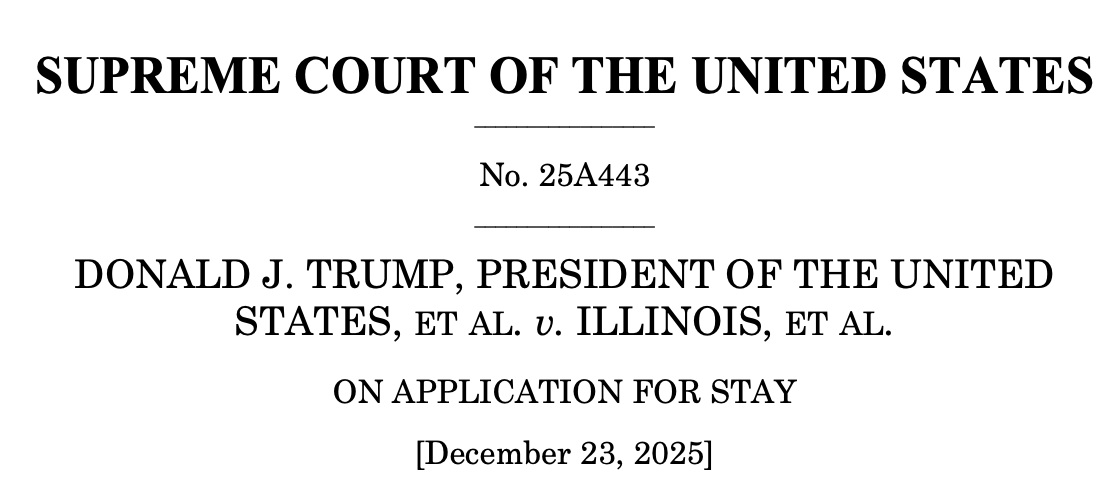
The U.S. Supreme Court on Tuesday issued a 6-3 decision rejecting for now President Donald Trump’s effort to deploy National Guard troops in Illinois.
It was a significant, if preliminary, win for those challenging the Trump administration’s efforts to send troops into American cities — and a notable loss for the Trump administration on the shadow docket.
The Supreme Court held that the statute Trump relied on to federalize the National Guard likely requires both that the U.S. military is authorized to “execute the laws” in a given situation where the president wants to federalize the National Guard and that the president is “unable” to execute the laws even with the use of the military.
Here, however, the court held that Trump didn’t succeed in meeting that first factor: “[T]he Government has failed to identify a source of authority that would allow the military to execute the laws in Illinois.”
Justices Clarence Thomas, Sam Alito, and Neil Gorsuch would have granted the Justice Department’s request to stay a district court order blocking the National Guard federalization and deployment in Illinois — allowing federalization and deployment for now. Even both dissenting opinions, it should be noted, highlighted the tentative nature of their thoughts, given the posture of the case.
The Supreme Court’s order and opinions — which came more than two months after DOJ asked the high court for “immediate” relief — also made clear that this is a preliminary ruling based on the case’s current procedural posture.
In a sign of how far outside the norm the Trump administration’s efforts are, even Alito noted in his dissenting opinion how “[o]ur country has traditionally been wary of using soldiers as domestic police,” in a dissent focused on the use of the National Guard for purely protective purposes.
The majority
In the order and opinions, six justices preliminarily adopted the argument advanced at the Supreme Court in an amicus curiae brief submitted by law professor Marty Lederman that the term “regular forces” used in 10 U.S.C. 12406 refers to the U.S. military. The initial submission of the amicus brief appears to have led the court in late October to call for supplemental briefing about the question.
The court’s unsigned order on Tuesday — a relatively detailed one, coming in at three pages, for the shadow docket — was issued with the backing of Chief Justice John Roberts and Justices Sonia Sotomayor, Elena Kagan, Amy Coney Barrett, and Ketanji Brown Jackson.
Once the Supreme Court identified the likely standard for judging the whether the statute was properly invoked, the court used basic statutory construction to explain how the Trump administration likely did not meet its burden here.
DOJ had argued that Trump’s “inherent constitutional authority … allow[ed] him to use the military to protect federal personnel and property.” The court noted, though, that the government has long argued that such protection does not constitute “execut[ing] the laws” under the Posse Comitatus Act — which prohibits the military from executing the laws except where specifically authorized. As such, the court’s order reasoned, “If that is correct, it is hard to see how performing those functions could constitute ‘execut[ing] the laws’ under §12406(3)“ — the statute invoked here.
The court, accordingly, concluded:
Thus, at least in this posture, the Government has not carried its burden to show that §12406(3) permits the President to federalize the Guard in the exercise of inherent authority to protect federal personnel and property in Illinois.
Justice Brett Kavanaugh concurred in the judgment, stating that he would have denied the Justice Department’s request on more narrow grounds at this point but agreeing that, “In my view, the statutory term ‘regular forces’ likely refers to the U. S. military, not to federal civilian law enforcement officers.“
Kavanaugh stated that, because the record contains no evidence that Trump “has yet made the statutorily required determination that he is ‘unable’ with the U. S. military, as distinct from federal civilian law enforcement officers, to ensure the execution of federal law in Illinois,” he would deny DOJ’s request.
He wrote that the court’s decision went further and that he would not have addressed those “challenging and far-reaching statutory questions at this stage of the case,” at least without further briefing and oral argument.
The dissents
Alito, joined by Thomas, wrote that he would have denied the stay in an opinion that focused on opposition to the court’s attention on the “regular forces” question — accusing the court of “unnecessarily and unwisely“ departing from the principle of “party presentation,” which Alito described as meaning that when “a party passes up what seems to us a promising argument, we do not assume the role of advocate” to advance that argument.
“[T]he Court should have decided this application based on the arguments the parties chose to present, and on that basis should have granted a stay,” Alito wrote. “Injecting another issue into the matter was unwise, and suggesting views on a host of important questions without adequate briefing, consideration, or explanation is imprudent.”
After stating, “I am not prepared at this point to express a definite view on these questions, but I have serious doubts about the correctness of the Court’s views,” Alito went on for another 14 pages to address his contrary, if tentative, views on several of the questions addressed by the court’s order.
Despite Alito’s claims about party presentation, it should be noted that the “regular forces” question was considered by U.S. District Judge April Perry in her opinion granting the order blocking the National Guard federalization and deployment in Illinois, and DOJ was seeking an order from the Supreme Court staying that order.
In her opinion, she wrote, “Several historical sources indicate that the phrase ‘regular forces’ was understood at the time of enactment to mean the soldiers and officers regularly enlisted with the Army and Navy, as opposed to militiamen who did not make it their livelihoods to serve their country but instead took up arms only when called forth in times of national emergency.“
In a separate, two-page dissent written only for himself, Gorsuch wrote that the case raises “sensitive and gravely consequential questions concerning what roles the National Guard and U. S. military may play in domestic law enforcement.“ Of those questions, he included:
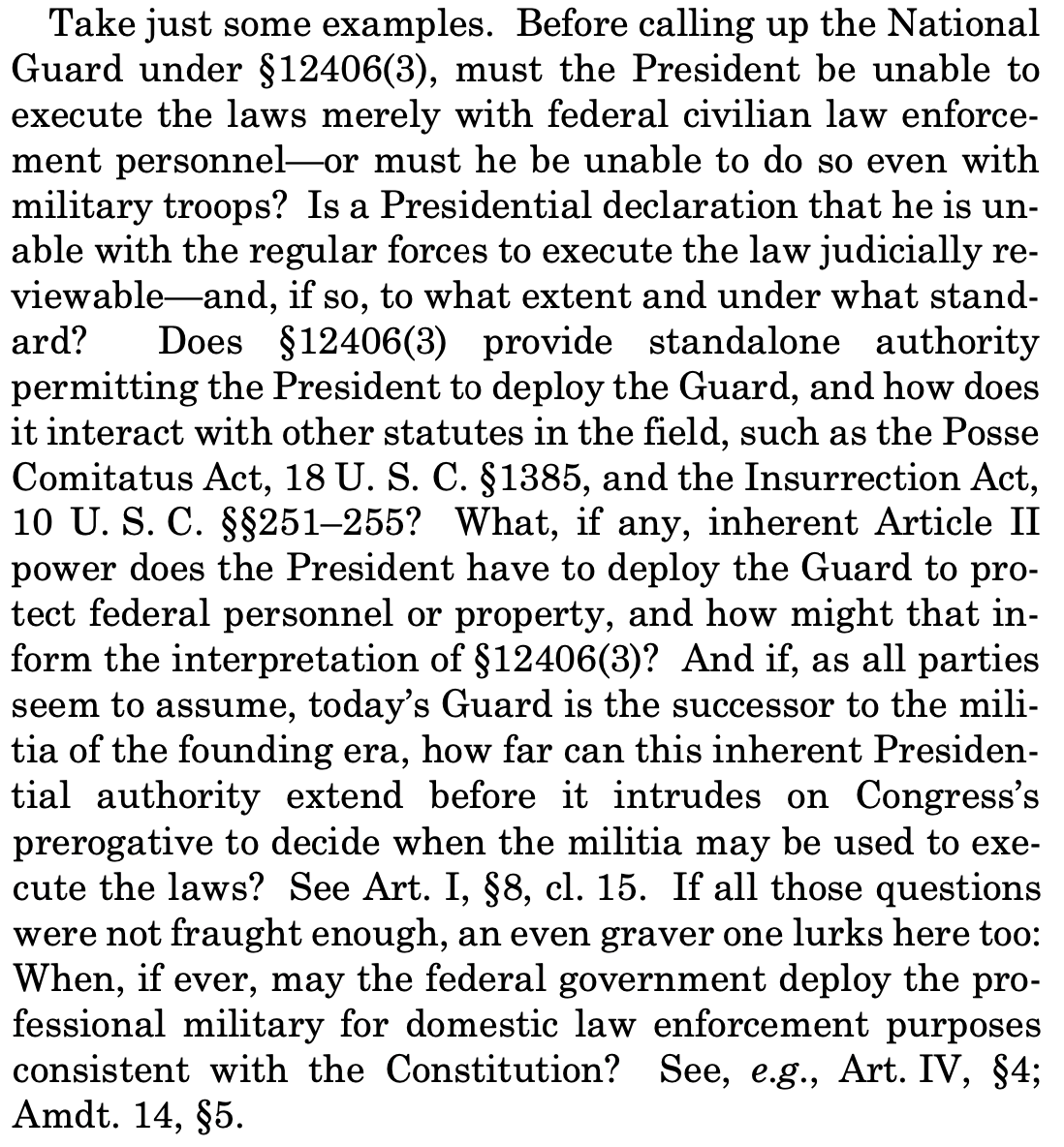
Given “the present posture of this case,“ Gorsuch wrote, “I am not comfortable venturing an answer to any of those questions” — a notable distinction from the many times on the shadow docket this year when Gorsuch has been eager not only to rule without full briefing or oral argument but to do so in cases raising significant separation of powers questions.
Gorsuch stated that he would have granted a stay “narrowly, based only on those few arguments the parties preserved and the evidentiary record as it stands.“
What now?
A follow-up question left unresolved on Tuesday is the federalization of the National Guard itself. DOJ’s request at the Supreme Court followed a unanimous three-judge ruling from the U.S. Court of Appeals for the Seventh Circuit denying DOJ’s stay request as to deployment, but staying the part of the district court’s order blocking federalization altogether.
Applying Gorsuch’s recent reasoning about shadow decision decisions, however, the logical conclusion of this Supreme Court decision could lead the Seventh Circuit to lift its stay of the federalization portion of the district court order, sending Illinois National Guard troops back under the authority of Illinois Gov. JB Pritzker.
A Kavanaugh note on Kavanaugh stops
Finally, in a case over Trump’s federalization and deployment of the National Guard, Kavanaugh dropped a footnote in his concurrence indirectly responding to the “Kavanaugh stop” questions I and others have raised and public outcry over the Supreme Court’s September ruling allowing racial profiling in certain circumstances in immigration raids — and, specifically, his statement supporting the ruling.
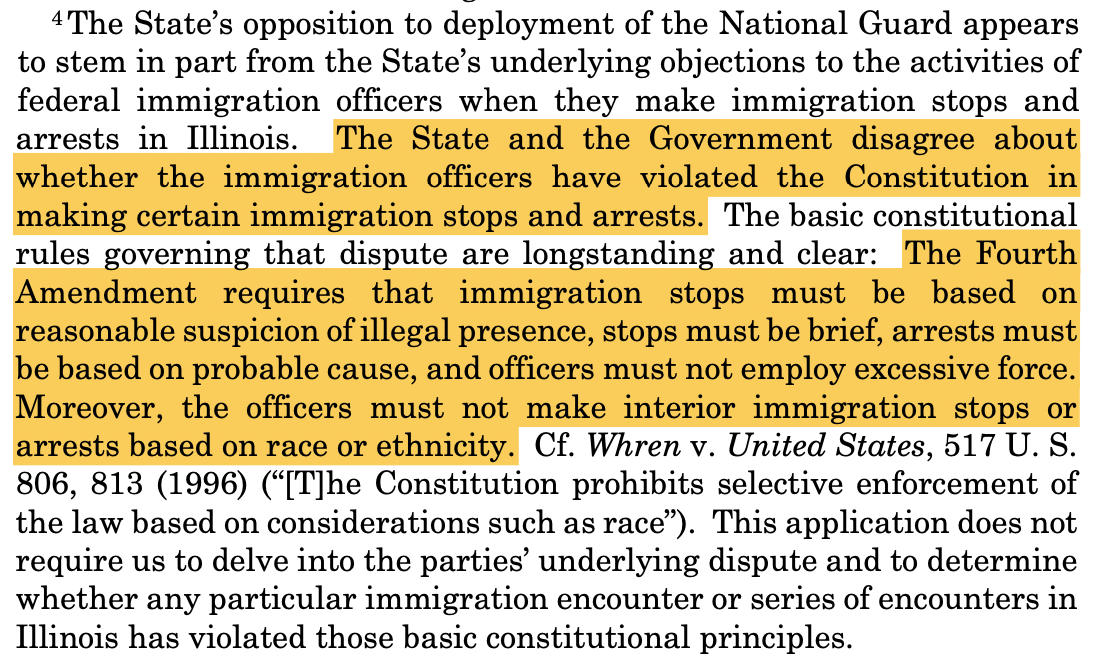
In a footnote in an only marginally related case, Kavanaugh wrote, “The Fourth Amendment requires that immigration stops must be based on reasonable suspicion of illegal presence, stops must be brief, arrests must be based on probable cause, and officers must not employ excessive force. Moreover, the officers must not make interior immigration stops or arrests based on race or ethnicity.“
It was, in short, an effort to address the “Kavanaugh stop” critique — without so much as a reference to his opinion or even the Supreme Court’s order in Noem v. Vasquez Perdomo.
I am a Chicago resident and want to make sure everyone knows that several hundred Illinois National Guard members are still federalized. They have never been deployed to the streets and are continuing to live on a training base about 50 miles from Chicago. Trump recently extended their orders until mid April 2026. So, for almost 4 months they have been sitting at a training facility and will continue to do so for the next 4 months.
Gorsuch's comment interests me. He writes: "And if, as all parties seem to assume, today's Guard is the successor to the militia of the founding era ..." Does this have any relevance to the 2nd Amendment? If the Guard = the Militia, does the 2nd apply, specifically and solely, to the National Guard?