

The justices will decide this June whether to constrain Trump at all — or give up completely
The justices have 26 cases outstanding. Even the best-case scenario isn't great. Also: Trump's slush fund "settlement" is getting court scrutiny. And, for paid subscribers: Closing my tabs.

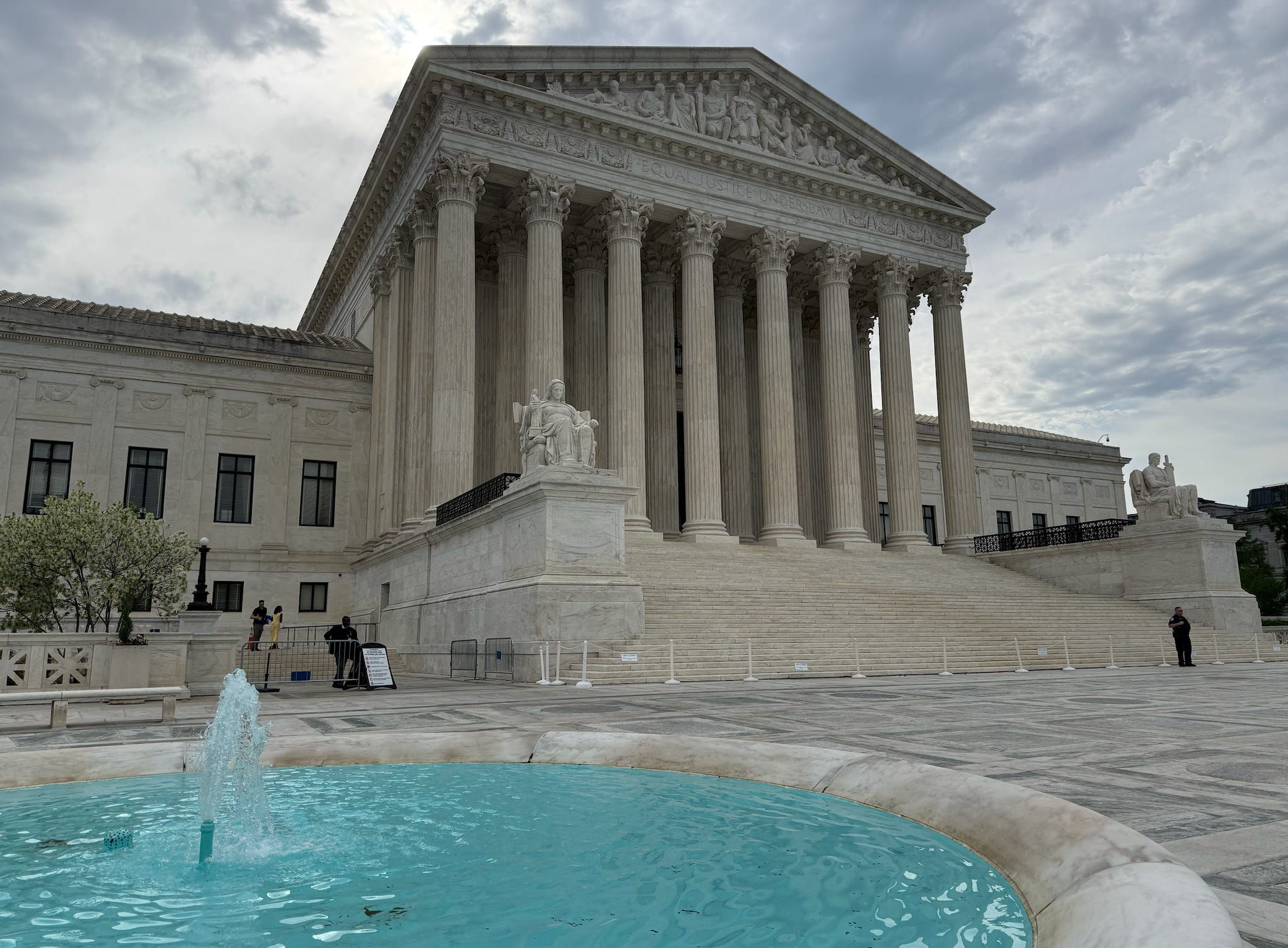
We are entering June and, with it, the U.S. Supreme Court’s increased pace at finalizing and releasing its remaining decisions. Although the court has no set deadline for doing so, it generally announces decisions in all argued cases by the end of June — with several of the key decisions usually handed down in the final days.
By the time all of that is done, we will have a better idea of the answer to the question I wrote this past fall would be the question of this term: Whether the U.S. Supreme Court has any intention of constraining President Donald Trump in any meaningful way in his efforts to take powers from both the judicial and legislative branches for himself.
Even the best-case scenario at this point would not be a sign of a healthy court interested in protecting constitutional rights — and we’re likely to get something less than that best-case scenario. And yet, as with Trump’s tariffs, there is likely to be some pushback against the most extreme efforts by Trump to ignore the constitutional and statutory limits that have been placed on the president.
Should that pushback come to pass — most notably in the cases over Trump’s efforts to end birthright citizenship and fire Federal Reserve Governor Lisa Cook — it will be both necessary and good.
But, even if Trump loses both of those cases, the Supreme Court will likely — in cases already decided and yet to have been decided — be taking steps to give Trump more power than the Supreme Court has held appropriate for the president since the Great Depression.
In the other firing case, over Trump’s effort to fire Rebecca Kelly Slaughter as a member of the Federal Trade Commission, the Supreme Court’s conservatives are likely overturn Humphrey’s Executor, a 90-year-old precedent upholding the protections against political firings of commissioners of the FTC that Congress put in place when creating the commission.
The decision would be a watershed ruling, more accurately described as tearing apart the dam that has enabled expertise in government as the federal government has expanded and become more complicated — in matters of the economy, but also science, health and safety, and more.
It is a question that has been debated since the constitutional convention and in the first Congress, as Law Dork has covered previously. It is a question the contours of which were largely defined by the Supreme Court for the past 100 years in Humphrey’s Executor and a case decided a decade earlier.
It is a question that Chief Justice John Roberts and the conservative majority of today might upend one morning in June.
We will all face — and have to deal with — the consequences.
In addition to those three decisions still to come, we are entering June with 23 other cases remaining.
They include:
The challenges to West Virginia and Idaho’s bans on transgender women playing on women’s sports teams in schools, which the justices appeared poised to uphold at arguments in January.
Three key immigration cases: Challenges to the Trump administration’s effort to end temporary protected status for immigrants from Haiti and Syria were heard at the last day of arguments in April, and an earlier-heard case raising questions over a policy that could dramatically limit the ability to bring asylum claims.
Two gun cases: one over Hawaii’s restrictions on concealed carry on private property open to the public and another over a federal law barring firearm possession by any person who is “an unlawful user of or addicted to any controlled substance.”
Two more election law cases (beyond the Voting Rights Act decision already handed down): one over limits on coordinated party expenditures and another over whether states are preempted by federal law from accepting ballots after Election Day that were mailed by then.
Law Dork will have coverage of all of this and more over the month of June. The next decisions are expected Thursday.
Trump’s slush fund “settlement” gets court scrutiny
The effort by dozens of former federal judges to reopen President Donald Trump’s lawsuit against the Internal Revenue Service has some, at least initial, traction from the judge who had been overseeing the case.
After the claimed “settlement” of the lawsuit included the creation of the nearly $2 billion “Anti-Weaponization“ slush fund, the former judges filed a motion on May 27 with U.S. District Judge Kathleen Williams seeking an order reopening the case.
“To be clear, the parties’ settlement was not, and never will be, legally justified,“ the motion argued. “That is because the Acting Attorney General’s Order creating the Anti-Weaponization Fund identified the Judgment Fund, 31 U.S.C. § 1304, and the Attorney General’s authority to enter “compromise settlements” under 28 U.S.C. § 2414, as the basis for the creation of the Anti-Weaponization Fund. Both of those authorities require the existence of a legitimate litigation and not, as here, one that is collusive, feigned, or fraudulent.“
In an order issued on May 29, Williams, an Obama appointee, noted that “movants submit that the settlement ‘is a product of collusion and is itself a fraud on the Court.’“ As such, she ordered the plaintiffs — Trump, his two eldest sons, and the Trump Organization — to respond to the former judges’ motion and their “grievous allegations,” including “the charges of collusion” and fraud on the court, by June 12:
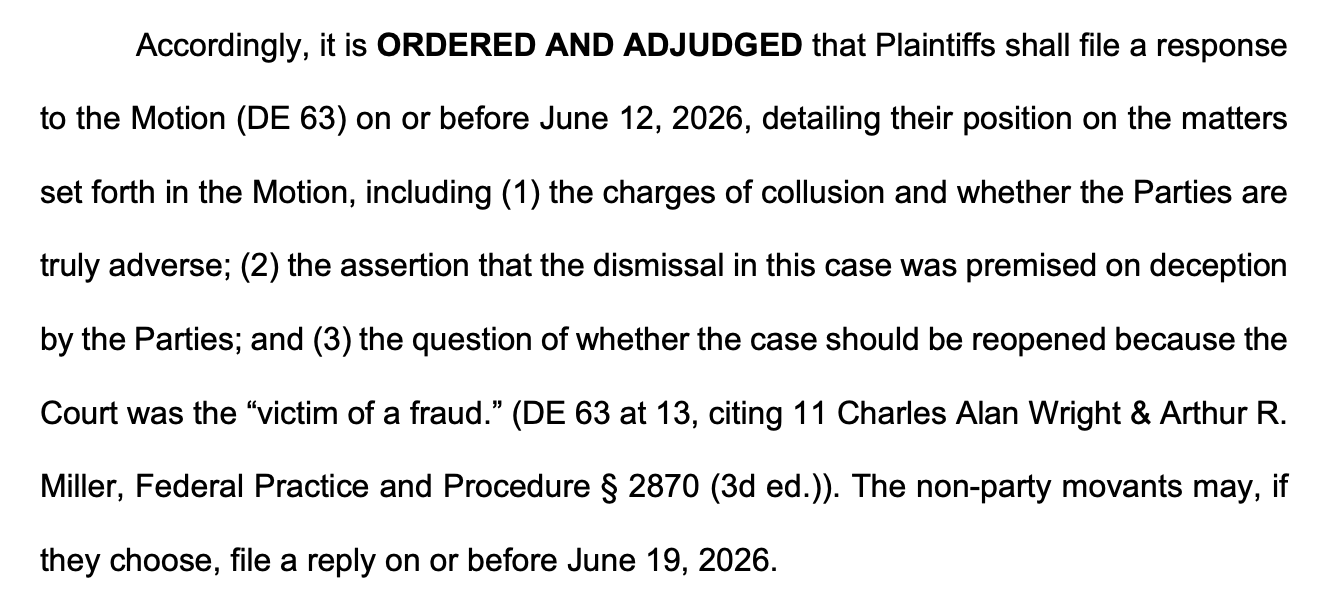
In other words, yes, briefing will be complete — and either arguments could be scheduled or a decision could be issued — as the Supreme Court is reaching its peak decision time — and as the Trump White House is readying for whatever its America 250 plans will look like by then.
Note: This scrutiny of the “settlement” is in addition to the lawsuit filed in Virginia challenging the fund itself. As Politico covered, that litigation led to a temporary order issued May 29 blocking officials from taking actions advancing the fund for now.
Closing my tabs
For those who don’t know what this is, it’s my effort to give a little thank you to paid subscribers. “Closing my tabs” is, literally, me looking through the stories and cases open — the tabs open — on my computer and sharing with you all some of those I was unable to cover during the week but that I nonetheless want to let you know that I have on my radar. Oftentimes, they are issues that will eventually find their way back into the newsletter as a case discussed moves forward or something new happens that provides me with a reason to cover the story more in depth.
This Sunday, these are the tabs I am closing:
