

Supreme Court likely to reject Trump's effort to end birthright citizenship
As Trump sat on watching, Solicitor General John Sauer faced skeptical questions from almost all of the justices — including all three justices Trump appointed to the high court.

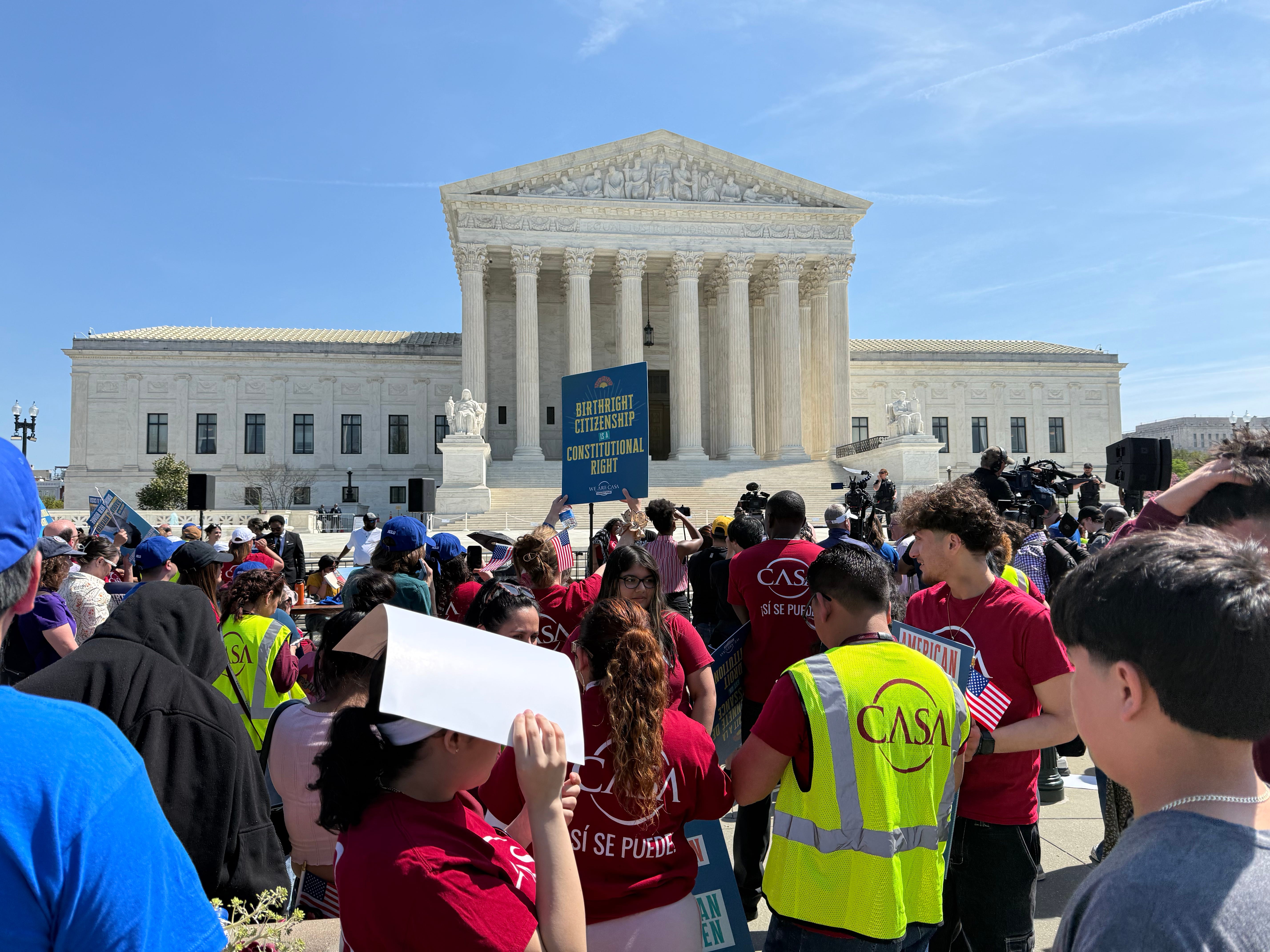
The U.S. Supreme Court appeared poised to rule against President Donald Trump’s effort to end birthright citizenship in the United States, a likelihood that became increasingly clear as Trump himself sat in the front row of the public-seating section of the courtroom on Wednesday.
After Solicitor General John Sauer tried to argue that “birth tourism“ — one of Trump’s regular refrains about the need for his executive order — didn’t exist at the time the Fourteenth Amendment’s Citizenship Clause was written but is a relevant concern now, Chief Justice John Roberts said bluntly, “It’s a new world; it’s the same Constitution.“
In addition to skepticism from Roberts and the Democratic appointees, Trump appeared unlikely to get support from any of the three justices he appointed to the court in his effort to end citizenship going forward for children born in the U.S. to parents who aren’t citizens or don’t have lawful permanent status.
Justice Neil Gorsuch wondered how the administration’s argument could succeed “even if we were to apply your own test,“ Justice Brett Kavanaugh questioned the “relevance” of the administration’s reliance on other countries’ policies, and Justice Amy Coney Barrett told Sauer that she found part of his argument “puzzling.”
Even Justice Clarence Thomas asked questions that did not betray solid alignment with the Trump administration, leaving Justice Sam Alito alone pushing the administration’s position — and even that lagged at points during the more than two hours of arguments.
After Trump, seated next to White House Counsel David Warrington, watched Sauer’s arguments, the president left the courtroom less than 10 minutes into ACLU Legal Director Cecillia Wang’s arguments for the class-action plaintiffs who successfully challenged Trump’s order below.
It was an argument that appeared likely to hand a lopsided loss to Trump and a win to the Constitution. There is even a path, as narrow as it might be, for a 9-0 win for the challengers and birthright citizenship. Despite that, though, the debate itself caused its own harms — both to the law and to the nation — as Trump’s anti-immigrant project was given room to breathe and grow.


The constitutional provision involved states: “All persons born or naturalized in the United States, and subject to the jurisdiction thereof, are citizens of the United States and of the State wherein they reside.“
In 1898, the U.S. Supreme Court held in the case of U.S. v. Wong Kim Ark that an effort to refuse him admission to the U.S. as a result of the Chinese Exclusion Act could not stand because he was a U.S. citizen, having been born to parents who, despite being citizens of China, were living in the United States at the time of his birth.
Sauer was, ultimately, asking the justices to reverse lower court rulings blocking the Trump administration from implementing Trump’s January 20, 2025 executive order. No court has sided with the Trump administration, although the Supreme Court used the cases to limit “universal injunctions” in June 2025, and Sauer fought an uphill battle the whole morning as the president for whom Sauer served as a private lawyer before joining the Justice Department looked on.
Sauer focused extensively on the fact that, 20 times in the court’s Wong Kim Ark ruling — including the question presented in the case — the court referenced the fact that his parents were “domiciled” in the U.S. at the time of his birth for a limitation on the holding of Wong Kim Ark.
At one point, however, Gorsuch shot back, “I’m not sure how much you want to rely on Wong Kim Ark.“
In later responding to Sauer, Wang noted in discussion with Roberts that domicile was referenced in the case’s decision repeatedly because it was a stipulated fact, but that the “controlling rule of the decision“ contained no such limit. In further discussion with Justice Elena Kagan, she said that the use of the domicile was simply because the court was applying the “controlling rule” — that comes from English common law — to the case before it.
That controlling rule, as applied in the Fourteenth Amendment, was that anyone born in the country becomes a citizen at birth — with a “closed” set of exceptions based on the common law, children born to diplomats and born to enemies during invasion, and a U.S.-specific “exception for children of members of Indian tribes,“ as Wang explained.
Sauer started the arguments on his heels. After a pair of questions from Thomas — including one relating to the Dred Scott decision — Roberts questioned Sauer’s effort to turn the “quirky” exceptions into a general rule covering “a whole class of illegal aliens.” He continued, “I’m not quite sure how you can get to that big group from such tiny and sort of idiosyncratic examples.“
Of Sauer’s argument that the purpose of the amendment was, as Barrett characterized it, “to put … newly freed slaves on equal footing, and so they would be citizens,“ she said, “But that’s not textual, so how do you get there?”
Although Sauer attempted an answer, Barrett kept pressing on how the purpose argument conflicted with or, at the least, set up complications with the government’s “domicile” arguments.
For his part, Kavanaugh noted that — despite the widespread and governmental understanding of Wong Kim Ark — the Immigration and Nationality Act (INA) “repeats ‘subject to the jurisdiction thereof.“ In light of the understanding, he asked Sauer, “one might have expected Congress to use a different phrase if it wanted to try to disagree with Wong Kim Ark on what the scope of birthright citizenship or the scope of citizenship should be. And yet Congress repeats that same language, knowing what the interpretation had been. So how are we to think about that?“
Sauer tried to argue that “the history” actually favors the Trump administration’s view — a part of the fringe academic effort to back up Trump’s order after the fact with new history — but Kavanaugh kept pushing him, “[I]f you’re in Congress in 1940 and 1952 and you want to limit the scope of Wong Kim Ark or to eliminate ambiguity, why do you repeat the same language rather than choosing something different?“
As noted, Alito did attempt at times to buttress Sauer’s argument, asking early on why “subject to the jurisdiction thereof“ wouldn’t have set up a “general rule” that could “apply to later applications that might come up,“ and continuing with other administration-backing questions at points in the morning’s arguments.
Despite that, one request for an answer from Sauer stood out for its acknowledgment of real-world implications — albeit still done in an Alito way. Noting the “unusual situation here,” in which “immigration laws have been ineffectively and, in some instances, unenthusiastically enforced by federal officials,“ Alito said that “people who are subject to removal at any time … have in their minds made a permanent home here and have established roots.” To Sauer, Alito then said, “[T]hat raises a humanitarian problem, and I wonder if you could address that.“
When Sauer responded, he initially made a “legal argument” about “the legal capacity … to create a domicile,” suggesting undocumented immigrants can never create a domicile here — a similar argument to one that Wang mentioned was raised by the United States in Wong Kim Ark.
In directly responding to the humanitarian question, however, Sauer’s only responses were that the U.S. birthright citizenship rule is “an outlier among modern nations“ and that the order “applies only prospectively.“
Even as to that latter part of that limited answer, however, Justice Sonia Sotomayor noted that, if the Trump’s administration’s argument succeeds here, “[t]here would be nothing” that limits “this president or the next president or a Congress“ from deciding to apply the rule retroactively, which could lead the government to “unnaturalize” people, as was done previously after a case holding that Indians could not be naturalized.
Although Sauer insisted that was not the government’s position, the point was one of several sharp moments illustrating not just the scope of the Trump administration’s attacks on immigrants but also the many times in U.S. history when the government sought to denigrate those deemed “others” through immigration and citizenship laws.
On Wednesday, though, the Trump administration did appear clearly to be headed for a loss in this “othering” effort — although the reasoning that would be used to do so was not clear. There were moments, for example, where some justices focused on the INA as possibly forming a basis for blocking the order — without addressing the Fourteenth Amendment at all.
When Kavanuagh asked “why would we address the constitutional issue given your argument on the statutory“ grounds, Wang acknowledged, “We’re happy to win on either or both of them.”
Then, however, she added, “I do think it would be prudent for the Court to reaffirm its decision in Wong Kim Ark where it’s a landmark decision about the definition of national citizenship in this country. I just think it would be prudent for the Court to go ahead and reaffirm that.“
A decision in the case is expected by the end of June.
A key moment
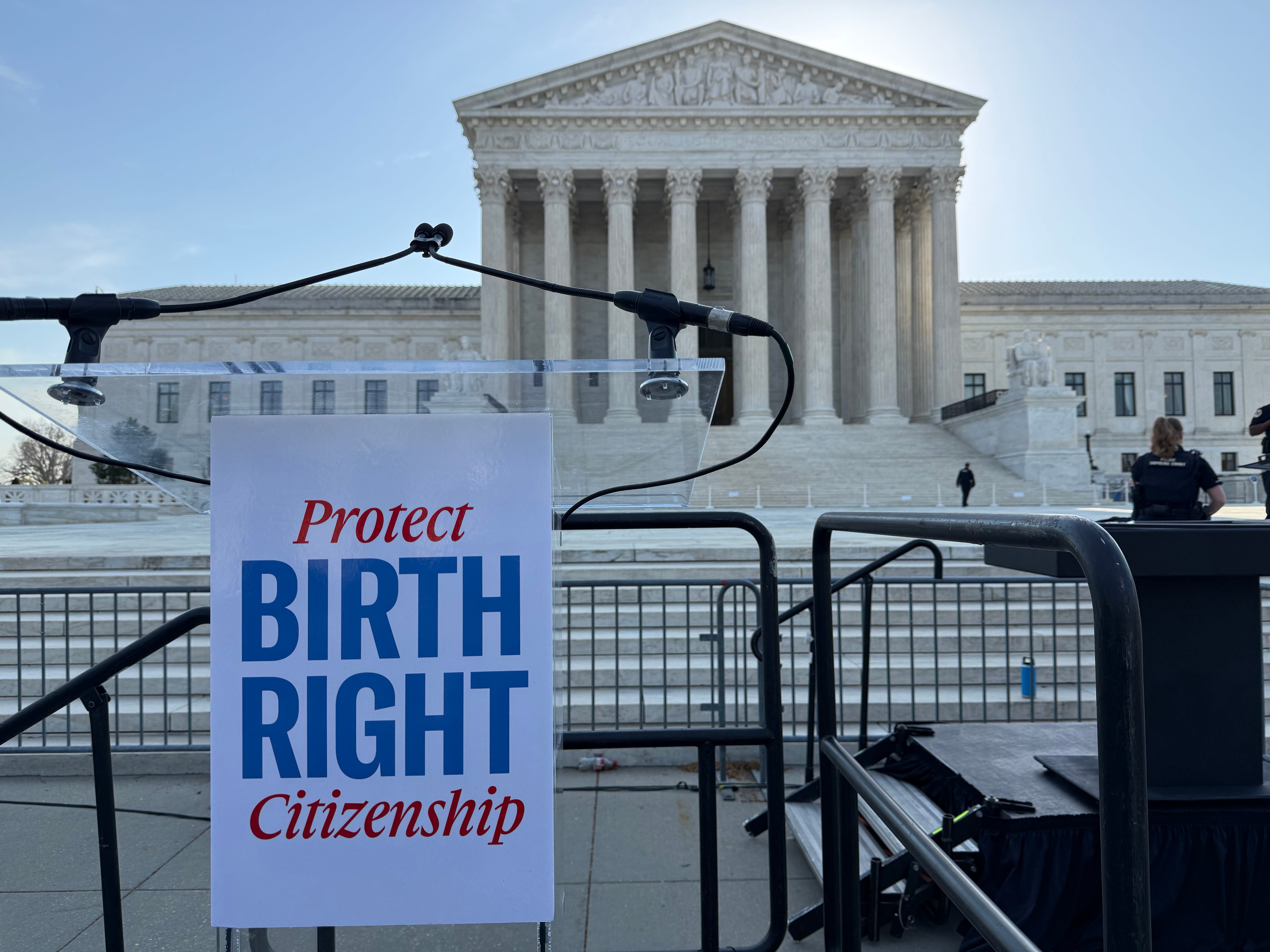
One exchange highlighted the damage done just by President Donald Trump having forced this debate. After Justice Amy Coney Barrett mentioned the “messy” process that could be involved in implementing the executive order, Justice Ketanji Brown Jackson pressed Solicitor General John Sauer.
I want to reprint this to show where even having this argument took things.
JACKSON: “Is this happening in the delivery room? How are we determining when or whether a newborn child is a citizen of the United States under your rule?
SAUER: I think that’s directly addressed in the SSA guidance that’s cited in our brief. What SSA says is there’s currently a system where, for example, Social Security numbers are generated based on the birth certificate. …
JACKSON: I’m just talking about the particulars because now you say your rule turns on whether the person intended to stay in the United States. And I think Justice Barrett brought this up. So are we bringing pregnant women in for depositions? …
SAUER: No. As I pointed out earlier, the Executive Order turns on lawfulness of status. So, if you give birth to a baby in the hospital right now, it gets the birth certificate in the system.
JACKSON: So there’s apparently no opportunity then for the person to prove or to say that they actually intended to stay in the United States?
SAUER: Absolutely not. The opposite is true. Their opportunity to dispute if they think they were wrongly denied, which would only happen in a minority of cases --
JACKSON: After the fact.
SAUER: -- is directly addressed in that guidance.
JACKSON: After the fact —
SAUER: Yes, yes.
JACKSON: — after their baby has been denied citizenship, then we can go through the process?
SAUER: Yes.
That is the discussion that Trump unleashed.
It looks as if the Court might actually uphold the law and constitution against Trump. That shouldn't be a rare occurrence.
"Sauer tried to argue that ...didn’t exist at the time the ...Amendment...was written but is a relevant concern now."
It would be nice to apply that to the Second Amendment, e.g., automatic weapons didn't exist then but are a relevant concern now.
Thank you very much for your exceptional reporting on this unbelievable case. Notwithstanding the harm inflicted by the admin's position, I was tremendously relieved to read that the justices weren't impressed. We can't take anything for granted with this Court!