

SCOTUS guts what remained of the Voting Rights Act before taking on TPS termination case
It was Alito's decision, but Roberts has sought Wednesday's VRA result for more than 40 years. In the arguments over temporary protected status, however, DOJ might have overstepped.

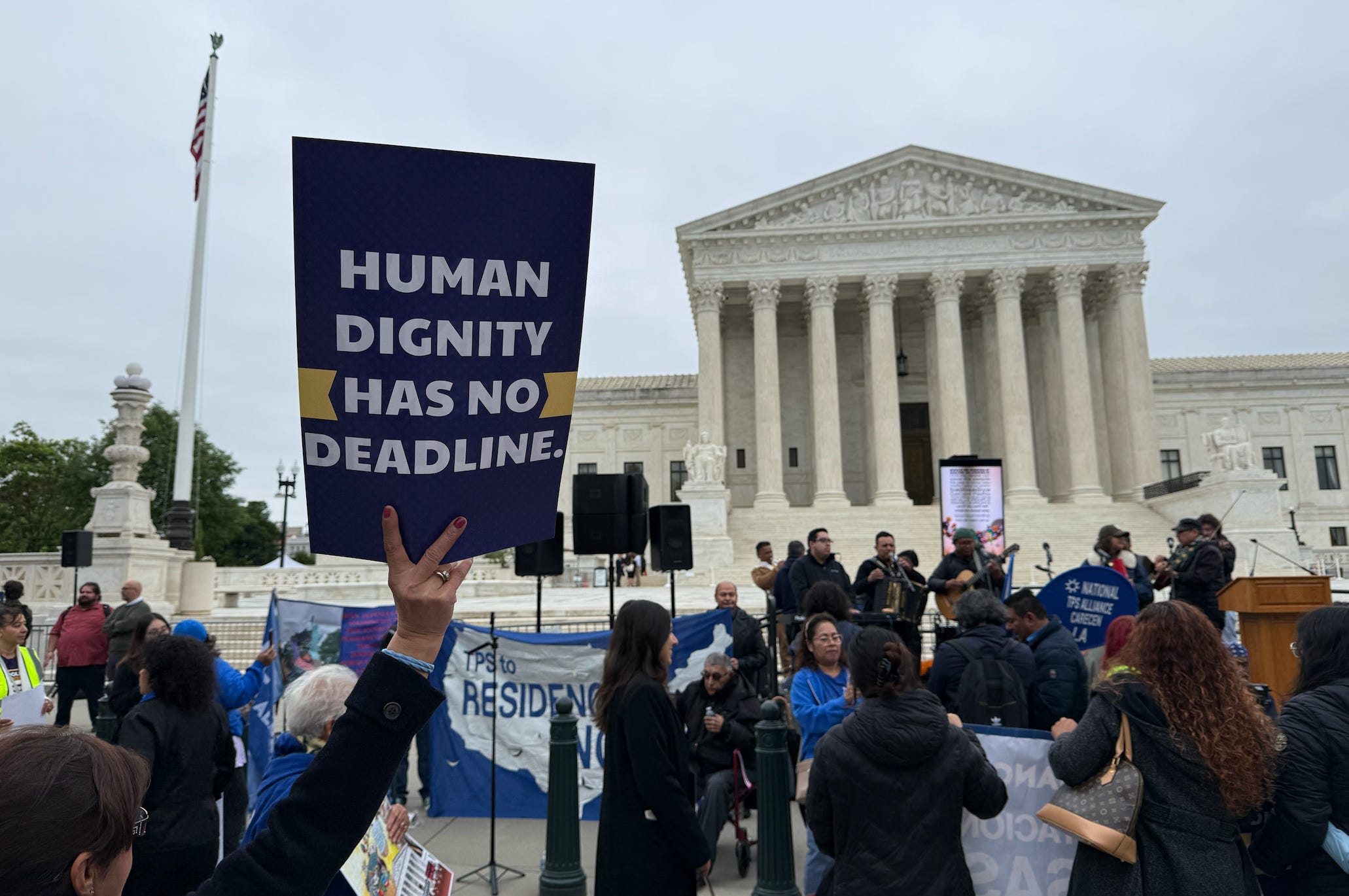
On a day the U.S. Supreme Court was to consider, among other concerns, whether racial animus had infected the Trump administration’s decision to cancel temporary protected status for many countries with non-white majority populations, the court’s conservative majority also used Wednesday to effectively end the use of the Voting Rights Act to help ensure that minority voters in the United States have the opportunity to elect lawmakers of their choosing.
“I don’t like dividing the people of the world into these groups,” Justice Sam Alito proclaimed from the bench during the TPS arguments — Wednesday’s iteration of a claim pressed by the right over the years to diminish civil rights protections through a “color-blind,” and later “race-neutral” prism. It is, however, a freedom that doesn’t exist in reality for those who face deportation following President Donald Trump’s attacks on “shithole countries” or those who have faced a long history of lawmakers seeking to exclude them from the electoral process.
It was a day that highlighted how far the Roberts court has gone to advance the chief justice’s long-term animosity toward the Voting Rights Act, paired with yet another request from the Trump administration to expand executive power.
The decision in Louisiana v. Callais upended the pivotal civil rights era voting law that Congress initially passed in 1965 and reauthorized several times since, leaving the section at issue “all but a dead letter,” as Justice Elena Kagan said with a somber voice, nearly stone faced, as she announced the dissent from the bench.1
In an opinion by Alito, the majority held that Louisiana’s map — which included two majority-minority districts — was an unconstitutional racial gerrymander regarding the second district.
With Kagan sitting silently to Alito’s left as he announced the court’s majority opinion, Alito insisted that the court had merely “updated” the framework for considering vote-dilution claims under Section 2 of the Voting Rights Act.
Under that “updated” framework, he explained, Louisiana’s addition of the second majority-minority district in response to a Section 2 case ruling did not meet the new test and, as such, did not advance any “compelling interest” — which would be necessary to defeat the equal protection challenge to the new map that was before the court.
When Kagan began announcing her dissent for the three Democratic appointees, she was abrupt and direct, with an anger simmering just below the surface as she described the “historic” place of the Voting Rights Act in the history of the United States.
“For more than a decade,” she told the pin-drop silent courtroom, “this court has had the act in its sights,” laying out a series of rulings beginning with 2013’s Shelby County v. Holder decision ending the requirement that certain jurisdictions get preclearance for voting rights changes, including redistricting. Following that, she continued, there were the court’s more recent decisions that partisan gerrymandering claims are nonjusticiable in Rucho v. Common Cause and that limited challenges to “time, place, and manner“ voting restrictions under Section 2 in Brnovich v. Democratic National Committee.
Wednesday’s decision, Kagan continued, is “the last piece” in the effort to “destroy” the voting rights law — making it “nearly impossible“ to succeed in bringing a constitutional vote-dilution claim, the last real task the law was accomplishing.
The TPS case
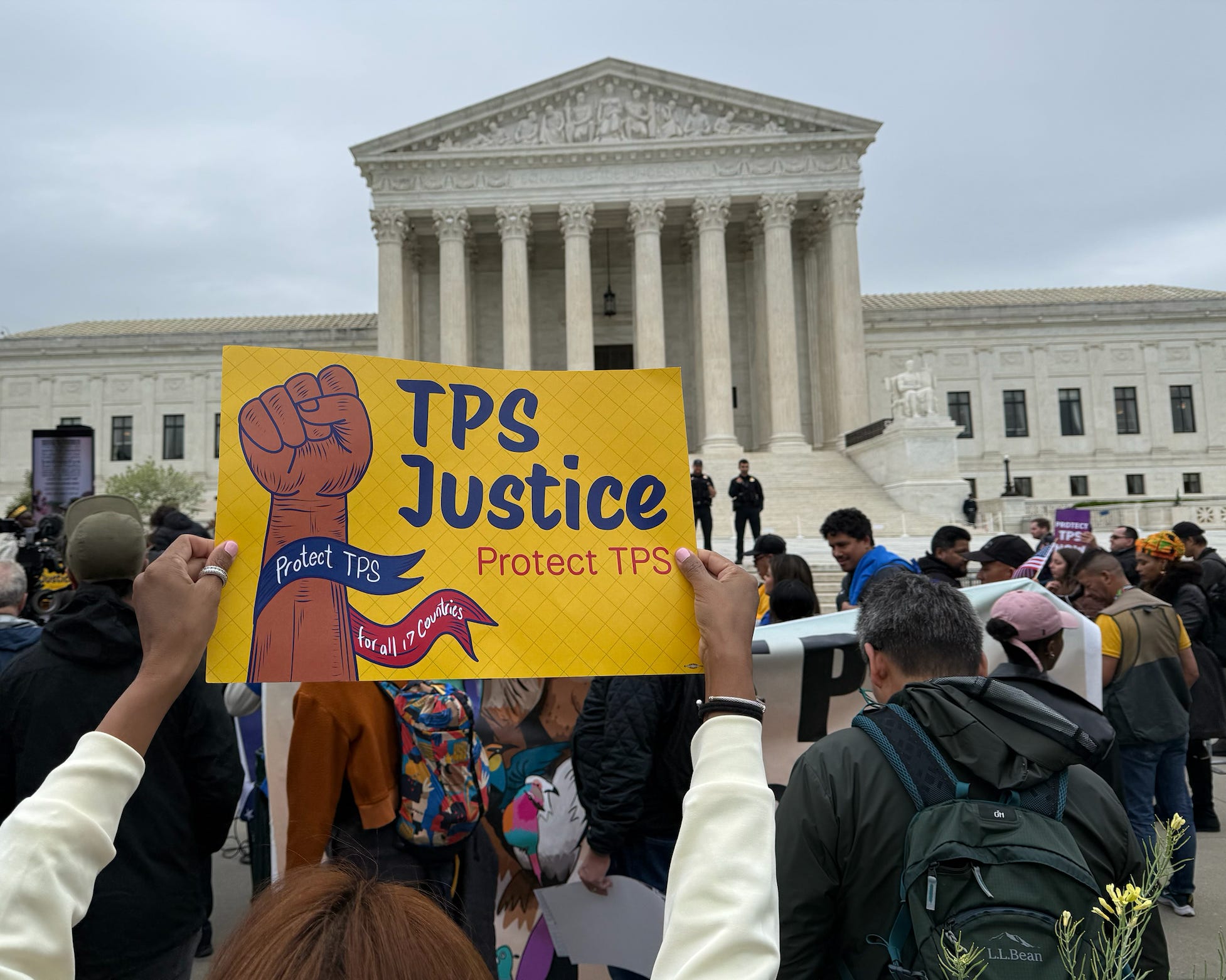
More than 30 minutes after the justices took the bench following the long opinion reading from Callais, Chief Justice John Roberts began the arguments in the TPS cases: Mullin v. Doe, relating to Syria, and Trump v. Miot, relating to Haiti.
The humanitarian “thrust” of the TPS statute, as Justice Ketanji Brown Jackson had to remind Solicitor General John Sauer at the end of his arguments, is to provide protections for people in the U.S. from countries where the conditions are such that return would be unsafe. For these cases, the question is about people whose countries had a TPS status — Syria and Haiti — before then-Homeland Security Secretary Kristi Noem purported to end it.
Sauer came to court seeking a maximalist ruling — arguing that the provision in the law barring judicial review of the secretary of Homeland Security’s determination to terminate TPS makes all aspects of how the secretary implements the TPS termination unreviewable, even procedural requirements laid out in the law. (The law was passed before DHS existed, and the law’s references to the attorney general now apply to the DHS secretary.)

The challengers, on the other hand, came to court seeking specific types of review — for procedural claims relating to the TPS law’s requirements, as well as for constitutional claims. Specifically, although there are some different presentation of claims in the two cases, parties are challenging infirmities relating to consultation required about country conditions under the law and improper consideration of national interest, as well as pretext. Constitutionally, the Haiti plaintiffs also raised an equal protection challenge.
After a little less than two hours of arguments, it appeared likely that a narrow decision by a narrow majority would allow at least some of the challenges to proceed — although the scope of review allowed could be quite minimal and any result would be dependent on Roberts and Justice Amy Coney Barrett agreeing on a path forward and finding one that the Democratic appointees would sign on to.
Right out of the gate, Roberts — referencing the court’s 2018 decision regarding the third iteration of Trump’s travel ban — made clear that in his view DOJ’s maximalist position was concerning:
General, you rely on Trump versus Hawaii in your argument, but that involved the President and entry restrictions. Here, we’re concerned with the Secretary and aliens that are already present. Your argument is a significant expansion of Trump versus Hawaii, isn’t it?
Following that, Justice Ketanji Brown Jackson asked, “Is it reviewable for a person to allege that the Secretary made this determination without following the statutory steps?“
Sauer replied, “Certainly not.”
Justice Sonia Sotomayor, looking at Sauer’s claims in light of the statutory requirements, remarked that “what you’re basically saying is Congress wrote a statute for no purpose“ if it’s unreviewable.
Refusing to back off of the consequences of his argument, Sauer told Sotomayor that “baked into the very concept of a judicial review bar is the possibility that the decision that’s not subject to judicial review might be totally baseless, arbitrary, wrongly decided or really crazy.“
At that point, Justice Elena Kagan jumped in. Saying “point taken“ as to a secretary’s “arbitrary understanding of what the country conditions are,“ she then pivoted back to the procedural question: “[T]hat’s a different thing than to say that all the things that the statute says that the Secretary is supposed to do in order to determine country conditions are themselves unreviewable.“
Later, Barrett posed a direct and notable question to Sauer:
I wanted to take you to the procedural objection. Let’s say that you lose on your argument that even the process that the Secretary followed to terminate is not subject to judicial review. Take your best crack at articulating what standards a court would apply when reviewing the sufficiency of the consultation.
Sauer discussed the definition of “consult,“ but the exchange highlighted that — for a narrow majority of the court — it appeared there was a weakness to Sauer’s argument.
During the challengers’ arguments, however, Barrett asked Ahilan Arulanantham, the lawyer representing the Syria-related challenge and co-director of the Center for Immigration Law and Policy at UCLA School of Law, about the effects of the case:
Is this going to get you very much? I mean, if it’s just kind of a box-checking exercise, why would Congress permit review of the procedural aspect when, really, what everybody cares about much more is the substance?
Arulanantham responded directly — although it was a stretch to take at face value in this moment — telling her, “I think it’s because Congress and us too and the millions of people who live with TPS holders have some faith in government, and they believe that if there is consultation, the decisions will be better.“
Jackson followed up, noting that enforcing such procedural requirements is “really not unusual” in an administrative context. “[I]sn’t that the whole thrust of something like the APA?“ she said of the Administrative Procedure Act. “Congress has always sort of understood that agencies are going to have a lot of discretion at the end of the day to make the determinations, but we still need to police to some extent the inputs — what they’re looking at, whether they give the public notice and comment,” concluding that “all of the things about procedural rules and requirements for decision-making are important even if the ultimate decision is still left to the agency.“
For his part Justice Sam Alito was focused on the potential for a ruling about procedural claims to expand. “[I]t is always going to be possible to raise procedural objections to what’s been done,” he told Arulanantham — although Arulanantham came back by noting that the court need not say anything about the “meaningfulness” of the consultation but could “only say it has to be about the topic” required under the statute.
At other points, the three remaining justices signaled support for a broad understanding of the judicial review bar.
Justice Clarence Thomas argued that the judicial bar was extremely broad. Justice Brett Kavanaugh — a near-constant defender of broad conceptions of executive authority — tossed Sauer a softball, asking him, “Can you explain the reasons why Congress would have barred judicial review as broadly as you assert?“ After that, Kavanuagh got mired down in the facts of conditions on the ground in Syria — which no one else, at this point, was discussing. Finally, for his part, Justice Neil Gorsuch was focused on the interim remedy “postponing“ the secretary’s termination during litigation and questioning why that wasn’t contrary to the judicial review bar.
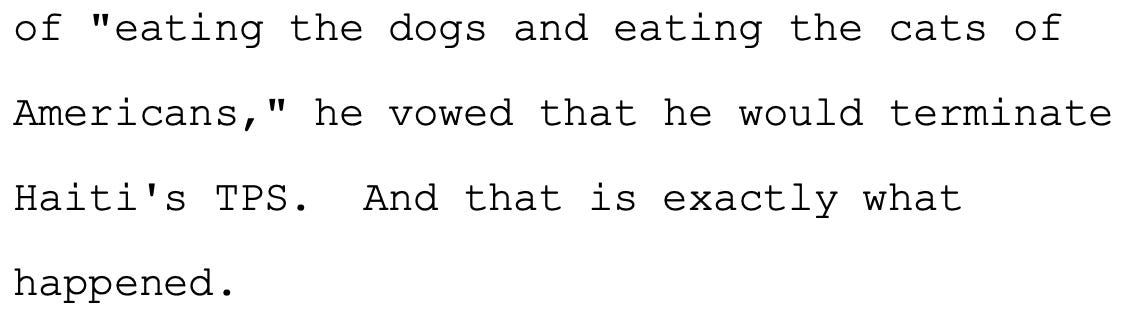
As to the constitutional equal protection claim in the Haiti TPS case, which Sauer acknowledged the government is not arguing (in this case) is blocked by the judicial review bar, Sotomayor confronted Sauer with Trump’s words and the implications under the Supreme Court’s 1977 decision about judging unconstitutional animus in Village of Arlington Heights v. Metropolitan Housing Development Corp. She said:
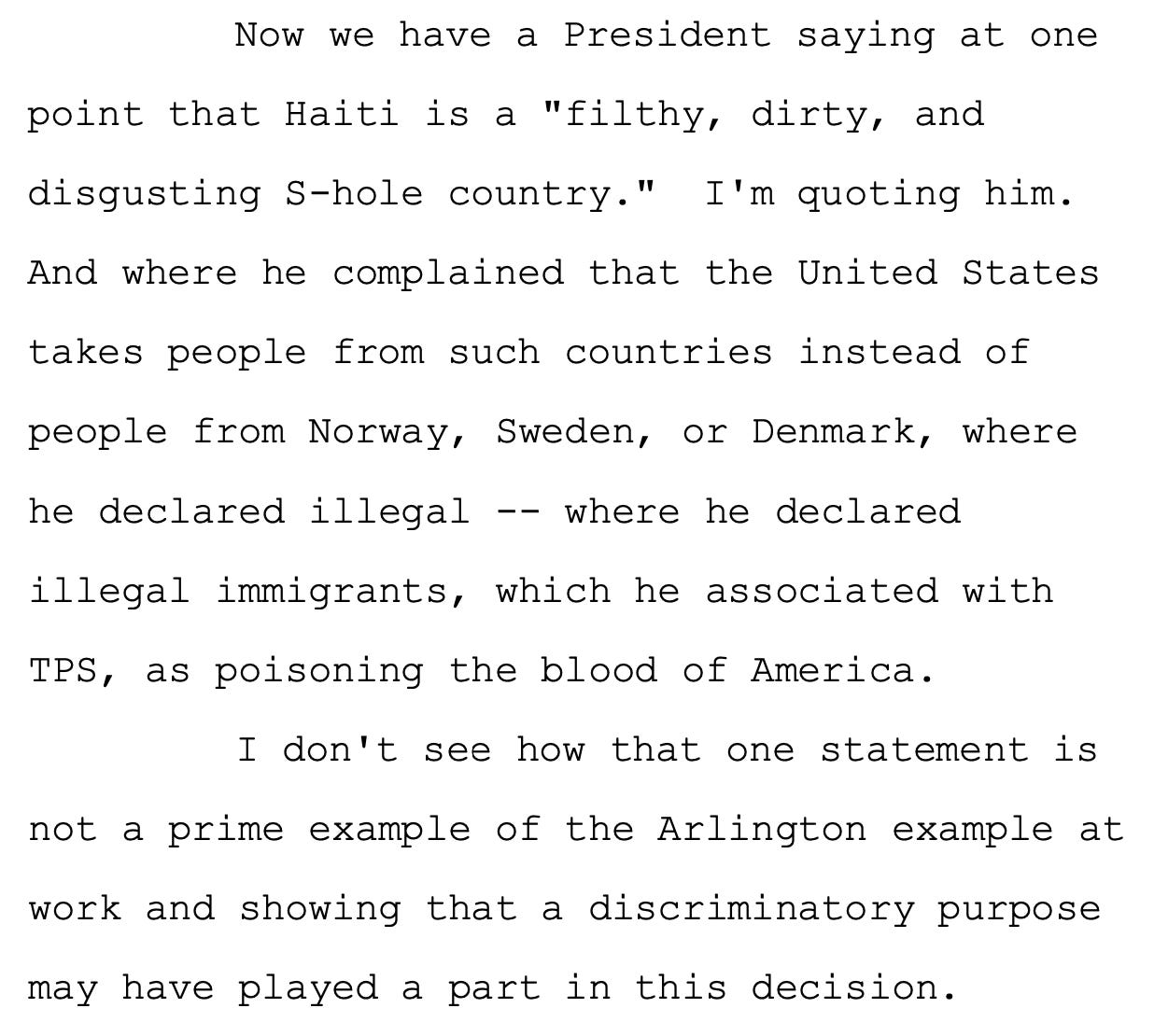
Sauer responded that “none of them, not a single one of them, mentions race or relates to race in any way,“ instead insisting, “All those statements in context refer to problems like crime, poverty, welfare dependence, drugs, drug importation.“
After Jackson jumped in, questioning Sauer as to specific comments that he said were presented by the challengers “wrenched from context,” Jackson incredulously questioned Sauer whether “the position of the United States is that we have to have an actual racial epithet“ in order to find animus.
After some back and forth, Sauer ultimately told her, “The Court should conclude that the statements are unilluminating and fail to raise any plausible inference of animus.“
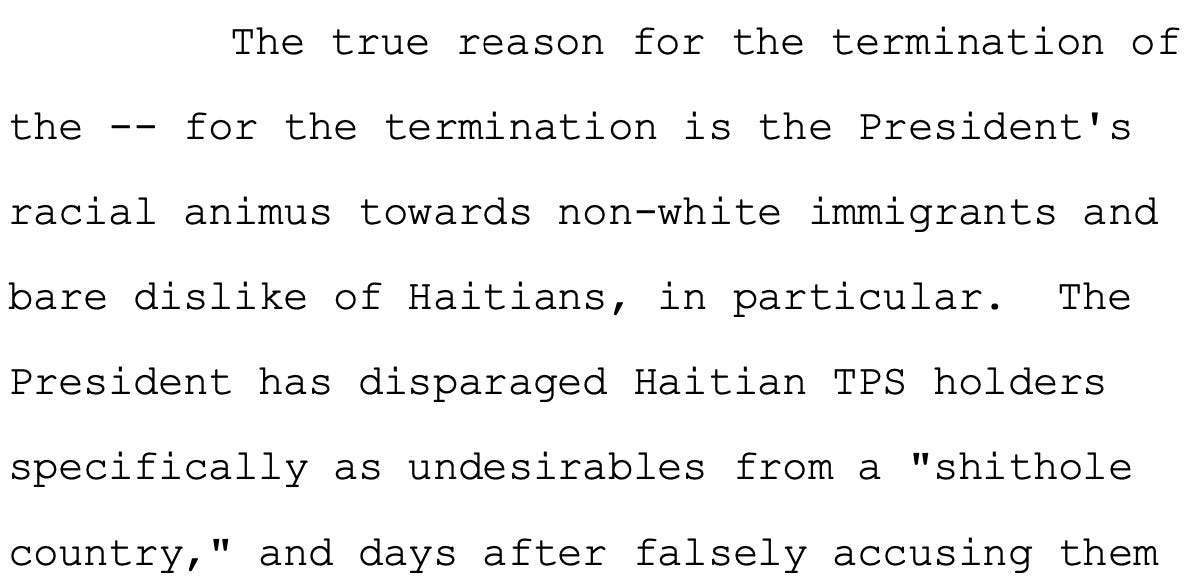
Later, when Bryan Cave partner Geoffrey Pipoly took to the podium regarding the Haiti-related challenge, he addressed the claim forthrightly and directly in his introduction.
“The reasons Secretary Noem gave for the termination were pretextual,” he told the court.
Alito told Pipoly of the TPS terminations, “you say they’re all non-white,“ and tried to take the lawyer down a path about who would be considered non-white — starting with Syrians, moving to Turks, and then Greeks.
When Alito then asked, “How about southern Italians?“ to laughter, Pipoly responded clearly — and correctly — that history had the answer there.
“Well, certainly 120 years ago when we had our last wave of European immigration, southern Italians were not considered white. So I think our concept of these things evolves over time.”
Moments later, Alito moved on with his statement about his dislike of “dividing the people of the world into these groups.“
More on the VRA decision
Two hours earlier, Alito advanced that claimed principle, as Kagan said, by ignoring Congress and its 1982 amendment to the Voting Rights Act.
With that amendment, Congress told the Supreme Court that its earlier decision requiring those challenging redistricting under Section 2 of the VRA to show discriminatory intent was, effectively, wrong — instead requiring the use of a discriminatory effects test to judge such claims.
“This court, for 40 years, has honored Congress’s choice,” she said of the Gingles test the court adopted to apply the law in the wake of the amendment — and reaffirmed just three years ago. With the court’s decision, “It is as if [the amendment] never happened.”
As Law Dork covered in 2023, Roberts, in reaffirming the Gingles test, detailed how it operates:
The minority group at issue has to be “sufficiently large and [geographically] compact to constitute a majority in a reasonably configured district”; “politically cohesive”; and be able to show that “the white majority votes sufficiently as a bloc to enable it . . . to defeat the minority’s preferred candidate.” If those “preconditions” are met, challengers must also then show that, in consideration of the “totality of the circumstances,” the “political process is not ‘equally open’ to minority voters.
Alito — for the court and citing constitutional concerns that “§2 of the Voting Rights Act properly fit within Congress’s Fifteenth Amendment enforcement power“ — held that the amended “§2 imposes liability only when the evidence supports a strong inference that the State intentionally drew its districts to afford minority voters less opportunity because of their race.“
Going on, he insisted, “This interpretation of §2 does not require abandonment of the Gingles framework. We need only update the framework so it aligns with the statutory text and reflects important developments since we decided Gingles 40 years ago.“
The “update,” however, in addition to requiring an alternative map be presented by challengers, also provides what Kagan called an “automatic partisan gerrymandering defense.“
Given Rucho and building on a 2024 decision restricting racial gerrymandering claims, Alito explained that “this is our first occasion to address the implications of Rucho in a vote-dilution case.“ Here, the court held, plaintiffs in a Section 2 case now “must show that voters engage in racial bloc voting that cannot be explained by partisan affiliation.“
That, Alito held for the court, did not happen here, so the new map was unnecessary under Section 2 and, accordingly, is an unconstitutional racial gerrymander.
Referencing the 1980 decision that preceded the 1982 amendment, City of Mobile v. Bolden, Kagan wrote in dissent, “It is Bolden redux, despite Congress’s repudiation of that decision (and this Court’s precedents honoring that rejection). The majority has made its own assessment of current needs … and concluded that preventing racial vote dilution does not count among them.”
Although he wrote nothing on Wednesday, this has been Roberts’s aim since Congress was considering the amendment and he was a young lawyer opposing it in the Reagan administration.
Wednesday’s decision is, Kagan warned, a bleak future for minority representation.
“The Callais requirements have thus laid the groundwork for the largest reduction in minority representation since the era following Reconstruction,” she stated simply.
A grammatical error in this paragraph was corrected shortly after publication, with a correction to the link made later as well.
Think of American racial history as being a 350 year game-of-life marathon in which one group was forced to carry 25 lb weights on their back for the entire race. In that game-of-life race they were denied access to education, jobs, promotions, land ownership, suffered constant police harassment and more. At the end of 350 years the weight carrying group is way behind in every measurable aspect of life. And it was all legal, Supreme Court approved, no worries about discrimination or racism.
Thoughtful people suggested, after 350 years, it was a societal responsibility to change the rules of the game and try to help the disadvantaged 25 lb carrying group. They suggested that as life continued the leaders would carry a 1 pound disadvantage in the future in hopes of equalizing societal opportunity.
Almost immediately, that tiny disadvantage was viewed by some as discrimination. After all they intone very piously, In America we are all equal and even the slightest disadvantage should be illegal, never mind the hundreds of years of past court sanctioned racism--sort of heads I win tails you lose mentality.
And now under Trump as Republicans try to erase history they and the conservative Supreme Court like to forget history make believe that it was a fair race from the start.
As the three “other” justices have pointed out, SCOTUS has no interest in how the hoi polloi are affected, the equity … as long as the elite are cocooned, and dominant.