

Federal judge blocks DOJ from seeking NYC trans care information via grand jury subpoena
Judge Failla's TRO is the first such ruling in DOJ's recent escalation in its effort to go after gender-affirming medical care for minors. [Update: Judge converted TRO into a preliminary injunction.]

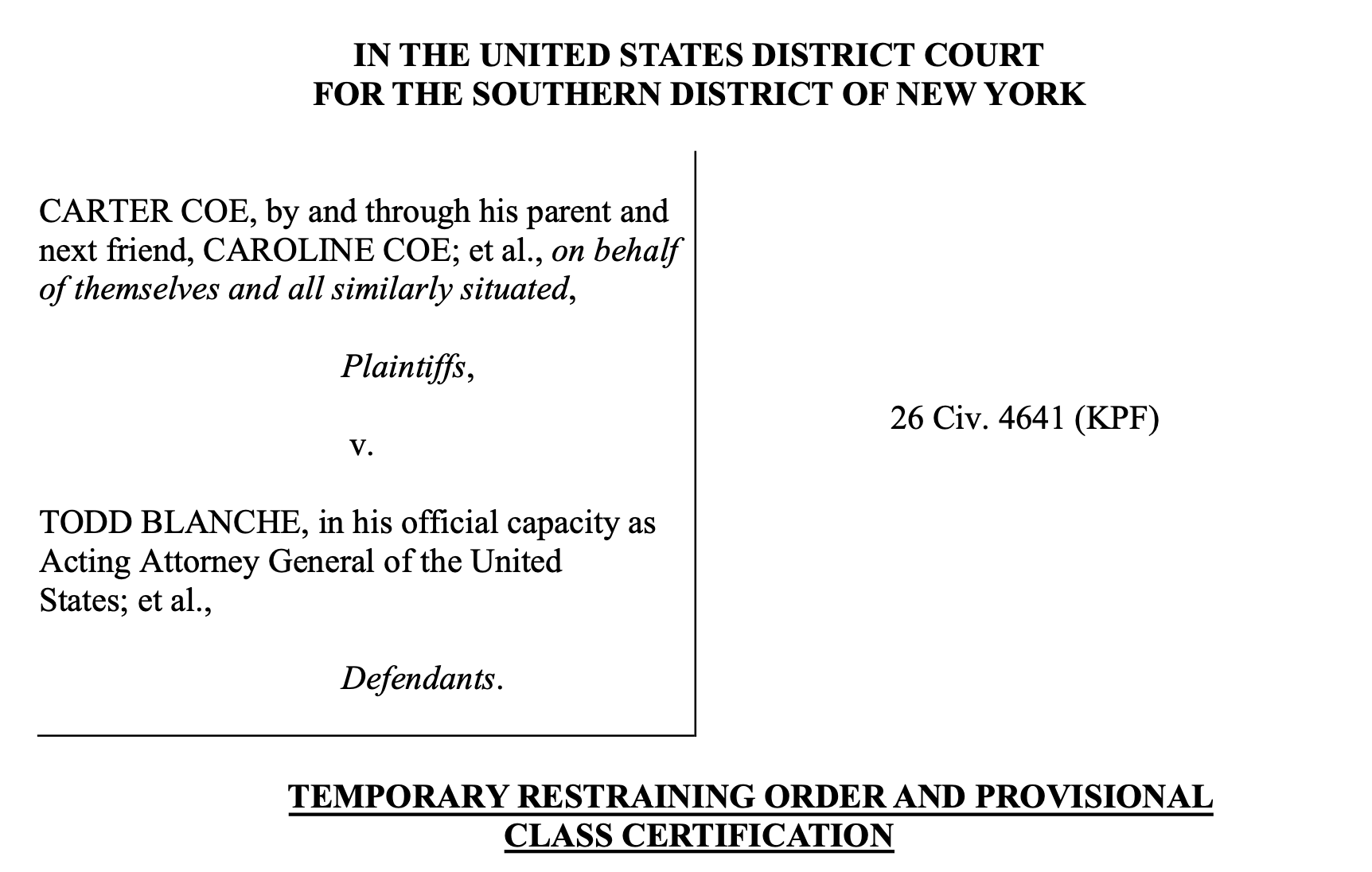
On Wednesday morning, a federal judge granted patients’ request to block the Justice Department from seeking or obtaining invasive patient information about transgender minors who received gender-affirming medical care in New York City.
It was the first such ruling to block DOJ’s escalated effort to obtain the information through grand jury subpoenas as part of the Trump administration’s broader effort to “reduce or eliminate” such care altogether.
U.S. District Judge Katherine Failla found the classwide temporary restraining order to be necessary because, she said in announcing her ruling from the bench, DOJ’s request “shocks the conscience” by seeking the “most personal and sensitive information a medical provider could hold” without providing “any legitimate government interest“ that would justify the level of disclosure being sought by the government.
Failla, an Obama appointee, had held a three-hour hearing on Tuesday over the patients’ lawsuit, which was filed after NYU Langone Health, citing New York law, provided public notice that it had received a grand jury subpoena from the federal government ordering it to turn over the records. The patients are represented by the ACLU, New York Civil Liberties Union, and Lambda Legal Defense and Education Fund.
Failla noted that the only reason the patients even knew the government was seeking this information here was due to NYU Langone’s view that New York law required it to inform patients of the government request.
As Law Dork has covered in depth, the Trump administration has spent the past year seeking this detailed information from medical providers as one part of its broader anti-trans policy efforts. Where challenged, judges had blocked the Justice Department’s initial effort to obtain the information through administrative subpoenas. Then, this spring, DOJ turned to issuing grand jury subpoenas out of the Northern District of Texas to obtain the information. This led to another round of litigation, including the New York City case.
Following Tuesday’s hearing, Failla called the parties together at 11:00 a.m. Wednesday — and provided remote access to the public — to issue her decision on the plaintiffs’ request.
[Update, 5:40 p.m. ET June 26: The plaintiffs in the Lucile Salter Packard Children’s Hospital (Stanford) case filed the full transcript from Judge Failla’s New York City case decision announcement as a “statement of recent decision“ notice in the Stanford case on Friday, so it is now readily available.]
[Update, July 8: Judge Failla converted the temporary restraining order into a preliminary injunction, which would stand throughout the litigation.]
The decision in depth
Reading the opinion from the bench — a process that took nearly an hour — Failla first laid out the facts established in the case, highlighting the importance of the context of the Trump administration’s actions since President Donald Trump returned to office in January 2025 and DOJ’s extensive efforts to obtain this information.
This is “worse than a game of wack-a-mole,” Failla said in describing the government’s shifting and secretive efforts, adding that it is forcing the patients to try and protect their medical records while “blind-folded.”
Citing the “reality of the timeline” involved, Failla also highlighted DOJ’s apparent effort to forum shop here, noting that the grand jury subpoena was issued in a “handpicked faraway jurisdiction.”
Failla’s presentation Wednesday was extensive and in-depth — impressive in general but all the more because she was only belatedly assigned the case on Monday after two other judges apparently recused themselves from hearing the case.
Attorneys Omar Gonzalez-Pagan from Lambda Legal and Chase Strangio from the ACLU made arguments for the patients on Tuesday, while DOJ’s Luke Miller represented the government and Zachary Cunha represented NYU.
Ultimately, Failla explained that she found she had jurisdiction to hear the request, citing the Declaratory Judgment Act (and Second Circuit precedent) and courts’ inherent equity authority, and subject matter jurisdiction to hear the plaintiffs’ claims raising both violations of statutory and constitutional rights. She additionally found that the plaintiffs had standing to bring the claims, given that they faced a “certainly impending” injury in fitting with Supreme Court precedent.
On the merits of plaintiffs’ request, Failla found that plaintiffs are likely to succeed in demonstrating violations of both the Fourth and Fifth Amendments.
While the government cited its effort to protect grand jury secrecy in declining to respond to many questions, Failla said that she failed to see “how any legitimate government interest” would justify seeking the patient requests at issue.
“I cannot conceive of a crime” that would require this disclosure, Failla said, concluding that the government’s interest does not likely outweigh the patients’ interest in privacy under the Fifth Amendment given the scope of the information sought and the fact that it is targeted at “a particularly and uniquely vulnerable group”.
As to the Fourth Amendment, Failla found that the patients “have an objectively reasonable expectation of privacy” in these records and that the government’s subpoena does not overcome those privacy rights.
Noting that NYU Langone has stated even anonymized data would provide incomplete protection to patient given the breadth of data sought, Failla concluded that it is impossible to guarantee anonymization of patients’ identity and that, under Supreme Court precedent, that data would provide an “intimate window into a person’s life.”
If turned over, the data would create “a sweeping profile of plaintiffs,“ Failla said, concluding that the plaintiffs are likely to succeed on their Fourth Amendment claim.
As to the other factors for granting the TRO, Failla easily found that the patients’ showed irreparable harm and that the balance of the equities are in their favor.
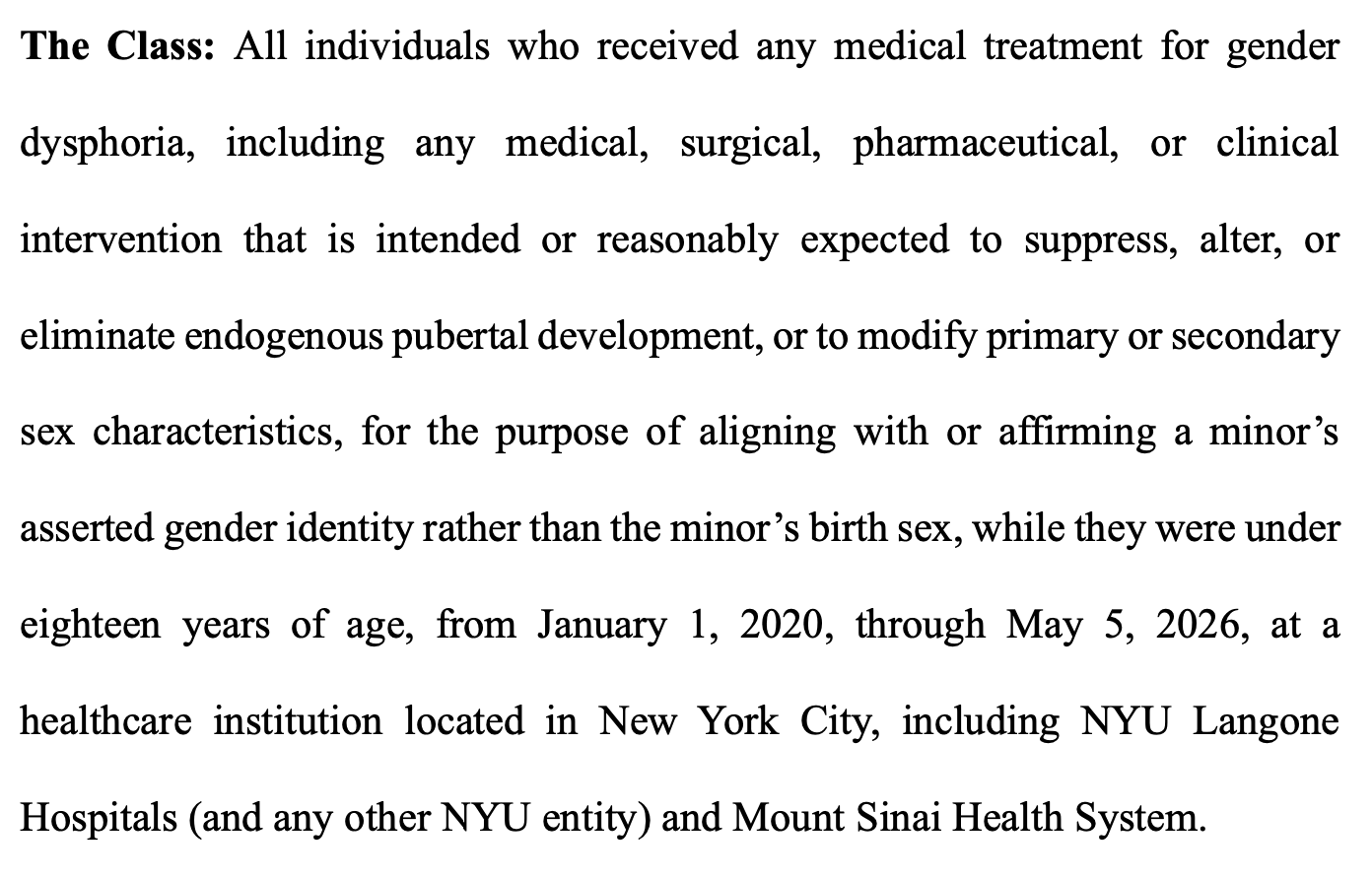
In addressing the scope of relief, Failla granted the plaintiffs request for provisional certification of a class of all people to have been provided with gender-affirming medical care in New York City and and subclass of those who did so at NYU Langone specifically.
Although Failla noted that DOJ argued this is too broad a scope of relief given the Supreme Court’s decision barring universal injunctions, Failla explained that the government “may have misperceived” that decision. Specifically, she noted that the Supreme Court there was addressing universal injunctions being used as a “workaround” to class relief. Here, however, class-based relief is exactly what the plaintiffs pursued.
Failla granted the class-based TRO on Wednesday, provisionally certifying the following class (and NYU subclass):
She then granted the following temporary restraining order against DOJ (and one directed at NYU, blocking it from turning over such information) as to not only the current grand jury subpoena at issue but all “substantially similar administrative or grand jury subpoenas“ part of DOJ’s claimed investigation into such care:
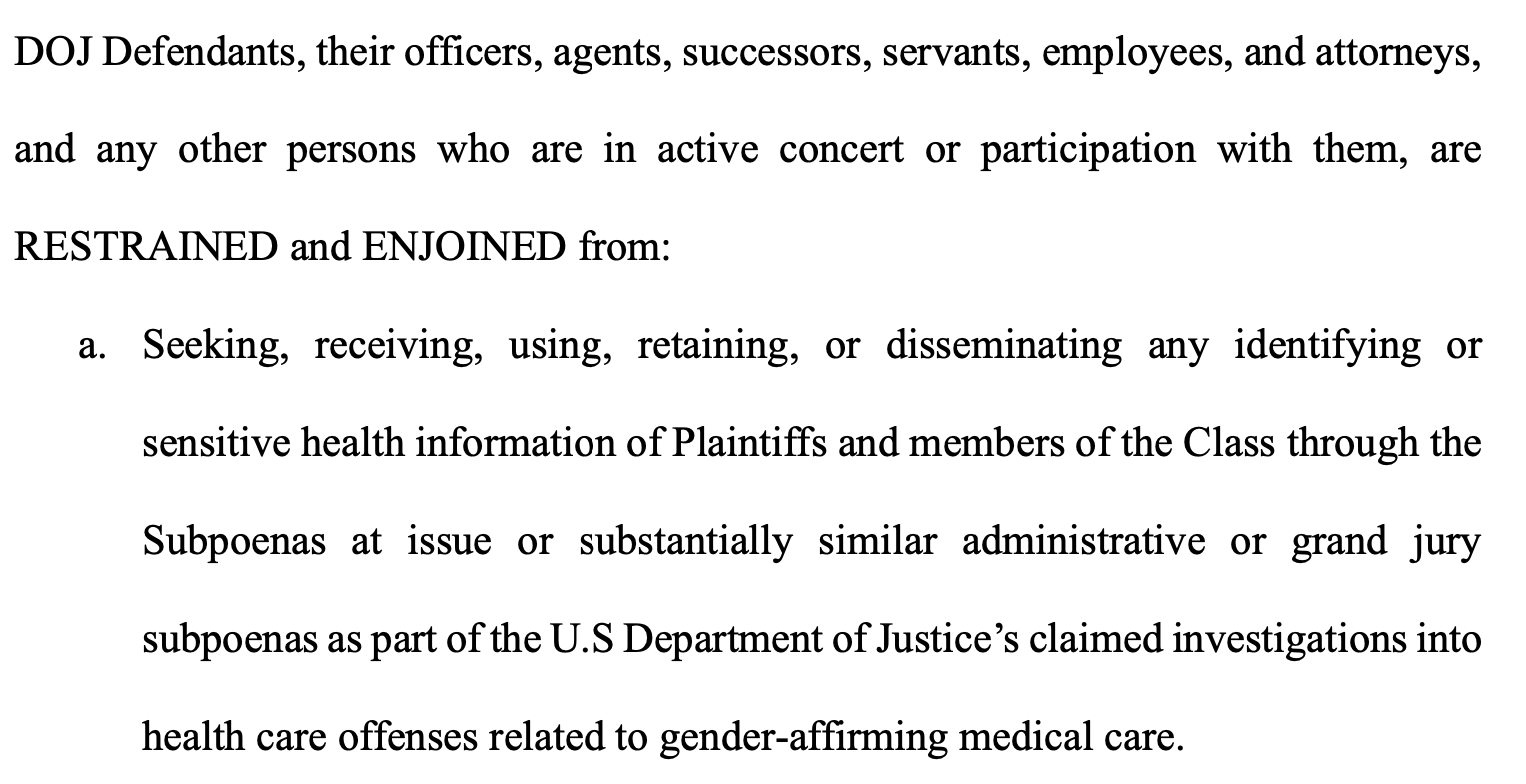
The TRO is now in effect. As TROs generally only remain in effect for 14 days, however, the case will now move forward quickly.
Failla concluded Wednesday’s opinion announcement by tentatively setting a preliminary injunction hearing for Wednesday, July 8. She also ordered the parties to submit a joint letter on the docket by the end of the day Friday regarding any additional discovery, motion practice, or briefing that they believe is needed for that consideration.
Two notes
A similar request seeking to block a similar DOJ grand jury subpoena — one issued to Lucile Salter Packard Children’s Hospital at Stanford — remains pending. The plaintiffs there have already alerted their judge — U.S. District Judge Casey Pitts — to Wednesday’s ruling.
One final matter should be noted.
Judge Failla on Wednesday highlighted DOJ attorney Miller’s reference on Tuesday to U.S. District Judge Reed O’Connor somehow being involved in this matter despite the facts that, as is usual, no judge had signed off on the grand jury subpoena at issue and DOJ has insisted it cannot even acknowledge the existence of the subpoena under grand jury secrecy rules.
O’Connor, a far-right George W. Bush appointee with a long record of anti-LGBTQ rulings, had overseen the same-day granting of DOJ’s request to enforce an earlier administrative subpoenas that had been issued in D.C. to Rhode Island Hospital, but there has been no public connection — until Tuesday — between O’Connor and the grand jury matter.
Thank you. Crucial reporting.
For Christ's sake, why not just let people be people?