

After a string of losses in its anti-trans project, DOJ turns to grand jury subpoenas in Texas
At least seven judges have blocked invasive administrative subpoenas targeting gender-affirming care for minors, so DOJ appears to be trying a new tactic to get the info it wants.

The Trump administration is apparently shifting tactics to advance its stated policy to “reduce or eliminate gender-related care to minors“ by using the U.S. Attorney’s Office in the Northern District of Texas to try and get invasive information from medical providers about transgender minor patients obtaining gender-affirming medical care.
The apparent shift came after more than a half-dozen federal judges across the nation have blocked the effort to obtain patient information through administrative subpoenas; following a hearing in multistate litigation against the Trump administration’s anti-trans policies; and in the midst of a sprawling dispute over the Justice Department’s effort to enforce one of the administrative subpoenas — issued last year against Rhode Island Hospital — in the same district in Texas.
The Trump administration has advanced an anti-transgender philosophy since day one of President Donald Trump’s second term, with then-Attorney General Pam Bondi seeking to put the Trump administration’s anti-trans policy positions into practice in a memo issued more than a year ago. Over this past summer, Assistant Attorney General Brett Shumate, the head of the Civil Division, signed about 20 administrative subpoenas, seeking records from providers of gender-affirming medical care for transgender minors. Soon thereafter, some providers and patients began challenging the requests. Judges were skeptical of DOJ’s efforts — and began blocking them or at least the patient-specific requests.
As early as December 22, 2025, several states that are engaged in a lawsuit against the Trump administration’s anti-trans policies cited the administrative subpoena effort — and its universal opposition from federal courts to the patient-specific requests. On April 20, the states submitted in their case the transcript from an August 2025 hearing in one of the subpoena challenges in advance of an April 23 hearing in their case.
In that transcript, longtime DOJ lawyer Patrick Runkle acknowledged the purpose of the investigation was to stop trans minors from being able to obtain gender-affirming medical care:
[T]he policy is that the executive branch wants to reduce or eliminate gender-related care to minors, especially the medicalized gender-related care to minors that this investigation is about ….
On September 9, 2025, U.S. District Judge Myong Joun had rejected DOJ’s argument and granted Boston Children’s Hospital’s motion to quash the administrative subpoena.
This pattern continued uninterrupted until DOJ secretly went to the Northern District of Texas and sought an order enforcing the subpoena issued against Rhode Island Hospital on April 30. U.S. District Judge Reed O’Connor — without informing the hospital, let alone allowing it time to respond — granted DOJ’s motion the same day in a two-page order, ordering the hospital to comply with the subpoena by May 14.
In the motion, and as noted at the time, DOJ provided no specific information as to how its Rhode Island Hospital investigation related to the Northern District of Texas, nor did O’Connor address that in his threadbare order granting DOJ’s request.
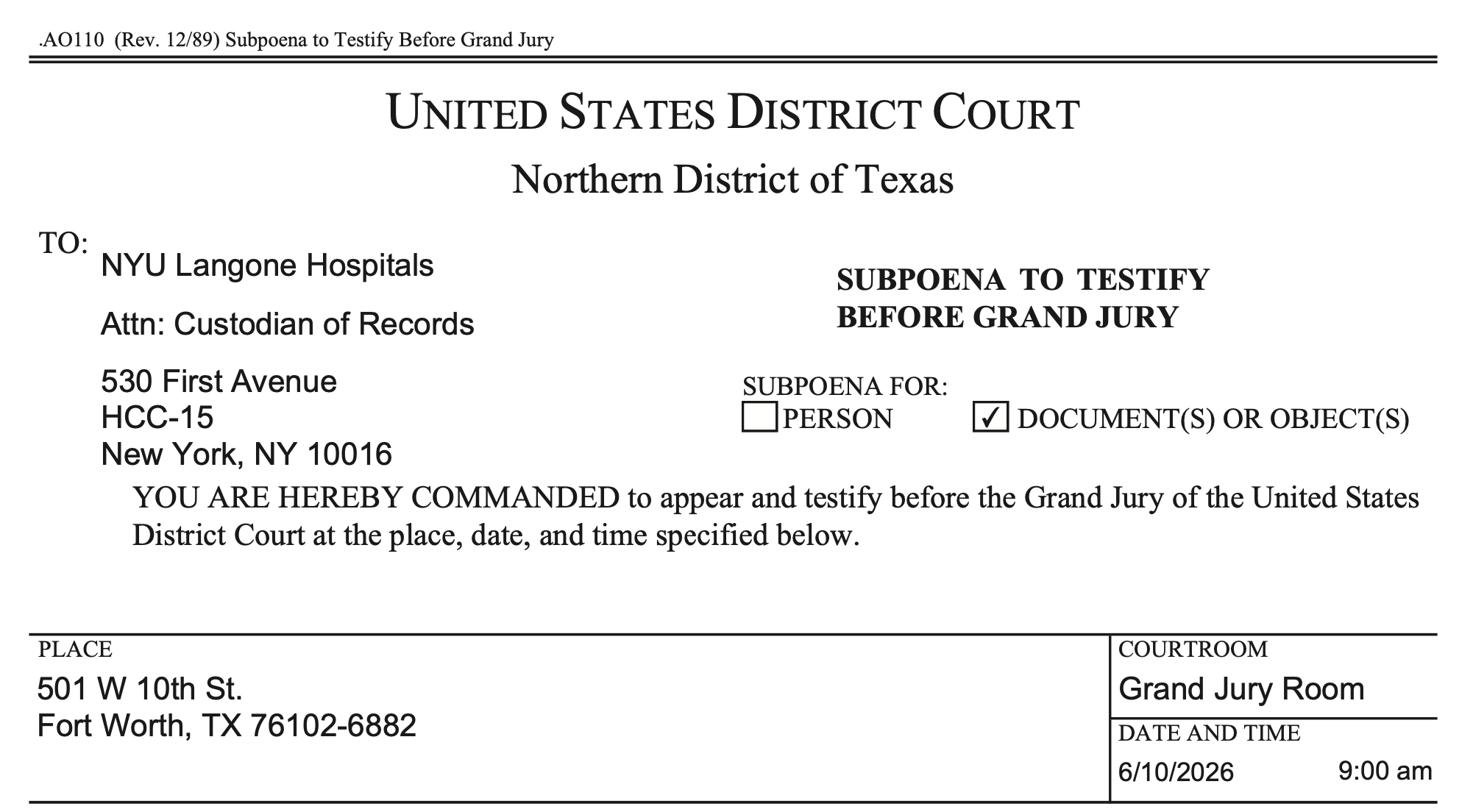
As the calendar turned into May, DOJ apparently shifted tactics — although the timing and the specific reasons for doing so remain murky — by having the U.S. Attorney’s Office in the Northern District of Texas issue grand jury subpoenas. NYU’s Langone Health first directly acknowledged the move, stating on May 11 that it was one of “several institutions“ that received the grand jury subpoena on May 7.
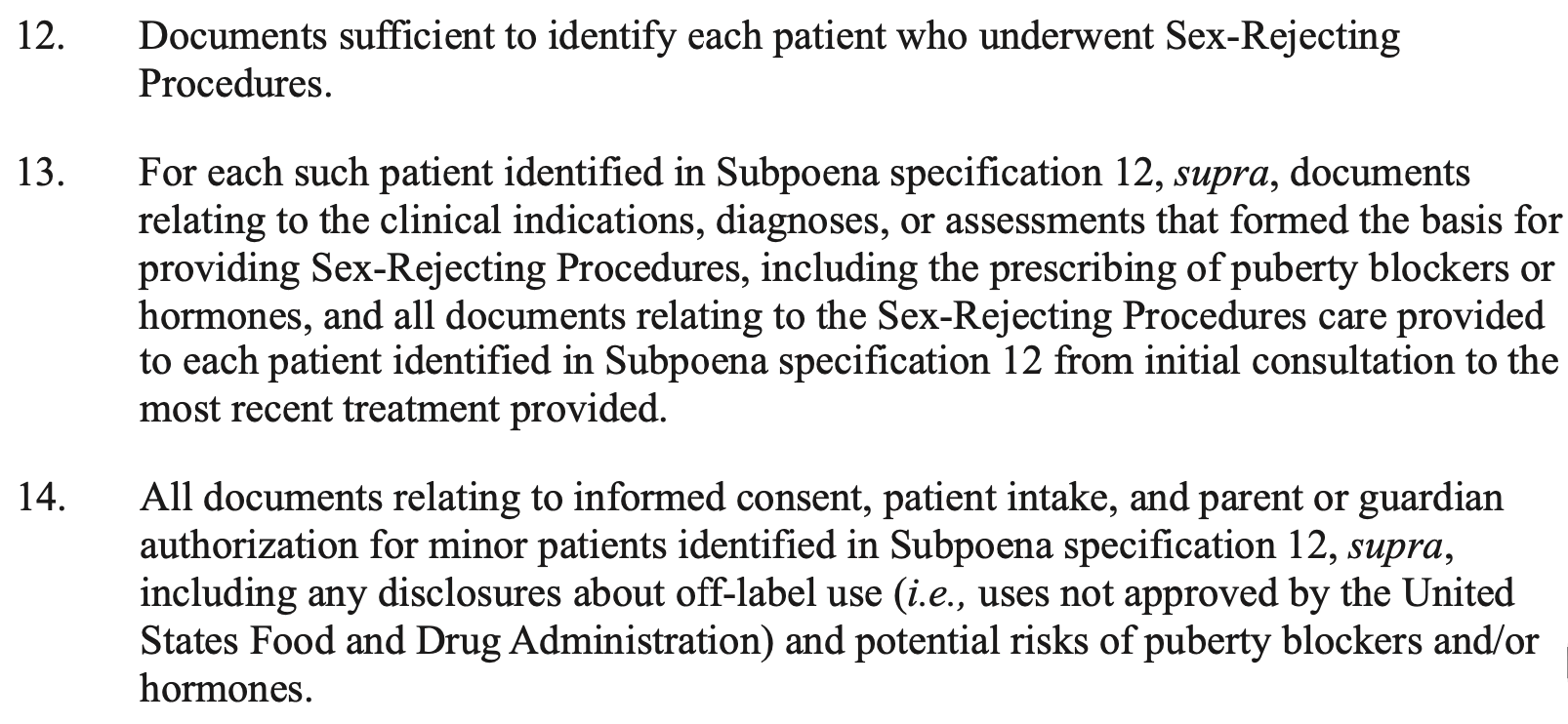
On May 13, NYU Langone posted the subpoena itself, which was sought by Assistant U.S. Attorney Ethan Womble, a former clerk to O’Connor, and dated May 6.
Among other documents it orders NYU Langone to produce, it — like the administrative subpoenas — includes patient-specific and patient-identifiable information:
The shift to the use of the U.S. Attorney’s Office in the Northern District of Texas — headed by Ryan Raybould, another former O’Connor clerk — to issue grand jury subpoenas appears to have come as or after Rhode Island’s Child Advocate filed a motion on May 4 in the federal court in Rhode Island to quash the administrative subpoena against Rhode Island Hospital.
Also on May 6, in the Northern District of Texas, Rhode Island Hospital itself appealed O’Connor’s order to the U.S. Court of Appeals for the Fifth Circuit. (It is not clear whether the notice of appeal came before the grand jury subpoenas were issued, or whether the notice of appeal followed the issuance of the grand jury subpoenas.)
The shift also appears to have coincided with a May 6 deadline for DOJ to file its brief in its appeal of a subpoena partially quashed as to Children’s Hospital of Pennsylvania (CHOP). Instead, at 4:44 p.m. ET May 6, DOJ filed a motion at the U.S. Court of Appeals for the Third Circuit seeking to dismiss its appeal.1 At the time, DOJ stated that the hospital “has stated that it intends to oppose this motion.“ In a filing on May 11, however, lawyers for CHOP had shifted their view:
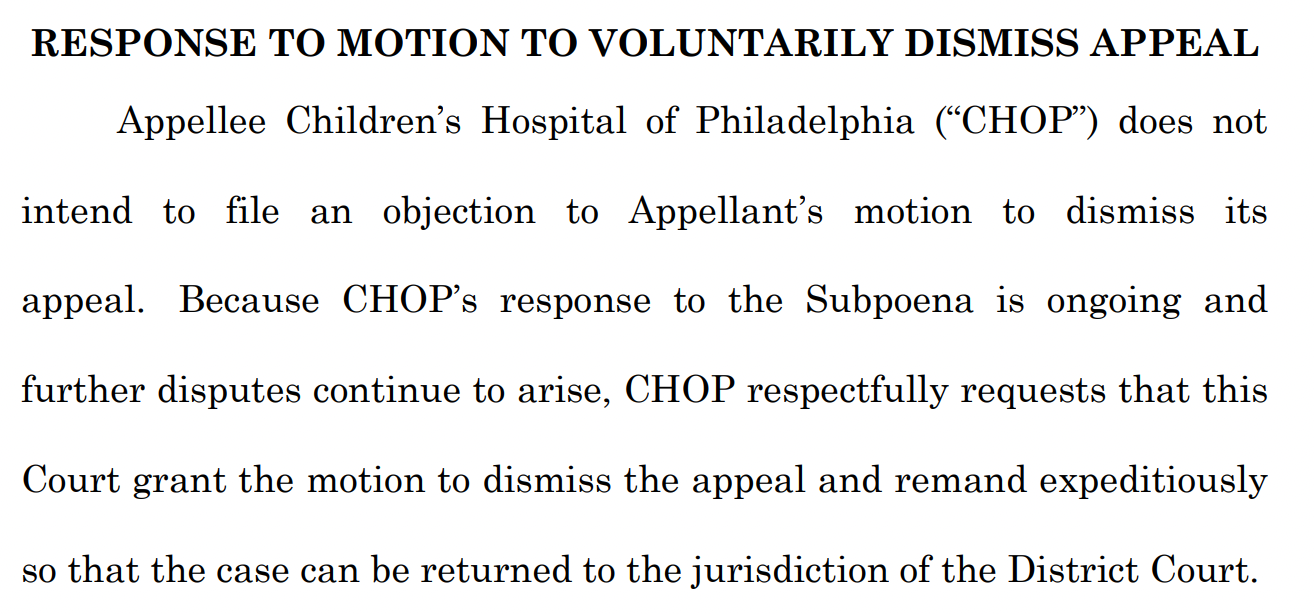
Although the response did not explicitly state it, the language — “further disputes continue to arise“ — suggested that CHOP may have been one of the other institutions that received a grand jury subpoena (and that its lawyers did not know so when they had initially opposed dismissing the appeal on May 6). On May 12 then, the Third Circuit dismissed the appeal.
The whole shift, though, appears to have happened quickly.
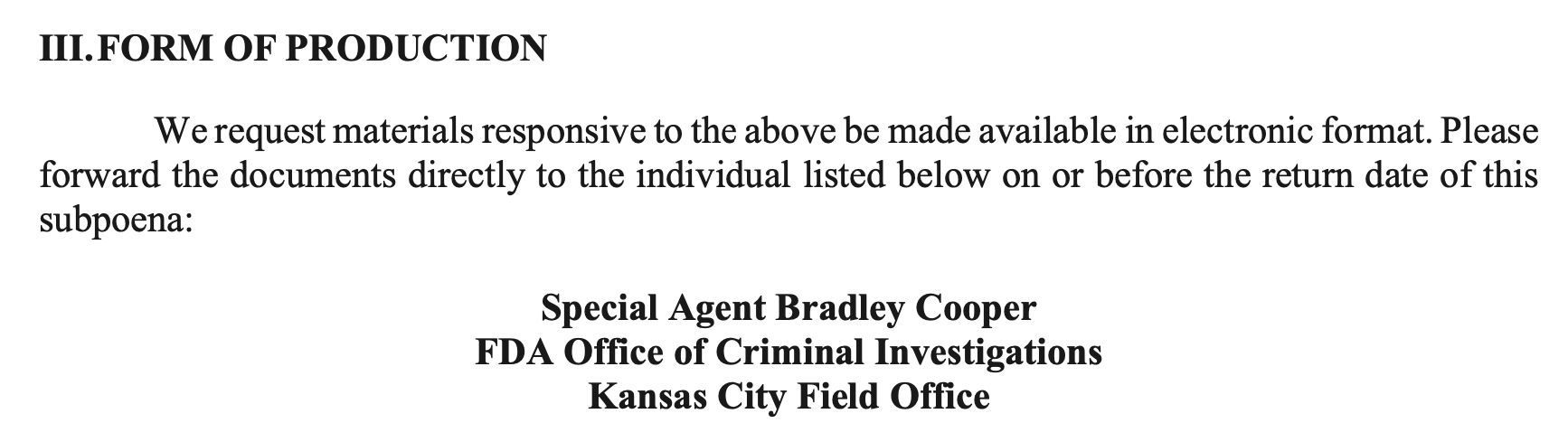
Despite the Northern District of Texas venue claims being central to this shift, the subpoena itself directly states that the documents are to be sent to a U.S. Food and Drug Administration agent in Kansas City.
In the week since, information about the grand jury subpoenas began to appear in court filings and elsewhere.
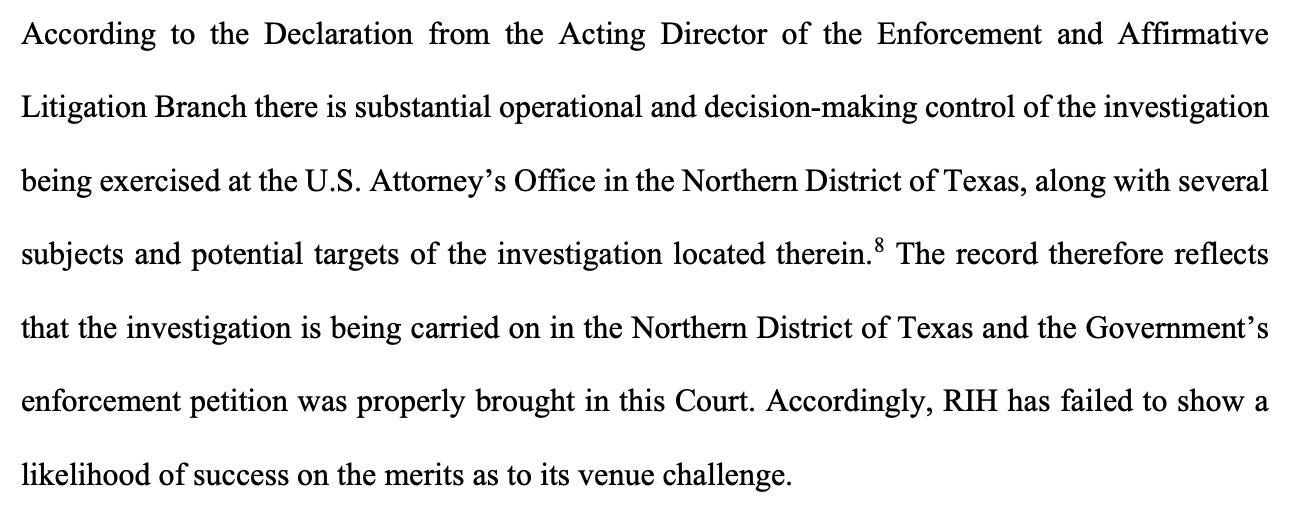
First, in addition to noting its appeal on May 6, Rhode Island Hospital filed a motion asking O’Connor to stay the order while it appealed it. When DOJ responded on May 8, it also filed a secret declaration with O’Connor from Lisa Hsiao, a longtime DOJ lawyer who is now the acting director of DOJ’s Enforcement and Affirmative Litigation Branch. (The declaration was filed under seal and ex parte, meaning even the Rhode Island Hospital lawyers did not see it at the time.) DOJ publicly stated that the declaration showed that “there is substantial operational and decision-making control of the investigation being exercised at the U.S. Attorney’s Office in the Northern District of Texas, along with several subjects and potential targets of the investigation located here.“ It also claimed that “there are substantial investigative steps happening here.”
Unsurprisingly, O’Connor, on May 10, denied Rhode Island Hospital’s request to stay the order compelling compliance (with a short-lived exception for the Fifth Circuit to rule on a similar stay request). At that point, O’Connor did provide additional reasoning for his earlier threadbare order, and DOJ has since used that order from O’Connor to provide support for its arguments in other courts. Notably, however, O’Connor again based his decision, in part, on material Rhode Island Hospital had not seen and could not have responded to:
The day before O’Connor’s ruling, the hospital had filed its request for a stay at the Fifth Circuit given the impending deadline.
In the meantime, on May 11 and as noted above, NYU Langone brought the news out into the open.
On May 12, at 11:39 a.m. CT — with a noon deadline — DOJ responded to the hospital’s Fifth Circuit stay request, opposing the request and citing its “ex parte declaration” and O’Connor’s “credit[ing]” of it. Less than four hours later, with no reasoning provided, the three-judge panel denied the stay request.
At the same time, however, across the country, U.S. District Judge Mary McElroy was digging into the matter filed in Rhode Island. On May 10, Rhode Island Hospital had sought to join the matter, filing its own motion to quash the subpoena the next day. That same day, McElroy — who previously denied DOJ’s request to send the matter to O’Connor — ordered DOJ to provide her with the secret Hsiao declaration and any other materials provided to O’Connor so that she would have them for the May 12 hearing.
It did not go well for DOJ. As the Boston Globe’s Steph Machado summarized the hearing:
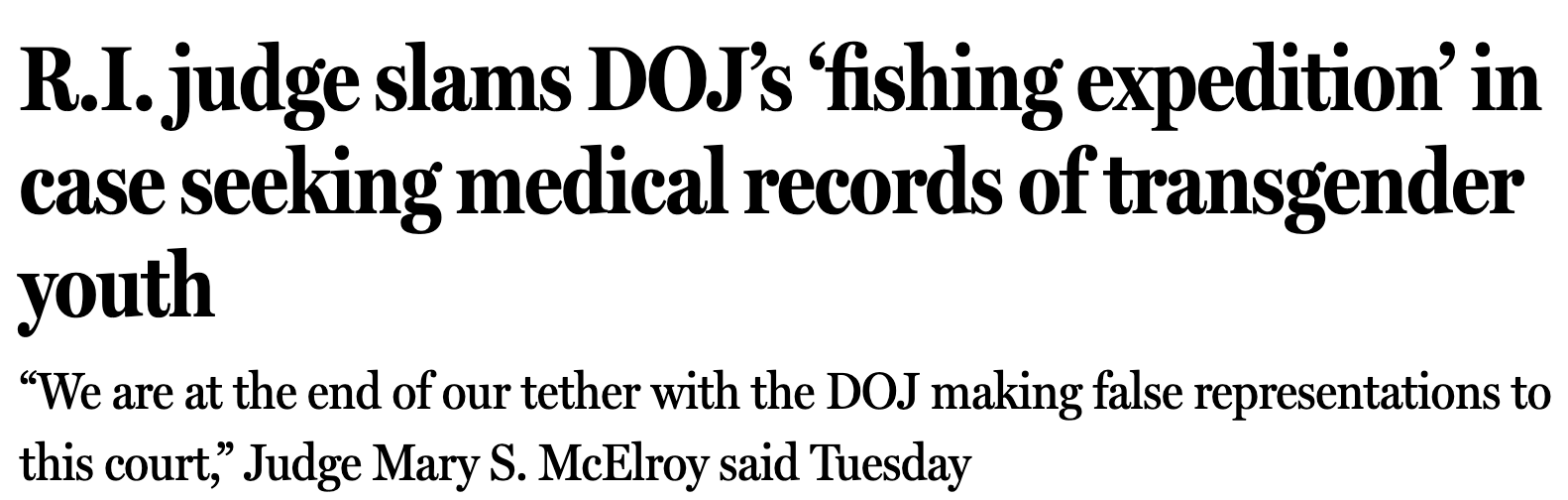
As Machado explained, DOJ lawyer Brantley Mayers — who had only served as a judicial law clerk for three judges before joining DOJ in November 2025 as counsel to Civil Division chief Shumate — faced tough questions and accusations from McElroy:
During a four-hour hearing on Tuesday, Rhode Island federal Judge Mary S. McElroy, who is considering blocking the subpoena, accused the DOJ of “shopping” the case to a Texas judge to enforce a Rhode Island subpoena. McElroy said lawyers then appeared to have “misled” the judge on multiple fronts.
“That is dirty pool in my opinion,” McElroy said.
A ruling from McElroy could come at any time, but, given the grand jury subpoenas, it is clear that, while an important fight, this is just another step in the constant pushback against this DOJ effort — and against the Trump administration’s broader anti-trans project.
A ruling in Rhode Island
[Update, 7:55 p.m.: Minutes after publication, Judge McElroy did rule, quashing the administrative subpoena in full and calling out the Justice Department’s behavior in the matter as — in part — “misrepresent[ing] salient facts” under oath.


In key part, as to the Rhode Island Hospital administrative subpoena, she concluded, “[T]he Court GRANTS both Motions to Quash and enjoins the DOJ from seeking or receiving any documents related to this now invalid subpoena.”]
[Update, 12:05 p.m. May 14: The Justice Department is appealing Judge McElroy’s decision to the U.S. Court of Appeals for the First Circuit.]
There has only been one appeals court argument over the subpoenas thus far, and that was a March 6 argument in the U.S. Court of Appeals for the Ninth Circuit. There has been no opinion issued in that case from the appeals court.
I deleted an anti-trans comment. Anyone is free to write at their own space if they want to do so, but you are not going to use my comments to spread anti-trans commentary.
Misinformation, misrepresentation, just plain lies … this administration soils everything it touches.