

DOJ has escalated its attack on trans care for minors. Where could it be headed next?
As Rhode Island Hospital begins turning over documents to a far-right judge in Texas, a number of grand jury subpoenas have been issued and DOJ settled with one hospital.

Three weeks ago, on April 29, lawyers for Rhode Island Hospital responded to an email from a Justice Department lawyer in Washington, D.C., sent the day before, asking for a conference on next steps in addressing an outstanding administrative subpoena issued by DOJ to the hospital nearly a year earlier about its provision of gender-affirming care for transgender minors.
The next day, DOJ shifted tactics without even initially telling the hospital — going to court across the country to try and get an order enforcing the subpoena.
At least seven challenges to the invasive subpoenas had previously resulted in federal court rulings quashing the subpoenas or, at least, the parts of the subpoenas seeking identifiable patient information. In the wake of those losses — and as Acting Attorney General Todd Blanche took over the Justice Department — the strategy, as Law Dork has covered, began to shift to more aggressive tactics on multiple fronts.
The change has had at least one tangible effect already with regards to Rhode Island Hospital.
Beginning Tuesday night, at least some records responsive to the administrative subpoena were sent to a far-right federal judge in Texas who on Monday ordered the hospital to provide the records to him — although, for now, not to DOJ — while the hospital appeals his earlier ruling that the records need to be turned over to DOJ.
Any action on that earlier ruling, however, would appear to conflict with a later ruling from a federal judge in Rhode Island quashing the subpoena in full and barring DOJ from receiving any such records from the hospital — although the U.S. Court of Appeals for the First Circuit late Tuesday denied a request to take further action immediately to enforce that order.
This latest dispute, which has now involved four courts across the country, as well as related discussions in court filings and before a federal judge in Rhode Island, serve as a warning for transgender people, their allies, and the parents of trans kids about how aggressively the Trump administration is acting to advance President Donald Trump’s anti-trans policies and then-Attorney General Pam Bondi’s implementation of them — and where the administration could be going next in this attack.
That April 28 DOJ email to Rhode Island Hospital’s lawyers — in which David Gunn, a DOJ lawyer, referenced having been out of office for the past few weeks before asking for a conference to discuss the subpoena production — was a DOJ response to a February 4 email from lawyers from the hospital.
The hospital’s lawyer responded simply the next day: “We are happy to connect. Would Monday of next week work?”
The conference never happened because, on April 30, DOJ went to a friendly forum for them in the Northern District of Texas seeking to enforce the administrative subpoena, which, to be clear, was issued in D.C. to a Rhode Island entity. Going there meant the case had a good chance of and was, in fact, assigned to U.S. District Judge Reed O’Connor, a far-right judge with a history of anti-LGBTQ rulings.
Within hours, and before the hospital even had a chance to file any response, O’Connor granted the request — ordering the hospital to turn over the records within two weeks.
Over the past three weeks, there have been daily developments — and often multiple developments — shining an alarming light on what is happening.
Grand jury subpoenas
In addition to the order to enforce the subpoena in the Northern District of Texas, one of the two other most significant other development was the news — acknowledged by NYU Langone Health in accordance with New York law on May 11 — that it had received a grand jury subpoena for similar records that was issued in the Northern District of Texas.
Ethan Womble is listed as the person who sought the grand jury subpoena. He is, as of last month, an Assistant U.S. Attorney in the Northern District of Texas. (He was previously listed — as recently as February — as a trial attorney in the DOJ Criminal Division’s Fraud Section, although that health care fraud work does appear to have been based out of Texas.)
Womble and Ryan Raybould, the U.S. Attorney for the Northern District of Texas, were the only two lawyers on the DOJ petition to enforce the Rhode Island Hospital subpoena. They are both former O’Connor clerks.
The grand jury subpoena — which does not require judicial approval — was received by NYU Langone on May 7 (although dated May 6), and the date for compliance is June 10.
There is also evidence that other grand jury subpoenas were issued. In addition to NYU Langone stating that it was “one of several institutions that received a grand jury subpoena,” Law Dork previously reported that DOJ’s decision to withdraw its appeal of one of its administrative subpoena losses — as to Children’s Hospital of Philadelphia (CHOP) — came the same date that the NYU Langone grand jury subpoena was issued.
In a filing later on May 6 before the district court that had heard and granted the Philadelphia hospital’s initial request, the lawyers for CHOP were direct:
Just this morning, DOJ attorneys reached out to counsel for CHOP indicating that DOJ intended to dismiss its appeal, which has been proceeding in the Third Circuit since January and in which DOJ’s brief was due today. That development, along with DOJ’s unexplained effort to compel compliance by a Rhode Island hospital in the Northern District of Texas, suggest that DOJ may seek to end-run this Court’s jurisdiction over additional issues that arise involving the Subpoena.
Unlike the administrative subpoenas, which were challenged in the locations where the hospitals were located, challenges to the grand jury subpoena(s) would generally be in the Northern District of Texas — although lawyers will be looking for other paths.
It also should be noted that it is not yet clear what, if any, action beyond the issuance of the grand jury subpoenas has actually happened in the Northern District of Texas.
The Texas Children’s Hospital settlments
The grand jury subpoenas aren’t the only new development.
On May 15, DOJ announced it had reached a “resolution” with Texas Children’s Hospital in conjunction with a long-running investigation against the hospital by the Texas Attorney General’s Office.
Although DOJ presented the development as “the first resolution secured under the Department’s ongoing national investigation into violations of federal law in connection with” provision of gender-affirming medical care for transgender minors, Texas Attorney General Paxton only mentioned DOJ in one sentence and instead stated, “After a years-long investigation by the Healthcare Program Enforcement Division, Attorney General Paxton has negotiated a historic settlement that will help protect Texans.“ DOJ does cite agreements reached by the hospital with both federal and Texas governments.
In addition to ending the provision of such care, Paxton’s news release stated that Texas Children’s Hospital has agreed to “the creation of the country’s first-ever Detransition Clinic” and “pay $10 million for billing Texas Medicaid for unallowable and illegal ‘gender-transition’ interventions, including by using false diagnosis codes.“
In the DOJ news release, which only quotes Main Justice senior officials from D.C., it noted, “These matters and the investigations into sex-rejecting procedures (sic) on minors are being led by the Justice Department’s Civil Division Enforcement and Affirmative Litigation Branch and Commercial Litigation Branch, Fraud Section.”
There was no mention of the U.S. Attorney’s Office for the Northern District of Texas — or any district in Texas, for that matter — but the fact that the news releases are about a Texas hospital, DOJ’s release referenced what appears to be the same investigation at issue in both the administrative and grand jury subpoenas, and Texas’s release referenced one of the topics raised by DOJ in defending its subpoenas as allegedly supporting its investigation (improper billing codes) should not be glossed over.
For its part, Texas Children’s Hospital, in a statement to Law Dork, sounded a significantly different note than DOJ and Paxton’s office:
Over the last three years, we have cooperated fully with the Texas Attorney General and Department of Justice, navigating an unconscionable campaign of mistruths and mischaracterizations related to gender affirming care. We produced over 5 million documents and conducted multiple internal and external investigations. These efforts have required significant staff time and financial resources to defend ourselves. All reviews and investigations continue to support the facts – we have been compliant with all laws.
Today, we made the difficult decision to settle with the Texas Attorney General and the Department of Justice, closing a chapter that has been wrought with falsehoods and distractions. To be clear – we are settling to protect our resources from endless and costly litigation. This settlement will allow us to redirect those precious resources to focus on the life-saving care and groundbreaking discoveries of our exceptional clinicians and scientists.
Nonetheless, if DOJ proceeds with a grand jury investigation in the Northern District of Texas, these settlements could quickly become very relevant to DOJ’s claims.
What happened with Rhode Island Hospital
All of which brings us back to Rhode Island Hospital.
After O’Connor issued his initial order three weeks ago Thursday, the Rhode Island Child Advocate — responsible for oversight of children under the care of Rhode Island’s youth services — sought to quash the subpoena in Rhode Island.
U.S. District Judge Mary McElroy, a Trump appointee who had initially been nominated during the Obama administration, was assigned the matter. She denied DOJ’s initial request to move the matter to O’Connor and set a quick timeline for consideration of the request.
The hospital, meanwhile, sought to stay O’Connor’s order — first before O’Connor and then at the U.S. Court of Appeals for the Fifth Circuit. (Both were denied.) The hospital also joined the Rhode Island Child Advocate’s request, intervening and filing its own motion to quash the subpoena.
On May 12, McElroy held an explosive hearing — accusing DOJ of having misled the hospital; the court in Texas; as well as, potentially, the court in Rhode Island.
Highlighting the incredibly invasive plans potentially involved in DOJ’s effort, McElroy told the relatively new DOJ lawyer before her, Brantley Mayers, counsel to the Assistant Attorney General, “[I]t is ridiculous to say that you’re going to find 14- and 15-year-olds who are undergoing gender reassignment or gender treatment and question them about what was told to them by their doctor. How invasive is that?”
An amicus brief submitted by Lambda Legal Defense and Education Fund addressed the improper ways DOJ is employing the Federal Food, Drug, and Cosmetic Act and other “healthcare offenses” to attempt to justify this investigation, but every judge has, again, found the effort to be an “improper purpose” under the laws at issue — or, at the least, the patient-specific documents requested not to have been appropriately sought.
Regarding the timing of the filing in Texas to enforce the Rhode Island Hospital administrative subpoena in conjunction with the emails earlier that week, McElroy told Mayers:
I take a very negative view to playing fast and loose by telling people one thing and filing other things with the court, and then taking the position like, oh, well, we didn’t tell you, but we did tell you afterwards. That is dirty pool, in my opinion, and the Department of Justice have willfully done that in this case.
Mayers had joined DOJ in November 2025 after three clerkships and with virtually no prior practice experience, a fact highlighted by McElroy, who repeatedly suggested that she believed the new lawyer was set up to defend the actions without having hardly any actual knowledge of the underlying investigation.
Sitting at his side, however, was Deputy Assistant Attorney General Jordan Campbell, a more senior Texas lawyer who joined DOJ in June 2025 after having co-founded a law firm that states it is “proudly seeking justice for the detransitioner community nationwide.“
Specifically as to the grand jury subpoena, which was discussed because NYU Langone’s statement had come out the day before, McElroy warned:
[T]he problem I’m having here is that it’s pretty clear to me that this was shopped to Texas, that’s fine, you have the right to investigate wherever you want, but these indictments that come out of Texas, if they ever come, because every person has signed an affidavit in this court and is going to be before me to explain it if they don’t.
Mayers insisted there were reasons for the investigation being in the Northern District of Texas — and acknowledged part of the content of a secret declaration that was filed ex parte (meaning just with the judge) in DOJ’s opposition to Rhode Island Hospital’s request that O’Connor stay his order enforcing the subpoena.
This secret declaration from Lisa Hsiao, the acting director of the Enforcement & Affirmative Litigation Branch — who has filed declarations in most if not all of DOJ’s efforts defending the administrative subpoenas and which have drawn questions previously — was later provided to McElroy as well. Of that, Mayers acknowledged:
[H]ere were many reasons why the investigation is being carried on in the Northern District of Texas. As the affidavit that you received yesterday ex parte indicates, there are potential targets, potential witnesses there.
The reference to “potential targets” of the investigation being in the Northern District of Texas appears to be a significant piece of information as that proceeds.
In any event, the next evening, on May 13, McElroy issued her ruling, quashing the administrative subpoena in full and blocking DOJ from receiving the requested documents. She also repeatedly questioned DOJ’s actions in the opinion, writing at one point that “the discrepancy between the honorable conduct expected of federal prosecutors and DOJ’s tactics in this case is unsettling.”
DOJ, however, did not let it go — appealing the order the next day and informing O’Connor of the ruling. O’Connor, on May 15, ordered an in-person hearing in Texas on May 18.
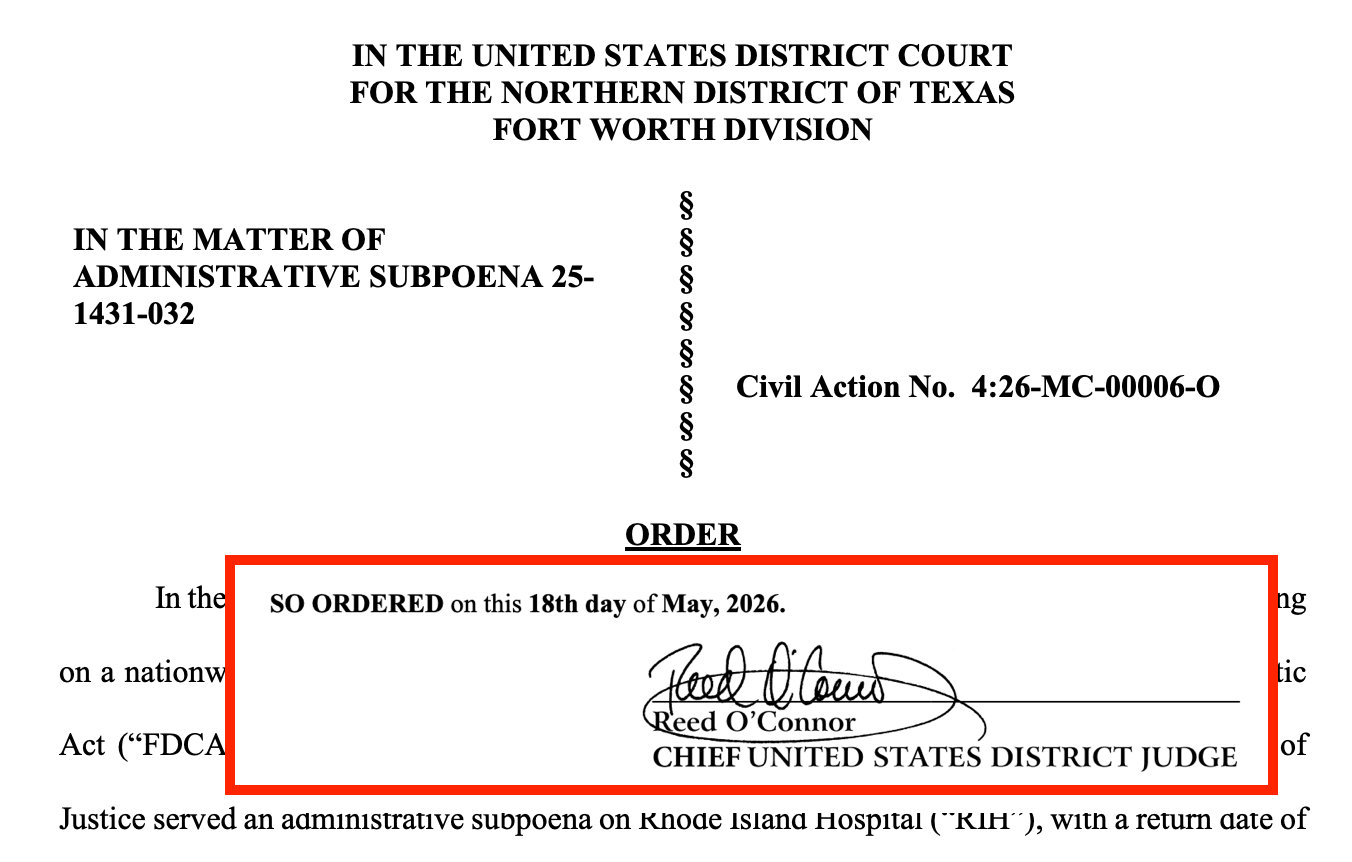
Following that hearing came the May 18 order from O’Connor, concluding that “RIH has also sought to circumvent the authority of this Court and the Fifth Circuit and attempted to collaterally attack the Enforcement Order“ and ordering the hospital to turn over to the court “all materials that it would have turned over to the Government in compliance with this Court’s Enforcement Order“ on the condition that the materials would be “secured and held in camera, inaccessible to the Government for the pendency of the appeals.“
Additionally, O’Connor — responding to his conclusion about the alleged circumvention — purported to bar Rhode Island Hospital from seeking relief from his order in any court aside from his court, the Fifth Circuit, or the U.S. Supreme Court and from “cooperat[ing] with others in seeking relief“ from his order.
The First Circuit
That led to one last effort to hold things off, with the Rhode Island Child Advocate filing a motion in the First Circuit — where DOJ had appealed McElroy’s order — on May 19 seeking an injunction ordering Rhode Island Hospital “not to produce patient-identifying information or protected health information” in response to the administrative subpoena “to any person or entity pending resolution of this appeal or until further order of this Court.”
DOJ opposed the request, and later highlighted the fact that, in Rhode Island Hospital’s notice about its production, “RIH represents that, ‘[t]o the extent that records RIH intends to produce contain any patient information, RIH will anonymize and de-identify this information.’“ DOJ stated that “RIH’s stated plan to anonymize any documents filed in the Northern District of Texas today further undercuts the Child Advocate’s claim of imminent irreparable harm.“
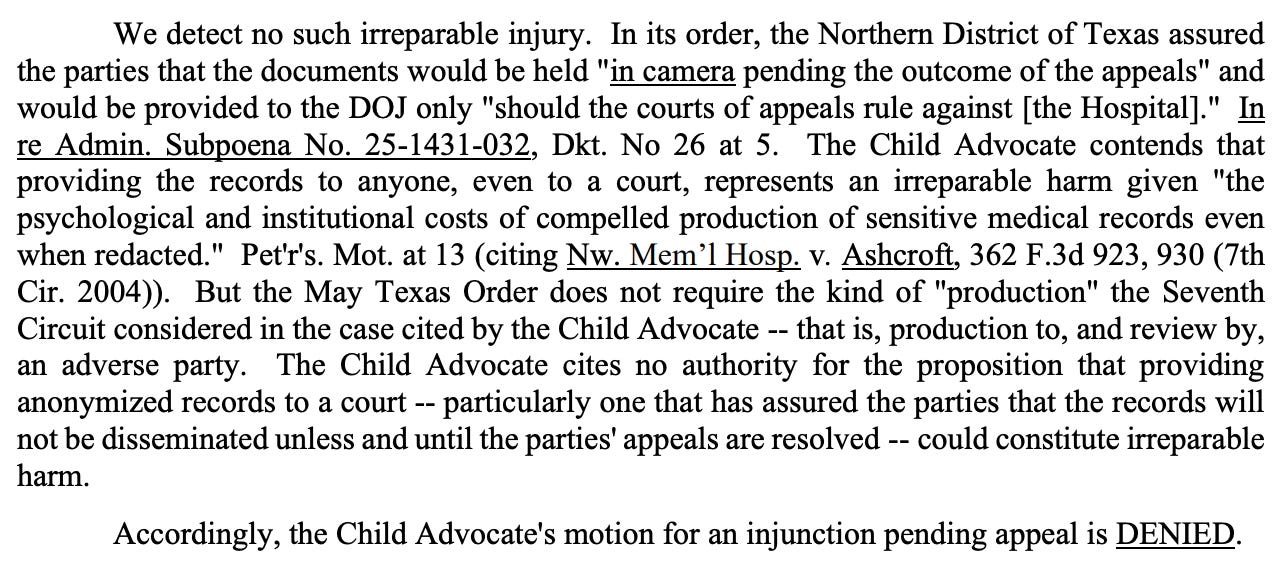
In a short order issued a few hours later, the First Circuit essentially agreed, denying Rhode Island Child Advocate’s request because, the court stated, “We detect no such irreparable injury.“
The panel consisted of Judges Gustavo Gelpí and Lara Montecalvo, both Biden appointees, and Judge Joshua Dunlap, a Trump appointee who took the bench in 2025.
Notably, Dunlap issued a concurring opinion, highlighting “additional concerns regarding the request for an injunction pending appeal“ — including, he wrote, “serious questions about the merits of the district court's decision.” This is contrary to the seven other federal judges to have ruled on the question and was an aside, but it is nonetheless notable coming from the one Republican appointee on the First Circuit.
The bigger problem, however, with the First Circuit’s ruling is what was missing.
The paragraph highlighted above seems to run counter to and with an almost blind ignorance to all that McElroy got on the record in her May 12 hearing.
This is a situation where DOJ has questionably, and without providing public evidence, claimed that it has moved an investigation to the Northern District of Texas, justifying invoking the court’s jurisdiction there to enforce an administrative subpoena issued many months before the investigation had a connection to the district and against an entity across the nation that had been in discussion with DOJ the day before the enforcement action was filed. Then, a far-right judge there granted the request sought by his former clerks and now has ordered the hospital to provide him with the information that every other judge has decided medical providers should not need to provide.
No awareness of that reality comes through in the First Circuit’s order. Although the caveats in the order do mean that renewed requests could follow and it certainly means nothing as to the hospital or Rhode Island Child Advocate’s chances on appeal in quashing the subpoena (Dunlap’s concurrence aside), the First Circuit’s presumption of regularity is particularly ill-suited here.
As McElroy wrote specifically in her order, quoting an Oregon colleague:
The Court cannot help but share the sentiment that “[t]he presumption of regularity that has previously been extended to [DOJ] that it could be taken at its word—with little doubt about its intentions and stated purposes—no longer holds.” United States v. Oregon, No. 6:25-CV-01666-MTK, 2026 WL 318402, at *11 (D. Or. Feb. 5, 2026). It is regrettable that this is now the case.
As DOJ continues with these escalations of its attacks on trans people — and the provision of medical care specifically — courts need to keep their eyes opened to the reality as McElroy saw and detailed it, not to the image of courts as they would wish things to be.
Forced detransition is next, clothing and underwear police, armed guards in potties (but only for theatrics, cops are expensive). Debanking doctors and other caregivers and health providers. Lawfare against doctors, hospitals, research centers, and my guess is open warfare against feminists and other rights advocates who help the gender nonconforming. The really SICK thing is that MOST of the cases they treat surgically are congenital disorders for children who desperately need care. Shame on conservatives…this is a blot and a stain upon America. My heart just breaks.
Next up, a Texas grand jury issues subpoena for hospitals serving people of the wrong color.