

John Roberts likes being political. He just doesn't like the accountability that comes with it.
Roberts complained Wednesday that people view the justices as "political actors." They are, though, issuing political decisions that have real-world consequences.

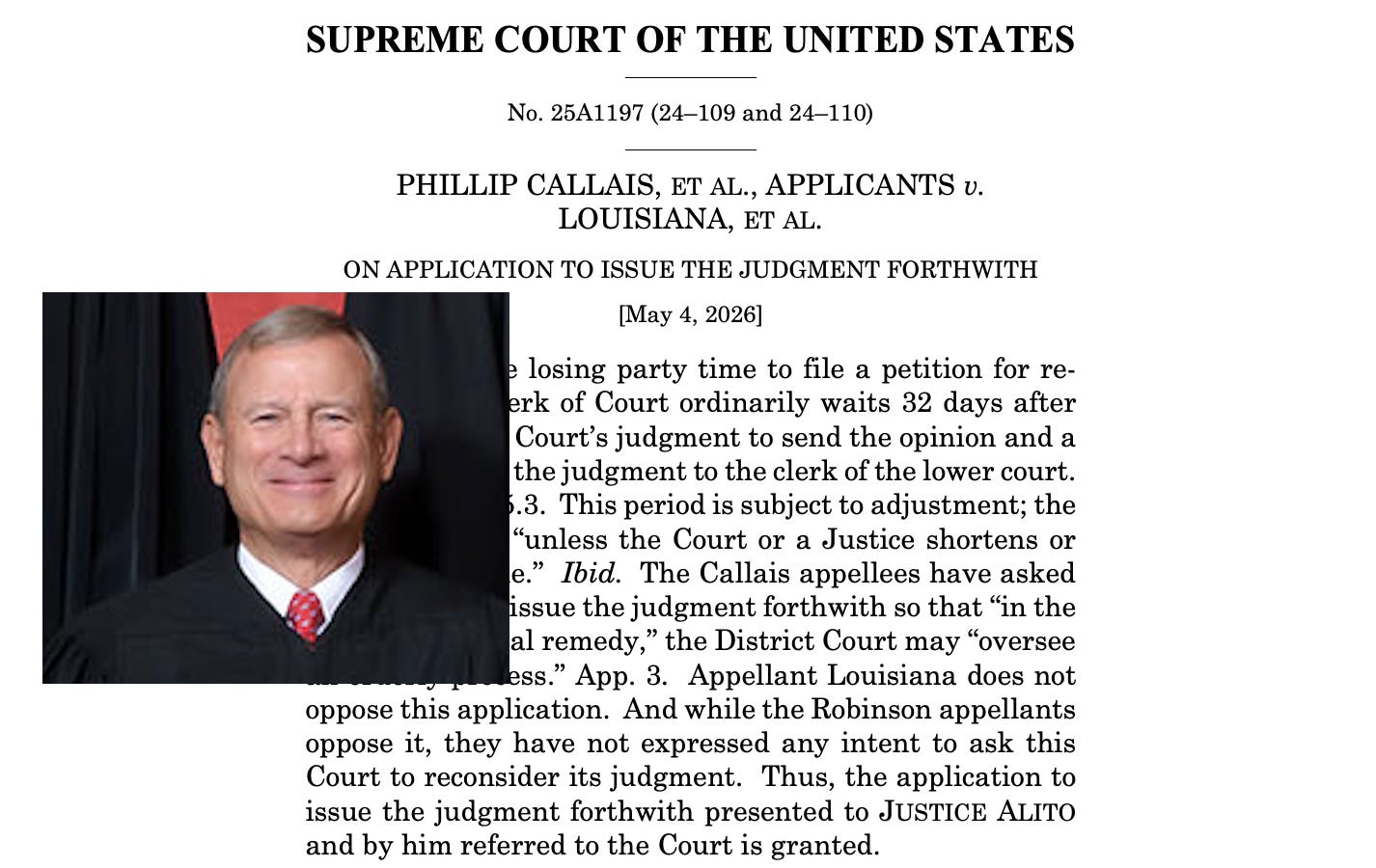
John Roberts has made it clear since his time as a young lawyer in the Reagan White House that he does not want to call balls and strikes.
He wanted to make policy then, and he failed in 1982 — at least as to whether violations of the Voting Rights Act could be shown by proving the effects of redistricting efforts and not just the purpose of the lawmakers behind the maps.
As chief justice of the United States, however, he oversaw the reversal of that congressional action signed into law by then-president Ronald Reagan — and, through two orders in the days since, told politicians that they are free to act quickly on it, cutting corners to do so if needed.
Following the second of those orders, Roberts complained to a group of lawyers and judges on Wednesday that “people think we’re making policy decisions, [that] we’re saying we think this is what things should be as opposed to this is what the law provides.“
As Lawrence Hurley reported for NBC News, Roberts continued: “I think they view us as truly political actors, which I don’t think is an accurate understanding of what we do. I would say that’s the main difficulty.“
No, the “main difficulty” is for the people living with the consequences of the court’s actions.
“We’re not simply part of the political process, and there’s a reason for that, and I’m not sure people grasp that as much as is appropriate,” Roberts told the crowd assembled.
Roberts’s statements would be laughable if the effects of the court’s actions since the 6-3 right-wing majority took over weren’t so stark.
We don’t need to look only at the Voting Rights Act and Roberts’s long-time effort to diminish and destroy it for proof of their part in the political process.
A justice not so long ago criticized the court for overstepping in a highly politicized case:
Surely we should adhere closely to principles of judicial restraint here, where the broader path the Court chooses entails repudiating a constitutional right we have not only previously recognized, but also expressly reaffirmed applying the doctrine of stare decisis. The Court’s opinion is thoughtful and thorough, but those virtues cannot compensate for the fact that its dramatic and consequential ruling is unnecessary to decide the case before us.
This was from Roberts’s opinion concurring only in the judgment in Dobbs v. Jackson Women’s Health Organization, where the five-justice majority overturned Roe v. Wade. Roberts thought that action lacked “judicial restraint” and was “unnecessary” to resolving the case and did not join the majority in doing so.
It was, in other words, the very “judicial activism” of which the right accused the legal left for so long.
The court — in a pair of rulings — made the second Trump presidency possible. It has allowed the death penalty and executions to continue in the United States. It has allowed the Trump administration to send people to nations where our own State Department urges Americans to stay out with virtually no legal process.
Then, there is the longtime effort to diminish the “administrative state,” itself a politicized term with a corporate, political goal of hindering regulation and a secondary goal of increasing the judicial branch’s political powers within the federal government.
This one was a John Roberts special. “[A]gencies have no special competence in resolving statutory ambiguities,” he wrote for the court. “Courts do.”
And, now, the court is expected to take the further action this term of diminishing, if not ending, Congress’s power to protect the existence of independent agencies with for-cause removal protections for the heads of those agencies — a debate that goes all the way back to the first Congress. If that comes to pass, Roberts’s majority would, essentially, be saying that Congress has no special competence in applying the Constitution. The majority already, on the shadow docket, diminished Congress’s power of the purse.
“We’re not simply part of the political process,“ Roberts protested.
That’s simply not true.
The court has always been a key part of the political process and is central to the political consequences of this moment.
Roberts just doesn’t like the accountability that comes along with being a part of the political process in the U.S.
In that sense, this complaint from Roberts is the most Trump-like thing about him.
I banned someone for responding inappropriately here. He wasn't even a subscriber, and I'm sorry it took a minute for me to get to it, but his comments are gone now.
He’s acting like he’s dumb when, of course, he isn’t.