

The many problems with and caused by Monday's Supreme Court voting-case order
The rush to act in the wake of last week's Voting Rights Act decision has meant stretching, if not ignoring, the ordinary rules. And, for paid subscribers: Closing my tabs.

It was, as Justice Elena Kagan explained less than a week ago, a project of the U.S. Supreme Court’s conservative majority for more than a decade to destroy the Voting Rights Act. But, once it was done, the Republican appointees and their fellow travelers in Louisiana moved immediately to implement their ruling.
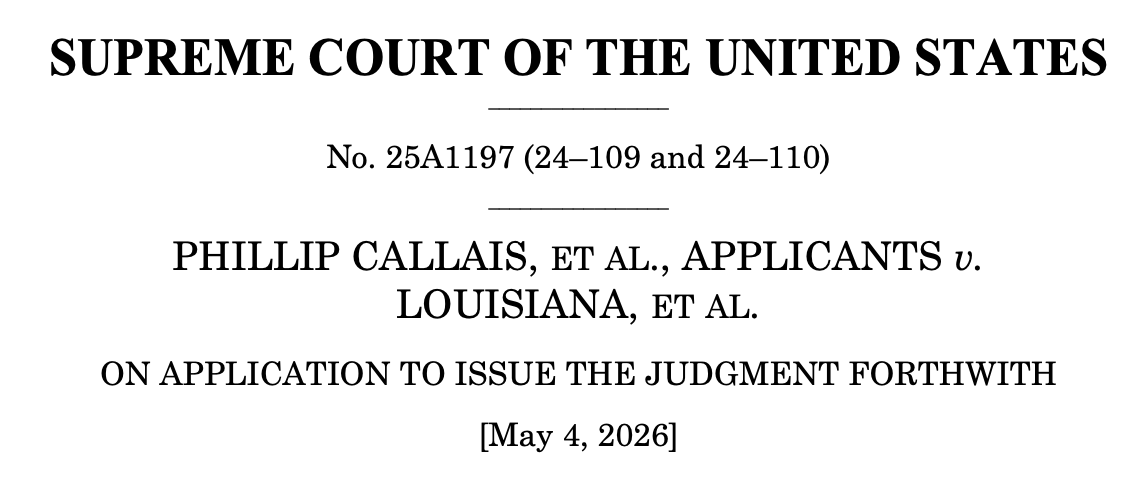
The Supreme Court on Monday — just five days after the court’s Callais decision — issued an order putting the ruling into effect immediately, bypassing the ordinary month that the court waits before sending the judgment back to the lower courts (at which point the lower courts actually implement the rulings).
Although I noted the ruling last night, I wanted to spend some time today diving into the many problems with and caused by the court’s order issuing the judgment “forthwith.“
In an ordinary legal system, even one that issued the Callais decision, the timing of the ruling was important. The 32-day period at issue would have meant the primary elections would have been completed before the judgment returned to the lower courts, and the state would have operated under its current maps this year, with plenty of time to pass a new map for the 2028 elections.
But, actors at all levels — Louisiana’s governor (and other statewide officials), the three-judge district court, and the Supreme Court — decided not to do that. Instead, Gov. Jeff Landry suspended the congressional primary elections, the three-judge district court set a schedule for briefing, and the Supreme Court granted the Callais plaintiffs’s request to send down the judgment immediately.
All three actions involved stretching, if not ignoring, the rules that are supposed to constrain the people in those roles.
Landry used an emergency statute generally used to address hurricanes to suspend the congressional — and no other — elections. The three-judge district court began acting immediately, ordering follow-on. briefing before it had the Supreme Court’s judgment sent to it. And, on Monday, the Supreme Court shortened the 32 days to 5.
As Justice Ketanji Brown Jackson wrote in dissenting from Monday’s order, “Apparently, neither the Governor nor the three-judge court viewed themselves as limited by the fact that this Court had yet to issue its certified judgment in these cases; in the ordinary course, we do not do so until at least 32 days after the opinion is released.”
To the Supreme Court’s actions on Monday specifically, she wrote, “Not content to have decided the law, it now takes steps to influence its implementation. The Court’s decision to buck our usual practice under Rule 45.3 and issue the judgment forthwith is tantamount to an approval of Louisiana’s rush to pause the ongoing election in order to pass a new map.“ (Jackson’s dissent also prompted a defensive concurring opinion issued by Justice Sam Alito, who was joined by Justices Clarence Thomas and Neil Gorsuch, suggesting that it was she — not the majority — who was “creat[ing] the appearance of partiality” here.)
By Tuesday afternoon, the danger of such rush was clear.
In the court’s one-paragraph order, it stated, “[W]hile the Robinson appellants” who had brought the underlying Voting Rights Act case that led to the order requiring the second opportunity district in Louisiana “oppose [the Callais plaintiffs’ request], they have not expressed any intent to ask this Court to reconsider its judgment.“
The Robinson plaintiffs, however, challenged that claim in a request filed Tuesday, asking the court to recall the mandate because the court’s order was based on inaccurate information:
The sole basis cited in the Order for granting Appellees’ Application and issuing the judgment forthwith was that “[Robinson Appellants] have not expressed any intent to ask this Court to reconsider its judgment.” However, in the second sentence of Appellants’ opposition to the Application, Appellants requested “the opportunity to consider seeking rehearing.”
The Robinson plaintiffs went on to state that they do, in fact, “intend to request rehearing in this case.“ Accordingly, they asked the court to recall the judgment to allow them time to file such a request.
[Update: On May 6, with no explanation, the Supreme Court denied the Robinson plaintiffs’ request to recall the judgment. There were no noted dissents.]
The real-word damage of the rush was also made clear, as the Louisiana Illuminator’s Piper Hutchinson reported on Tuesday morning that “[t]he Louisiana Secretary of State received more than 42,000 absentee ballots from voters for the May 16 election by the time Gov. Jeff Landry suspended primaries last week for the state’s six U.S. House races, according to records officials provided Monday.”
Further still, and apart from the actions of the past six days, it is important to remember that all of this chaos is of the Supreme Court’s own making.
The court had initially received the request from Louisiana to hear this case on July 30, 2024. The court agreed to hear the case on November 4, 2024. It was argued on March 24, 2025. On June 27, 2025, the court announced it was holding over the case for reargument in the fall. On August 1, 2025, the court asked the parties to provide briefing on the constitutional question. Arguments were held on October 15, 2025. On April 29, 2026, the court issued its ruling — after ballots had been mailed and even submitted and days before early voting was set to begin.
One last note about hypocrisy. Sure, there is much to be found in the actions of the past week — particularly regarding the speed which which the court can act when it wants to do so and the interminable slowness of other moments (see, e.g., the immunity case). But I would just like to point out something that stood out to me as I read Alito’s indignant concurrence.
Last August, Gorush warned of “anarchy” when lower courts couldn’t divine the proper meaning from barebones shadow docket rulings. On Tuesday, Gorsuch joined Alito in waving the go-ahead flag to a governor and lower court unwilling to even wait for the ruling to be formally transmitted before they acted.
Law Dork out and about
If you missed the Constitutional Accountability Center’s Home Stretch panel that I moderated last week, you can still check it out!
Closing my tabs
For those who don’t know what this is, it’s my effort to give a little thank you to paid subscribers. “Closing my tabs” is, literally, me looking through the stories and cases open — the tabs open — on my computer and sharing with you all some of those I was unable to cover during the week but that I nonetheless want to let you know that I have on my radar. Oftentimes, they are issues that will eventually find their way back into the newsletter as a case discussed moves forward or something new happens that provides me with a reason to cover the story more in depth.
This Tuesday, these are the tabs I am closing:
