

Arguing that DOJ's trans care subpoenas have no precedent, challengers on both coasts push back
A pair of hearings on Tuesday highlighted the extreme nature of DOJ’s requests — and the speed with which DOJ has moved to try and get the invasive patient data in recent weeks.

The Trump administration’s actions aimed at making it more difficult for transgender minors to receive gender-affirming medical care regardless of state policies allowing or even protecting such care are facing strong pushback. And while the Justice Department has described a “nationwide” investigation into the care, it was those challenging DOJ who prompted hearings on both coasts on Tuesday.
The Justice Department’s efforts to obtain information about patients who received gender-affirming medical care by way of administrative subpoenas and, more recently, grand jury subpoenas are extreme — and lawyers say, unprecedented.
The pair of hearings Tuesday highlighted the extreme nature of DOJ’s requests — and the speed with which DOJ has moved to try and get the invasive patient data in recent weeks after nearly a year since the first requests went out in July 2025.
The administrative subpoenas have been blocked when challenged, leading a set of patients to seek a class-action order quashing the patient-specific requests in all of the administrative subpoenas.
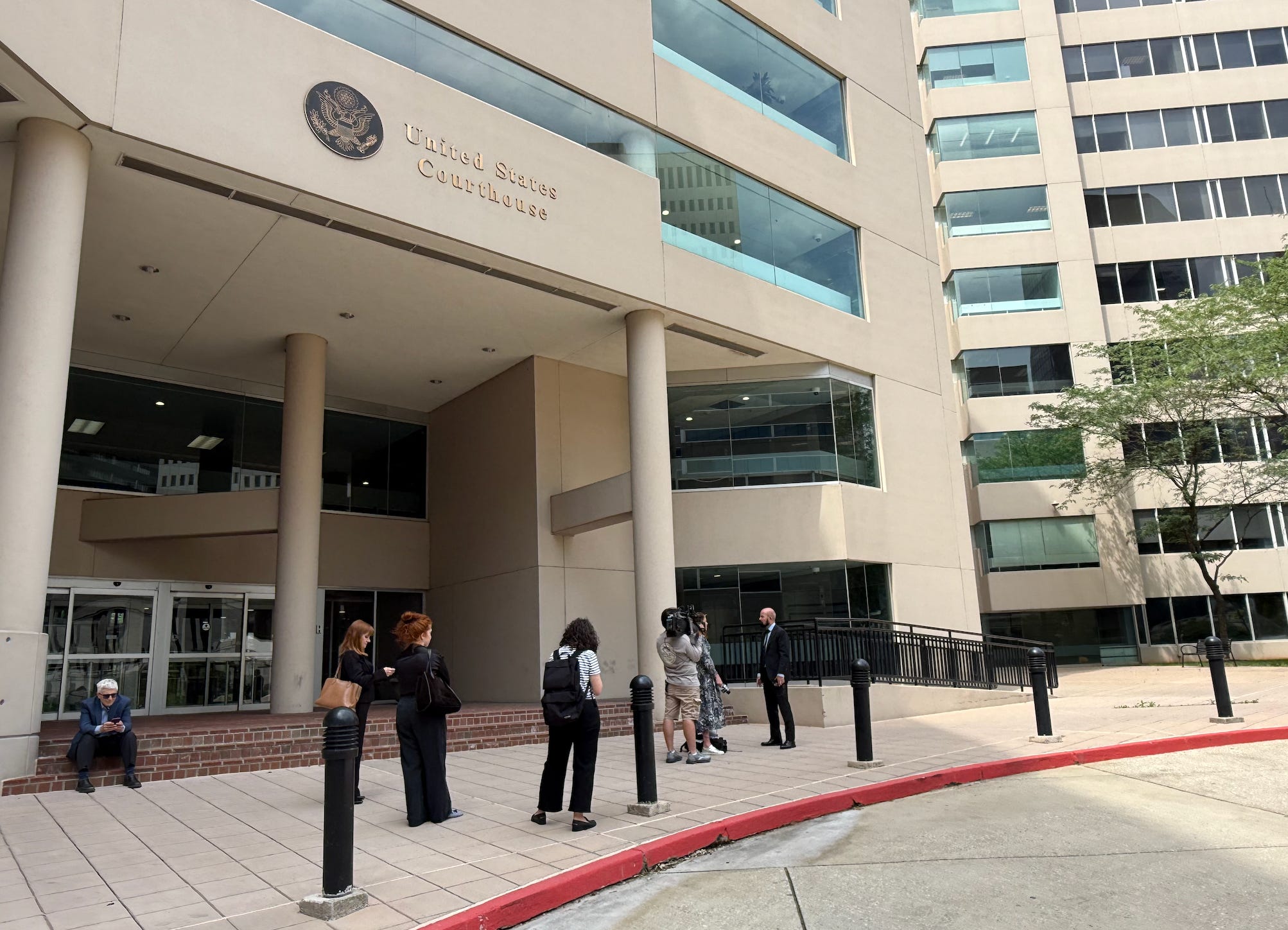
At 10:00 a.m. ET Tuesday, U.S. District Judge Julie Rubin held a hearing related to that request at the Edward A. Garmatz U.S. District Courthouse in Baltimore.
Rubin, a Biden appointee, was one of the judges who had previously quashed the patient-specific requests, as to those who moved to quash the administrative subpoena issued to Children’s National Hospital (headquartered in D.C. but with locations in Maryland as well), finding that the “Subpoena lacks a legitimate purpose.“
The bulk of Rubin’s questions to Rachel Berg from the National Center for LGBTQ Rights on Tuesday related to whether Rubin could certify a class in a motion to quash an administrative subpoena and, if not, how far relief could go.
Ultimately, Berg acknowledged that, if Rubin did not certify a class, relief could only reach those with a connection to Maryland. In their filing, they had noted that “[a]t least two Movants currently reside in Maryland and four families received services from Children’s National Hospital in Maryland.“
That would, however, not accomplish what the litigation is seeking to do — stop DOJ from getting any of the patient-specific information in response to any of the administrative subpoenas. As such, if Rubin denies this request, there likely would be a further effort to accomplish that goal.
At the same time, Rubin pushed DOJ’s Scott Dahlquist on the opposite side nearly as strongly as she’d pushed Berg. When he insisted that the patients were seeking “sweeping, nationwide” relief, Rubin asked how that’s different from any class-action litigation. Dahlqust’s response was, essentially, that you can’t get class relief for an administrative subpoena.
On rebuttal, though, Berg responded that, though the patients’ request to the court might be without a perfect match from past litigation, the reason that is so is because there is no precedent for the Justice Department’s actions here.
Although it is not clear how Rubin will rule, the relevance of the administrative subpoena fight could be taking on less importance in short order. As Law Dork has covered in depth, DOJ’s apparent move to grand jury subpoenas issued in the Northern District of Texas in May is reaching a head — with at least two grand jury subpoenas having initially had a return date of Wednesday, June 10.
Over the past week, patients of Lucile Salter Packard Children's Hospital at Stanford have made efforts to block the grand jury subpoena issued to Packard. After a first attempt to block Packard from turning over the information — in a lawsuit filed only against Packard — was rejected over the weekend, the patients filed an expanded lawsuit on Monday. In that, they added the Justice Department and Acting Attorney General Todd Blanche as defendants and asking for class-action relief for all who received gender-affirming medical care as minors in California and, specifically, Packard patients (similar to litigation in New York City). They also filed a request for a temporary restraining order barring DOJ from receiving patient-specific information, given the forthcoming return-date deadline.
At 10:00 a.m. PT Tuesday, U.S. District Judge Casey Pitts held a conference related to that request. Pitts was presiding over the remote hearing from his courtroom at the Robert F. Peckham Federal Building and U.S. Courthouse in San Jose.
The hearing before Pitts, another Biden appointee, ultimately, was less adversarial — for now — than the Baltimore hearing.
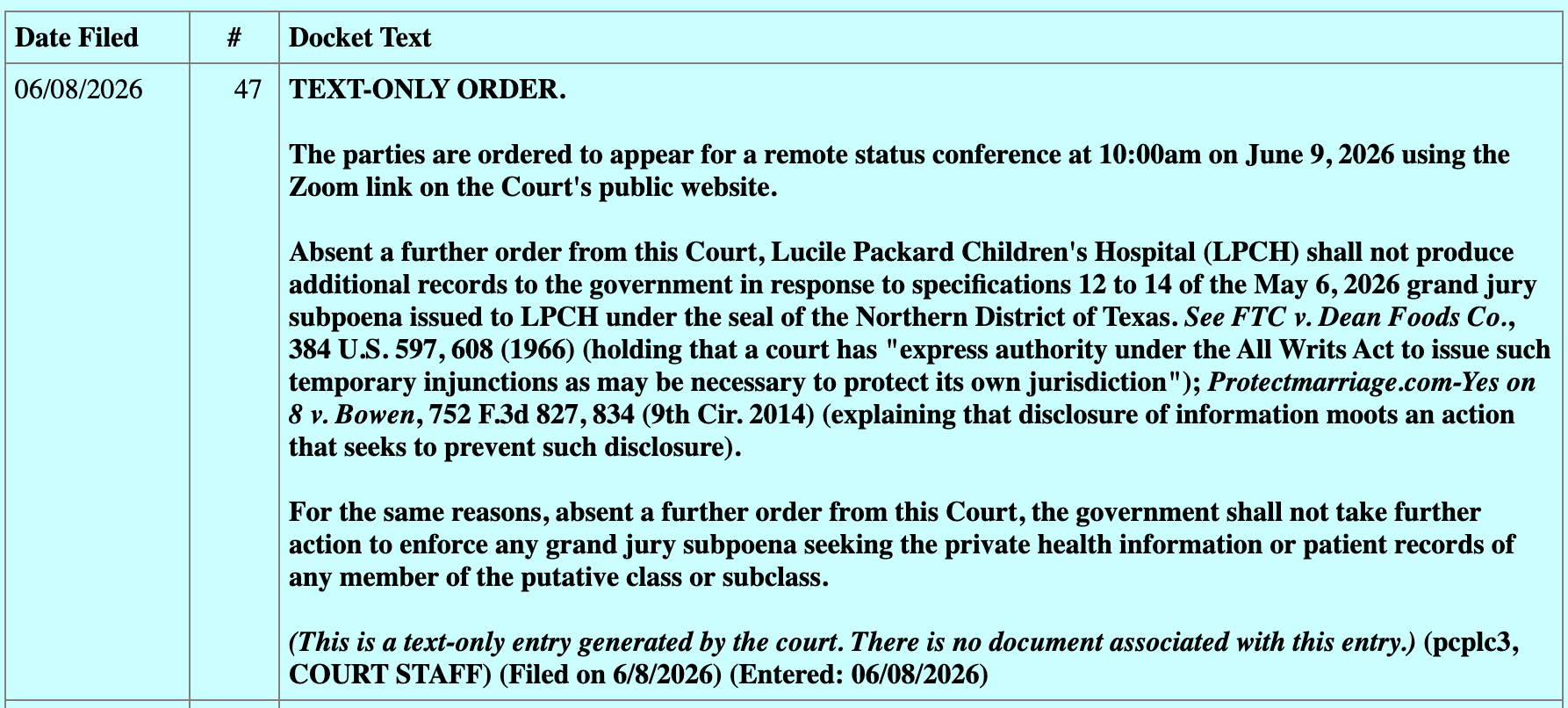
Late Monday, Pitts had issued a temporary order blocking Packard from turning over any more documents to the government and blocking DOJ from taking any further action to enforce any grand jury subpoenas that would affect the would-be class here while he considered the matter.
Everyone, more or less, was OK with keeping that status while taking up the TRO request on a slightly less rushed timeline.
Although it took a few minutes at the status conference for everyone to agree that everyone was on the same page, ultimately John Wollman, the assistant U.S. attorney from the Northern District of California representing the government at the hearing, while not acknowledging any grand jury subpoena, agreed to push back any Packard subpoena response date to June 25 to allow time for briefing and arguments on the patients’ request.
Although the parties need to submit a briefing schedule to Pitts for how to proceed, the outcome is similar to that reached temporarily as to the grand jury subpoena challenge in New York City, where the next hearing is set for June 22.
In short, the grand jury subpoenas that are known to have been challenged are on hold for now by agreement of the government while the litigation is considered.
Despite that, though, the return date was June 10 on both published grand jury subpoenas, so it is possible that others are out there that have not been challenged and will lead to productions on Wednesday. (Of course, it is also possible there are other challenges that have just flown under the radar.)
Regardless, and as NCLR’s Berg detailed Tuesday in Baltimore, this is an unprecedented, multi-pronged attack on a small handful of children. What’s more, given the way DOJ is going about this, they and their families might not even know that their records might be turned over to the government — or if their provider has even been subpoenaed.
Law Dork will continue to cover this story. If you know about any previously unreported subpoenas, other related DOJ efforts, or other challenges to those efforts, please reach out. Chris Geidner is available on Signal at crg.32 for more secure communications.
Possibly naive question: how does HIPAA play in these requests? It would seem to me that the confidentiality promised by those statutes are intended to stop exactly this kind of heinous overreach?
What is the DOJ’s reasoning for obtaining private medical records of minors? Where is the crime?