

Three examples of how Trump's lawlessness is spreading — and how the other branches are failing
Todd Blanche is confirmed as attorney general, Stephen Miller is backing a new birthright citizenship executive order, and Judge Emily Marks won't dismiss the SPLC indictment.

Three concerning developments over the past three days merit attention, illustrating, as they do, the failings of all three branches in this moment.
At 4:17 a.m. Saturday, on a 50-49 vote, all but three Republican members of the United States Senate voted to confirm Todd Blanche as attorney general.
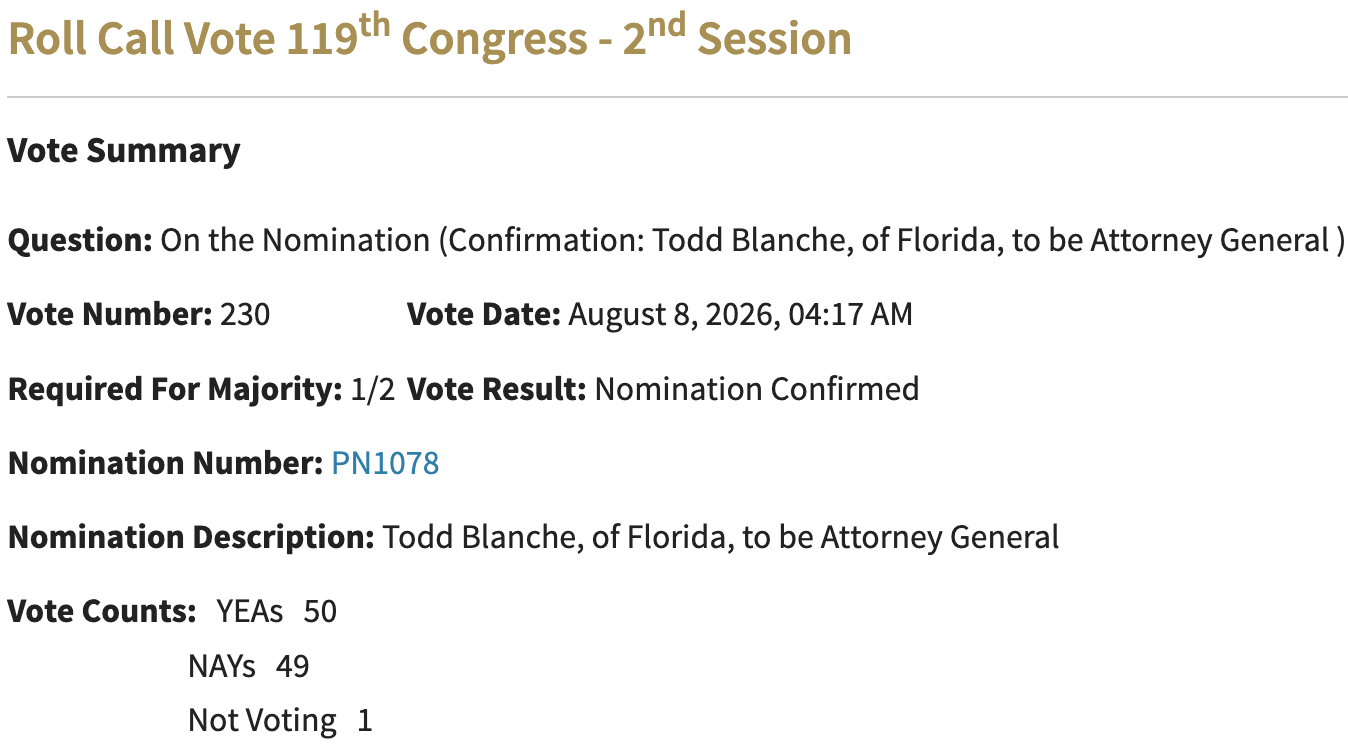
We will all regret this development, as it means that the utter degradation of the Department of Justice, begun by Pam Bondi, will get substantially worse.
Blanche is not a civil servant, not a statesman. He is President Donald Trump’s arm at Justice. He was Trump’s criminal defense lawyer, he’s not changed since he took an oath to the Constitution as deputy attorney general, and he won’t change now.
This is about the Senate, though.
Almost worse than Blanche himself is the fact that every one of the 50 Republicans who voted to confirm him knows this about Blanche. (Or, at least, their staffers do.)
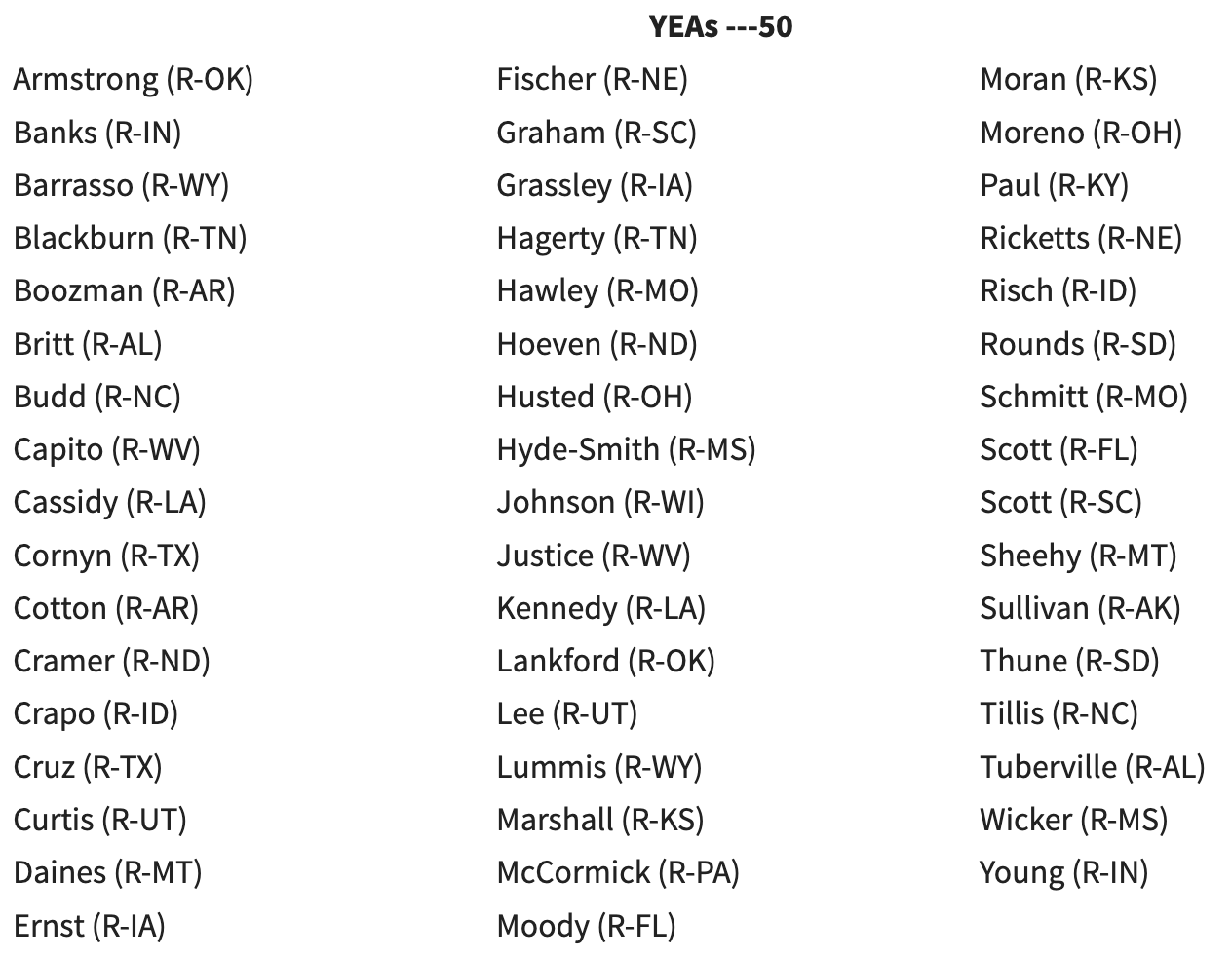
They voted for corruption. They voted for grift. They voted for concealment. They voted for lawlessness. It is as bad a moment for the United States Senate as we have seen since the Senate confirmed Emil Bove to a seat on the U.S. Court of Appeals for the Third Circuit just over a year ago. On the same vote.
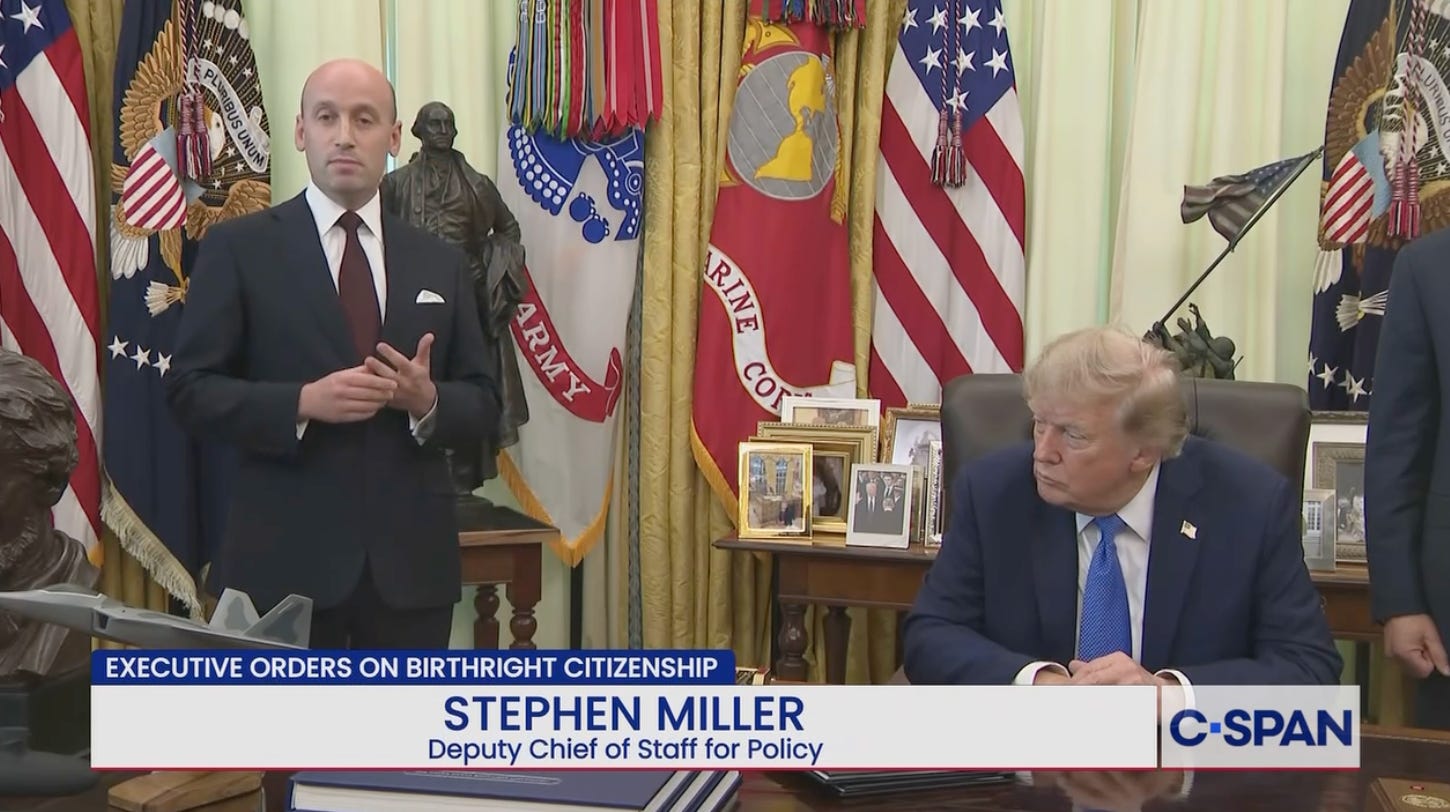
Speaking of lawlessness, there is also Trump. With henchman Stephen Miller at his side, Trump on Thursday announced that he was going to try to limit birthright citizenship again following June’s U.S. Supreme Court decision holding that his first effort would violate the Fourteenth Aamendment.
In the new executive order, Trump purported to be responding to that ruling by “identif[ying], non-exhaustively, and prescrib[ing] action concerning certain categories of children of aliens who do not fall within the rule of birthright citizenship as announced by the Supreme Court.” (A second, related order seeks to “end[] birth tourism,” which, of course, excited Miller.)
At the same time, though, Trump makes clear that he’s engaging in the same sort of constitutional game-playing:
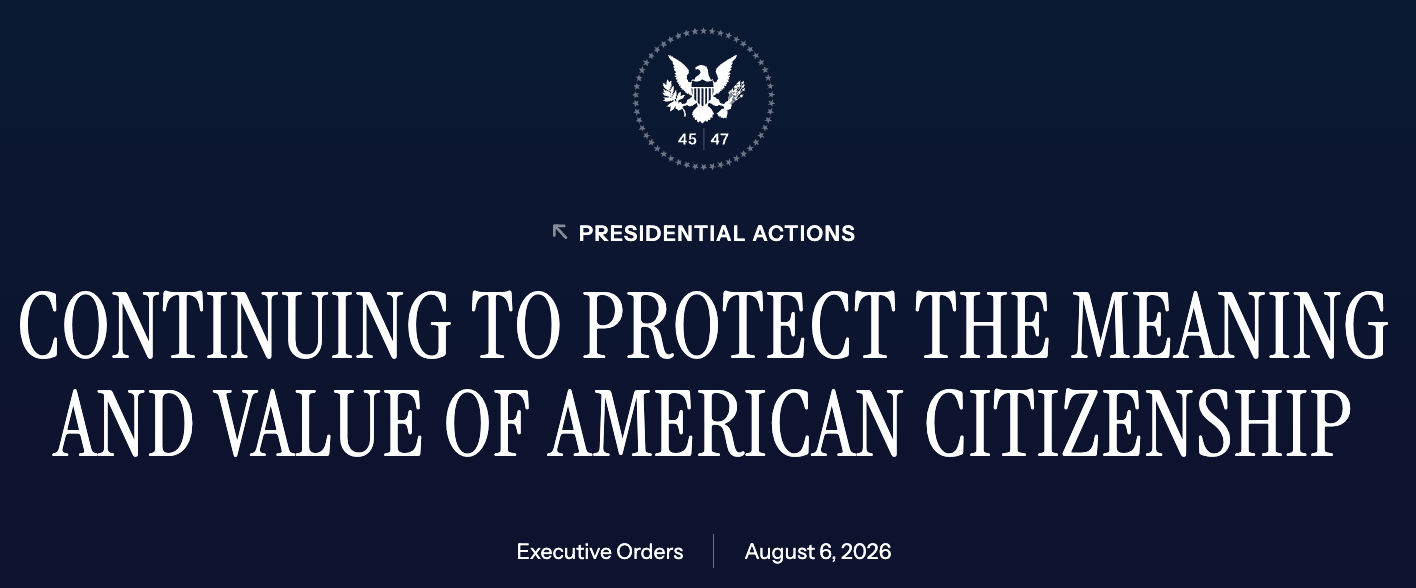
The original, day one birthright citizenship executive order was titled, “Protecting the Meaning and Value of American Citizenship.“
This will, again, be challenged, but the main point here, for these purposes, is admittedly not a new one for Trump: He does not take no for an answer.
This is not an example of a court laying out a roadmap for how lawmakers or the executive could take future action that would be lawful. It is a sloppy attempt by Trump to shoehorn much of the unconstitutional action he tried to take last year into a new order that, from 30,000 feet, might appear to be acting in a constitutional way but, at a closer look, is not.
Finally, there is the judiciary. Although district court judges have done significant work at maintaining the rule of law in spite of the executive branch’s antipathy to it and the legislative branch’s lack of interest in upholding it, there are cracks.
On Friday, U.S. District Judge Emily Marks provided her opinion that the Southern Poverty Law Center had not shown that there is anything untoward about the Trump administration’s treatment of the organization in advance of or since its indictment in April.
In rejecting the SPLC’s motion to dismiss the case for vindictive prosecution or, alternatively, ordering discovery on the topic, Marks decided to operate somewhere outside of both our current legal and political environment.
“The SPLC has failed to offer some evidence tending to show animus on the part of the prosecutors involved in bringing this case and that such animus resulted in the prosecution, the showing required for discovery. Because it cannot satisfy that standard, it necessarily fails to satisfy the higher standard that would entitle it to dismissal of the indictment,” Marks, a Trump appointee, wrote.
How is this so, given aggressive comments about the SPLC from Trump, Blanche, and FBI Director Kash Patel, who called the organization “a partisan smear machine” before ending the FBI’s longtime cooperation with the group?
“Mr. Patel’s statements are not automatically imputed to the United States Attorney’s Office for the Middle District of Alabama,“ Marks wrote.
The unitary executive theory was nowhere to be found on Friday.
That’s not all, though. Here is Marks’s summary of another key issue:
In August 2025, groups that had been placed on the Hate Map, including conservative organizations like Liberty Counsel and Turning Point USA, penned a letter to Stephen Miller, President Trump’s Deputy Chief of Staff, complaining about the designations. (Doc. 74-2 at 2). They criticized the SPLC as “biased, politicized, and unmoored from its original mission.”
…
On September 26, 2025, a Liberty Counsel employee spoke with an FBI agent and apparently discussed Liberty Counsel’s grievances with the SPLC.
…
[O]n October 10, 2025, the FBI “obtained concurrence from Acting United States Attorney for [the] Middle District [of Alabama], Kevin Davidson, to open this matter”—but the report also notes that the investigation was then closed on October 24, 2025, “[w]ithout [s]ubmission.”
SPLC argued that this preceded the indictment — that this investigation into the Hate Map was closed because it was “entirely violative of the First Amendment“ but that “someone in the [DOJ] decided to cloak this improper investigation under the guise of donor fraud.“
Of all that, Marks saw, essentially, nothing, writing that “all the SPLC has shown by objective evidence is that it was indicted a few months after the report was generated.“
She continued:
Even if it is true that this report was connected in some way to the investigation that ultimately produced the indictment, the extent of that connection is not at all clear. The SPLC’s bald, citationless assertion that the FBI report “led to the indictment in April 2026,” (doc. 74 at 8), is not evidence and therefore cannot move the needle.
So, Patel’s pre-indictment actions are irrelevant, and the unusual timing of a political, clearly unconstitutional investigation being dropped months before the indictment was brought is also irrelevant.
What about Trump?
Marks, who practiced as a lawyer for two decades before becoming a judge, wrote that “President Trump’s rhetoric is (rather famously) wide-ranging, and he has undoubtedly been critical of the SPLC.” Nonetheless, she continued, “SPLC fails to establish that President Trump’s statements evince animus on the part of the United States Attorney for the Middle District of Alabama.”
In other words, Marks concluded that Trump says all sorts of wild stuff and courts couldn’t actually put that on the lawyers who his former attorney general has stated are “his lawyers.” This, also, is despite the fact that there has been a year and a half of evidence of Trump and Main Justice diving into the operations of U.S. Attorney’s Offices in precisely the ways that Marks pretended to ignore in her decision.
“The Court cannot license a fishing expedition based on innuendo or speculation,“ Marks insisted, in an opinion that aggressively ignored the reality of the second Trump administration — and the Justice Department specifically.
The entire Bondi tenure as attorney general was a test drive of the unitary executive theory and it’s about to get worse with Blanche’s confirmation, but, for one federal judge in the Middle District of Alabama in one extremely convenient scenario, the unitary executive theory does not apparently exist.
The Trump administration will keep pushing to act outside the law. Every person in the other branches who decides to ignore that reality, well established at this point, is choosing to empower that lawlessness.
They will be remembered for their failure to play their proper role in our constitutional structure.
The corruption reeks. The bias reeks. And the GOP sits on its collective ass with its fingers in its ears and its eyes shut tight and hears nothing and sees nothing and knows nothing and fears nothing other than the wrath of the vengeful oaf to whom they give obeisance.
FFS, what reasons for discovery ARE allowed? Not allowed to ask WHY the government decided to bring this suit? Not allowed to ask for any normal evidence that MIGHT reveal vindictiveness?