

The Fifth Circuit would like to run the United States
The far-right federal appeals court and the district court judges below them are taking actions to control and influence what happens outside of Louisiana, Mississippi, and Texas.

On May 1, the U.S. Court of Appeals for the Fifth Circuit issued a ruling that would ban the mailing of an abortion drug during litigation — an order that the court acknowledged would have nationwide effect.
Although the drugmakers quickly went to the U.S. Supreme Court seeking relief, the decision in Louisiana v. U.S. Food and Drug Administration immediately upended the post-Roe landscape in the United States.
It was one of a trio of issues in which the appeals court and the district court judges who are subject to the court’s appellate jurisdiction sought to act this past week in ways that could have varying levels of control and influence outside of the Fifth Circuit states of Louisiana, Mississippi, and Texas.
And though it is true that the Supreme Court has regularly reversed the Fifth Circuit in recent years, that — as I’ve written previously — paints a misleading picture, because many of the court’s rulings are also affirmed by the Supreme Court or not even reviewed by it. More importantly, this report explains why, regardless of what the Supreme Court ultimately does, the Fifth Circuit’s actions can be (and are often intended to be) extremely destabilizing in the interim.1
The Fifth Circuit liked nationwide injunctions on Friday
First, as to the mifepristone ruling, the appeals court took advantage of one of the ways in which the U.S. Supreme Court allowed nationwide effects of court rulings even after its 2025 decision ending “universal injunctions.” The ruling itself asserted that nationwide injunctions were impermissible when they provided protection unnecessary to give “complete relief” to the plaintiffs who brought the case. But, there were three areas in which the court at least left open the possibility of broad-based relief.
The first, at issue in one of the birthright citizenship challenges before the court in 2025, was when the plaintiffs — there, states — asserted that the only way for them to get complete relief would be through a nationwide (or global) injunction. The second, used in the follow-up birthright citizenship case that was before the justices this term, is class-action litigation. Although not technically “universal,” a class-action lawsuit can provide protections that cover everyone (or every business) that would be affected by a policy. The final method left open with the decision is the one used by the Fifth Circuit on Friday: the Administrative Procedure Act. Under the APA, a court can stay or vacate a regulation or policy — a move that has nationwide effect.
As discussed at Law Dork on Saturday, the district court in this case held off on issuing immediate relief in part because of the nationwide effect of an APA stay order. The Fifth Circuit, however, moved ahead — leaving questions up in the air about what people’s rights are across the nation in the wake of the ruling.
The secret subpoena enforcement petition
The day before, the Department of Justice secretly went to the Northern District of Texas and filed a petition to enforce a subpoena issued last year by Main Justice in Washington, D.C. against Rhode Island Hospital relating to its provision of gender-affirming medical care for transgender minors.
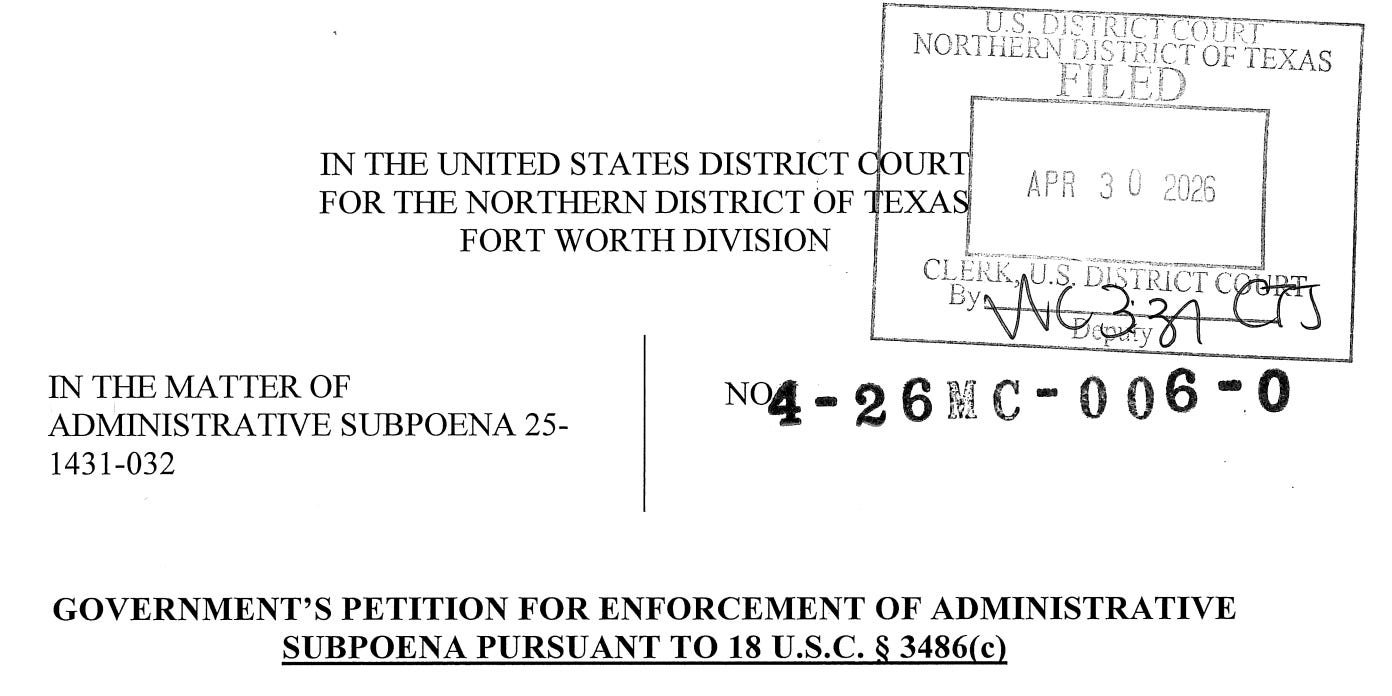
Yes, this is as ridiculous as it sounds. (It gets worse.)
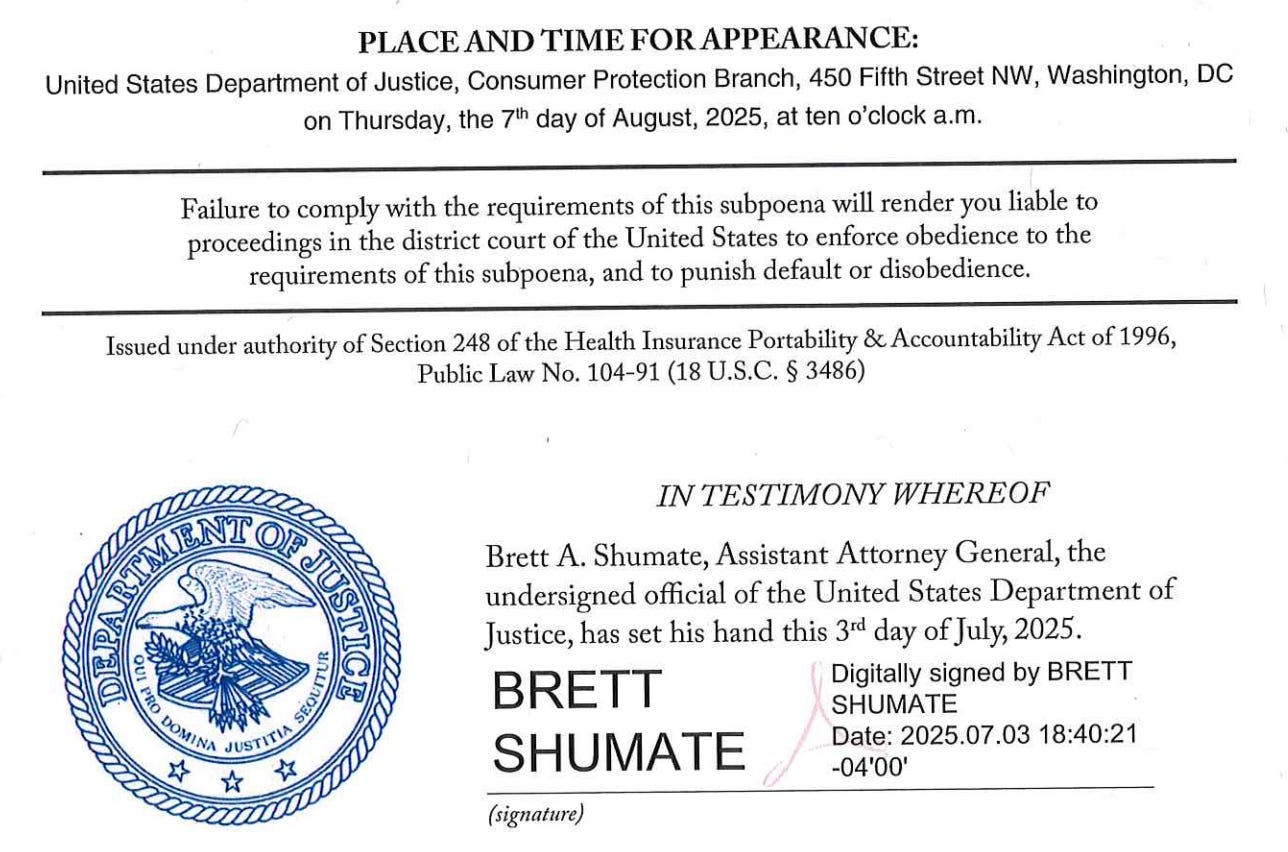
This is one of nearly two dozen subpoenas DOJ issued against providers of such care, and, among other requests, the subpoenas seek invasive information about patients. At least six federal judges across the nation have blocked DOJ’s effort when providers or patients have challenged the subpoenas. (Additionally, a magistrate judge in Colorado has recommended that a different subpoena be quashed.)2
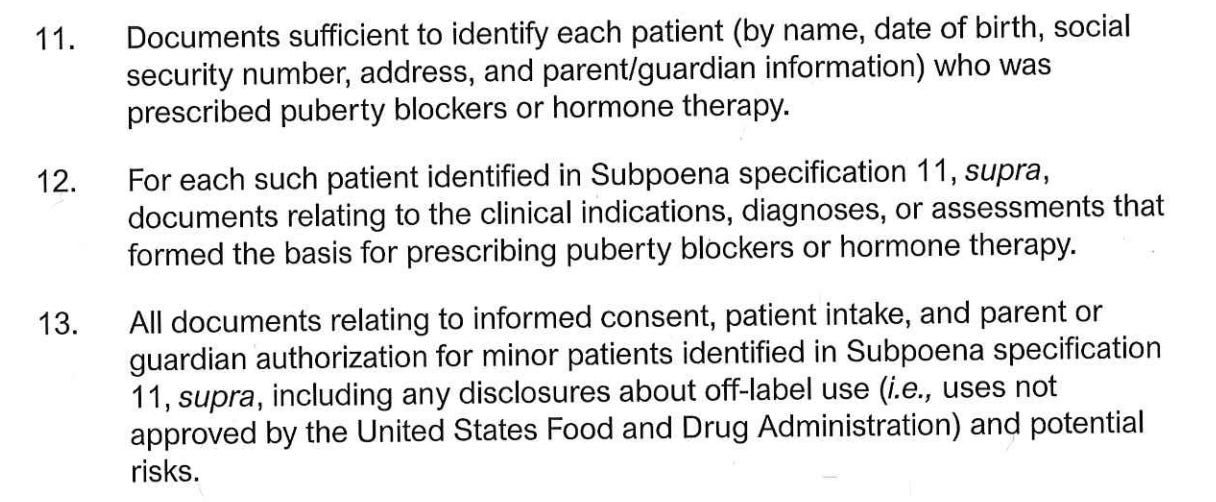
The Justice Department, apparently not wanting to challenge Rhode Island Hospital’s alleged noncompliance in Rhode Island or D.C., went to the next most obvious place: The Northern District of Texas, and, specifically, to the Fort Worth Division, where the petition was almost certain to be assigned to U.S. District Judge Reed O’Connor, an extremely right-wing George W. Bush appointee, or U.S. District Judge Mark Pittman, a Trump appointee.
It went to O’Connor, who has a long history of anti-LGBTQ rulings, and he came through. The same day the petition was filed, he granted it — without seeking any response from the hospital and before DOJ even publicly announced it had sought such relief.
O’Connor granted the petition in a two-page order entered on April 30 but not posted on the court’s docket until May 1.
Operating within the Fifth Circuit, given its extremism, has empowered the most extreme district court judges — like O’Connor — to go even further, and they have done so, with this being judge the latest example.
In the petition, DOJ appeared to have claimed that O’Connor had jurisdiction here under a federal law that allows DOJ to seek enforcement of an administrative subpoena in “any court of the United States within the jurisdiction of which the investigation is carried on or of which the subpoenaed person is an inhabitant” simply by stating that its broader investigation “is being carried out in the Northern District of Texas.”
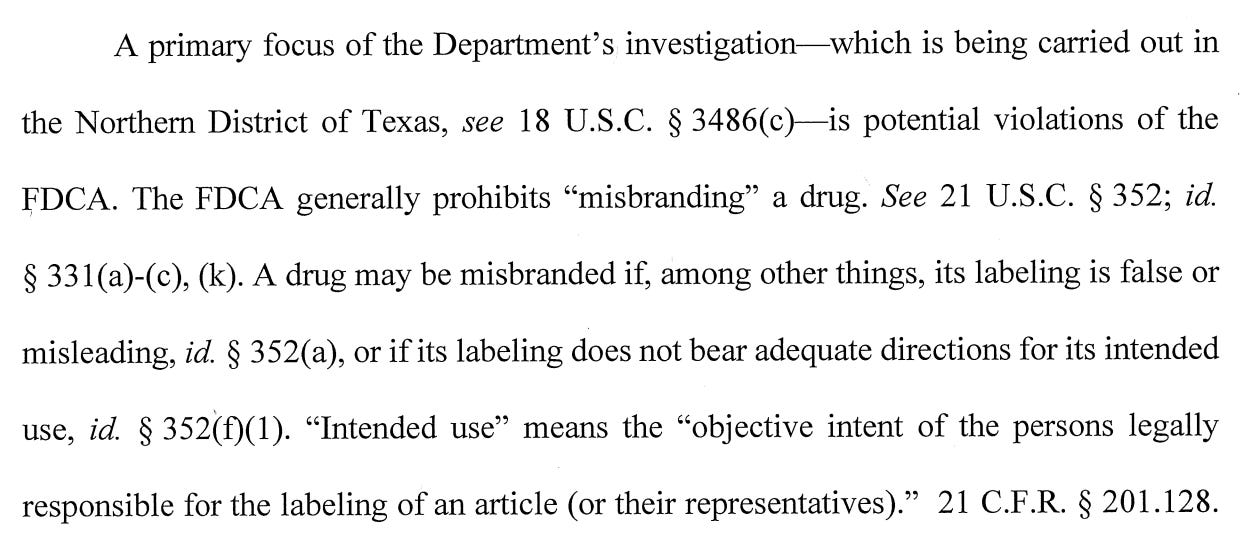
Putting aside the questions about the legitimacy of the underlying investigation, the DOJ declaration attached to the petition contains no other information suggesting that the Rhode Island Hospital investigation specifically involves the Northern District of Texas at all. Neither the petition nor the declaration even provide any specific evidence that any DOJ action in the broader investigation has taken place in the Northern District of Texas aside from the filing of the petition there.
Nonetheless, eight lawyers signed onto this filing.
Further, the Justice Department barely acknowledged the widespread conclusion from district courts that the patient-specific portions of the subpoena, at the least, are inappropriate — not mentioning the contrary court decisions once in the first two sections of its petition, arguing that “The Subpoena Is Within the Department’s Statutory Authority“ and that “The Subpoena Seeks Documents Reasonably Relevant to the Investigation.“
Contrary to that, to give just one example, U.S. District Judge Mark Kearney wrote last year that “Congress never authorized a roving mandate to regulate and alter state-licensed medical care” in his ruling blocking the patient data from needing to be turned over.
Instead, the Justice Department — again, in a petition signed onto by eight lawyers — only mentioned the contrary rulings in a footnote in the last section of its petition, arguing that “The Subpoena’s Demands Are Reasonable.
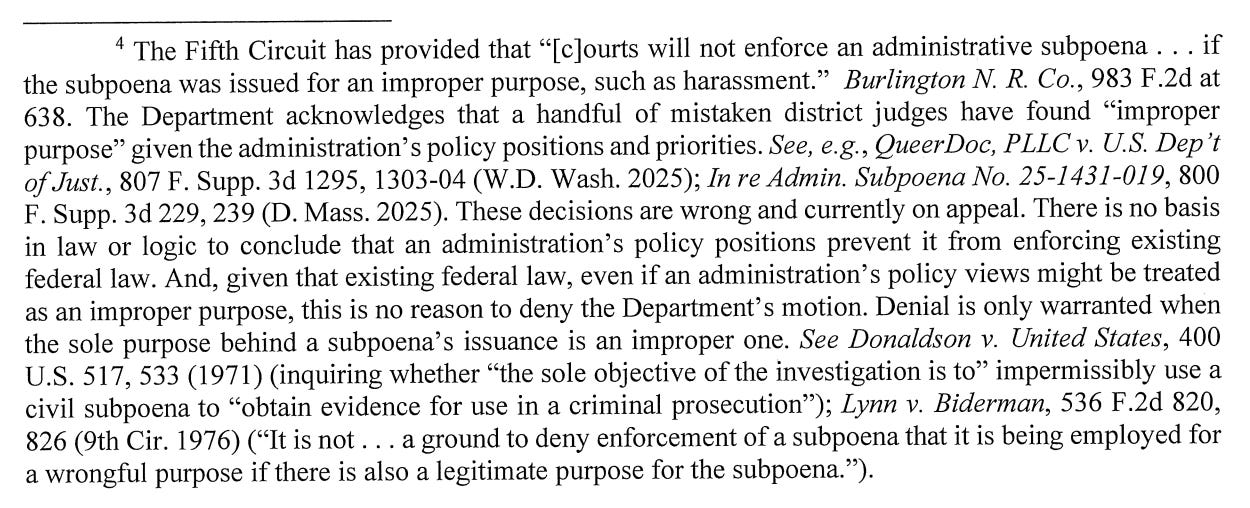
Even then, the footnote only cited two of the cases (not including Kearney’s ruling), and the text introducing those cases asserted, “The Department acknowledges that a handful of mistaken district judges have found ‘improper purpose’ given the administration’s policy positions and priorities.“ The lawyers then claimed, “These decisions are wrong and currently on appeal.“
The eight signatories were: Ryan Raybould, United States Attorney for the Northern District of Texas; Brett Shumate, Assistant Attorney General, head of the Civil Division, and the person whose name is on the subpoena; Jordan C. Campbell, Deputy Assistant Attorney General; Lisa K. Hsiao, Acting Director of the Enforcement and Affirmative Litigation Branch and the person who submitted the declaration; Ross Goldstein and Patrick Runkle, Assistant Directors of the branch; Scott Dahlquist, Trial Attorney in the branch; and Ethan Womble, an Assistant U.S. Attorney in the Northern District of Texas.
DOJ sought and O’Connor granted a secretly obtained order in Texas for a D.C. subpoena of a Rhode Island entity.
It was not immediately clear what the next steps will be for the hospital. Reuters had reported Friday that a spokesperson for Brown University — Rhode Island Hospital is a part of Brown University Health — said they were “reviewing it carefully with counsel.“
Among the multitude of ways that the hospital or patients could respond to this ruling, several paths could end up with a request before the Fifth Circuit relating to a New England hospital.
Nonetheless, for now, there is an order in place from O’Connor requiring Rhode Island Hospital to comply with the subpoena by May 14 — leaving questions up in the air about what people’s rights are (literally) across the nation in the wake of the ruling.
The Callais fallout
Finally, in the immediate aftermath of the U.S. Supreme Court’s Voting Rights Act decision, two different three-judge district court panels are in place addressing different aspect of what happens next.
Under federal law, redistricting cases are among the cases that can be subject to a three-judge district court. When such a set-up is called for, the three-judge panel includes the judge who drew the case, a circuit judge “designate[d]” by the chief judge of the circuit, and a third judge designate[d] by the chief judge of the circuit.
The Callais panel — the Louisiana map challenge that was on appeal at the Supreme Court — is made up of Circuit Judge Carl Stewart is a Clinton appointee, and U.S. District Judges Robert Summerhays and David Joseph are Trump appointees. They sought to move quickly, ordering briefing over the week after the ruling about next steps in the state — despite questions raised at (and still before) the Supreme Court about whether they even had authority to act.
That same day, though, Louisiana Gov. Jeff Landry issued an executive order purporting to immediately suspend the congressional primary elections.
In a new federal lawsuit filed challenging Landry’s action, another three-judge panel was sought and appointed. (There is other litigation — filed in state court — as well.)
In the federal case, in addition to U.S. District Judge Shelly Dick, an Obama appointee in the Middle District of Louisiana who was originally assigned the case, the two other judges designated by Chief Judge Jennifer Walker Elrod of the Fifth Circuit are two Trump appointees: Circuit Judge Kyle Duncan and U.S. District Judge Greg Guidry.
That panel’s first task is to decide whether to grant Louisiana’s request to send the case to the Western District of Louisiana, where it could be considered by the Callais panel. The panel is — in light of the circumstances — taking their time with it.
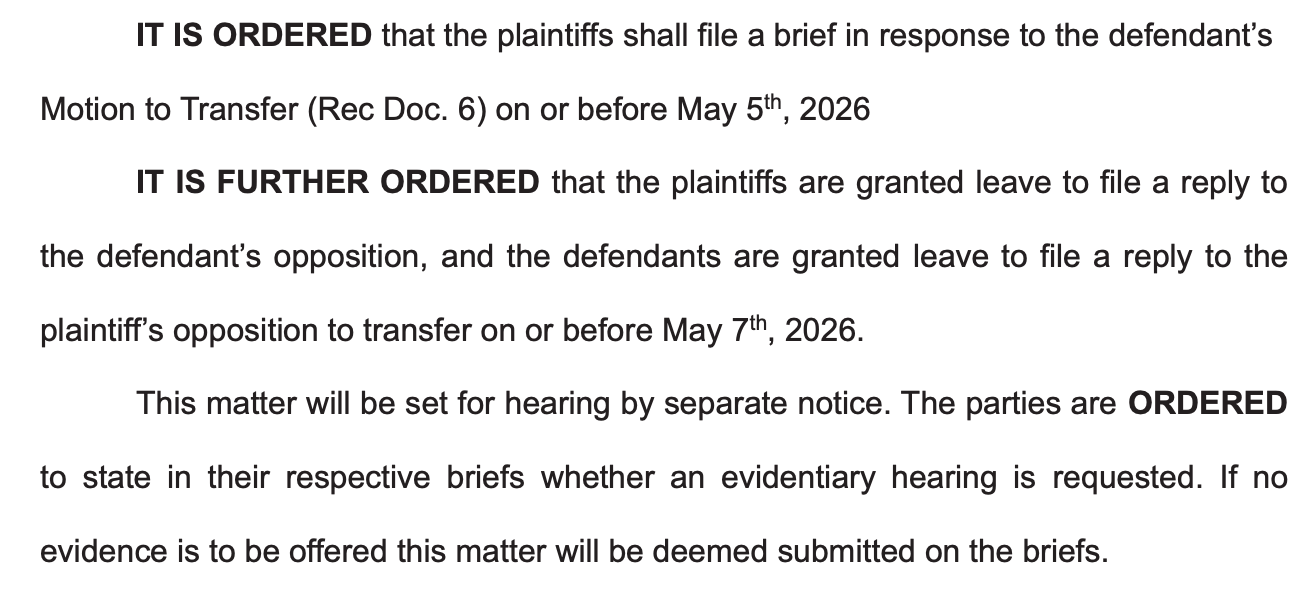
The challenger, a Democrat running for Congress, has already opposed the request; filed a response to the three-judge panel’s order; and on May 3 filed a motion for leave to submit an amended complaint that includes 11 more plaintiffs, including other Democrats running for Congress.
As I noted elsewhere, this is a mess of Chief Justice John Roberts and Justice Sam Alito’s making, but, because of the way this is all being done, the Fifth Circuit and district court judges within the Fifth Circuit are taking the first actions — and making the first law — about what is going to happen and be allowed in this post-Callais country. And though the Supreme Court will still be able to weigh in, the Fifth Circuit and its district court judges are creating the record that would come before the justices.
As the weekend ends, these briefing schedules in the wake of the Supreme Court decision and Landry’s executive order are leaving questions up in the air about what people’s rights are in Louisiana — and with implications for us all.
This paragraph was added after initial publication, with the final edit at 10:35 p.m.
This sentence was expanded after initial publication, with the final edit — including the added parenthetical sentence — at 6:40 p.m. May 4, 2026.
First, loyalty checks … now purity checks? Nice and cosy back in the 19th Century …
What a country. Yuck. Oh to have a second passport.