

Federal appeals court backs DOJ administrative subpoenas targeting gender-affirming care
The 2-1 Ninth Circuit opinion, issued Friday, prompted a strong dissent from Judge Richard Paez.

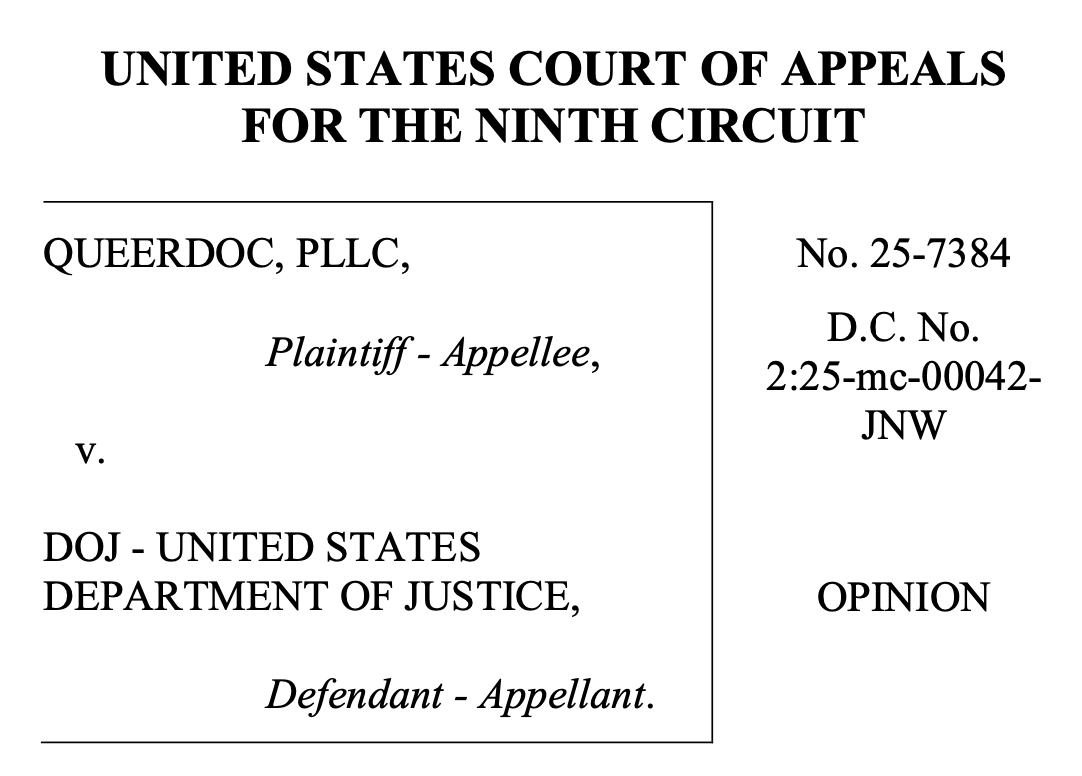
A federal appeals court, on a 2-1 vote, issued the first substantive opinion upholding one of the Justice Department’s administrative subpoenas seeking invasive patient information from providers of gender-affirming medical care for transgender minors.
Over the past year, the universal view of federal district courts to substantively address the issue was that DOJ had overstepped with its effort to issue the administrative subpoenas under the Health Insurance Portability and Accountability Act of 1996 (HIPAA), which allows the attorney general to subpoena information in “any investigation of … a Federal health care offense,” for a claimed investigation relating to the care.
The June 2025 administrative subpoenas themselves followed President Donald Trump’s early executive orders in January 2025 opposing trans rights and seeking to “end” gender-affirming medical care for trans minors, as well as a memo from then-Attorney General Pam Bondi in April 2025 moving to implement Trump’s orders.
If the August 14 decision from two Republican appointees on the U.S. Court of Appeals for the Ninth Circuit regarding the administrative subpoena issued to QueerDoc stands, it would have implications not only for the Trump administration’s anti-trans agenda, but also could have consequences for general questions about standards for reviewing government actions and, even broader, separation of powers.
Judge Carlos Bea, a senior status George W. Bush appointee who is 92 years old, wrote the court’s opinion for himself and Judge Daniel Bress, a Trump appointee who is half Bea’s age.
The opinion aggrandizes the powers of the executive branch — specifically, the president — to the detriment of both the judicial and legislative power, a point highlighted by Judge Richard Paez, a senior status Clinton appointee who is 79 — and Bea does so, at points, by illustrating apparent agreement with the Trump administration’s opposition to such care.
Given the makeup of the panel and the fact that a majority of the court is Democratic appointees, this is a possible candidate for en banc review although no request had been filed as of publication on Monday night.
The opinions at the district court level have focused on different issues with the subpoenas, and some quashed the subpoenas in whole — as with QueerDoc — while others only quashed the provisions relating to individual patients’ information. But, the general view has been that the subpoenas were issued for an “improper purpose” or in “bad faith” — standards for quashing subpoenas — and/or that the privacy interests of minors and their families “far outweigh” the interest DOJ has in getting the information sought as to patients.
For Bea, however, Trump’s policy choice — seeking to end gender-affirming care for minors (if not for all) — can apparently be implemented virtually however Trump desires.
“[T]here is nothing improper about a President having policy preferences and directing the Executive Branch to enforce federal law in a manner consistent with those preferences,” he wrote. “A district court has no warrant to override the President’s judgment on a disputed matter of public policy. It is for the American people, through the democratic process, to decide whether a President’s views on such topics and the policies that result from those views are ‘improper.’“
The problem with that, Paez explained, is that, insofar as it is true that Trump can have his own policy preference, that does not mean that DOJ can ignore the limits placed on its implementation of federal law by Congress — or that the judiciary can ignore its responsibility to ensure that the executive is adhering to those limits.
“In this case, it is the law enacted by Congress—HIPAA—that dictates the legality of DOJ’s subpoena,“ Paez wrote. “That the President may lawfully voice policy opposition to a practice does not mean the DOJ can exceed its statutory authority and issue pretextual subpoenas to put a company out of business.“
Paez was not done. Taking a rather aggressive swipe at Bea’s opinion in response to Bea’s swipe at his dissent, he continued:
![The majority claims I "never explain[]" why DOJ may not issue a subpoena for the purpose of ending gender-affirming care, if the President may voice policy opposition to such care. Majority 50. I will repeat myself for the majority's benefit: the law Congress enacted does not allow DOJ to issue a subpoena in order to harass a practitioner or to put a provider out of business, and our precedent prohibits agencies from pursuing bad faith, pretextual investigations. See Powell, 379 U.S. at 58. As judges, our duty is to follow the law, not ignore it.](https://substackcdn.com/image/fetch/$s_!UYGP!,f_auto,q_auto:good,fl_progressive:steep/https%3A%2F%2Fsubstack-post-media.s3.amazonaws.com%2Fpublic%2Fimages%2Fba2c2810-a1a5-421f-a2e6-8e14d2d4cc17_1066x506.png "The majority claims I \"never explain[]\" why DOJ may not issue a subpoena for the purpose of ending gender-affirming care, if the President may voice policy opposition to such care. Majority 50. I will repeat myself for the majority's benefit: the law Congress enacted does not allow DOJ to issue a subpoena in order to harass a practitioner or to put a provider out of business, and our precedent prohibits agencies from pursuing bad faith, pretextual investigations. See Powell, 379 U.S. at 58. As judges, our duty is to follow the law, not ignore it.")
On March 14, however, Paez was dissenting.
Although Bea’s primary argument was that Trump can choose his policies and act accordingly, throughout his opinion, his support for the Trump administration’s policy here was fairly apparent.
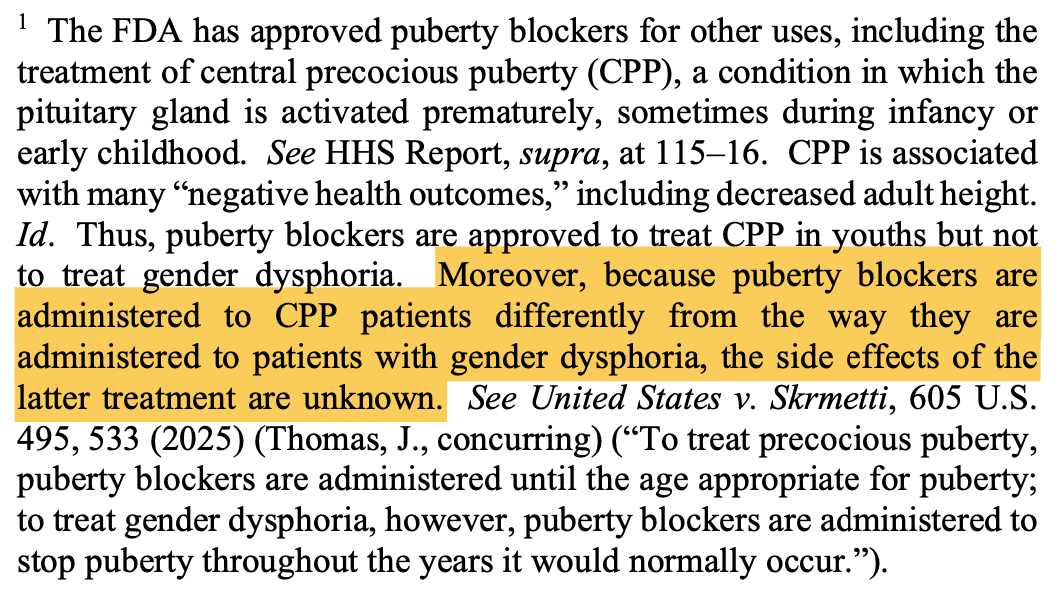
In one footnote, Bea cited to Justice Clarence Thomas’s concurrence in U.S. v. Skrmetti, in which Thomas was joined by no other justice, to make a broader point than even that made by Thomas in the quoted material.
Later on, however, Bea dropped a footnote to state, “In March 2026, Finnish researchers published a study based on data from 2,100 Finns who sought care from a gender clinic between 1996 and 2019 before they reached age 23.“ It goes on, but, for these purposes, Paez’s response is key: This was a study “not briefed by the parties and not raised by amici curiae.” In other words, Bea went outside the district court record — and outside the appellate briefing — desperately looking for “evidence” to prove his point.
That’s a problem, and Paez explained why.
“As a threshold matter, it is not our role to parse the merits of quantitative research neither raised before the district court nor briefed on appeal,“ he wrote. Continuing, he added, “Assuming we were tasked with evaluating this study, since the study’s publication, wide-ranging critiques have emerged about its methodology,“ citing two critiques that followed the publication of the March study.
Bea, joined by Bress, put a study into an appellate opinion that no party or amicus had even brought to the court, and, based on Paez’s response, there was a reason why no one did so. More importantly, Paez’s response also perfectly illustrated why a court should not put something in an opinion that has not been subject to adversarial testing from the parties.
A notable justification underlying Bea’s opinion was the “presumption of regularity,” discussing it at three points in his decision, including the introduction. In a key portion, he explained how he viewed (and adhered to) that presumption, even in this moment and, in particular, regarding this issue on which the Trump administration has a stated goal of “end[ing]” such care.
Bea, however, wrote:
![DOJ’s actions are “entitled to a presumption of regularity.” Citizens to Preserve Overton Park, Inc. v. Volpe, 401 U.S. 402, 415 (1971). This “long-standing” principle holds that “in the absence of clear evidence to the contrary,” a court presumes that government officials “properly discharged their official duties.” Cruz v. Bondi, 146 F.4th 730, 739 (9th Cir. 2025) (quoting United States v. Chem. Found., Inc., 272 U.S. 1, 14–15 (1926)). Yet the district court inferred from the Administration’s general opposition to gender-affirming care, along with its directives to DOJ to issue subpoenas to providers of such care, that DOJ had “issue[d] [the] subpoena not to investigate legal violations but to intimidate and coerce [QueerDoc] into abandoning lawful medical care.” QueerDoc, 807 F. Supp. 3d at 1299 (emphasis in original). In doing so, the district court improperly disregarded the presumption of regularity.](https://substackcdn.com/image/fetch/$s_!63yL!,f_auto,q_auto:good,fl_progressive:steep/https%3A%2F%2Fsubstack-post-media.s3.amazonaws.com%2Fpublic%2Fimages%2Fbfe35a69-097a-41a3-a55b-17b20f9a53d4_1062x808.png "DOJ’s actions are “entitled to a presumption of regularity.” Citizens to Preserve Overton Park, Inc. v. Volpe, 401 U.S. 402, 415 (1971). This “long-standing” principle holds that “in the absence of clear evidence to the contrary,” a court presumes that government officials “properly discharged their official duties.” Cruz v. Bondi, 146 F.4th 730, 739 (9th Cir. 2025) (quoting United States v. Chem. Found., Inc., 272 U.S. 1, 14–15 (1926)). Yet the district court inferred from the Administration’s general opposition to gender-affirming care, along with its directives to DOJ to issue subpoenas to providers of such care, that DOJ had “issue[d] [the] subpoena not to investigate legal violations but to intimidate and coerce [QueerDoc] into abandoning lawful medical care.” QueerDoc, 807 F. Supp. 3d at 1299 (emphasis in original). In doing so, the district court improperly disregarded the presumption of regularity.")
To that, Paez essentially responded, “Yes, you are right about the standard. Here, there is abundant ‘clear evidence to the contrary.’”
Paez wrote:
![The majority also argues that the district court disregarded the presumption of regularity in finding DOJ acted in bad faith. True, courts presume that government officials “properly discharge[] their official duties.” Cruz v. Bondi, 146 F.4th 730, 739 (9th Cir. 2025) (quoting United States v. Chem. Found., Inc., 272 U.S. 1, 15 (1926)). But there is “[n]o doubt” that the presumption “is subject to be rebutted.” R.H. Stearns Co. v. United States, 291 U.S. 54, 63 (1934). That is, the presumption applies “in the absence of clear evidence to the contrary.” Cruz, 146 F.4th at 739 (quoting Chem. Found., Inc., 272 U.S. at 14–15) (emphasis added). As described above, QueerDoc has presented ample evidence “to the contrary.” Id. We need not assume that DOJ is acting in good faith to investigate crimes when it has told us that it is acting with the intent to end an industry.](https://substackcdn.com/image/fetch/$s_!eg9x!,f_auto,q_auto:good,fl_progressive:steep/https%3A%2F%2Fsubstack-post-media.s3.amazonaws.com%2Fpublic%2Fimages%2F3b3d7728-9110-4898-91ae-0329cb2e5752_1040x770.png "The majority also argues that the district court disregarded the presumption of regularity in finding DOJ acted in bad faith. True, courts presume that government officials “properly discharge[] their official duties.” Cruz v. Bondi, 146 F.4th 730, 739 (9th Cir. 2025) (quoting United States v. Chem. Found., Inc., 272 U.S. 1, 15 (1926)). But there is “[n]o doubt” that the presumption “is subject to be rebutted.” R.H. Stearns Co. v. United States, 291 U.S. 54, 63 (1934). That is, the presumption applies “in the absence of clear evidence to the contrary.” Cruz, 146 F.4th at 739 (quoting Chem. Found., Inc., 272 U.S. at 14–15) (emphasis added). As described above, QueerDoc has presented ample evidence “to the contrary.” Id. We need not assume that DOJ is acting in good faith to investigate crimes when it has told us that it is acting with the intent to end an industry.")
In his conclusion, Paez summed it up: “It is hard to imagine clearer evidence that DOJ issued the subpoena to QueerDoc in bad faith.“
That clear evidence of bad faith is why the district court judges blocked these administrative subpoenas, at least as to the patient information; why DOJ shifted gears toward its Northern District of Texas grand jury approach; and why even those have hit walls in courts thus far when challenged.
But, on August 14, for two judges on the Ninth Circuit, that was insufficient to overcome the president’s powers to run the executive branch as he wishes.
Thank you for the thorough explanation. I’m not a lawyer and sometimes these rulings are very difficult to understand.
It’s become clear that you must include the age and who appointed each judge to help explain these rulings….unfortunately.
No gender-affirming care! Whoops, there goes Viagra for cis men.