

Second federal judge blocks DOJ from getting trans minors' info via grand jury subpoena
Judge Pitts issued the preliminary injunction covering a subpoena directed at Stanford. Also: About the dismissed charges in the "judge shopping" case. And: The SCOTUS shadow docket is still going.

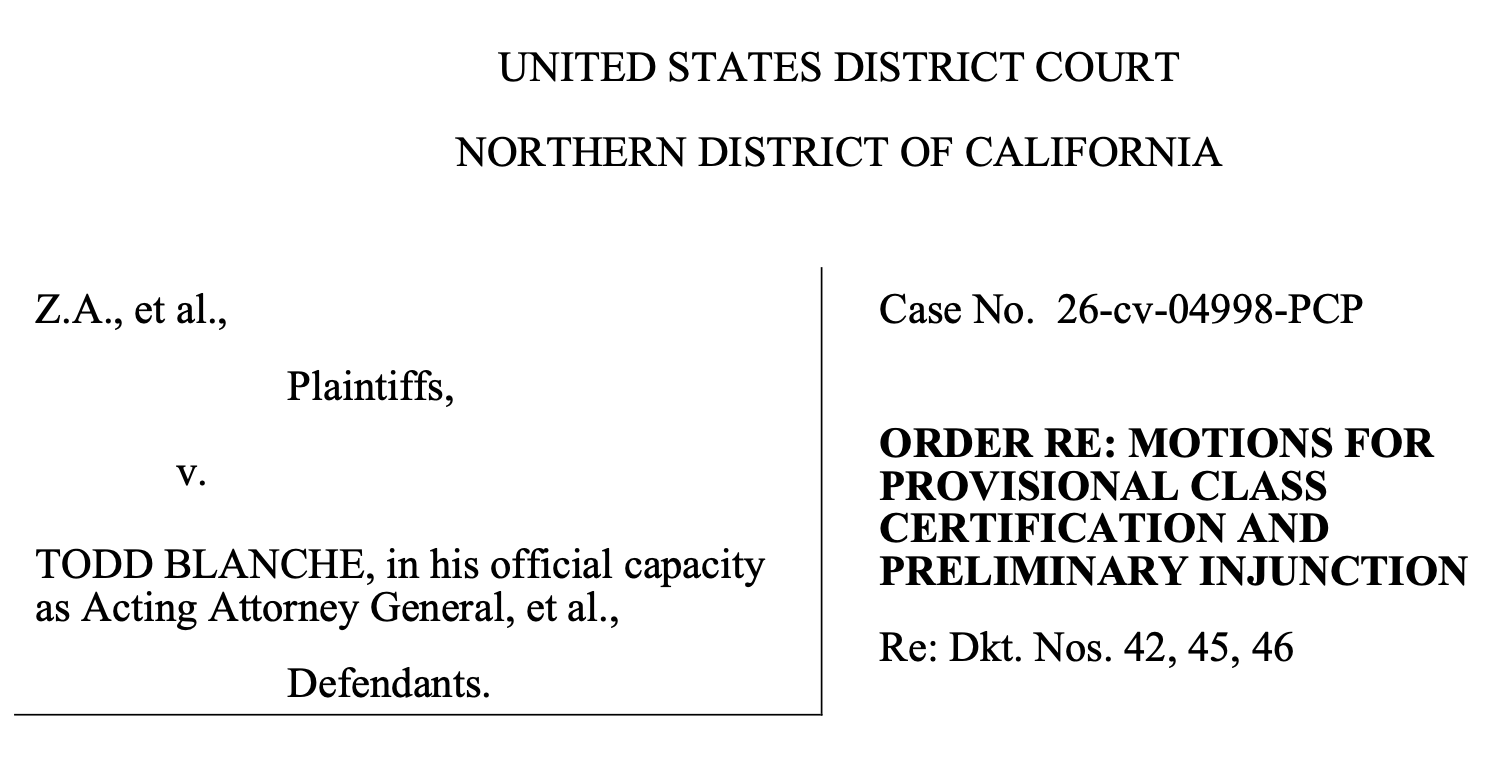
On Thursday, U.S. District Judge Casey Pitts barred the Justice Department from seeking invasive information about transgender patients who received gender-affirming medical care at the Lucile Packard Children’s Hospital at Stanford.
The preliminary injunction came in a lawsuit resulting from DOJ’s escalated effort to obtain such information by way of grand jury subpoenas issued in the Northern District of Texas after administrative subpoenas issued last summer have consistently been quashed, at least as to the patient-identifiable information, when challenged.
Thursday’s order from Pitts, a Biden appointee in the Northern District of California (where Stanford is located), came after patients sued and is the second such order blocking DOJ’s grand jury effort. The first came out of a grand jury subpoena issued to NYU Langone Health.
Pitts took particular umbrage at DOJ’s effort to go all over the country — to far-flung places — to act on its efforts investigating gender-affirming medical care for trans minors that ultimately are in service of the Trump administration’s efforts to “end” such care altogether.
“DOJ’s protestations about comity and separation-of-powers principles are unavailing,” Pitts wrote, because “[a]ny risk of conflicting court orders or interference with criminal investigations has been manufactured by DOJ itself.”
He continued:
The unavoidable conclusion is that DOJ issued its grand jury subpoena to avoid another loss and force Packard and its patients to pursue any challenge to DOJ’s demands in a forum that DOJ deems friendlier. This is hardly DOJ’s first such ploy. … DOJ cannot reasonably invoke comity and the separation of powers as cover for its forum shopping.
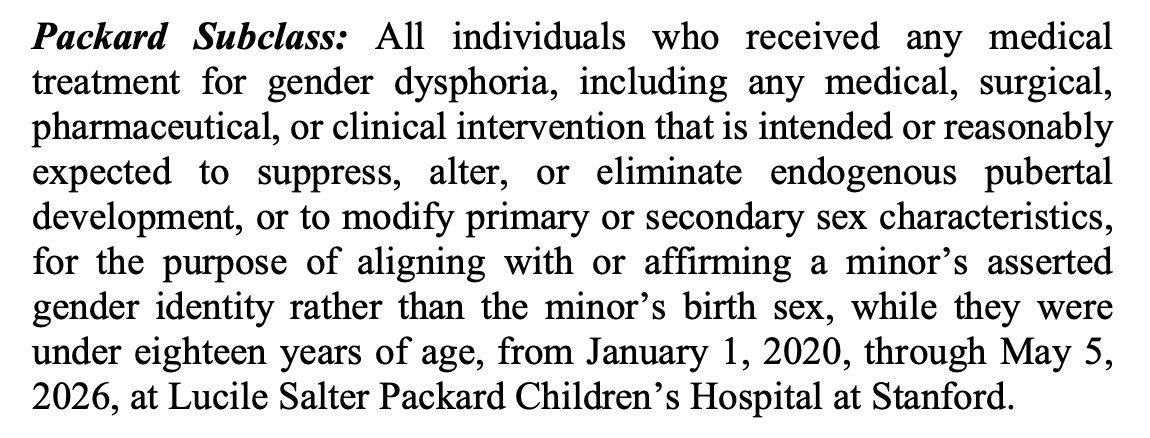
Pitts granted a classwide injunction as to Packard patients — provisionally certifying that class — but did not grant the patients’ request for a statewide class, finding that “the preliminary record before the Court does not support plaintiffs’ assertion that every California hospital providing gender-affirming care to minors is subject to DOJ’s demands for identifying patient records.“
In Pitts’s opinion, he laid out the factual background discussed above, then put the situation in the context of the U.S. Supreme Court’s 2025 decision, U.S. v. Skrmetti, addressing such care:
In Skrmetti, the Supreme Court held that the responsibility for resolving those debates falls on state legislatures. That is because the Constitution “afford[s] States ‘wide discretion to pass legislation in areas where there is medical … uncertainty,” which the Supreme Court held includes the use of “puberty blockers and hormones … for minors.”
The Trump administration, he continued, is handling matters differently.
“Despite the Supreme Court ‘underscor[ing] the need for legislative flexibility in this area,’ id., its counterparts in the Executive Branch have displayed significant antipathy for the choice of some state legislatures not to ban gender-affirming care for minors,” he wrote.
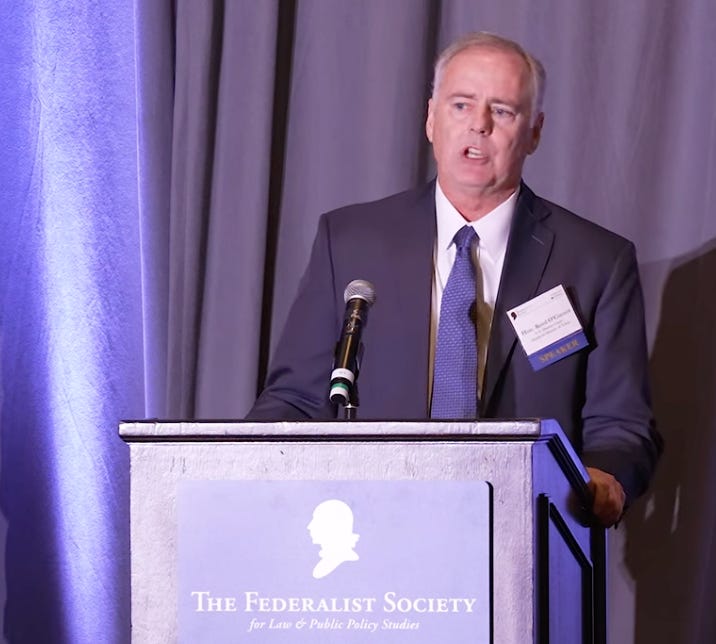
He went on to describe DOJ’s escalation, detail the effort’s new-found home in the Northern District of Texas, and reference U.S. District Judge Reed O’Connor’s role — with citation to a Federalist Society speech O’Connor gave in September 2024, during the Biden administration, in which he derisively referred to DOJ as a “frequent forum shopper.“
As to the claims, Pitts then granted provisional class certification as to the Packard patients:
Before addressing the merits of the Packard class’s claims, Pitts initially addressed DOJ’s argument that, “regardless of the merits of plaintiffs’ constitutional claims, their assertion of those claims here is improper.”
Pitts quickly rejected DOJ’s claims that “sovereign immunity bars” patients’ claims and that the patients have “no private right of action” to bring their claims, finding an equitable claim likely is available to the patients, before examining the DOJ’s argument that Federal Rule of Criminal Procedure 17 — addressing subpoenas — bars any equitable action the patients might otherwise be able to bring.
“This issue is closer than the first two,“ Pitts acknowledged. “[A] traditional equitable remedy remains available unless ‘Congress has demonstrated an “intent to foreclose” that form of relief.’ There is good reason to doubt that Rule 17 precludes the equitable relief plaintiffs seek.“
Noting that Rule 17 would likely bar an effort to quash the grand jury subpoena in his court, Pitts continued:
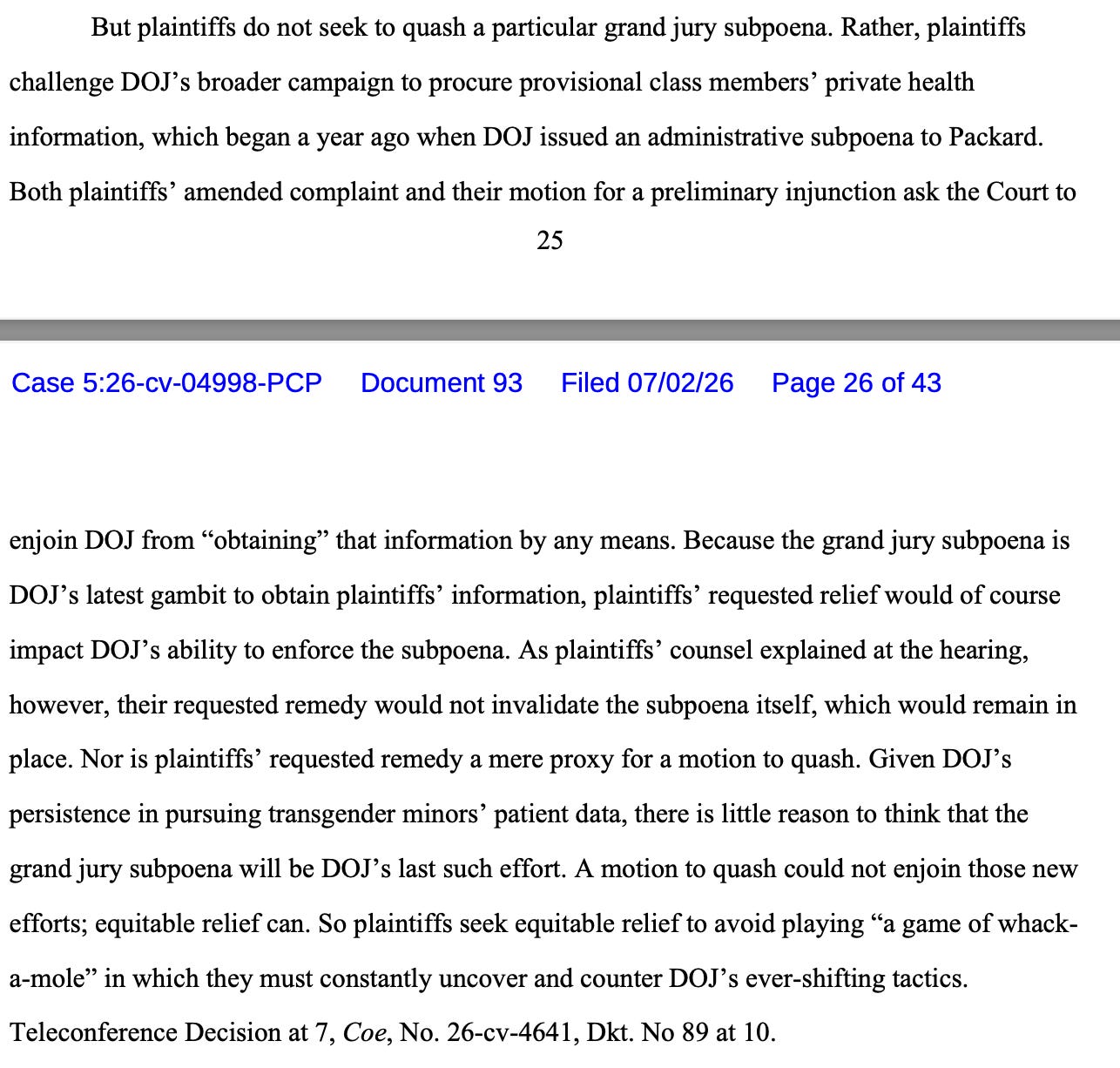
Ultimately, Pitts concluded, “A conclusive answer [as to whether this effort is allowed] must await fuller briefing on a non-expedited schedule. At this early stage, however, the Court concludes that Rule 17 likely does not foreclose such remedies.“
Finally, Pitts wrote, “DOJ argues that even if the Court has discretion to review plaintiffs’ claims for equitable relief, it should decline to do so based on comity and separation-of-powers concerns. Neither rationale is convincing.“
Pitts was not having it, explaining that “plaintiffs’ requested injunction does not terminate DOJ’s criminal investigation in the Northern District of Texas. It narrowly prevents DOJ from obtaining private health information that, as the Court explains below, has no apparent relevance to any crime indictable in Texas.“
To the larger point, he wrote, “Plaintiffs received care in this district from a hospital in this district, and unless Rule 17 forbids it, they may seek protection for the resulting medical records in this district.“
On the merits of the patients’ claim, Pitts found that “Plaintiffs are likely to succeed on the merits of their informational-privacy claim” because “the provisional class’s privacy interests likely outweigh DOJ’s interest in obtaining class members’ sensitive health information.“
As to the heart of the matter — the claimed need for this information — Pitts calls DOJ’s bluff.
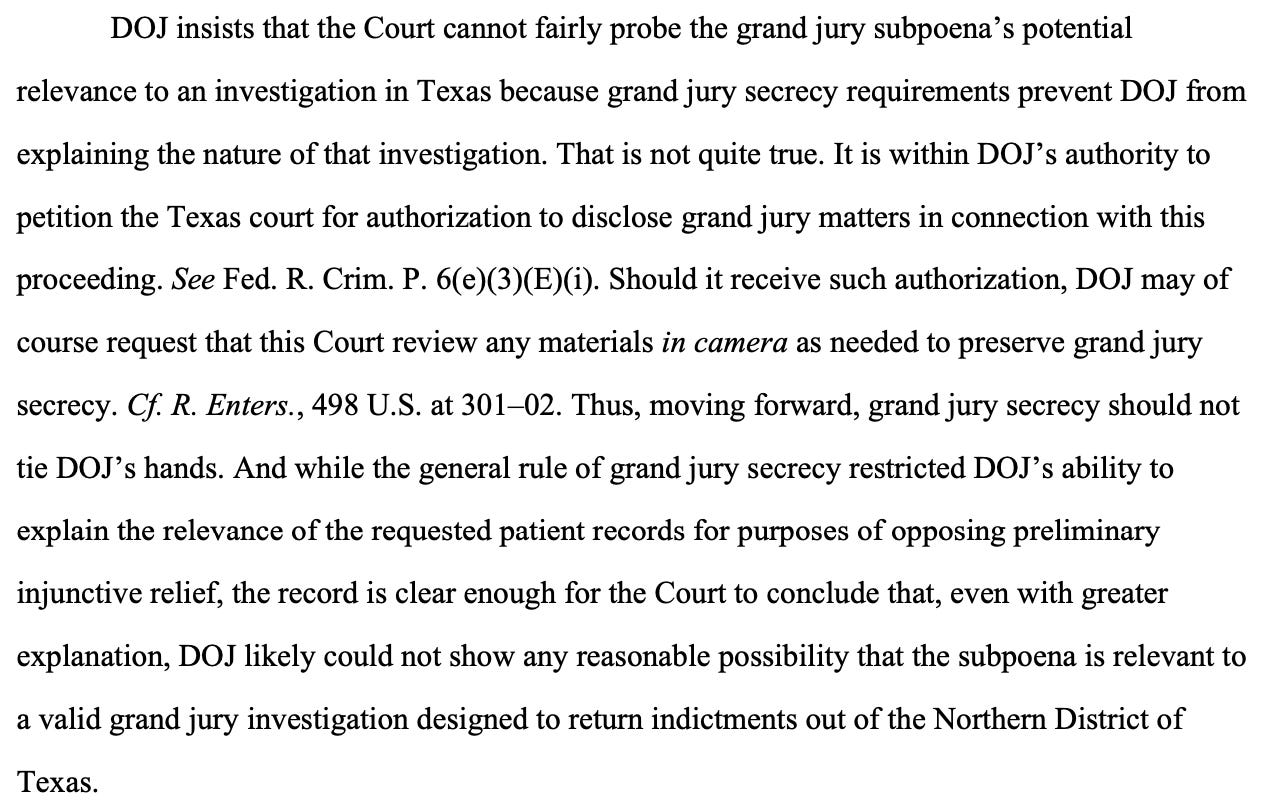
In any event, he continued, the information sought “has no discernible relevance to any federal healthcare offense or other fraudulent billing or insurance-claim practices,“ crediting other courts for having “ably explained” this previously.
“The record before the Court thus establishes that there is little to no possibility that the patient information DOJ demands will be of any relevance to the grand jury investigation in Texas,“ he concluded.
Finding the patients showed irreparable hard and that the balance of equities “tip sharply” in the patients’ favor, Pitts granted the preliminary injunction as to the provisional Packard class.
A look into the dismissed charges in the “judge shopping” inquiry
[Note: This report is the latest development in the Alabama “judge-shopping” investigation, which Law Dork began reporting on in May 2024, including two in-depth reports that provide substantial background on the happenings since 2022.]
A federal court confirmed in June that the indictment from last year against a LGBTQ legal organization lawyer charged with making a false statement to a panel of judges investigating “judge shopping” has been dismissed.
Not much more is known the end of the case against Carl Charles, a lawyer with Lambda Legal Defense and Education Fund.
A pair of orders from U.S. District Judge Cecelia Altonaga in June referenced the earlier dismissal of the case against Charles, including a June 23 order that “modified” the dismissal by allowing the sealed dismissal to be disclosed to certain parties. (Altonaga is a federal judge from Florida who was assigned to Charles’s now-dismissed criminal case after all of the federal judges in the Middle District of Alabama recused themselves from hearing it.)
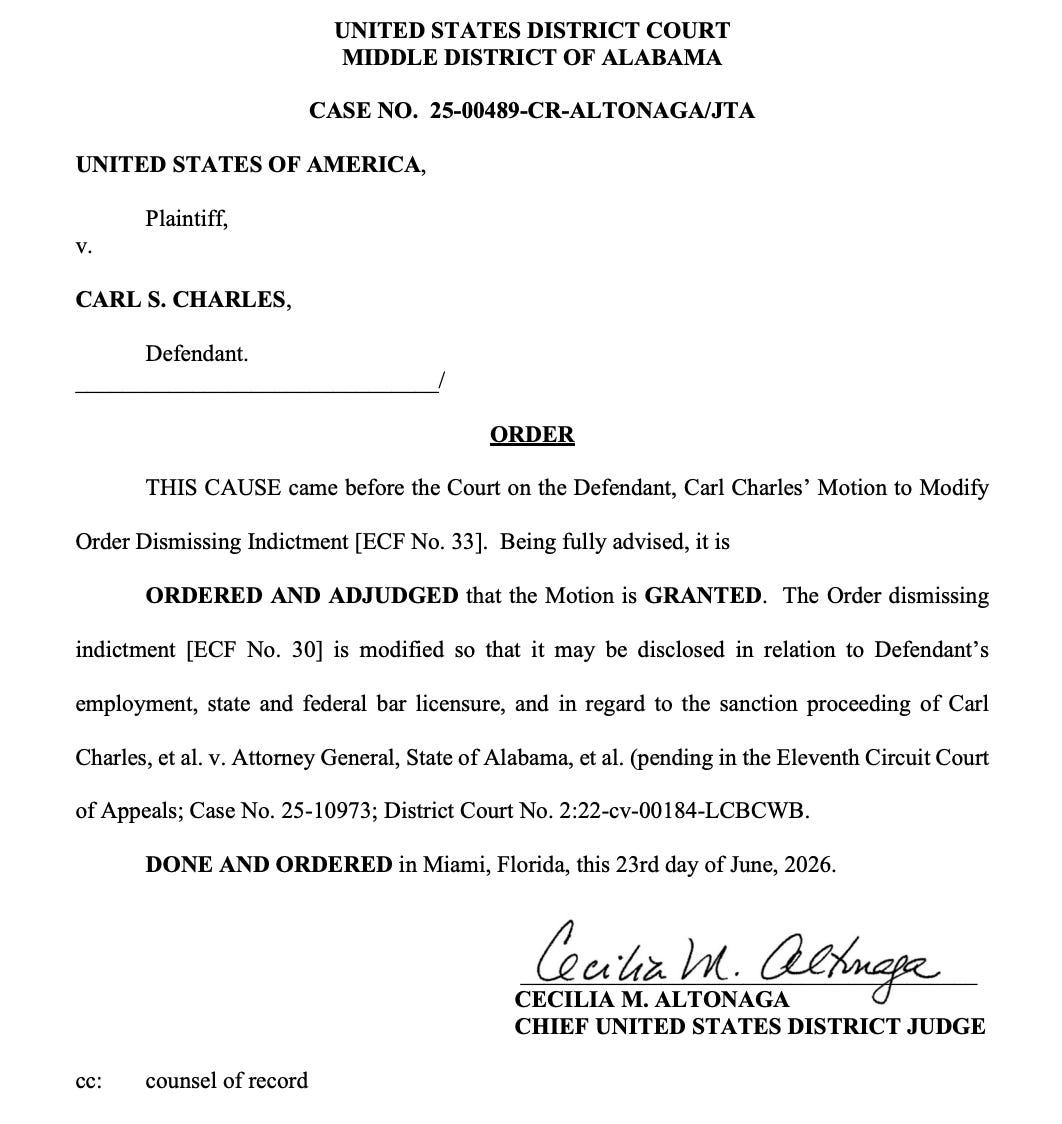
The dismissal has been widely reported, but, as part of Law Dork’s coverage, here is a look into what happened and what we still don’t know about this broader story.
The order dismissing the indictment (identified in Altonaga’s orders as Docket No. 30) and four other docket numbers do not even appear on the docket, suggesting significant action happened out of the public’s eye since an October 2025 pretrial conference in the case.
Given the docket, the dismissal happened sometime between February 11 and June 1.
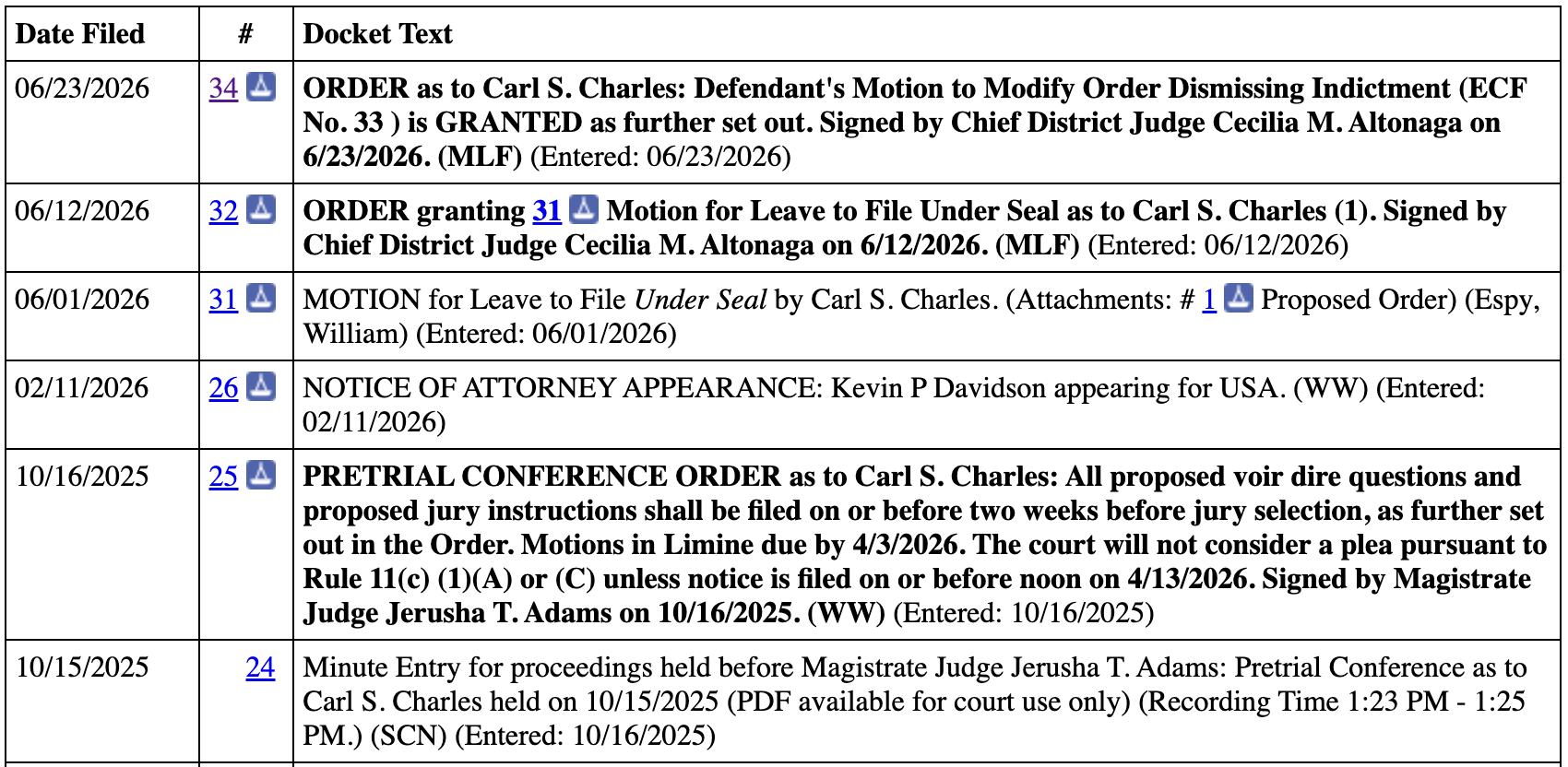
The June 1 entry, Docket No. 31, is a request from Charles’s lawyers to file a sealed request to modify the “Order Dismissing Indictment,” which it refers to as “Sealed Doc. 30.“
Charles had been working on litigation challenging Alabama’s ban on gender-affirming care for trans minors and was later caught up an an extremely unusual mutli-year investigation by all three districts of Alabama’s federal courts into accusations of “judge shopping” initially raised by U.S. District Judge Liles Burke, a Trump appointee who was later given the authority by the investigating judges to assess whether sanctions were merited against the lawyers involved.
Burke ultimately issued sanctions against three lawyers involved, including referring Charles, who is transgender, to the U.S. Attorneys Office for the Middle District of Alabama. The trio’s appeal of Burke’s sanctions order is ongoing. Arguments in that appeal were supposed to be heard at the U.S. Court of Appeals for the Eleventh Circuit in August, but the case was removed from the calendar in May with no reason given. Although that order stated that the case “will be reassigned at a later date,“ arguments have not been rescheduled as of Thursday.
It’s an altogether disconcerting reality, not just for those involved but for anyone who cares about this alarming series of events that have transpired in this inquiry over the past four-plus years.
SCOTUS rejects reporter’s request
Also on Thursday, the U.S. Supreme Court denied a stay to reporter Catherine Herridge, who now faces a daily $800 civil contempt fine for refusing to name her sources in an ongoing Privacy Act lawsuit in which she was not sued but was called as a third-party witness.
Justice Brett Kavanaugh noted that he would have granted Herridge a stay.
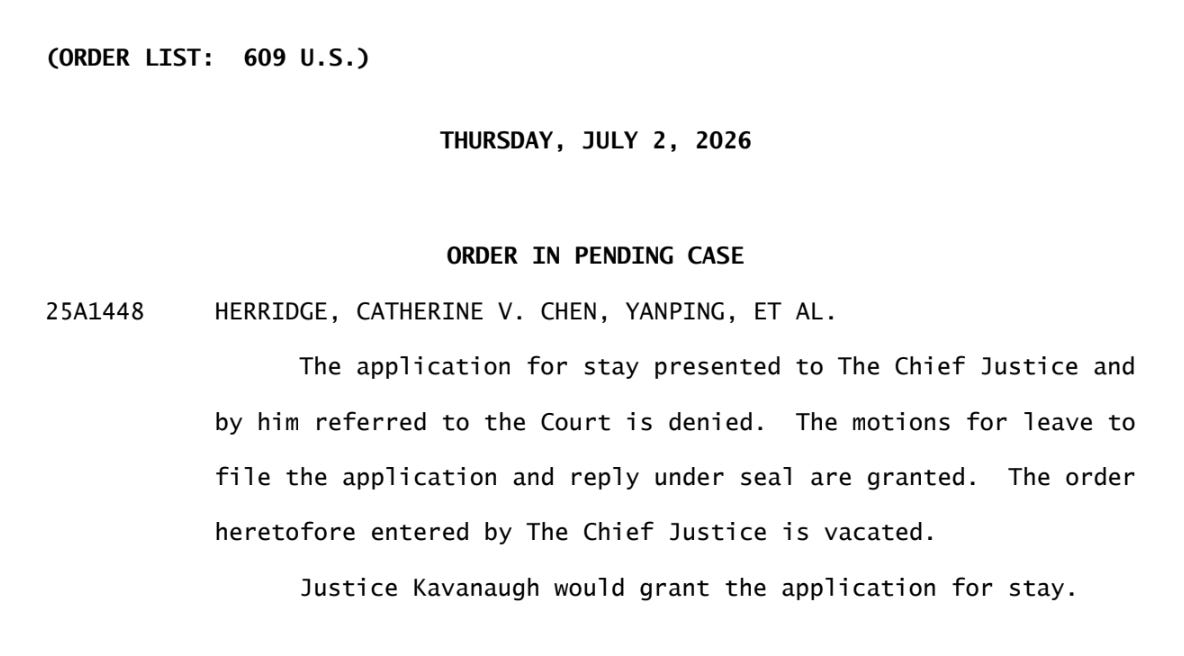
This means Kavanaugh is the only justice who publicly stated he would have protected the reporter while she argues in litigation — a request for the Supreme Court to hear her appeal — that the First Amendment should protect a reporter against revealing sources.
Soon the DOJ will just trot out their black gestapo uniforms and terrorize their victims directly.
WTF is going on in Atlanta? This is the second high profile case removed from the argument calendar for no stated reason. The other of course is the appeal from Cannon barring release of the Smith report.