

The fight over DOJ's invasive trans care subpoenas is coming to a head
Update: Upcoming court appearances could represent the most critical moment in the past year for DOJ's effort to target the provision of medical care for transgender minors.

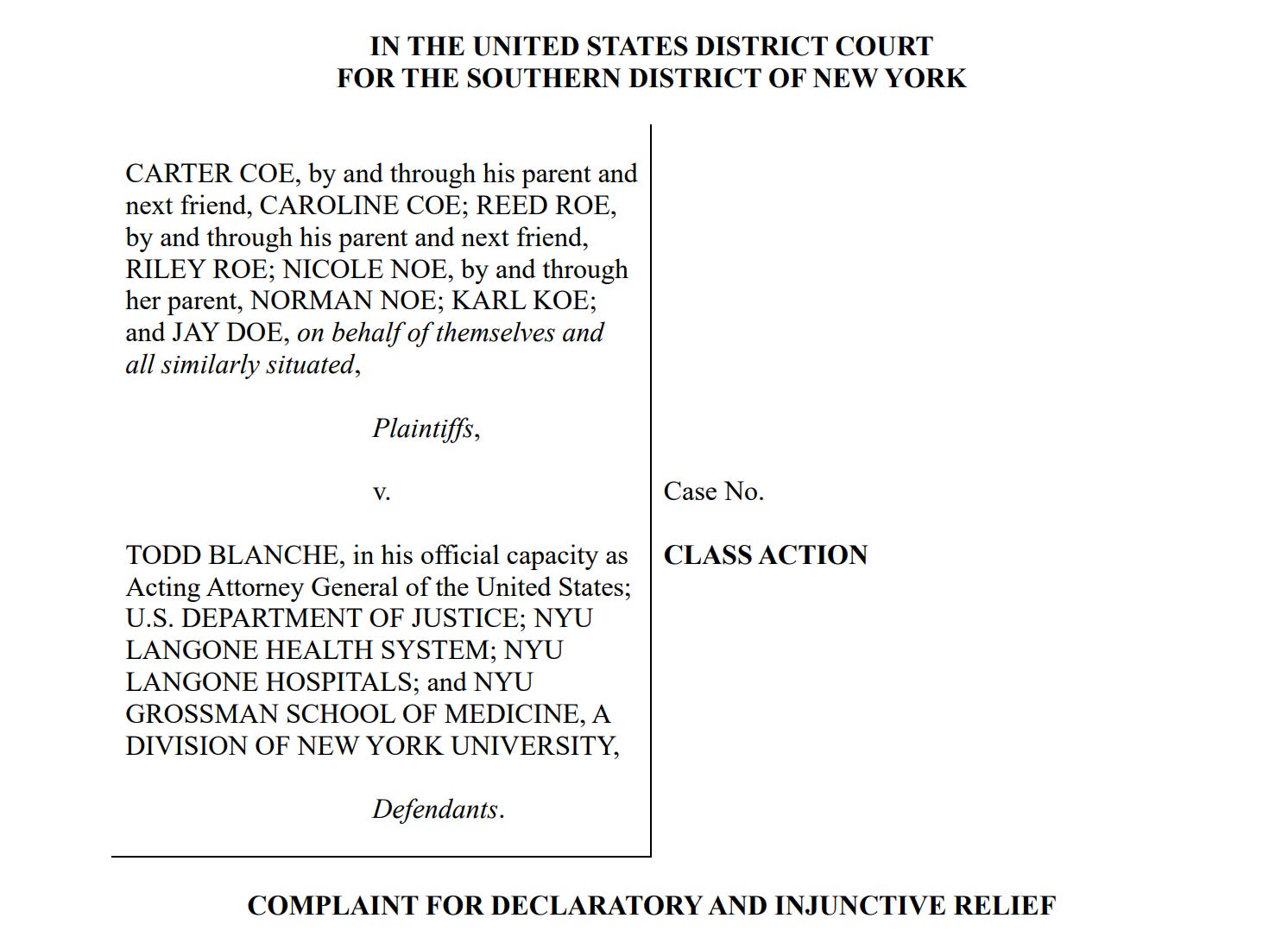
Key court appearances in the Trump administration’s attack on transgender children’s right to obtain gender-affirming medical care are scheduled this month. The outcome of those appearances — and decisions regarding the underlying requests at issue — could represent the most critical moment in the past year for Justice Department’s effort to target the provision of medical care for transgender minors.1
As Law Dork has covered in depth, from the opening day of the second Trump administration, President Donald Trump and then-Attorney General Pam Bondi had aggressively sought to challenge the provision of gender-affirming care for trans minors — even in states where such care is allowed or even explicitly protected by law.
Among other steps, the Justice Department issued administrative subpoenas last summer to more than 20 providers of such care seeking extremely invasive data about individual patients, in addition to other records.
The shifting rationales for the requests have included “health care offense“ claims related to off-label prescribing of medication used in gender-affirming medical care, coordination with pharmaceutical companies regarding the provision of such medication, and billing of such care. Despite that attempt at nuance, last August a DOJ lawyer admitted the broader goal, telling a court that “the executive branch wants to reduce or eliminate gender-related care to minors, especially … medicalized gender-related care to minors.“
Several providers challenged the administrative subpoenas, as did some patients who became aware of the administrative subpoenas. All of those challenges ended with judges quashing the subpoenas in whole or at least as to the individual patient information, with judges finding the subpoenas lacked a proper purpose or went “beyond the authority granted by Congress.”
Although DOJ did file appeals of those rulings, at least initially, it has since come to light that DOJ was moving forward with two other efforts — both in the Northern District of Texas.
In one, DOJ filed a motion in Fort Worth, Texas on April 30 asking for a court order enforcing one of those administrative subpoenas issued in Washington, D.C., to a hospital in Rhode Island. The case was assigned to U.S. District Judge Reed O’Connor, a George W. Bush appointee with a long record of anti-LGBTQ rulings (and one of two active judges in the division), and he granted the request that day without even seeking a response from Rhode Island Hospital.
Days later, as news of the Texas order spread (and follow-up litigation proceeded), DOJ opened another front. The U.S. Attorney’s Office for the Northern District of Texas — as part of an apparent (alleged?) criminal investigation — issued grand jury subpoenas to several providers, including NYU Langone Health, which disclosed the issuance of the subpoena under New York law.2 The return date for the grand jury subpoenas — the date by which the documents sought are to be submitted — is Wednesday, June 10, at least as to NYU Langone.
Although the pushback to these efforts had been piecemeal, advocates, working with patients and their families, have launched two larger legal efforts over the past month to try and stop DOJ in its tracks.
Judges in each effort — one in Maryland and the other in New York — have ordered the parties to court next week, and, given the June 10 grand jury subpoena date, a lot could happen — to advance or block DOJ’s efforts — over the next several days.
[Update, 5:55 p.m.: The parties are seeking to push the New York hearing, filing a joint stipulation Thursday afternoon. More on that below.]
[Update, 6:30 p.m.: The New York hearing, previously set for June 10, has been rescheduled for June 22. Again, more below.]
TIPS: If you have information about the subpoenas discussed in this report or related subpoenas, challenges to them, any federal grand jury activity or any criminal investigation, or related developments, please reach out. Chris Geidner is available on Signal at crg.32 for more secure communications.
The administrative subpoenas
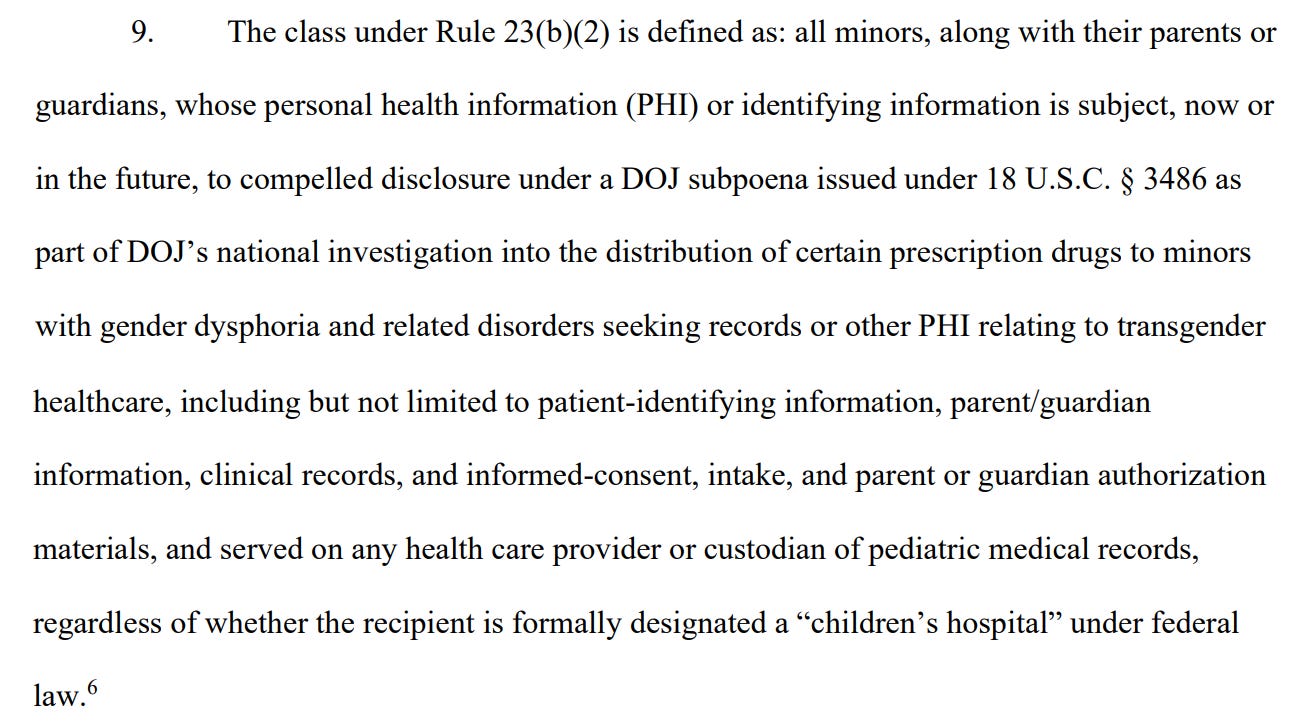
In Maryland, patients and families represented by lawyers from GLBTQ Legal Advocates & Defenders and National Center for LGBTQ Rights, joined by Brown Goldstein & Levy LLP, filed a request for a class-action ruling to protect all patients targeted by the administrative subpoenas:
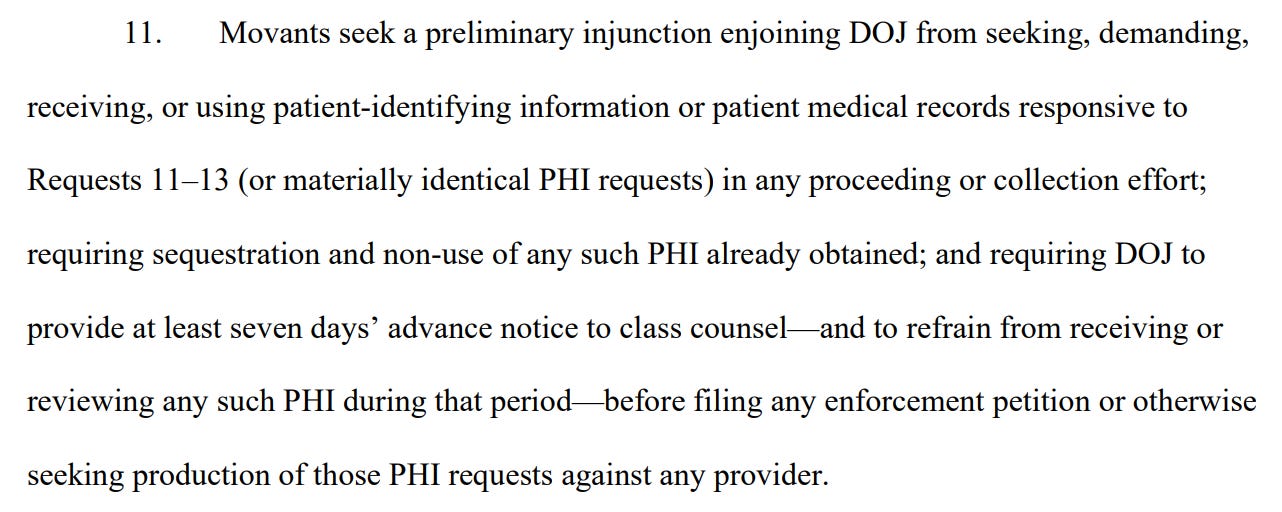
They are seeking a class injunction quashing the three patient-specific requests in the subpoenas and blocking DOJ from obtaining or using the personal health information of patients requested in the administrative subpoenas:
The matter was assigned to U.S. District Judge Julie Rubin, a Biden appointee, who ordered DOJ’s response by June 1. DOJ opposed the request in its response, largely arguing that class-wide relief is not possible here.
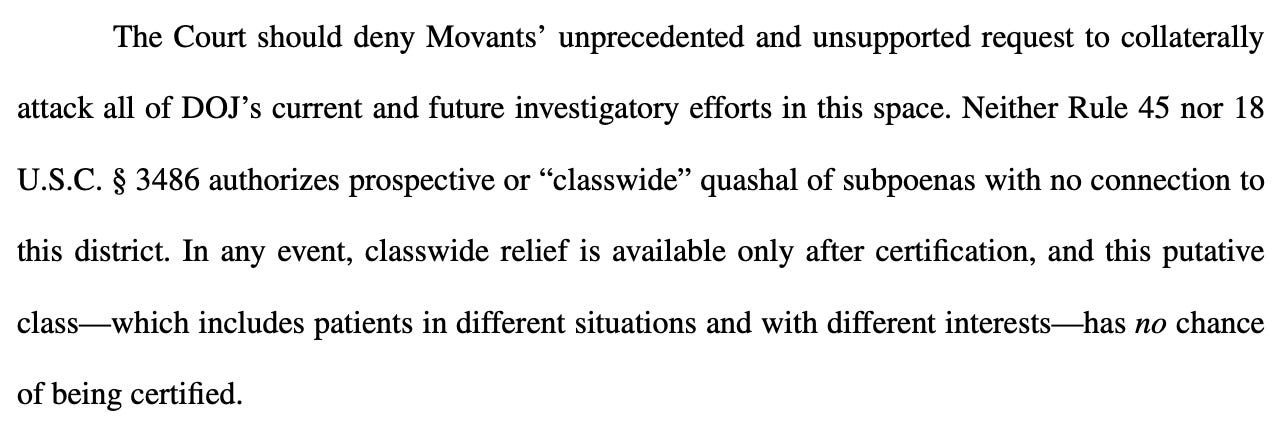
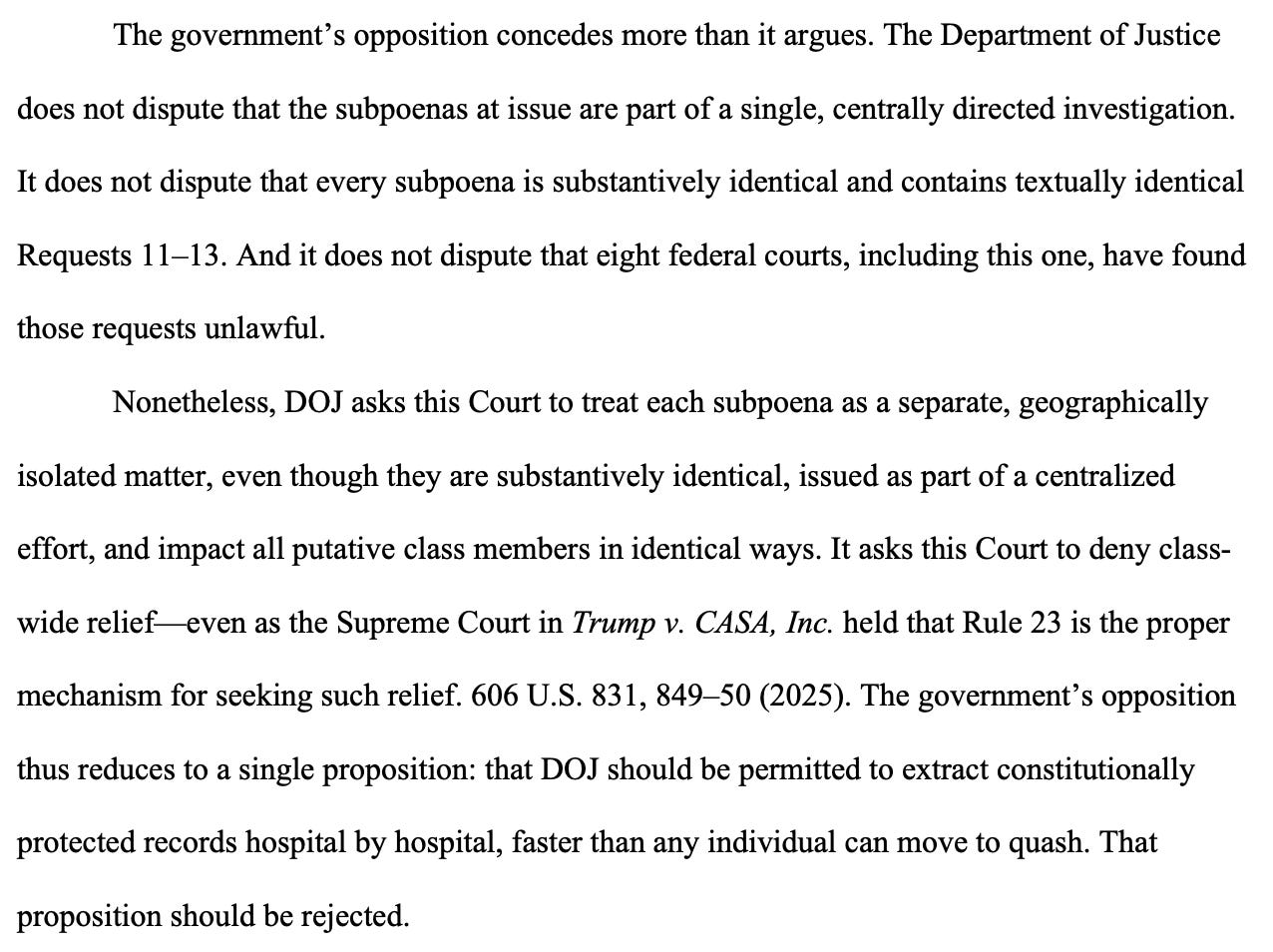
The families replied on Thursday, with a two-paragraph introduction that really sums things up quite well:
Rubin has set a hearing for 10 a.m. ET Tuesday, June 9, in the federal courthouse in Baltimore, Maryland.
The grand jury subpoenas
On the grand jury subpoena front, patients and families represented by Lambda Legal Defense and Education Fund, the American Civil Liberties Union, and New York Civil Liberties Union filed a class-action complaint in the Southern District of New York this week challenging the NYU Langone subpoena and more.
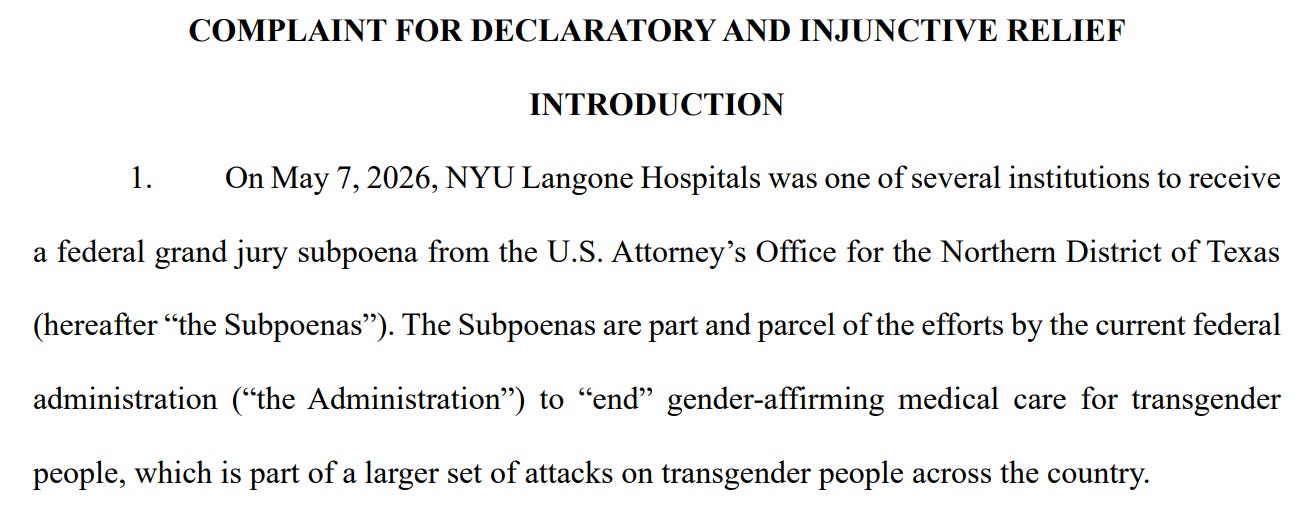
In the June 2 complaint, they raise Fourth and Fifth Amendment claims and are seeking class certification as to anyone who received gender-affirming medical care “at a healthcare institution located in New York City” while they were younger than 18 (and as to an NYU-specific subclass).
The argument is direct and blunt:
The Plaintiffs and proposed class representatives in this putative class action are minors, their parents, and young adults seeking to challenge the imminent and unconstitutional disclosure of their identities and sensitive health information related to gender-affirming medical care to the DOJ Defendants, whom they allege are seeking that information for improper, unlawful, and discriminatory purposes.
In the lawsuit, they are ultimately looking for an order that would bar DOJ from seeking personal health information “through the Subpoenas at issue or any substantially similar administrative or grand jury subpoenas“ as part of the claimed investigation and NYU hospitals from disclosing such information to DOJ.
Highlighting the time-sensitive nature of the request given the quickly approaching June 10 return date, they also are seeking a temporary restraining order in the interim.
The case was assigned to U.S. District Judge Jeannette Vargas, a Biden appointee, who issued an order on June 3 requiring DOJ’s opposition to be filed by noon Friday. Any reply is due from the plaintiffs by Saturday.
She also made clear she is already looking forward, ordering the parties to answer a series of questions about plans for the remainder of the case — including whether a preliminary injunction motion from plaintiffs and a motion to dismiss from DOJ are forthcoming and whether discovery and/or an evidentiary hearing is going to be requested — by noon Tuesday.
In conjunction with all of that, Vargas has set a conference for 2:30 p.m. ET Wednesday, June 10, in the federal courthouse in Manhattan.
[Update, 5:55 p.m.: On Thursday afternoon, the parties filed a joint stipulation that would push off any need for the TRO until the end of the month. Per the filing:
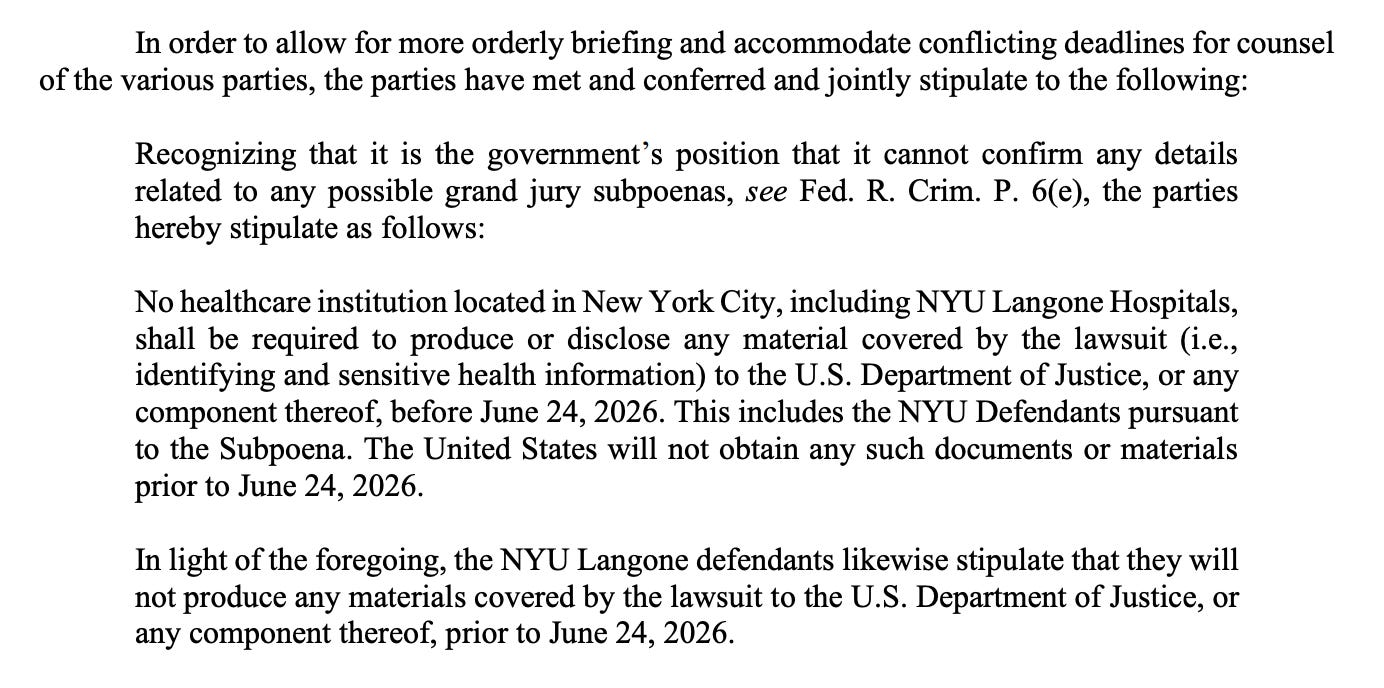
As such, the letter — signed only by the plaintiffs’ lawyers but listed as a “joint letter motion” — continues: “[I]n light of the above stipulation and proposal, the parties respectfully request that the Court adjourn the June 10, 2026 conference date, and propose that said conference, along with any hearing on Plaintiffs’ TRO motion, occur on June 22, 2026, or on any other date prior to June 24, 2026 that is acceptable to the Court.”]
[Update, 6:30 p.m.: Judge Vargas moved the hearing to 2:30 p.m. ET June 22.
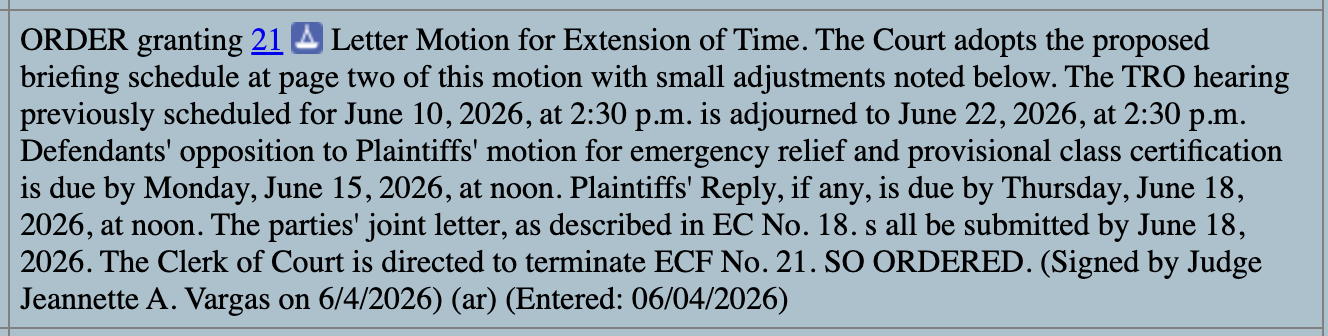
The briefing schedule also has been extended accordingly.]
An earlier lawsuit, covered by The Advocate, was also filed by patients of Lucile Packard Children’s Hospital at Stanford on May 27 in the Northern District of California. Represented by National Center for LGBTQ Rights and GLBTQ Legal Advocates & Defenders, along with Galvan & Grunfeld LLP, the lawsuit differs from this week’s lawsuit because it only names the hospital as a defendant. This subpoena was also issued on May 6 in the Northern District of Texas with a return date of June 10.
The patients filed a motion for a temporary restraining order and arguments supporting the request, the hospital responded on June 3, and U.S. District Judge Casey Pitts set a hearing on the TRO motion for 10:00 a.m. PT Friday via Zoom.3
Despite all of this action, it is not clear what — if any — action is being sought regarding any other possible grand jury subpoenas.
The grand jury?
All of which brings us back to Texas and the potential grand jury investigation.
It is not clear what has already happened, what all is being sought, and what the aims of the investigation would be.
Much of the public information known about the involvement of the Northern District of Texas in this investigation beyond a handful of court filings and the NYU Langone subpoena itself came in a May 12 hearing before U.S. District Judge Mary McElroy in Rhode Island as part of the Rhode Island Child Advocate’s effort to quash the Rhode Island Hospital subpoena after news of O’Connor’s order in Texas was made public.
At that hearing, DOJ’s Brantley Mayers was asked when Main Justice began communicating with the U.S. Attorney’s Office in the Northern District of Texas about the investigation.
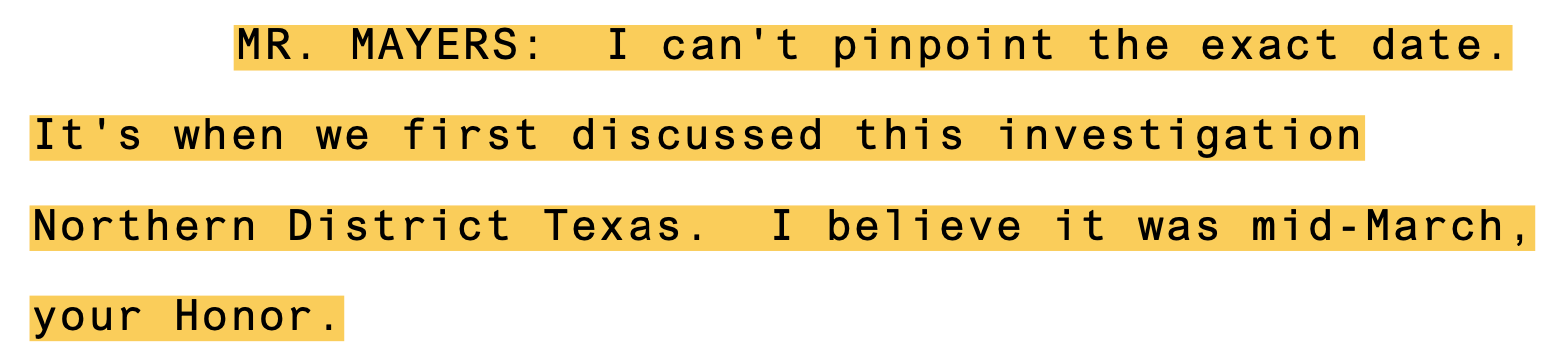
The speed with which DOJ’s approach morphed became clear in the exchange that followed as McElroy; Mayers, a lawyer in his first year of litigating; and Deputy Assistant Attorney General Jordan Campbell, a more senior DOJ lawyer with a private practice history of anti-trans litigation who was sitting at counsel’s table at the hearing.
Although Mayers said the first discussion with the Texas office about the investigation was in mid-March, he and Campbell made clear that the decision to file the motion to enforce the subpoena was not made — or drafted — until the closing days of April immediately preceding the April 30 filing of that motion.
By a week later, the grand jury subpoena — at least the NYU Langone one — had also been obtained and issued. Although NYU Langone stated that it received the subpoena on May 7, it is dated May 6.
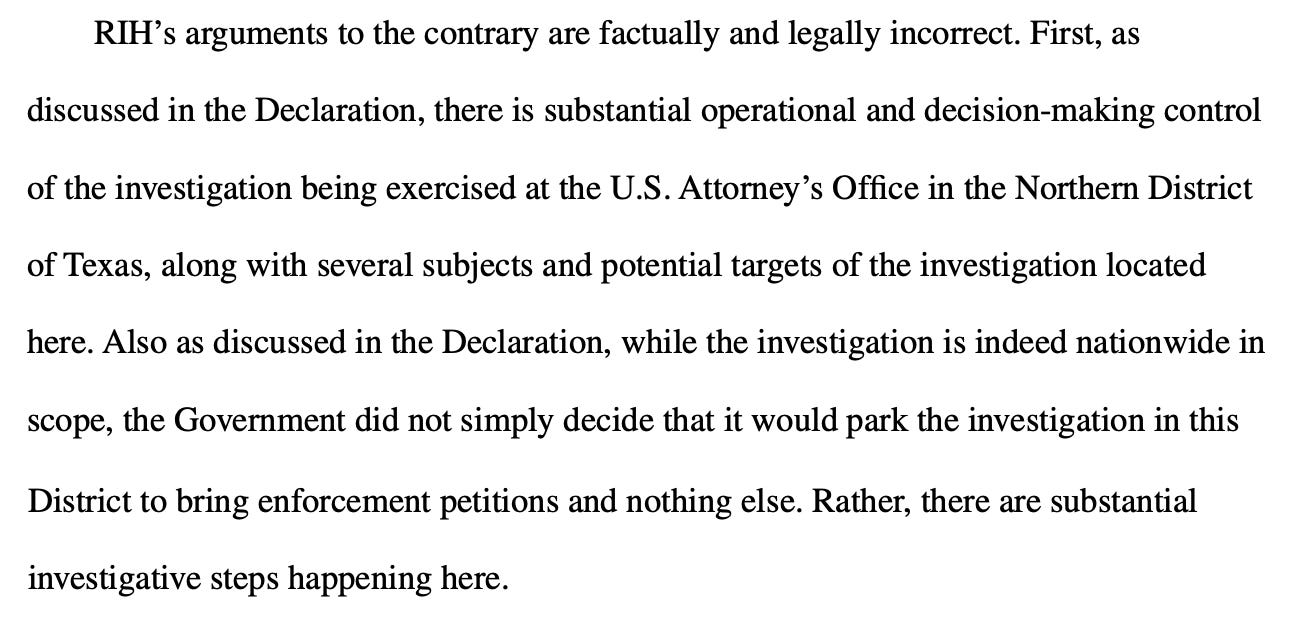
After having provided no information beyond a bare assertion of any connection to the Northern District of Texas in its April 30 motion to enforce the Rhode Island Hospital subpoena, when the hospital filed a motion on May 6 before O’Connor to stay the order, DOJ responded on May 8 by including an ex parte (meaning, only provided to the judge) declaration from Lisa Hsiao, the acting director of DOJ’s newly formed Enforcement & Affirmative Litigation Branch. In it, she apparently provided information that “the ‘investigation is being carried on’ in this district,” as DOJ told O’Connor in its public filing.
DOJ continued:
Before McElroy, however, Mayers made clear the limits of what is known publicly when she asked about “the fact of a grand jury” in Texas:
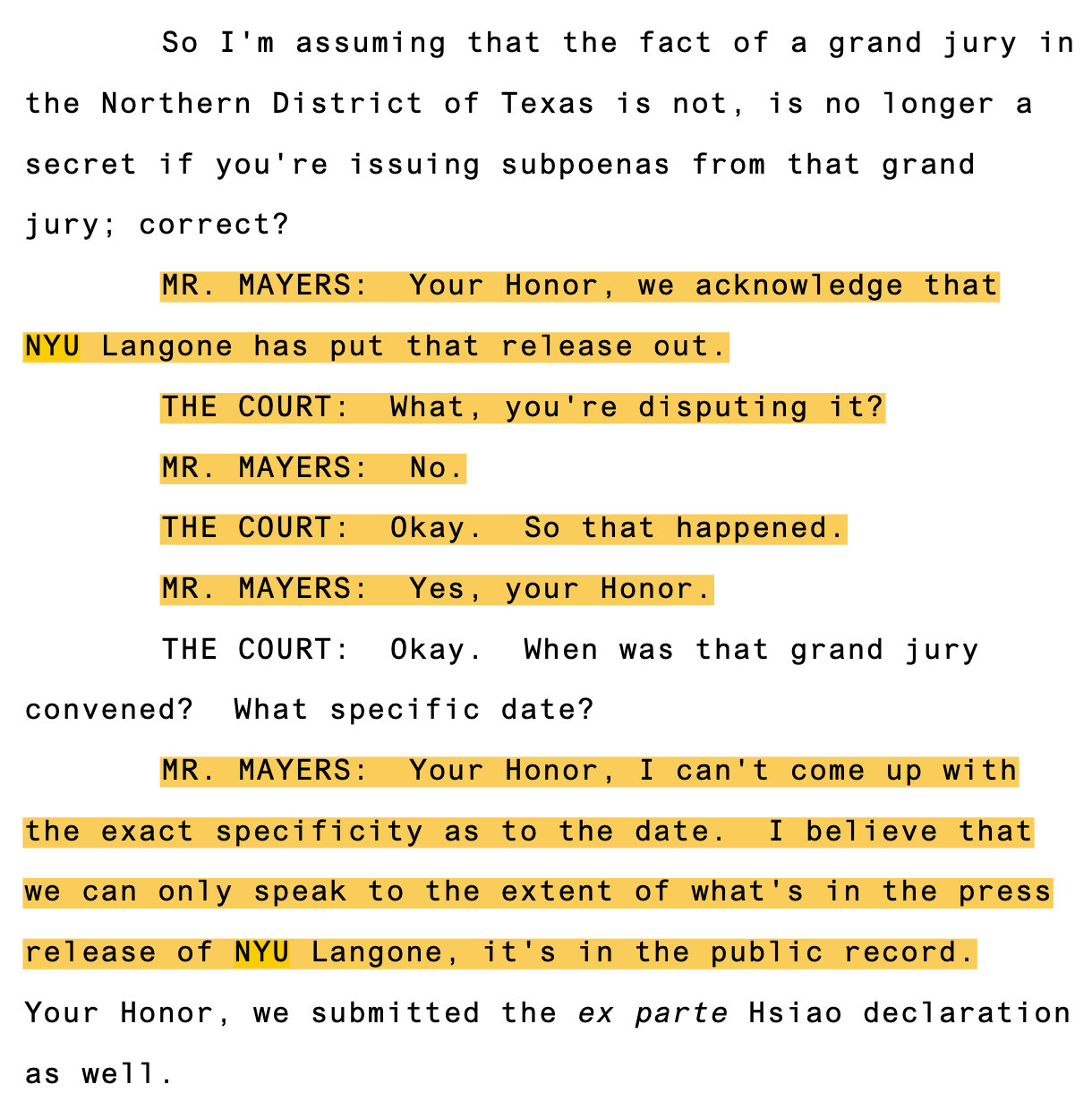
There are a few reasons why Mayers could have made these comments. First, there is Mayers’s inexperience. As Law Dork has noted previously, McElroy repeatedly highlighted that reality at the hearing — often in the context of questioning DOJ’s decision to put him up there. Second, and relatedly, this could be a result of Mayers’s efforts to adhere to grand jury secrecy rules.
Third, however, there also is the possibility that “a grand jury” — as McElroy had put it in her question — had not yet done anything at that point. A grand jury subpoena does not require judicial or grand jury approval. The NYU Langone grand jury subpoena was issued by the clerk of court upon the request of an assistant U.S. attorney.
In other words, we know little to nothing about what any grand jury has done — if it has done anything — regarding this alleged investigation.
That is set to change at 9 a.m. CT Wednesday, June 10, when — as of now — NYU Langone is to bring the subpoenaed documents to the grand jury room in the federal courthouse in Fort Worth, Texas.
This paragraph was updated after initial publication to reflect the status of the situation in light of the updates included in the report.
DOJ also, in conjunction with Texas Attorney General Ken Paxton, reached a settlement with Texas Children’s Hospital, ending a long-running Texas investigation and potentially providing backing for DOJ’s apparent broader investigation.
The two paragraphs about the Stanford-related lawsuit were added after initial publication, with the final update at 6:20 p.m.
I assume you are aware of the case by patients against Stanford in California, raising the same issues as in the NY case and citing the subpoena to that hospital since they haven't seen the one to the Stanford hospital. https://www.advocate.com/health/transgender-health/lawsuit-stanford-transgender-care-subpoena
Also, thanks for your thorough coverage of this very important issue.
Echoing Ms. Moore's thanks for your thorough coverage of this important civil rights issue!