

Does DOJ even know how to issue subpoenas for a proper purpose these days?
Judge Patrick Schiltz quashed federal grand jury subpoenas issued against Minnesota officials. The move echoes the quashed Federal Reserve and trans care subpoenas.

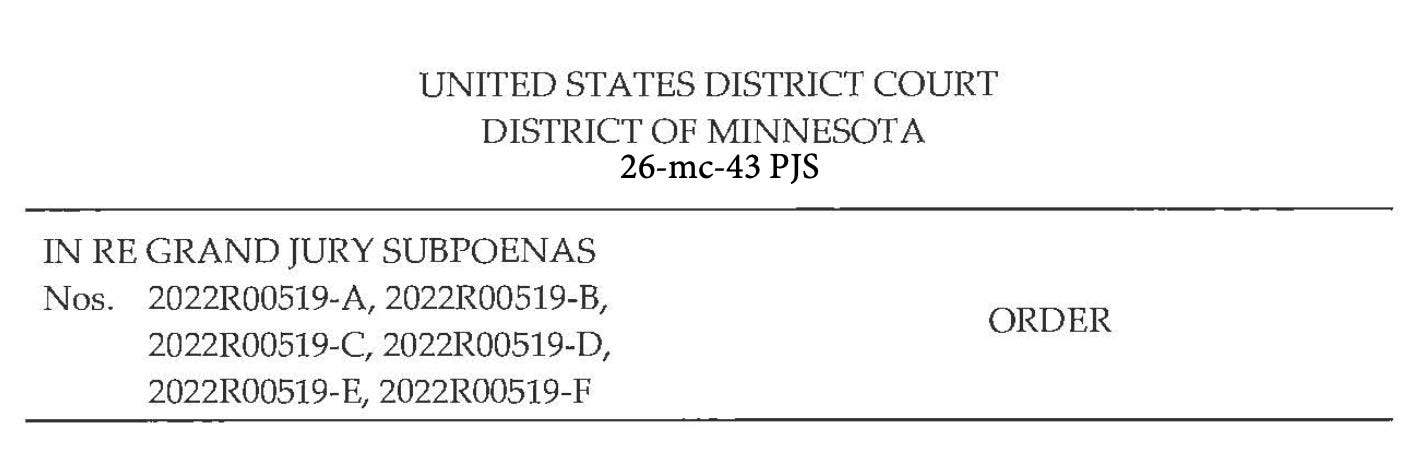
On Monday, the federal court in Minnesota made public a court order issued last week that blasted the Trump administration — specifically, the Justice Department — for its efforts to seek a large amount of immigration-related information from state and local officials.
Chief Judge Patrick Schiltz was facing motions from Minnesota Gov. Tim Walz, Minnesota Attorney General Keith Ellison, Minneapolis Mayor Jacob Frey, St. Paul Mayor Kaohly Her, and Hennepin and Ramsey county commissioners to quash six federal grand jury subpoenas that had been issued January 20, 2026.
“Because the Court finds that the dominant purpose of the challenged subpoenas is to coerce Minnesota officials into assisting the federal government with enforcing civil immigration law and to harass and retaliate against them for failing to do so, the Court grants the motions to quash,“ Schiltz, a George W. Bush appointee, wrote.
Schiltz, who has called Trump administration officials to account for the federal government’s failure to comply with orders coming out of litigation resulting from Operation Metro Surge, made clear that this latest decision was not a particularly close call.
![Initiating a criminal investigation in order to harass political opponents or to coerce them into taking official action-particularly official action that the federal government cannot directly require those political opponents to take-is a blatantly unlawful and unethical use the grand-jury process. See In re Grand Jury Subpoenas Nos. [Redacted] & [Redacted], 2026 WL 710202, at *6 ("[I]f prosecutors are forbidden from meddling with an official's duties, then they cannot use criminal investigations to pressure him into enacting their preferred policies."). The only question, then, is whether the challenged subpoenas were issued for one of these forbidden purposes.](https://substackcdn.com/image/fetch/$s_!uwsN!,f_auto,q_auto:good,fl_progressive:steep/https%3A%2F%2Fsubstack-post-media.s3.amazonaws.com%2Fpublic%2Fimages%2F083d72e2-ab89-41bb-b810-bff555e7a633_1384x750.png "Initiating a criminal investigation in order to harass political opponents or to coerce them into taking official action-particularly official action that the federal government cannot directly require those political opponents to take-is a blatantly unlawful and unethical use the grand-jury process. See In re Grand Jury Subpoenas Nos. [Redacted] & [Redacted], 2026 WL 710202, at *6 (\"[I]f prosecutors are forbidden from meddling with an official's duties, then they cannot use criminal investigations to pressure him into enacting their preferred policies.\"). The only question, then, is whether the challenged subpoenas were issued for one of these forbidden purposes.")
“The Court has no doubt that they were,“ Schiltz continued, noting, in describing the factual record, that the Trump administration has regularly “taken aim at so-called ‘sanctuary’ jurisdictions” and that “President Trump has repeatedly insulted Minnesota generally and its Somali population in particular,” among other points.
It is “beyond reasonable dispute,” he wrote, that “the subpoenas were a part of a broader campaign to coerce state and local officials in Minnesota to assist the Trump administration in its enforcement of immigration laws.”
This, Schiltz explained, runs counter to “the Tenth Amendment’s ‘anti-commandeering’ rule,” under which — quoting the Supreme Court — the federal government “may not ‘command the States’ officers, or those of their political subdivisions, to administer or enforce a federal regulatory program.’”
Because of that, he wrote, [T]he subpoenas are directed to investigating activity that is not only legal, but constitutionally protected from interference by the very federal government that issued the subpoenas.”
Looking at the “asserted investigatory purpose,” Schiltz found the government’s claims lacking and concluded, "The fact that connections between the information sought in the subpoenas and any possible criminal violation range from extremely weak to nonexistent only adds to the overwhelming evidence that these subpoenas were not issued to investigate, but to harass, coerce, and retaliate.”
With that, the subpoenas were quashed.
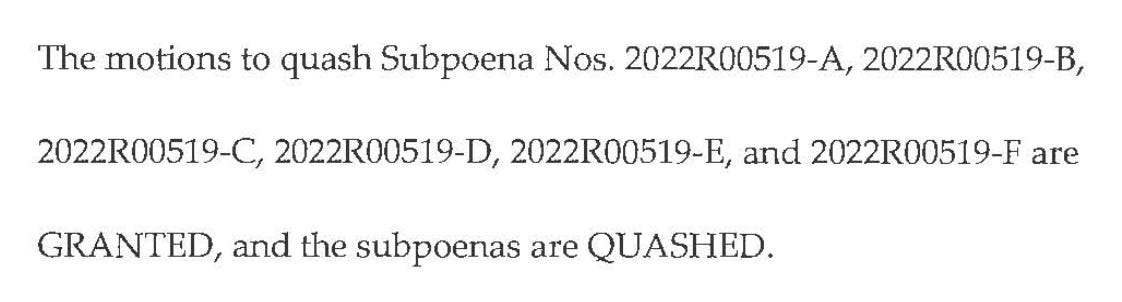
Schiltz’s order was a remarkable one. For a federal judge to block a grand jury subpoena takes a lot. As Schiltz himself noted — quoting the U.S. Court of Appeals for the Eighth Circuit, his appeals court — “[A] grand jury subpoena issued through normal channels is presumed to be reasonable, and the burden of showing unreasonableness must be on the recipient who seeks to avoid compliance.”
That presumption was overcome, easily, here.
For this to have happened once is a big deal — a blow to the Justice Department.
In 2026, however, this is becoming the norm.
In D.C., there was the effort to subpoena the Federal Reserve — another target of Trump’s wrath. There, Chief Judge James Boasberg quashed those two subpoenas with a March order.
Highlighting “one of at least 100 statements that the President or his deputies have made attacking the Chair of the Federal Reserve and pressuring him to lower interest rates,” Boasberg, an Obama appointee, wrote that the case asked: “Did prosecutors issue those subpoenas for a proper purpose?” Finding that they had not done so, Boasberg wrote, “There is abundant evidence that the subpoenas’ dominant (if not sole) purpose is to harass and pressure Powell either to yield to the President or to resign and make way for a Fed Chair who will.“
In Schiltz’s order, he quoted from Boasberg’s decision — a new example of the practice Quinta Jurecic described in The Atlantic earlier this month of judges “building upon one another’s work to adapt criminal law to an era when the federal government cannot be trusted.“
In New York, U.S. District Judge Katherine Failla on Monday scheduled a hearing for 2:30 p.m. Tuesday1 on a group of patients’ request to prevent NYU Langone and any medical care provider in New York City from needing to comply with a grand jury subpoena issued in the Northern District of Texas for records relating to the provision of gender-affirming medical care for minors. The patients’ request also seeks an order barring the Justice Department from seeking or receiving the information.
In that case, one of the patients’ arguments to the court is: “DOJ’s bad-faith investigation and utter lack of legitimate purpose demand the conclusion that the Subpoenas are oppressive and unreasonable.“ In seeking invasive, patient-identifiable information from providers in states where such care is legal, the patients explained, the effort is “[e]ffectuating the Administration’s mission to ‘end’ this necessary care.”
This, as Law Dork has covered in depth, is, itself, an escalation of DOJ’s yearlong effort to seek such information, initially through administrative subpoenas, as part of the Trump administration’s attack on gender-affirming medical care for minors and its broader attack on trans people.
All of those administrative subpoenas challenged have been quashed, in whole or in part, with judges finding that they, too, were issued for an improper purpose. As one of those judges — U.S. District Judge Jamal Whitehead, a Biden appointee — put it, “No clearer evidence of improper purpose could exist than the Government’s own repeated declarations that it seeks to end the very practice it claims to be merely investigating.“
The last-minute scheduling came after the assigned judge in the case changed repeatedly on Monday.
Very nicely explained. Thank you.
Enter Trumplandia … leave brains at door.