

Two-hundred-and-fifty years in, Justice Jackson is doing the work that is needed from our leaders
The United States needs leaders willing to speak forthrightly about our past and ambitiously about our future in order to make it through the treacherous present.

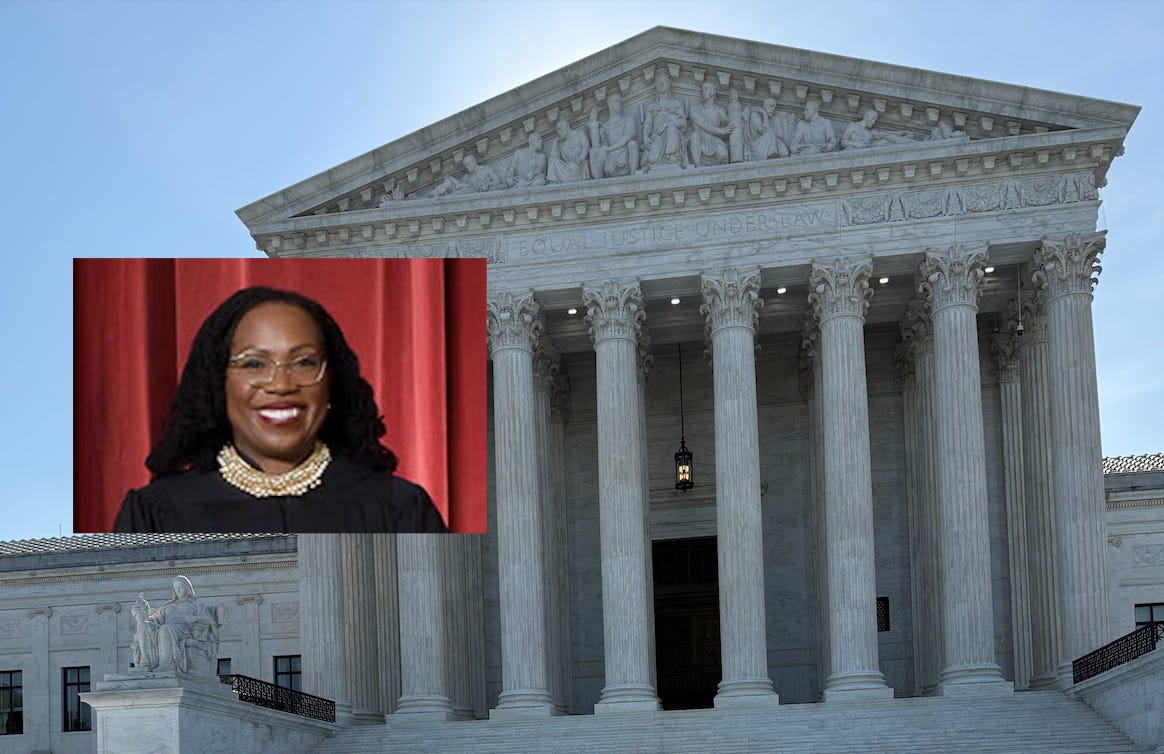
On this Fourth of July, I am thinking about how important it is for the United States that we have leaders willing to speak forthrightly about our past and ambitiously about our future in order to make it through the treacherous present.
On June 30, Justice Ketanji Brown Jackson did both, illustrating perfectly what is needed from our leaders.
In the birthright citizenship case, as I covered earlier this week, Jackson did the work that was needed to put the facts of history in the record in spite of Justice Clarence Thomas’s effort to the contrary.
Jackson’s telling of that history in Trump v. Barbara was not the hateful parody of anti-Americanism that the Trump administration insists that proponents of diversity represent. Instead, it was a beautiful celebration of the Reconstruction Amendments as “an anticaste, antisubordination reset for the Nation.”
Her discussion of the Colored Conventions alone — with reference to available documentation — was a critical example of how important Jackson’s work on the court is for the country. After discussing some efforts to encourage freed Black people to “self-deport” — a hateful phrase that felt very intentionally used — she moved forward to the effort to “guarantee[] liberty and justice for all,“ writing:
In the decades leading up to the ratification of the Fourteenth Amendment, Black Americans organized and gathered at more than 600 local and national conventions across the country.18 There, delegates erected the political and intellectual scaffolding for the Fourteenth Amendment and, later, for the Black Civil Rights Movement more generally.19
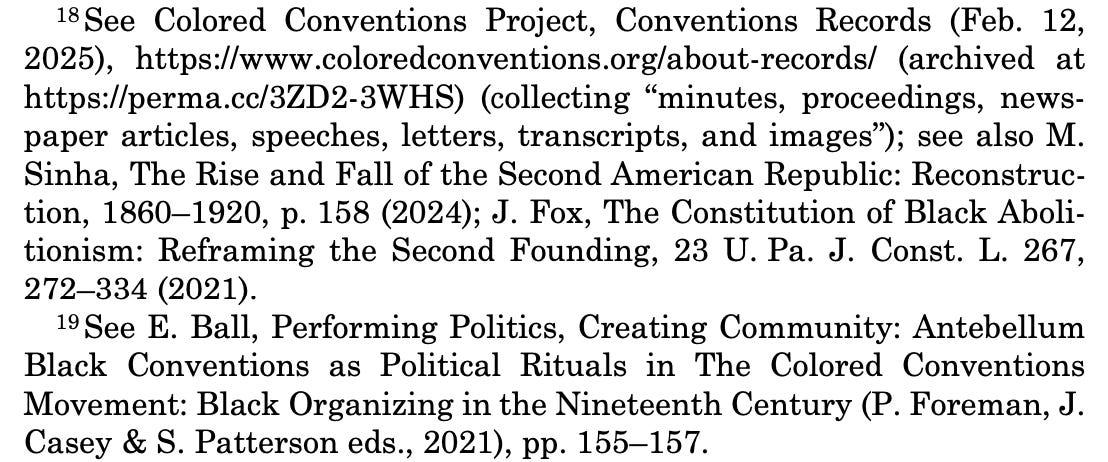
In doing so — in this brief paragraph alone — Jackson opened a path for all to greater exploration of this moment through the work of Manisha Sinha, James Fox, and Erica Bell. As I noted earlier this week, she did so throughout her opinion in an important way for the court and helpful way for all of us.
Jackson’s equally important ability to provide the needed forward-looking voice was also on display on June 30. In her other opinion that day — in West Virginia v. B.P.J. — Jackson showed an awareness of a greater way of living beyond the anti-transgender spirit that appears to be animating the majority of justice on the Supreme Court currently.
While the litigation decision in the case over West Virginia’s trans sports ban not to challenge the definition of “sex” in Title IX as meaning anything beyond “biological sex” meant that the three Democratic appointees agreed with the Republican appointees that Becky Pepper-Jackson’s Title IX challenge to West Virginia’s law failed, Jackson was not done. She authored a three-page solo opinion to add an additional, important discussion into the mix.
After describing that conclusion regarding the Title IX challenge in the B.P.J. case, she wrote, “But there is reason to doubt the soundness of the concession that Title IX’s reference to ‘sex’ means only sex assigned at birth.“
It was an essential comment, and the three paragraphs that followed spoke ambitiously about what the United States could be if its laws were, as she wrote, “properly construed.”
Jackson explained that civil rights laws like Title IX are to be construed “broadly” and that the court has noted that, within the context of sex discrimination laws, they are aimed “at the entire spectrum of disparate treatment of men and women resulting from sex stereotypes.“
From there, she explained what that means and why it matters in a way that concluded with a path forward.
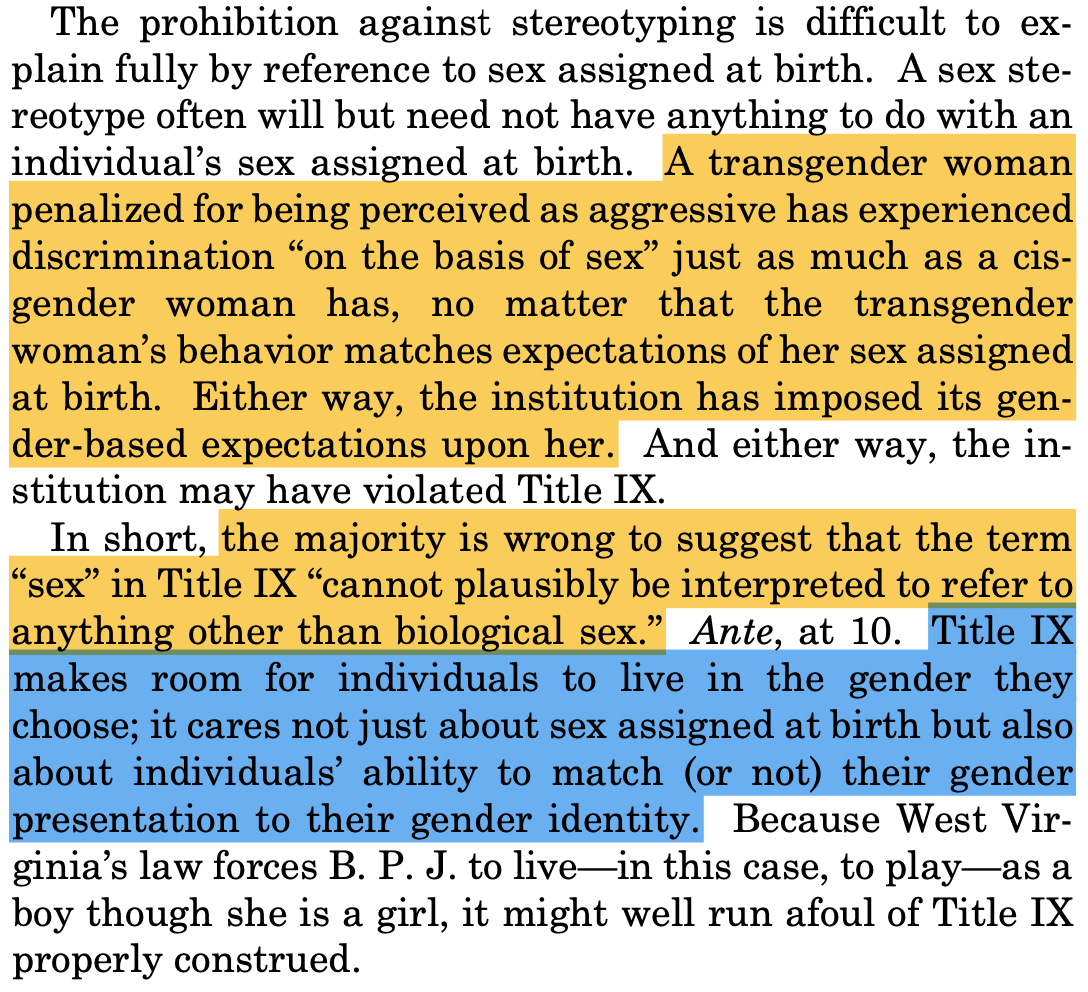
Jackson made clear that even in the midst of this anti-trans moment we can and must look ambitiously toward a better world.
“Title IX makes room for individuals to live in the gender they choose; it cares not just about sex assigned at birth but also about individuals’ ability to match (or not) their gender presentation to their gender identity,” she explained directly.
That was not the view that succeeded this week, but, as Jackson made clear in Barbara, sometimes the most important work takes time.
As one of the two youngest justices on the bench, Jackson is also 25 years younger than the president. She has made it clear this term repeatedly that she is regularly not writing for today but, rather, is writing for the future United States in which she hopes to live.
Two-hundred-and-fifty years into this experiment, Justice Ketanji Brown Jackson might very well be the exemplar of what this nation can be today because of the generations of people who learned from all that it wasn’t and were willing to change. She also appears to be seeking to carry that lesson forward, learning from the past and charting a more inclusive future.
This Fourth of July, I can celebrate that.
Thank you for this discussion. Her work is brilliant.
Wow! So beautifully written about biological sex and gender identity! I’m so glad she’s on the court! Thank you, Chris!