

The presumption of irregularity
It's a new DOJ, and that's no good. This week alone, DOJ's actions regarding executive privilege, the July sanctions order, the Epstein files, and DHS investigations are at issue.

There has been lots of talk in recent months, including from federal judges, about the ways in which the Department of Justice has lost the “presumption of regularity” that is generally afforded to government lawyers.
This week has raised a more alarming question: What happens — and how do you deal with matters — if the reality shifts even further, toward a presumption of irregularity?
On Monday, Attorney General Todd Blanche was sworn in by Judge Emil Bove — a taunting reminder that both men value keeping President Donald Trump happy as their primary goal. Both men’s actions in the first year of the second Trump administration led to ethics complaints filed against them.
It’s a new DOJ, and the first signs are no good.
That same day, the Justice Department’s Office of Legal Counsel issued an opinion concluding that a president could claim executive privilege over communications with private citizens outside of the government.
Specifically, Assistant Attorney General T. Elliot Gaiser concluded that, “as a general matter, executive privilege can apply to presidential communications with private advisers so long as the communications (1) relate to official presidential decisionmaking, (2) involve or reflect communications with the President or his direct advisers, and (3) are confidential.“
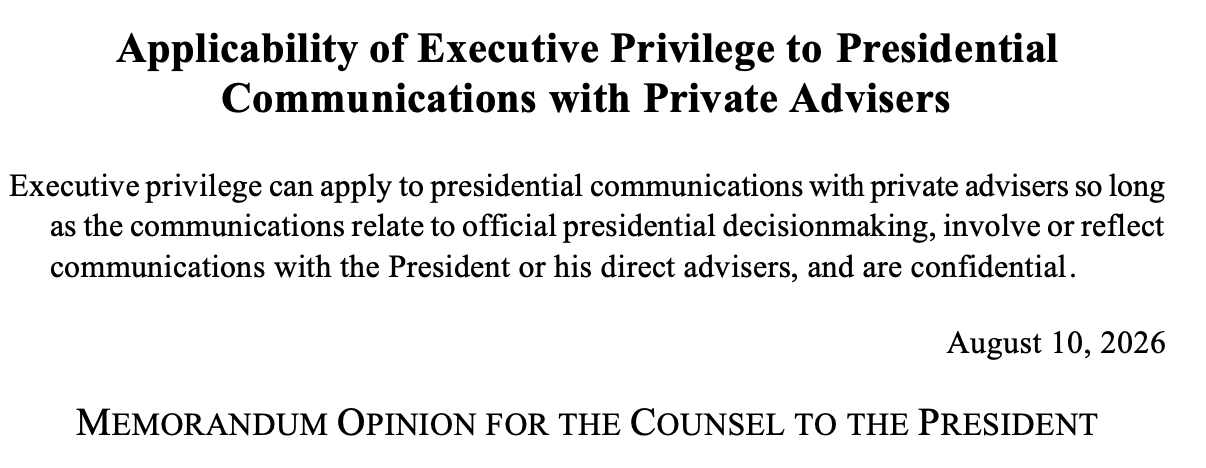
In order to reach that conclusion — and claim some semblance of historical support for it — Gaiser had to shake things up a bit and simply drop a footnote: “For the purposes of this memorandum, we use the term ‘private advisers’ to include anyone the President consults outside the Executive Branch, whether they be members of the public, state officials, or employees of other branches of the federal government.“
With that sleight-of-hand, Gaiser was able to conflate any historical discussion of federal officials, state officials, and private officials as being part of the same legal matter.
The implications are a feature, not a bug, for Gaiser. After noting that “the President’s governmental advisers typically are publicly affiliated with him, and therefore with his policies and administration, regardless of the advice they provide,“ he explained that private advisors — with private interests — might not want to communicate their thoughts with the president if the public — or even Congress — might later find out what they said.
Gaiser wrote:
Outside advisers, by contrast, may have little or no affiliation with the President apart from the specific advice sought. Such individuals may be reluctant to provide advice on controversial or unpopular policies based on a fear of public disclosure or potential ramifications for their personal endeavors. The President must be able to protect the confidentiality of his communications with these advisers if he is to “ensure that presidential decision-making is of the highest caliber, informed by honest advice and full knowledge.”
The president must be able to keep discussions with private individuals private because they might be not want the public to know what they said.
The primary OLC opinion relied upon by Gaiser to support this week’s opinion is a 2007 opinion, “Assertion of Executive Privilege Concerning the Dismissal and Replacement of U.S. Attorneys.“ Yes, the opinion used, by Paul Clement, was one saying the president could keep Congress from getting information about the 2006 politicized firing of U.S. Attorneys during the George W. Bush administration. The questions over the firings — along with then-Attorney General Alberto Gonzales’s response in congressional hearings — eventually led Gonzales to resign.
It’s true. The firings and that scandal seems quaint now, but, just 20 years ago, it was, indeed, a big scandal.
This week, it’s justification for a DOJ argument for even broader government secrecy.
That’s not all.
On Wednesday night, a senior DOJ political appointee filed a brief supporting Trump’s motion to block the sanctions order U.S. District Judge Kathleen Williams issued in July relating to the Trump v. IRS litigation and attempted “settlement” of the case to create the “Anti-Weaponization” slush fund.
Acting Deputy Attorney General R. Trent McCotter — on the day it was reported that he would be taking the title in the midst of Blanche’s promotion — not only backed the request from Trump’s private lawyers to stay the sanctions order but also asked that the appeals court reassign the case when it sends it back to the district court.
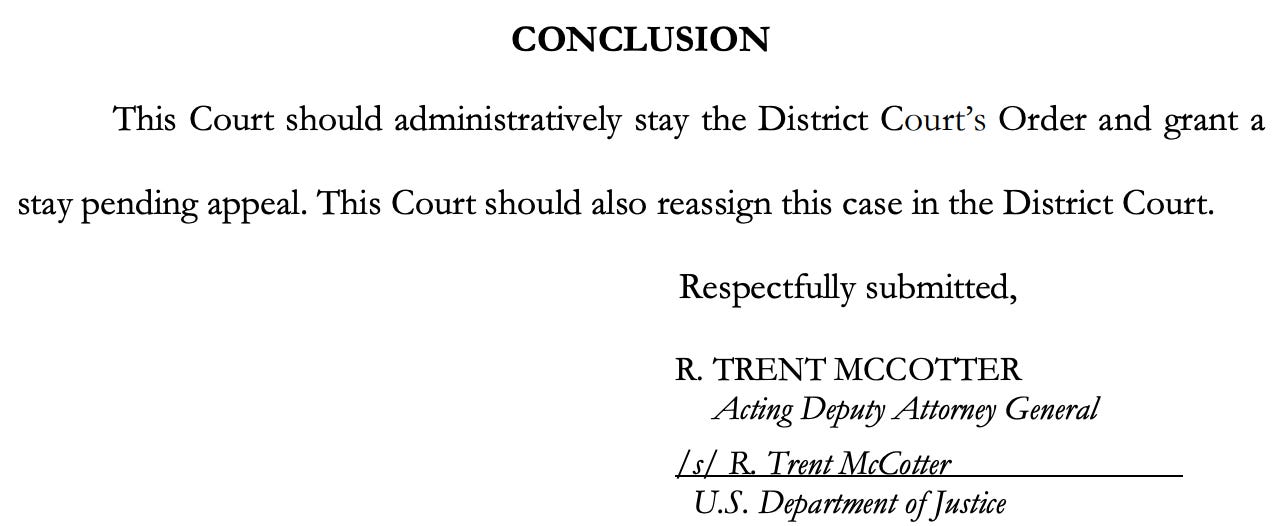
The entire brief was a politicized screed, illustrating quite clearly why Williams had found that the case had been “brought for an improper purpose.”
McCotter — in one of his first acts, if not his first act, as acting deputy attorney general — submitted the following paragraph to the Eleventh Circuit:
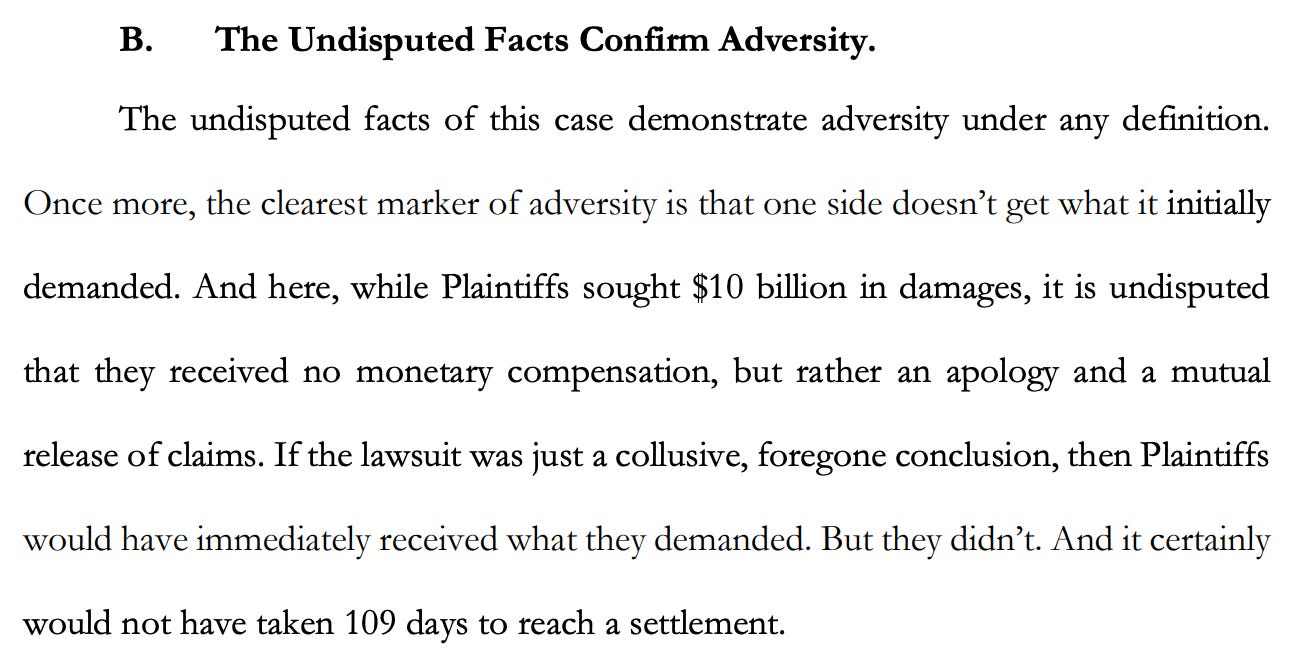
This wasn’t collusive litigation, McCotter insisted, because the federal government didn’t just immediately pay the president $10 billion.
Gotcha.
There’s more.
On Thursday, U.S. District Judge Emmet Sullivan made clear that contempt was on the table in Katie Phang’s lawsuit over DOJ’s non-compliance with the Epstein Files Transparency Act.
As Adam Klasfeld reported, Sullivan made his frustration clear on Thursday:
Attorney Emily Gilman, who is representing Phang on behalf of the Public Integrity Project, said that the plaintiff’s team shares the concern of protecting “genuine victim information” — but doesn’t trust that is actually the government’s goal.
“They just don’t want to produce those documents,” Gilman said.
The government’s attorney emphatically denied that, adding that he could be more candid in speaking to the judge in private.
Sullivan then explained why he convened the hearing to be public rather than sealed.
“The public has a right to know what the hell is going on in this case,” Sullivan said. “The victims have a right to know.”
It’s not just DOJ — although DOJ plays a key part in the final example as well.
Earlier Thursday, the lawyer for one of the people charged (by DOJ) in a mass-prosecution coming out of Operation Metro Surge in Minnesota, filed a shocking brief detailing information that the federal government has already turned over in the prosecution.
The key news is that Homeland Security Investigations (HSI) within the Department of Homeland Security opened an invasive operation days after agents killed Alex Pretti — not into immigration enforcement operations, but, rather, those protesting the fatal operations.
The name: Operation Puppet Master.
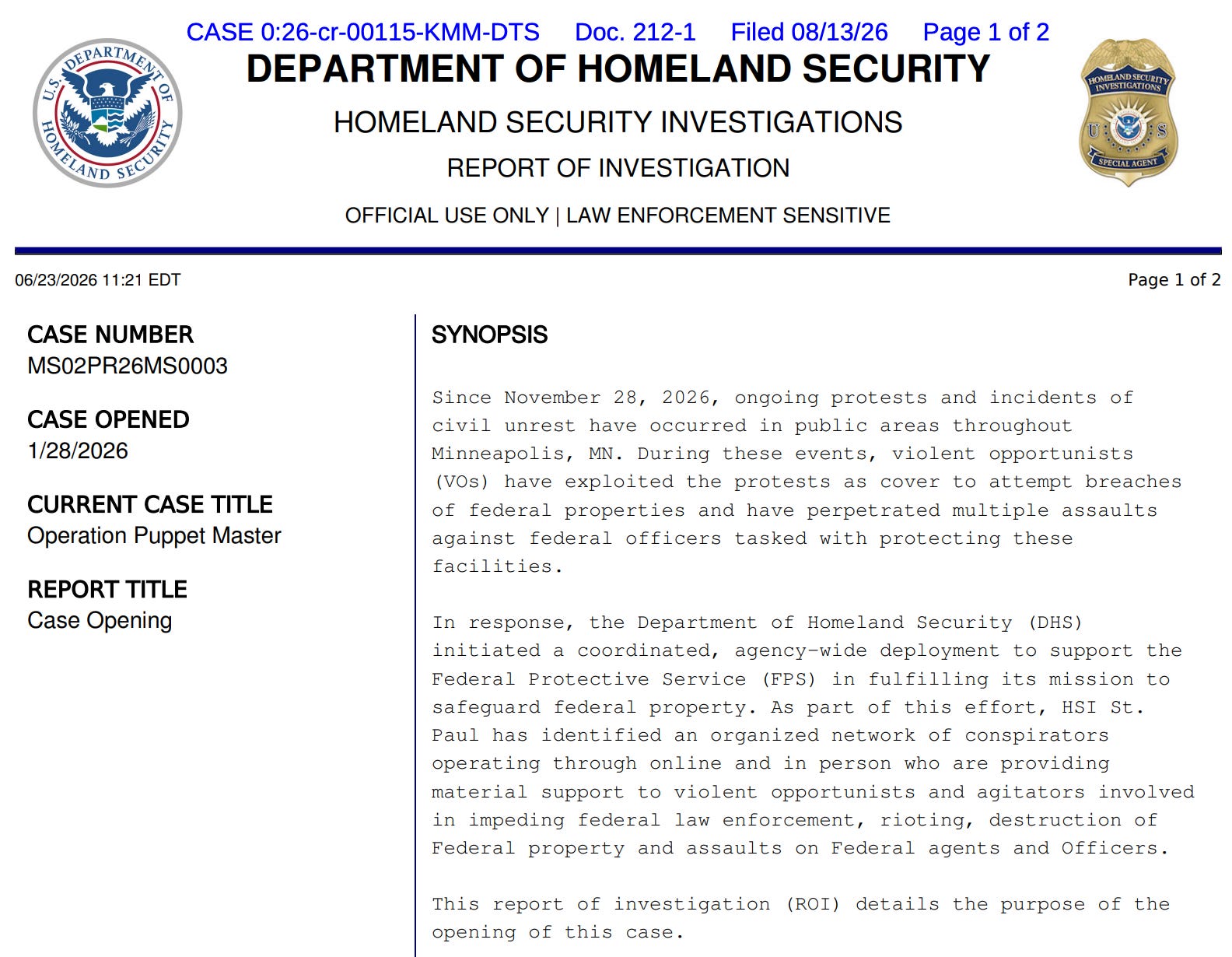
Of this operation, Kevin Riach, lawyer for Isaac Sant, wrote, “During Operation Metro Surge, undercover agents posing as protesters surveilled community meetings at churches, parks, libraries, schools and union halls. These agents surreptitiously recorded dozens of conversations with ordinary people who were simply exercising their First Amendment right to protest ICE’s lawless rampage in our state.”
Beyond that, Riach explained:
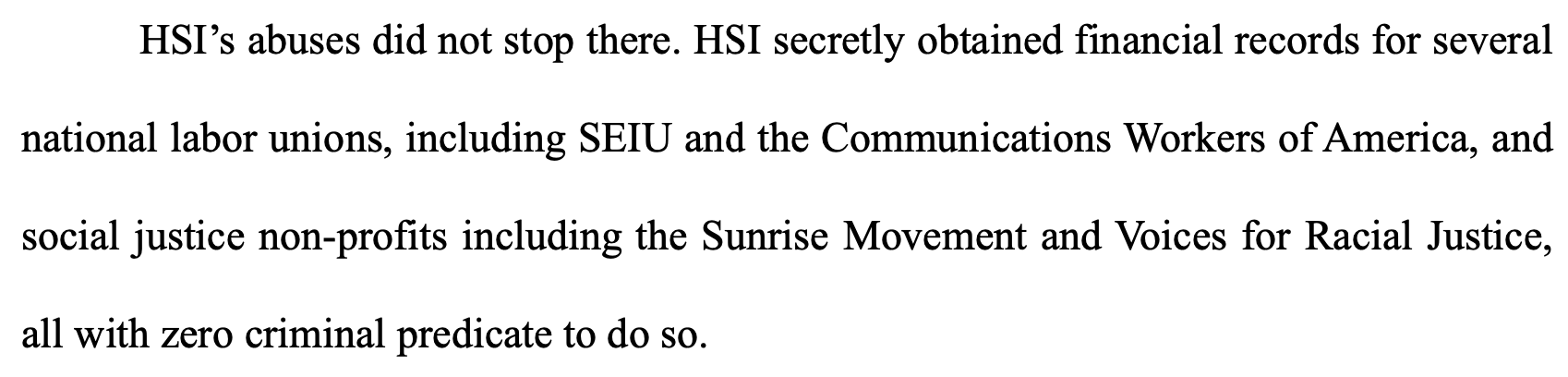
And, of course, Riach noted, “The government’s presentation to the grand jury reflected this broad and irrational investigation.”
The purpose of the filing was to seek an order that the government disclose information that it must disclose and that Riach alleged it is still holding back.
In other words, Riach believes this is just the tip of the iceberg.
DOJ, through the U.S. Attorney’s Office in Minnesota, chose to bring this mass-indictment — with a press conference announcement and all — likely fully aware of all of the underlying information Sant’s lawyer discussed in Thursday’s filing.
There was much reporting on this throughout the day, including MPR News’s Jon Collins; The Guardian’s Sam Levin and Rachel Leingang; and Democracy Docket’s Natalie Hausmann and Jacob Knutson.
The response in this moment is to push back, and that is correct, but that is just the beginning.
If the presumption of irregularity is the norm in the Blanche era, then lawyers, judges, journalists, and anyone else engaged in this moment is going to need to adjust their ways of operating accordingly.
Thanks for the info/update. I’m way past “Susan Collin’s Concerned” about this.
Also, didn’t realize Bove swore Blanche in…that pretty much sums up where this is going.
This week has raised a more alarming question: What happens — and how do you deal with matters — if the reality shifts even further, toward a presumption of irregularity?
It already has. From TLA (Three Letter Agencies) protecting and supporting TRump to ICE and CBP abusing people regardless of citizenship it has gotten really irregular.