

Federal judge finds Trump's IRS case and "settlement" was "improper," sanctions lawyers
Judge Williams: "[T]his was an attempt to use the Court to provide some legitimacy to an agreement to confer immunity to people and entities affiliated with the President."

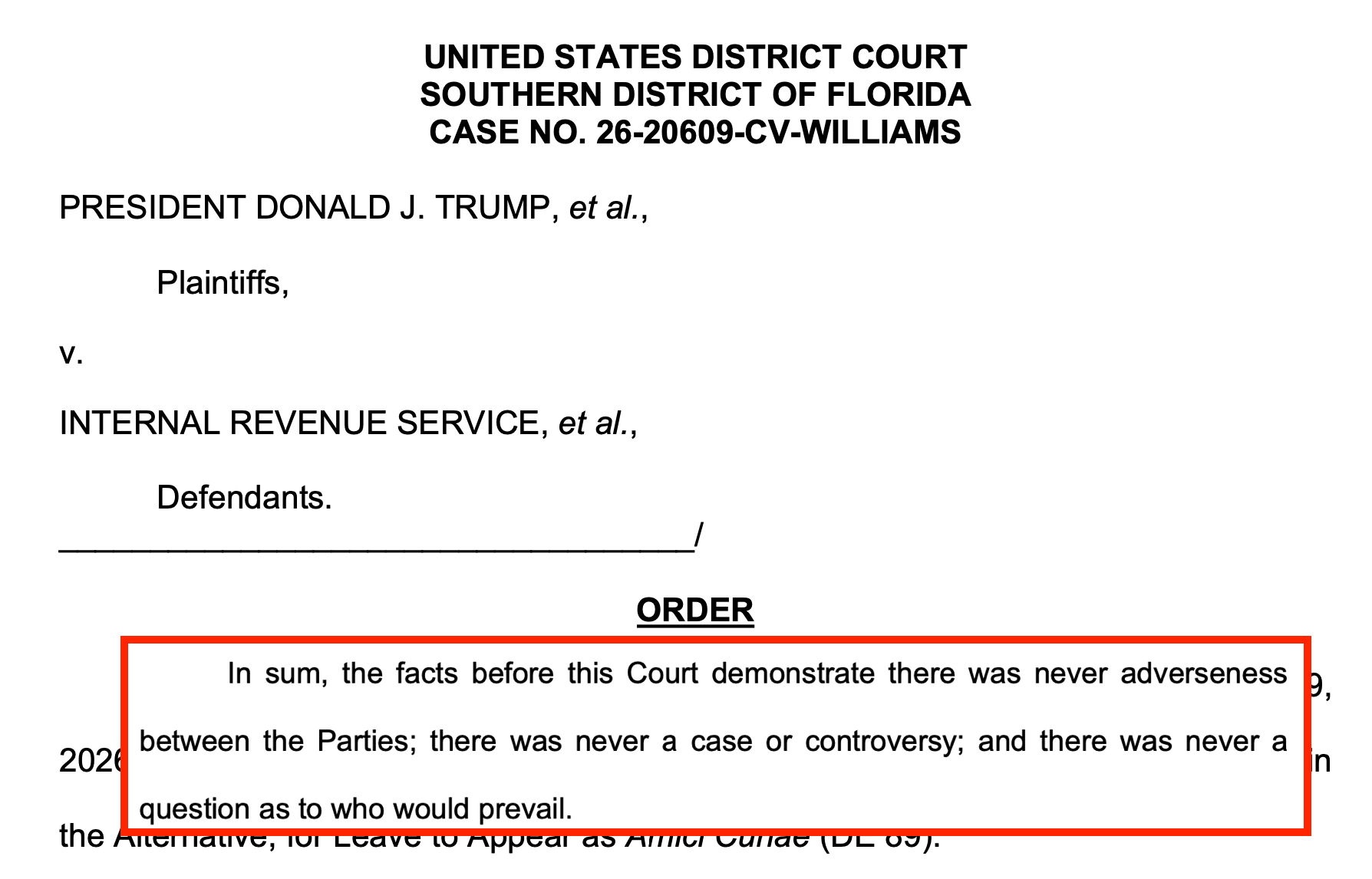
A federal judge on Monday issued an extraordinary ruling that concluded the Justice Department and private lawyers representing Donald Trump improperly had “a shared, unitary interest“ in purporting to settle Trump’s lawsuit against the Internal Revenue Service through the creation of the now-jettisoned “Anti-Weaponization” slush fund and immunity for Trump from tax-return prosecution.
“[T]he Court finds that this matter was brought for an improper purpose—to gain the imprimatur of judicial legitimacy for a ‘settlement’ that had no viable basis in law or fact,” U.S. District Judge Kathleen Williams wrote.
Williams, an Obama appointee, sanctioned Trump’s lawyers by referring Alejandro Brito to the Florida Bar and ordering that Daniel Z. Epstein not be allowed to practice in the Southern District of Florida for one year; ordered monetary sanctions as well; ordered that Monday’s opinion be sent to the State Bar of New York and District of Columbia Bar, where Acting Attorney General Todd Blanche and Associate Attorney General Stanley Woodward already face bar complaints; and prohibited any parties from holding out what they concocted as a settlement.
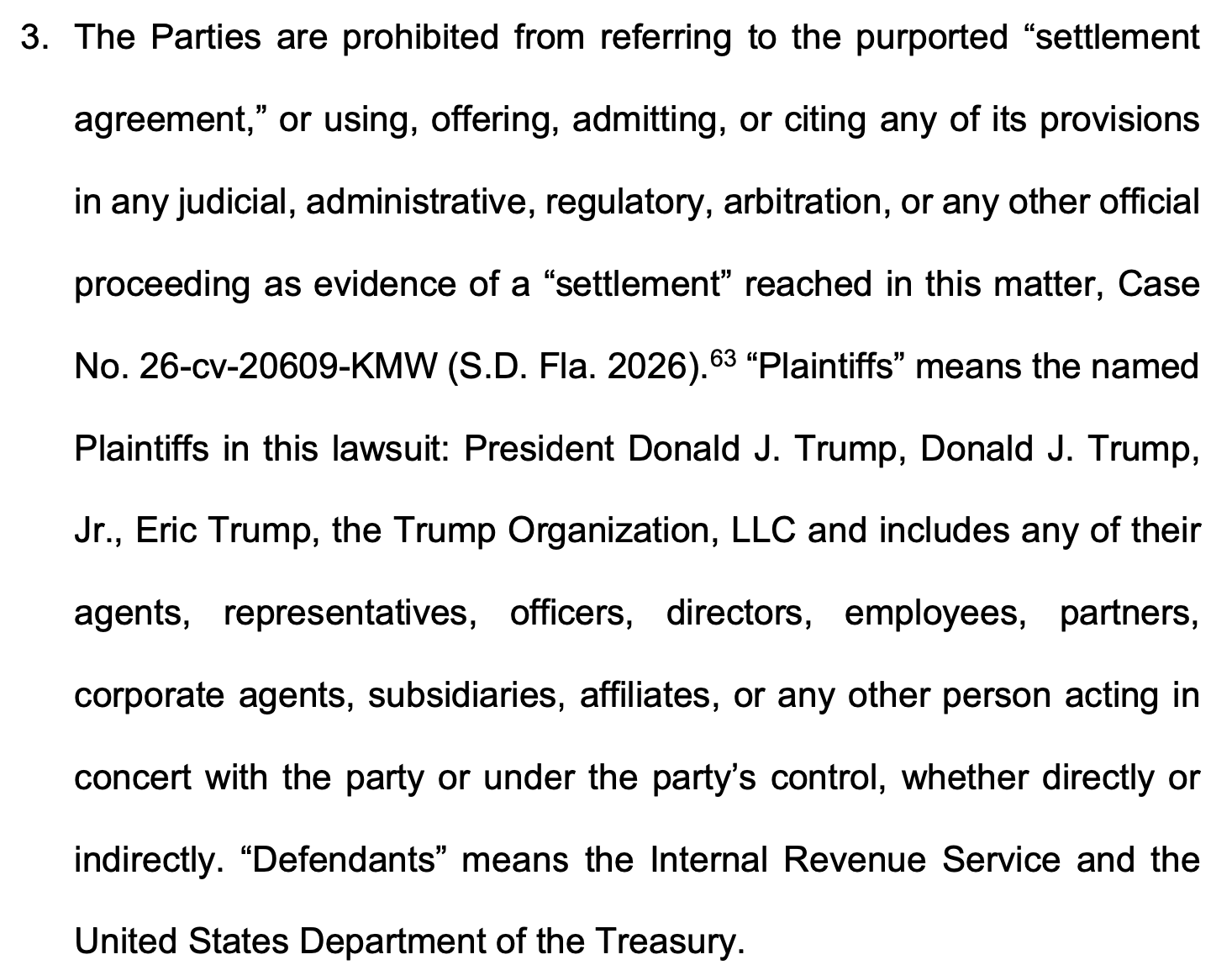
Williams found sanctions appropriate both under Rule 11 of the Federal Rules of Civil Procedure and the court’s inherent authority.
“The Parties used the existence of federal litigation as a means of conferring legitimacy upon a course of action that they were unwilling to subject to judicial review,“ she wrote in invoking the court’s inherent authority “to police the matters and litigants who avail themselves of its jurisdiction.“
Williams reviewed the matter before her in depth, clearly aware of the stark circumstances and, as she put it, “sui generis“ — one of a kind — nature of the case.
“This action was never about a party seeking judicial resolution of a legal issue or a factual dispute,” Williams wrote. “The nature of the suit itself and the conduct of the Parties and counsel from its filing make plain that this was an attempt to use the Court to provide some legitimacy to an agreement to confer immunity to people and entities affiliated with the President and to earmark billions of dollars from American taxpayers to redress grievances not defined in the law.”
Williams issued the 56-page opinion and order after a group of retired judges had filed their own request to the judge to reopen the matter after Trump and DOJ purported to settle the lawsuit. The former judges, as Williams noted Monday, raised the request because of a concern that the case appeared to be “a fraud on the court.”
Although Trump’s lawyers had argued that Trump was filing the suit against the IRS in his “personal capacity” over the illegal disclosure of some of Trump’s tax returns by a contractor, Williams, an Obama appointee, wrote that “the Court declines to adopt or accept the credulous exercise of divorcing President Trump’s current job title from an understanding of what happened here.”
Before reaching the conclusion that sanctions were appropriate, Williams first detailed the facts of the case, her previously raised “serious concerns about whether [the court] had subject matter jurisdiction in a case where the Lead Plaintiff ostensibly had direct, unassailable control over Defendants,“ and the plaintiffs’ dismissal of the case days before they were to respond to Williams’ concerns.
That coincided with DOJ’s May 18 announcement of the $1,776,000,000 “Anti-Weaponization Fund” as part of the purported “settlement agreement,” which Blanche testified about before Congress the next day. Blanche also issued an addition to the “settlement agreement,” purporting to immunize Trump and related individuals from prosecutions coming out of any audits based on “tax returns filed before” May 19.
By June 2, Blanche testified that, as Williams wrote, “the Anti-Weaponization Fund would not be moving forward,” adding, “He did not, however, commit to a similar termination of the audit and immunity protections set forth in his Release Order.”
Getting to the question before her, Williams was incredulous. “Plaintiffs and Defendants are not adverse because one party controls this litigation,” she wrote. “[T]he Court determines that Plaintiffs improperly employed this lawsuit to justify a particular award in this matter—access to taxpayer funds and exemption from audits and other investigations—which was accomplished by leveraging control over Defendants.“
Quoting from the recent Supreme Court decision over presidential firing powers:
Plaintiffs cannot argue before the Supreme Court that Executive Branch actors “unquestionably exercise[] executive power, and must therefore be controlled by the Chief Executive[,]” Slaughter, 609 U.S. at 27, and then here, argue that the Parties are sufficiently adverse to establish an actual case or controversy.
Specifically regarding the actions of Blanche and Woodward — in the two top roles at DOJ currently — Williams was blunt and to the point.
Noting that Blanche had represented Trump in multiple key criminal matters and that Woodward had, among others, represented Trump’s co-defendant in the Mar-a-Lago documents case, Williams wrote, “Instead of either recusing because of their previous representations or vigorously defending this lawsuit as required to do so by DOJ policies and procedures, these lawyers agreed to a ‘settlement’ involving a staggering amount of money potentially benefitting former clients.”
Williams stated that she was, in particular, “extremely troubled“ by Blanche’s congressional testimony regarding why the purported “settlement agreement” was not “submitted to this Court for review.”
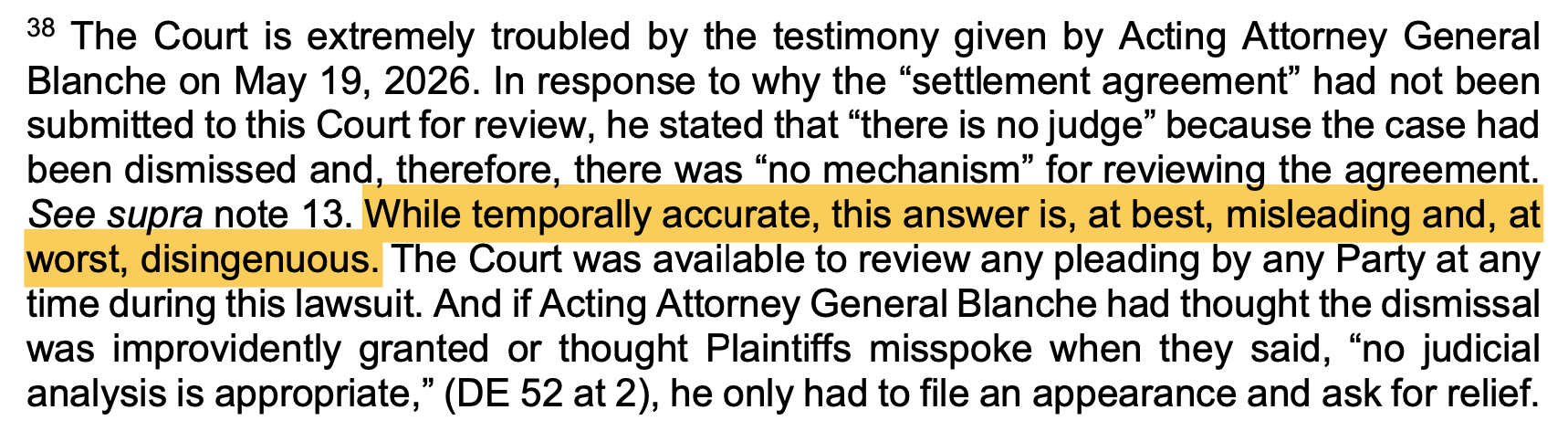
The behavior of all of the lawyers here was clearly a problem. As Williams wrote:
No sitting President has ever sued federal agencies completely subject to his control for monetary benefits, or any benefits that inure to him, his family, and associates. The failure of any attorney in this case to address, on this docket, the relationship of this Article II proscription with the benefits conferred by the “settlement” is a glaring omission that speaks to the control of the Lead Plaintiff.
Ultimately, the matter was simple.
“In sum, the facts before this Court demonstrate there was never adverseness between the Parties; there was never a case or controversy; and there was never a question as to who would prevail,” Williams wrote.
That is not our system, and, on Monday, Williams stood up for that system.
District courts have had enough. We would still have a strong democracy if SCOTUS would have the same wisdom and not insert their personal beliefs in the place of lower court decisions.
Improper? It was a fraud on the American people! The time has come for the legal profession to officially denounce it and pursue punitive measures against the perpetrators.