

John Roberts's 5-4 opinion saving the Fed should have saved all independent agencies
In his 6-3 opinion over the Federal Trade Commission, however, Roberts ended the independence of the FTC and other agencies, sowing "chaos" across the federal government.

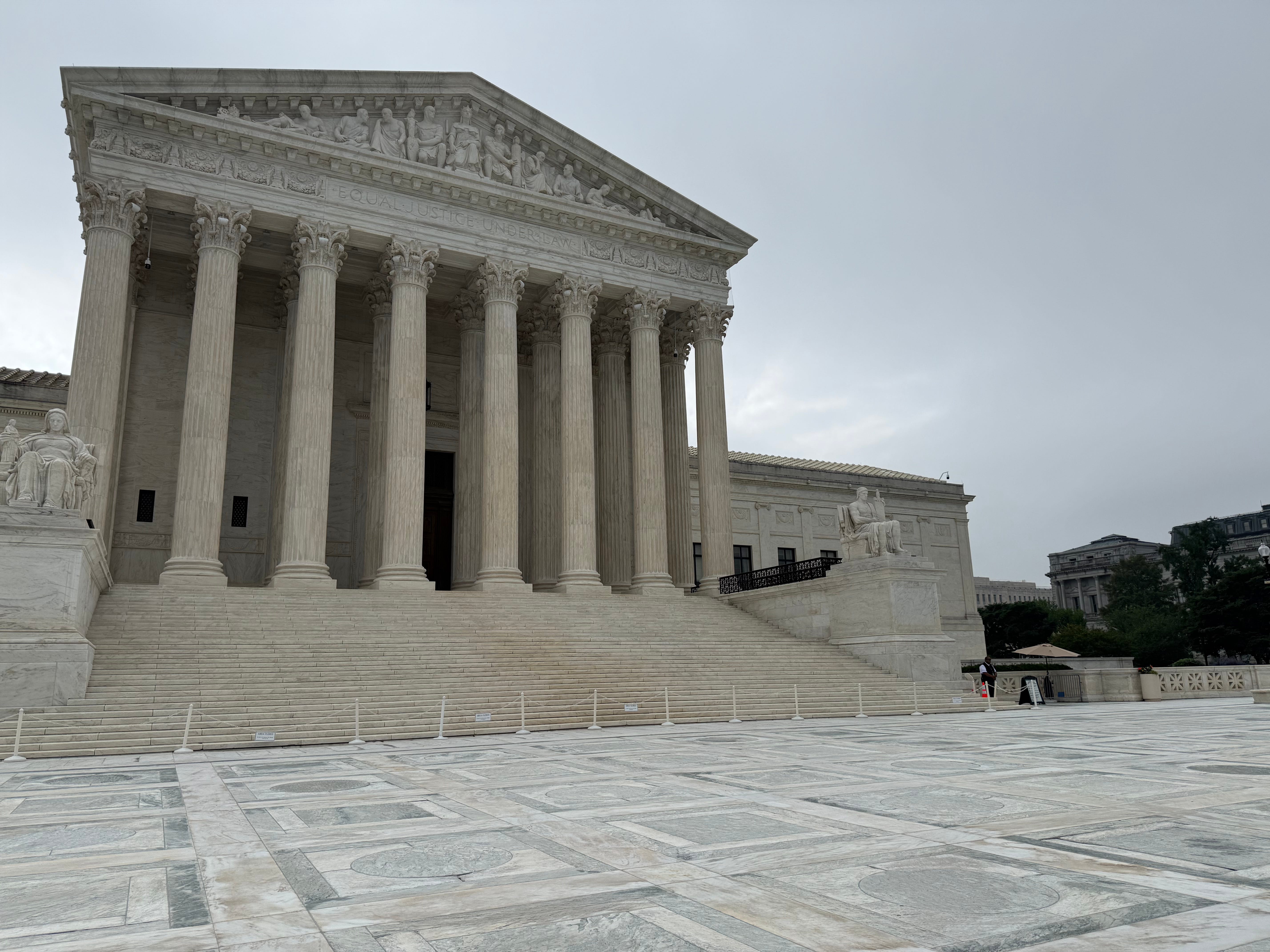
On Monday, Chief Justice John Roberts issued two major decisions addressing presidential firing powers of so-called independent agencies — the second protecting the Federal Reserve’s independence even as the first, addressing the Federal Trade Commission, purported to lay out a broad principle ending the independence of such agencies by holding that removal protections are unconstitutional.
When the two are considered together, Roberts — by writing both decisions — showed the emptiness of the project. Even from 30,000 feet, the two opinions show how simple it was for Roberts — with support from Justice Brett Kavanaugh — to save the Fed’s independence from the rule he had just laid out in allowing President Donald Trump to fire Rebecca Slaughter as an FTC commissioner for no reason.
“Last August, for the first time in the Federal Reserve’s 111-year history, the President attempted to fire one of its Governors,“ Roberts began the opinion for the court denying the Trump administration’s request to stay a lower court’s injunction keeping Lisa Cook in office as a governor of the Federal Reserve during litigation. This was not subtle. With 22 words, Roberts told everyone that the court couldn’t believe what Trump had done. Everything that followed fit with that opening.
Compare that to the opening of his opinion rejecting the for-cause removal protection for FTC commissioners.
“Nearly 250 years ago, the Framers decided to vest ‘[t]he executive Power’ in one person—‘a President of the United States of America,’” Roberts wrote. In the 480-word introductory section, Roberts does not once mention the firing of Slaughter. He also did not mention Humphrey’s Executor v. United States, the 1935 Supreme Court decision upholding the FTC’s for-cause removal protection that Roberts and the 2026 Supreme Court was about to overrule.
Ultimately, Roberts wrote:
The FTC unquestionably exercises executive power, and must therefore be controlled by the Chief Executive, in whom such power is vested. It follows, then, that Slaughter served as the President’s subordinate at the FTC—and that the President was entitled to cut her tenure short.
The decision significantly expands Trump’s power — and could, as Law Dork has covered previously, change the country.
Justice Sonia Sotomayor authored the liberals’ dissent in Trump v. Slaughter, and, as she did last week, she read from her dissent from the bench on Monday.
“For most of this Nation’s history, Congress and the President together have decided that some Government functions should operate at a distance from partisan politics,“ she opened the dissent, noting that the Supreme Court had “affirmed” that understanding in Humphrey’s Executor. Of the majority’s action on Monday, she then wrote, “Today, this Court undoes centuries of political practice and concludes that all three branches of Government have been acting in open defiance of the Constitution all this time. Its conclusion is wrong.”
There are many problems with Monday’s Slaughter ruling.
As Sotomayor explained in describing the “chaos” that the majority’s ruling “promises to unleash,” the ruling set up — but did not address — the implications or reach of its ruling.
“With remarkable steadfastness, the majority simply refuses to explain where its theory leads or where it ends,” she wrote.
For his part, Justice Neil Gorsuch highlighted, in an opinion concurring with Roberts’s decision, a separate — but related — problem that will follow Monday’s decision in Slaughter given the time that passed between Humphrey’s Executor and Monday:
Apparently relying on the assumption that it can afford their leaders some protection against presidential removal, Congress has not just assigned executive law-enforcement power to independent agencies. It has delegated extensive lawmaking and adjudicative functions to them as well. Today’s decision may not have occasion to address those delegations directly, but it carries weighty consequences for them. Open-ended delegations of legislative power have not gone away; now they will just be exercised by agency officials who answer to the President. The power to write new regulatory crimes still exists, but now the pen ultimately rests in the President’s hand. The ability to judge disputes in-house remains, but now the house is white.
In short, all of the independent agencies created by Congress in reliance on Humphrey’s Executor now exist in a way that Congress had not wanted: in the hands of the president.
As to Sotomayor, she noted several of the unanswered questions about the reach of Monday’s Slaughter decision.
First, she noted that the majority “suggests that its rule might not apply to adjudicatory agencies, including non-Article III courts like the Tax Court.” To that, she wrote, “That is welcome news, but why is it so?”
Second, what about “inferior officers and civil-service employees”? Noting that the majority “studiously ignores” that huge question, Sotomayor cited the 1886 ruling, United States v. Perkins, allowing protections against at-will removal for inferior officers. Then, though, she wrote:
Until today, however, Perkins and Humphrey’s were the “two exceptions to the President’s unrestricted removal power” this Court had recognized. Seila Law, 591 U. S., at 204. With one of those exceptions now wiped away, the majority’s silence on the other one provides cold comfort. Nor is there much in the majority’s logic that supports drawing a line at principal officers. Inferior officers (and likely many employees within the civil service) wield some executive power.
Finally, Sotomayor pointed to Roberts’s other opinion on Monday.
“Perhaps most strikingly, the Court today also makes clear that, whatever the logic of its decision, there are some ad hoc historical exceptions to its totalizing view of Article II, at least for the Federal Reserve,” she wrote.
I’m not sure Sotomayor went far enough.
The ad hoc exception that Roberts wrote about on Monday in upholding the for-cause removal protection for Fed governors in Trump v. Cook showed why Slaughter is insupportable and should not stand the test of time.
Addressing Justice Clarence Thomas’s dissent in the Fed case, Roberts wrote:
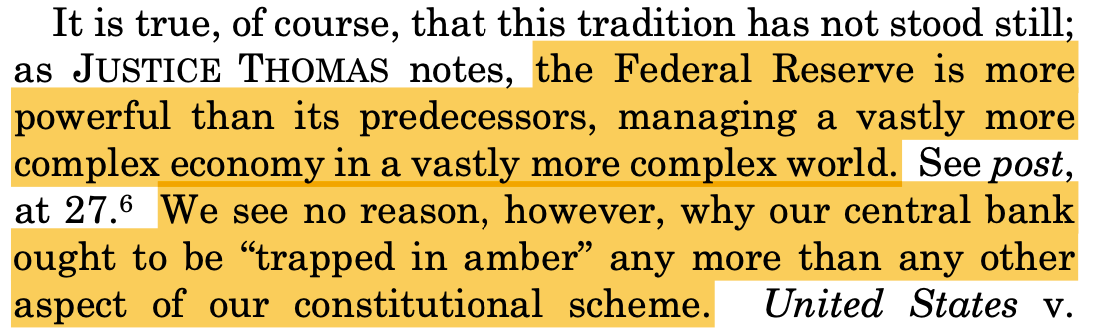
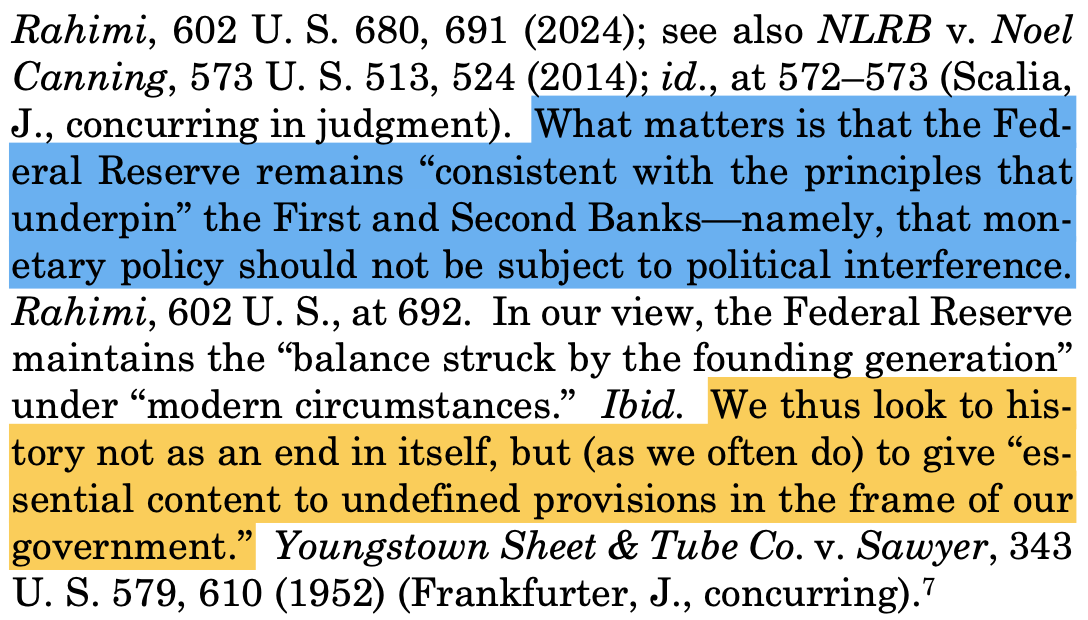
This is Roberts at his best and worst.
It is, he acknowledged, “a vastly more complex economy in a vastly more complex world” today. He went on to acknowledge that government need not be “trapped in amber” based on practices in a far less complex time and that we “look to history … to give essential content to undefined provisions in the frame of our government.”
That’s the good.
But then, in the middle of that, Roberts insisted that “[w]hat matters” is that the Fed is “consistent” with the First and Second Banks and their commitment “that monetary policy should not be subject to political interference.”
That claim is only necessary because to excise that would be to obliterate his Slaughter decision.
If you take out that one sentence from the above paragraph, the understanding of Roberts’s Cook decision would change dramatically.
What that paragraph would then say is that the First and Second Banks show that our longtime constitutional understanding is that Congress — under its constitutional authority — can create entities as it desires, so long as they accord with their constitutional powers to create those entities.
There is no constitutional reason to limit that independence to “monetary policy” just because John Roberts cares about the independence of monetary policy. The legal, constitutional point it proves is that Congress can create that independence.
Ironically, it is Thomas, in dissent in Cook, who most clearly illustrated the incompatibility of Roberts’s pair of opinions. Of Slaughter, Thomas wrote:
Any statute that limits “[t]he President’s power to remove—and thus supervise—those who wield executive power on his behalf ” is unconstitutional. Seila Law, 591 U. S., at 204 (plurality opinion). This principle admits no exceptions: “The Constitution places all Executive power in the hands of the President.”
Of the Fed, he then wrote (quoting Slaughter), “The Board ‘unquestionably exercises executive power, and must therefore be controlled by the Chief Executive, in whom such power is vested.’ … The President, therefore, may remove Cook for any reason that he wants and by any procedure that he wants.“
That’s not what happened. As Thomas wrote, quoting both of Roberts’s Monday opinions:
Instead, the Court endorses a contradiction: “the Constitution vests the whole executive power in the President alone,” Slaughter, 609 U. S., at ___ (slip op., at 21) (internal quotation marks omitted), but the Board can exercise executive power “independen[t] from Presidential control,” [Cook], at 22.
Thomas is wrong in his analysis, concluding that Roberts was right in Slaughter and wrong in Cook, but he is right that there is a contradiction.
The problem is that Roberts refused to let his reasoning in Cook light the way for a decision affirming Humphrey’s Executor — and allowing the federal government to continue to operate is it has for the past 100 years.
Instead, the courts — and country — will now face the questions that Sotomayor (and Gorsuch) detailed and that Roberts left unanswered.
What fantasy world do these arch conservatives live in? In Holder v. Shelby County, Texas was deemed mature enough to avoid preclearance. Justice Kavanaugh assured us that his stops would be quick and nearly imperceptible. Here, a president can fire nearly at will, without notice or justification, because he what? Is noble, honest, caring about his country … none of which Trump is—honoring an ideal kingship without reference to that prospective king. “Oh, don’t worry—Adolph loves German shepherds!”
Yes, it is a "a vastly more complex economy in a vastly more complex world". So, what about the SEC? I would argue that enforcing the integrity of offerings and financials in the market is just as complex as setting interest rates. What about the FDA? Biology is vastly more complex than setting interest rates. And nuclear engineering? What an incredibly naive view of the world.