

Supreme Court holds that Colorado's conversion therapy ban "censors" talk therapists
Justice Gorsuch wrote for the 8-1 court that the law is presumptively unconstitutional as to talk therapy. Justice Jackson dissented, writing that the “fallout could be catastrophic.“

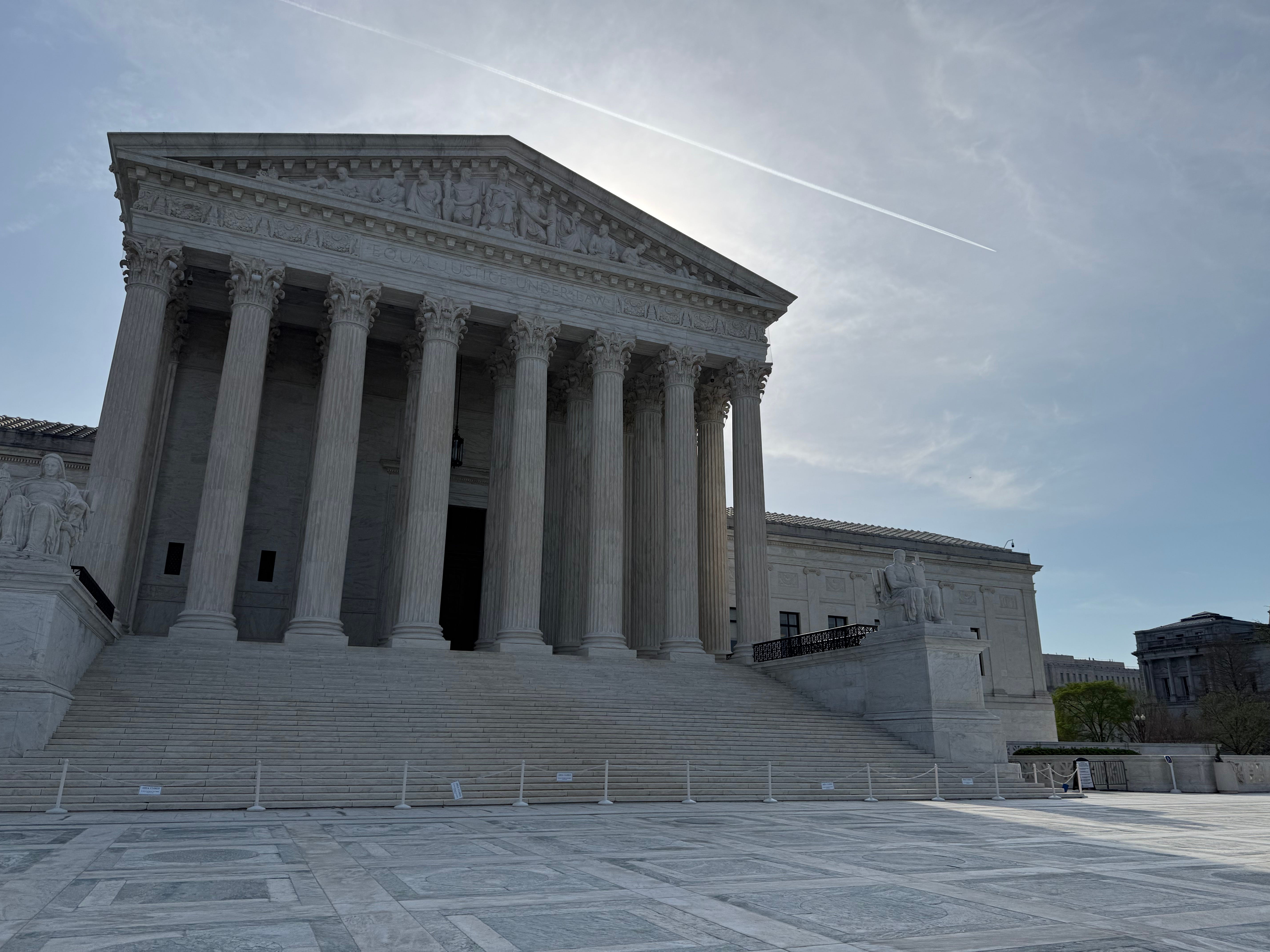
The U.S. Supreme Court on Tuesday held, on an 8-1 vote, that Colorado’s law banning therapists from engaging in conversion therapy with minor patients is presumptively unconstitutional as to talk therapy, deeming the law “an egregious form“ of speech regulation that almost always violates the First Amendment.
Only Justice Ketanji Brown Jackson dissented from the court’s decision — warning that the court might have made talk therapy “effectively unregulatable” and that the “fallout could be catastrophic.“ Taking the rare step of announcing her dissent from the bench, Jackson declared that the majority got it “wrong as a matter of precedent, first principles, and history.”
Justice Neil Gorsuch wrote the court’s majority opinion, holding that lower courts had applied the wrong standard for addressing Kaley Chiles’s First Amendment challenge to the state’s ban on conversion therapy — efforts to change a patient’s sexual orientation or gender identity.
As with his opinion in the wedding website case in 2023, 303 Creative v. Elenis, Gorsuch waved broadly at his purpose being to protect free speech and to stop, as he wrote on Tuesday, “censorious governments.“
The proper standard to be applied in Chiles’s case, the court held, is a particularly skeptical form of strict scrutiny because the law is a content-based regulation and, further, includes “viewpoint restrictions” by banning efforts to change a person’s sexual orientation or gender identity and allowing efforts to affirm a patient’s sexual orientation or gender identity. Gorsuch wrote that Chiles’s challenge would likely succeed when the case goes back to the lower courts because “Ms. Chiles seeks to engage only in speech, and as applied to her the law regulates what she may say.“
Colorado’s effort to justify the law as a traditional licensing law, Gorsuch wrote, doesn’t work. “[W]hatever traditional interest a State may have in ensuring a professional possesses a particular set of qualifications, that interest does not automatically entail a right to dictate a professional’s point of view,” he concluded for the court.
Colorado’s law, he stated of Chiles’s case, “censors speech based on viewpoint.“
The problem with that, Jackson countered, is that “regulation of the practice of medicine is pervasively and unavoidably viewpoint based. … When a State establishes a standard of care, or punishes a doctor for providing care outside of that standard, it necessarily limits what medical professionals can say and do on the basis of viewpoint.”
The court, she wrote, is upending that well-established basis for state regulation of medical standards of care — something previously understood to be a basic part of state enforcement of its historic and fundamental police powers.
“Today, the Court turns its back on that tradition. And, to be completely frank, no one knows what will happen now,“ she wrote. “Certainly not the majority. It appears to have made this momentous decision without adequately grappling with the potential long-term and disastrous implications of this ruling.“
Noting that “[m]any regulations” beyond talk therapy “impact the speech of medical professionals in the context of their provision of healthcare to patients,“ Jackson highlighted rules that “require that medical professionals ‘make every reasonable effort to promote the welfare, autonomy and best interests of’ the client“ and a Kansas rule that “prohibit[s] medical professionals from treating a patient ‘in a cruel manner’” — concluding that “the Court could be ushering in an era of unprofessional and unsafe medical care administered by effectively unsupervised healthcare providers.“
Diving into the opinion
A significant part of the lopsided dispute on Tuesday came down to a debate that was prominent during the oral arguments in October over what Justice Clarence Thomas’s 2018 opinion in National Institute of Family and Life Advocates v. Becerra meant when it held that one of the “two circumstances” where the court has given “less protection for professional speech” was regulation of “professional conduct, even though that conduct incidentally involves speech.”
In NIFLA, the court held that California’s effort to require “crisis pregnancy centers” to provide certain information to people who came to the centers was a regulation of “speech as speech,“ and not protected by the exception.
The majority on Tuesday described that as a rule that “laws regulating conduct in ways that incidentally sweep in speech may also generally avoid strict scrutiny,” then detailing how “Colorado and the dissent try to shoehorn the State’s statute into“ that exception.
Jackson, however, pointed back to the earlier underlying decision in Planned Parenthood of Southeastern Pennsylvania v. Casey upholding an abortion-related informed-consent law to explain why Tuesday’s majority, applying NIFLA, got it wrong. Jackson wrote:
California’s notice was “not tied to a procedure at all. It applie[d] to all interactions between a covered facility and its clients, regardless of whether a medical procedure [was] ever sought, offered, or performed.” Ibid. (emphasis added). So, we reasoned, unlike Pennsylvania’s informed-consent requirement in Casey, California’s notice mandate warranted heightened scrutiny because it “regulate[d] speech as speech.”
The rule, then, she continued is properly understood as such: “Thus, the key distinction, as the NIFLA Court saw it, was whether the challenged law was a regulation of speech as such or a regulation of ‘professional conduct that incidentally burden[ed] speech.’“
Although the difference sounds minimal, it’s important. The majority held that NIFLA’s “incidental” is referring to a conduct regulation that “incidentally sweep[s] in speech.“ It’s almost a scope argument and, arguably, requires a regulatory focus on “conduct.” Jackson, on the other hand, pressed that NIFLA’s “incidental” is referring to the intent. If the purpose is of the provision is to regulate “professional conduct,” then "incidentally burden[ing] speech” should not prompt strict scrutiny.
What about the other Democratic appointees?
Justices Elena Kagan and Sonia Sotomayor joined Gorsuch’s majority opinion on Tuesday, although Kagan also wrote an opinion for the pair explaining, in part, their independent thoughts about the case.
But, join Gorsuch’s opinion they did.
“The Court today decides that the Colorado law challenged here, as applied to talk therapy, conflicts with core First Amendment principles because it regulates speech based on viewpoint,” Kagan wrote. “I agree.”
She explained how the viewpoint-based aspect of the law was, to her, key to the decision, noting, “[I]f Colorado had instead enacted a content-based but viewpoint-neutral law, it would raise a different and more difficult question.“
To that, Jackson responded by calling the prospect “a mirage” because ”[s]tandards-based regulations exist in the medical context precisely because the State has a view about safety or efficacy.”
As to Kagan’s concerns with the viewpoint-based aspect of the law, and echoing a point made by Gorsuch, she wrote for her and Sotomayor that “it does not matter what the State’s preferred side is“ — warning of “a hypothetical law that is the mirror image of Colorado’s“ law:
Instead of barring talk therapy designed to change a minor’s sexual orientation or gender identity, this law bars therapy affirming those things. As Ms. Chiles readily acknowledges, the First Amendment would apply in the identical way. See Tr. of Oral Arg. 25–26; see also id., at 37–38 (United States as amicus curiae agreeing). Once again, because the State has suppressed one side of a debate, while aiding the other, the constitutional issue is straightforward.
In other words, this decision also prevents a hypothetical Texas or Florida law banning affirming sexual orientation and gender identity talk therapy.
For his part, Gorsuch highlighted a time, “[n]ot so long ago,” when medical organizations “considered homosexuality a mental disorder,“ and warned:
So what if that kind of reflexive deference to currently prevailing professional views may not always end well? Cf. Buck v. Bell, 274 U. S. 200, 205–207 (1927).
Buck v. Bell is one of many infamous Supreme Court cases. It is that case in which the Supreme Court 99 years ago upheld a law allowing compulsory sterilization of those deemed unfit and in which Justice Oliver Wendell Holmes did so by proclaiming, “Three generations of imbeciles are enough.“ (The decision was 8-1.)
It was an odd cite for Gorsuch to make — highlighting as it did how the court can get cases very wrong, even on a lopsided vote — and seemingly was aimed more at providing a “gotcha” moment than anything else.
As Jackson noted in a footnote responding to this point:
[T]he majority points to shameful parts of this country’s past to show the dangers that can come from regulation that relies on outdated medical practices. Ibid. (citing Buck v. Bell, 274 U.S. 200, 205–207 (1927)). But the majority does not mention that, if the standard of care does change, the state legislature has the power to change the law in response to that evidence.
Not taking his bait, she instead concluded that “uncertainties—which have always existed—are no reason to abandon medical standards or to alter how the law has traditionally accommodated scientific discoveries.“
Whether such standards have been abandoned with Tuesday’s decision remains to be seen, but Jackson certainly made a strong case that the majority, at the least, made such abandonment possible — and laid out a path to watch as the law moves forward and new challenges pop up.
Stepping back
The Chiles v. Salazar decision is obviously an important decision on its own, but, before I close, I do want to note how it fits in two larger contexts as well — one long-term pattern and one of a more recent pedigree.
Both put queer people on the losing side of Supreme Court cases.
As I covered at Law Dork this past July, the current Supreme Court is increasingly protecting anti-LGBTQ views in law while rejecting — or outright ignoring — claims brought by or on behalf of LGBTQ people.
This trend has continued this term, was furthered on Tuesday, and is not likely done for the term.
Relatedly, as to the long-term pattern, the Supreme Court for more than 30 years has regularly sided with anti-LGBTQ figures or against LGBTQ people in free-speech cases.
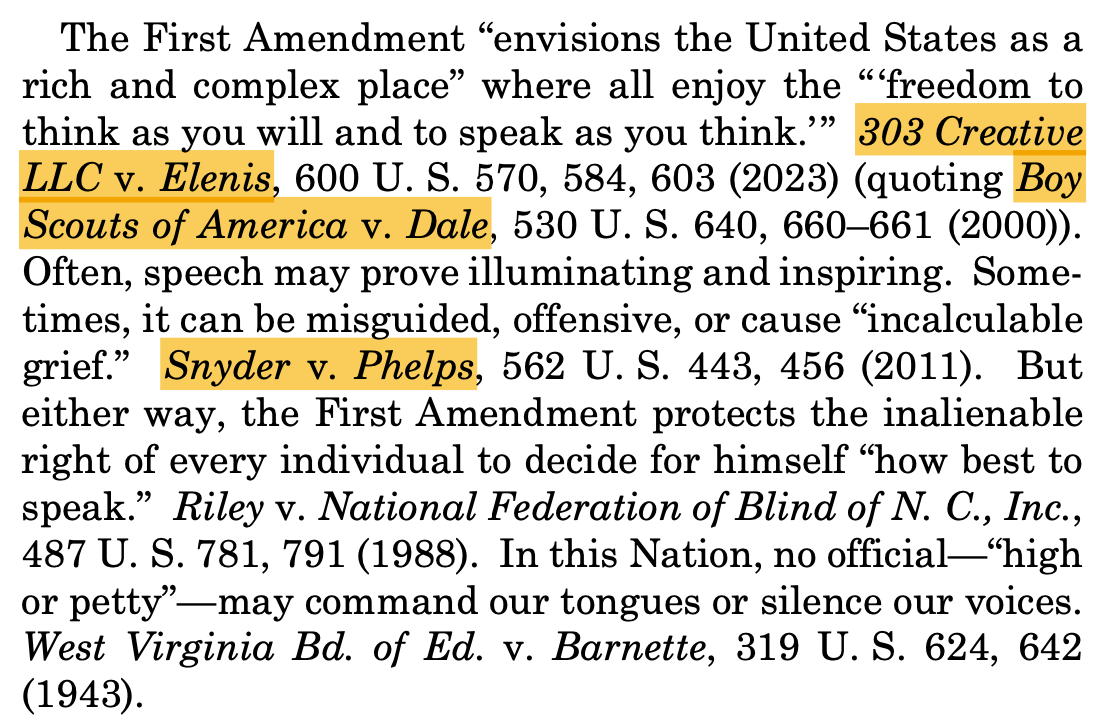
In Gorusch’s paean to the First Amendment that started that section of Tuesday’s opinion, for example, all of the first three cases cited were either a loss for queer people — or, in the third case, a win for the “God Hates Fags“ church.
Odd that only one free thinker respects medical science among the nine.
A violation of free speech!?!? Doesn’t seem to matter what the psychological research and science has shown about the dangers of trying to change someone’s sexual orientation or gender identity. Or that Exodus closed its own doors because conversion therapy just didn’t work!! Good for Judge Ketanji Brown Jackson for standing up to this dangerous precedent…