

SCOTUS conservatives block California gender-identity student protections, N.Y. map change
The two Monday night orders were issued over the objections of the three liberal justices.

The U.S. Supreme Court’s Republican appointees, over the objection of the Democratic appointees, on Monday night granted two shadow docket requests advancing conservative aims.
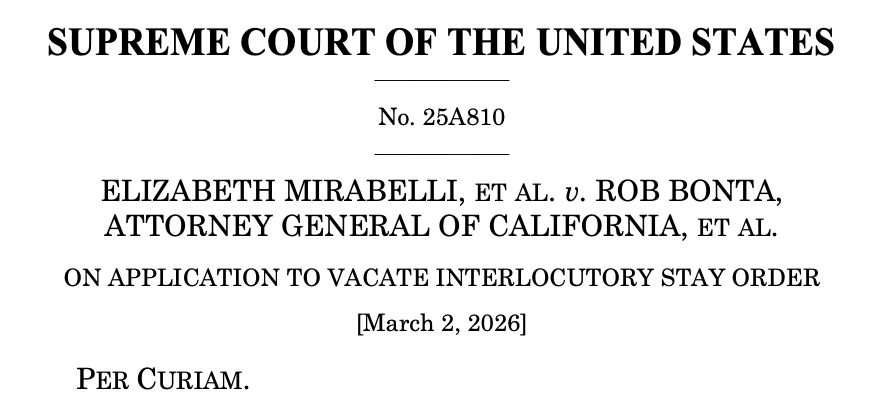
In Mirabelli v. Bonta, the conservative justices allowed a district-court injunction to go back into effect during litigation that blocks California schools from preventing parents from being told about their children’s gender presentation, name, or pronouns. The challenged policy requires a student’s consent for a teacher to do so.
A district court had granted class-wide injunctive relief to parents and teachers who objected on free exercise of religion claims and on due process claims — ultimately creating four subclasses. The U.S. Court of Appeals for the Ninth Circuit issued a stay of the injunction while it is considering the state’s appeal.
On Monday, in a relatively extensive per curiam — unsigned — order, the court’s conservatives “vacate[d] the stay with respect to the parents.“
Although the reasoning is not discussed, the application is denied as to the teachers.
Justices Clarence Thomas and Sam Alito wrote nothing, but noted they “would grant the application in full“ — so, as to the parents and the teachers.
While Justice Elena Kagan wrote a dissent joined by Justice Ketanji Brown Jackson — noting several procedural irregularities in the court’s consideration of the request, in addition to substantive disagreements with the majority’s order — Justice Sonia Sotomayor simply noted that she “would deny the application in full.”1
The Mirabelli shadow docket order is alarming and offensive, showing that the court majority’s far-right extremism — particularly in addressing transgender kids’ lives — will seek to move the law further right so long as it has the votes to do so. As I wrote on July 1, 2025, “SCOTUS’s parental rights messages: Protect anti-LGBTQ views, ignore LGBTQ people.” Monday’s order signified how much more extreme the majority is willing to go when the harm will be borne by trans and gender-nonconforming students.
In opposing the request, California Attorney General Rob Bonta and his office’s lawyers noted the very real harm that could be at issue if the injunction were allowed to go back into effect: “The district court’s injunction would allow no exceptions, even for extreme cases where students or teachers reasonably fear that the student will suffer physical or mental abuse.”
As to the free exercise claim, the decision represents a quick and abrupt expansion of this past term’s Supreme Court decision in Mahmoud v. Taylor, which I had already called a “dangerous piece of work” at the time.
“California’s policies will likely not survive the strict scrutiny that Mahmoud demands,“ the Monday order declared. The anonymous order sniped at the Ninth Circuit for having relied upon a “not-precedential” decision from the U.S. Court of Appeals for the Sixth Circuit and having “brushed aside“ Mahmoud “as ‘a narrow decision focused on uniquely coercive “curricular requirements.”’”
Even more alarmingly, Justice Amy Coney Barrett, in a concurring opinion joined by both Chief Justice John Roberts and Brett Kavanaugh, echoed that, writing that “[t]he Ninth Circuit (following the Sixth Circuit) significantly misunderstood Mahmoud … and general course correction will allow the case to progress efficiently.“
In other words, the Mahmoud opinion was the low-water water mark for the ways this court plans to use religious freedom to wash away any protections and policies that might be opposed by religious parents.
As to the due process claim, that portion of the order is hypocritical and offensive on multiple grounds.
In her dissent, Kagan addressed why at length.
“Even in recognizing that parental right, the Court cannot quite bring itself to name the legal doctrine—it is, again, substantive due process—that provides the right’s only basis,“ Kagan wound up. “Anyone remotely familiar with recent debates in constitutional law will understand why: Substantive due process has not been of late in the good graces of this Court—and especially of the Members of today’s majority.“
Noting that the Due Process Clause itself only protects “liberty,” she goes in:
Members of the majority often have expressed skepticism—sometimes outright hostility—to understanding the “capacious” term “liberty” to enshrine specific rights. Dobbs v. Jackson Women’s Health Organization, 597 U. S. 215, 239 (2022).
After raising the court’s decision overturning Roe v. Wade, Kagan quoted Justices Clarence Thomas, Neil Gorsuch, and Brett Kavanaugh attacking substantive due process in the past.
“There are many such statements to choose from in this Court’s recent substantive due process caselaw,” she wrote. Returning to Dobbs, she continued, “Especially given the Court’s last venture into the field, today’s decision cannot but induce a strong sense of whiplash.“

It is shocking.
Then, in a footnote, Kagan provides one last lowlight — addressing the discordance between Monday’s order and the June 2025 decision in U.S. v. Skrmetti, upholding Tennessee’s ban on gender-affirming medical care for minors:
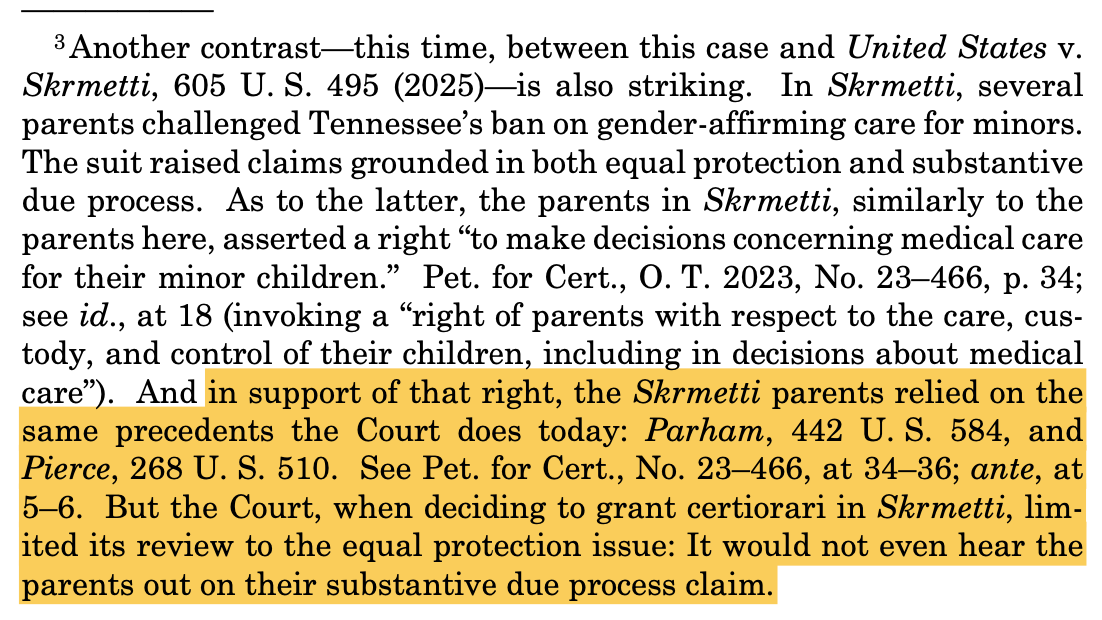
It was the concern I had raised in that July 1, 2025, article.
The point was made aggressively clear in Barrett’s alarming concurrence, in which she wrote this about the anti-trans parents:
Under California’s policy, parents will be excluded—perhaps for years—from participating in consequential decisions about their child’s mental health and wellbeing. Thus, the parents are likely to suffer irreparable harm if California enforces its policy while this litigation winds its way through the courts.
In her concurring opinion upholding the Tennessee ban, in contrast, Barrett wrote about why classifications based on transgender status shouldn’t receive heightened protection under the Equal Protection Clause — why anti-trans laws shouldn’t be looked at more skeptically:
[H]olding that transgender people constitute a suspect class would require courts to oversee all manner of policy choices normally committed to legislative discretion.
It is a tough road ahead.
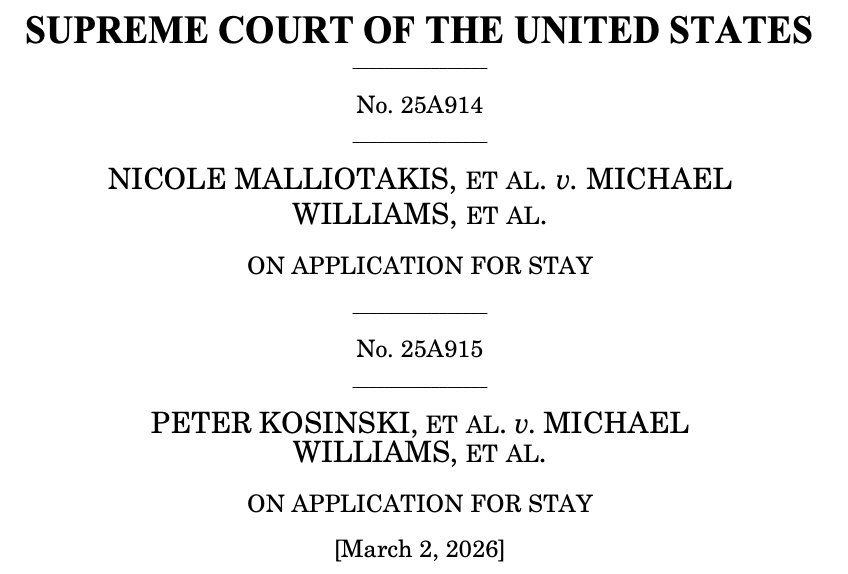
In Malliotakis v. Williams, the conservative justices blocked a New York state court ruling that found “unlawful vote dilution” of Black and Latino voters in a congressional district — NY-11 — and would have required changes to that district.
The Supreme Court stayed that order in a one-paragraph order of its own on requests that included Rep. Nicole Malliotakis, the Republican representative of NY-11.
Justice Sam Alito wrote a concurring opinion for himself laying out his view that the state court-order was “unadorned racial discrimination” — a move that UCLA Law professor Rick Hasen called “bad news not just for Section 2 of the [Voting Rights Act] at issue in [Louisiana v.] Callais but for more voting protections in the states.“
The Callais case — raising the question of whether the “intentional creation” of a “majority-minority congressional district” is unconstitutional — was reargued on October 15, and the court is yet to issue a decision.
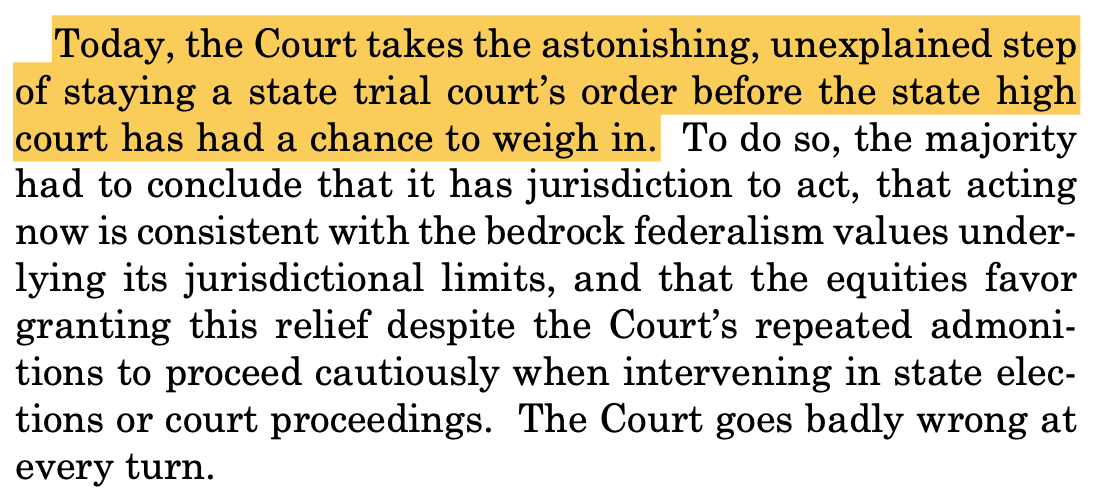
This shadow docket application raises different issues than the Texas and California shadow docket requests, which were part of federal court challenges to mid-decade redistricting. This, on the other hand, was a New York state court ruling about the 2024 congressional map, so the intervention of the court raises its own, unique issues.
Justice Sonia Sotomayor detailed those concerns in her dissent, joined by Justices Elena Kagan and Ketanji Brown Jackson. Beginning, “The Court’s 101-word unexplained order can be summarized in just 7: ‘Rules for thee, but not for me,’“ the dissent did not hold back:
If, as Hasen wrote, “Alito is the conservatives’ leading voice attacking voting rights,” and this concurrence represents the majority’s view, this is a sign that Section 2 of the Voting Rights Act is almost certain to be gutted as to vote-dilution claims when Callais does come down.
A note, though: As with one particularly notable shadow docket order last year, a solo concurrence from a justice — if that’s the only opinion from the majority — can have outsized impact on the discussion of the shadow docket order.
Unlike the shadow docket order that led to discussion of Kavanaugh stops, however, the implications of Monday’s ruling outside of this order — and centrality of Alito’s concurrence to the court majority’s thinking — is likely to be reinforced by or pushed aside by the forthcoming Callais decision in short order.
Sotomayor wrote the dissent in Mahmoud, so be careful reading too much into this.
Damn the uncaring ultra-conservative justices.
Thanks to The Donald’s brazenness, the elite can now realize its biases … mostly without explanation.