

Supreme Court allows new Texas congressional map to be used in 2026
The Dem appointees dissent in the racial gerrymandering case. Also: A D.C. Circuit "administrative stay" means National Guard can remain deployed in D.C. for now.

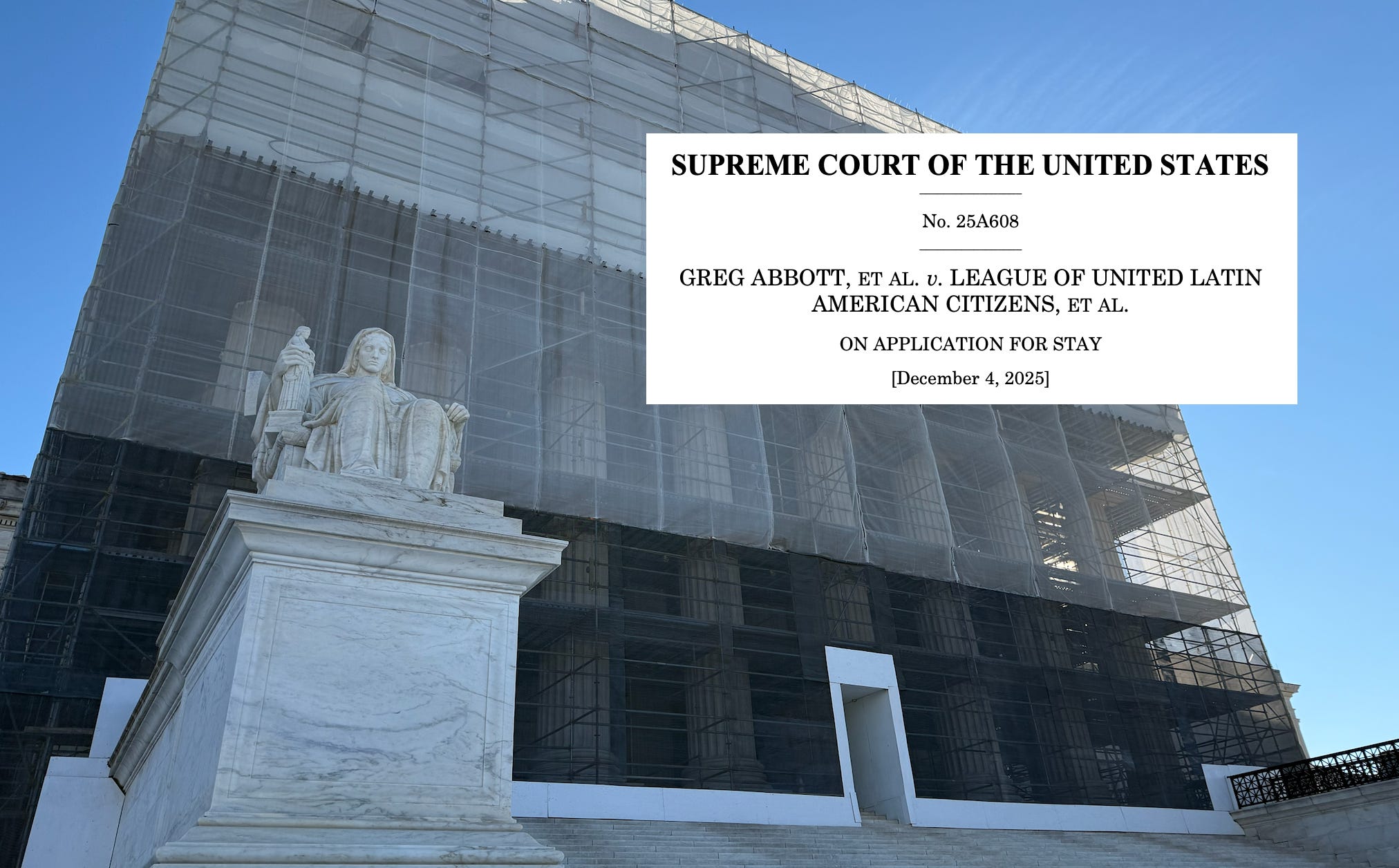
The U.S. Supreme Court’s Republican appointees on Thursday issued an order allowing Texas to use its new congressional map in the 2026 midterm elections, blocking a lower court order finding the map was likely an unconstitutional racial gerrymander. The map could lead to Republicans gaining up to five new House seats in the next session of Congress.
In the unsigned order, the court stated that Texas “satisfies the traditional criteria for interim relief“ — after a “preliminary evaluation” of the case.
“Texas is likely to succeed on the merits of its claim that the District Court committed at least two serious errors,” the court stated. The district court “failed to honor the presumption of legislative good faith by construing ambiguous direct and circumstantial evidence against the legislature” and “failed to draw a dispositive or near-dispositive adverse inference“ against the challengers because they “did not produce a viable alternative map that met the State’s avowedly partisan goals.“
Notably, in assessing “irreparable harm” that Texas would face, the court also stated, “The District Court improperly inserted itself into an active primary campaign, causing much confusion and upsetting the delicate federal-state balance in elections.”
This is, however, a function of the timing of the Texas legislature’s action — not the challengers or three-judge district court (whose 2-1 opinion was authored by U.S. District Judge Jeffrey V. Brown, a Trump appointee and former Texas Supreme Court justice) — and it’s astounding to see an unsigned Supreme Court order accusing a lower court of such a “improper[]” act in this fashion.
Justice Elena Kagan, joined by Justices Sonia Sotomayor and Ketanji Brown Jackson, dissented, starting by noting exactly what the district court actually did:
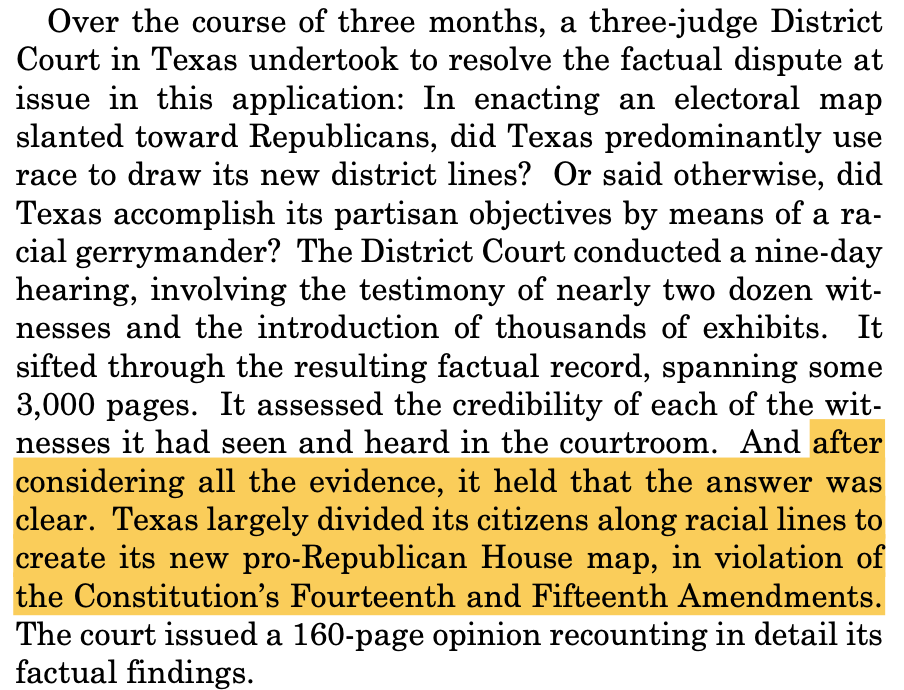
But on Thursday, Kagan continued, “this Court reverses that judgment based on its perusal, over a holiday weekend, of a cold paper record. We are a higher court than the District Court, but we are not a better one when it comes to making such a fact-based decision.”
Noting that the Supreme Court’s order “disrespects the work of a District Court that did everything one could ask to carry out its charge” and “disserves the millions of Texans whom the District Court found were assigned to their new districts based on their race,” Kagan went on to detail the district court’s actual trial work and legal conclusions regarding the racial gerrymandering claim that is all but ignored by the Supreme Court’s order.
“You would never guess it from the majority’s order, but under this Court’s precedents, a district court’s factfinding about electoral districting—’most notably, as to whether racial considerations predominated in drawing district lines’—is reversible ‘only for clear error,’” Kagan wrote.
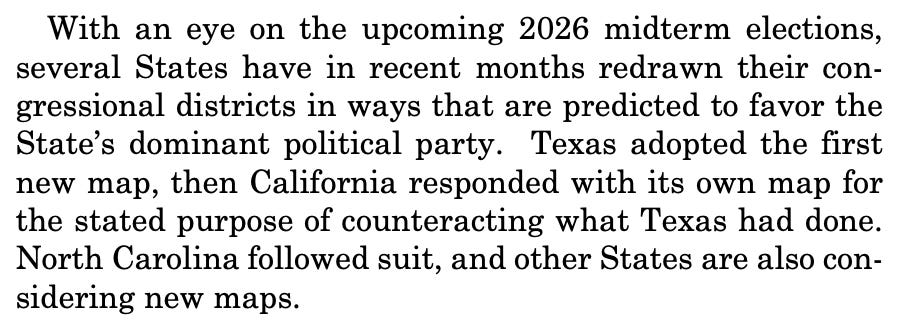
More than that even, the opening of the Supreme Court’s unsigned order — which sounds as much like an opinion from Chief Justice John Roberts as anything signed by him — frames the case as completely outside of the actual case’s racial gerrymandering claim:
In a brief, signed rejoinder to the dissenters, Justice Sam Alito, joined by Justices Clarence Thomas and Neil Gorsuch, wrote about the “two short points which for [him] are decisive“ in their concurring in the court’s order.
Apparently unwilling or unable to read the district court opinion or the DOJ Civil Rights Division letter from Harmeet Dhillon sent to Texas officials expressing “serious concerns regarding the legality of four of Texas’s congressional districts,” Alito wrote that “it is indisputable … that the impetus for the adoption of the Texas map … was partisan advantage pure and simple.“ He also wrote a paragraph about the “alternative map” issue referenced in the court’s order.
No one has disputed that there is a partisan advantage that would result from the new Texas map, but Alito’s concurring statement — and the unsigned order’s framing — aggressively ignore the Texas legislature’s initial unwillingness to redistrict based on President Donald Trump’s call for partisan redistricting; the intervening DOJ letter; and the resulting, extensive decision from the district court.
The latest on the National Guard deployment in D.C.
On Thursday afternoon, a three-judge panel of the U.S. Court of Appeals for the D.C. Circuit issued an order that will allow National Guard troops to remain deployed in Washington, D.C. for the time being.
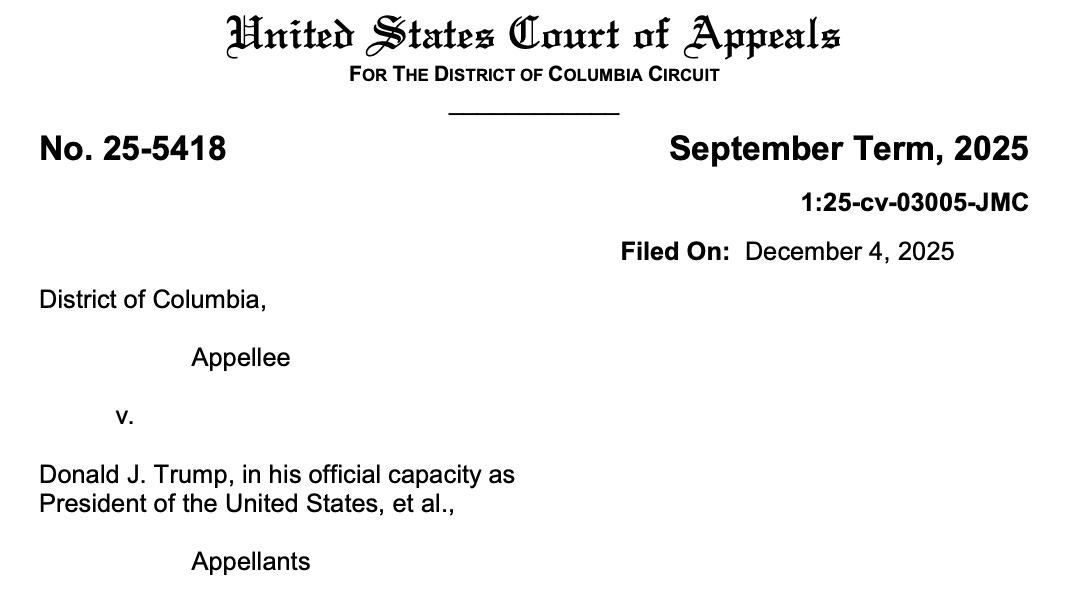
The temporary order — an “administrative stay” — blocks U.S. District Judge Jia Cobb’s November 20 preliminary injunction while the appeals court considers the Justice Department’s request for a stay pending the appeal of Cobb’s ruling.
The D.C. Circuit panel included Judges Patricia Millett, an Obama appointee, and Judge Gregory Katsas and Neomi Rao, both Trump appointees.
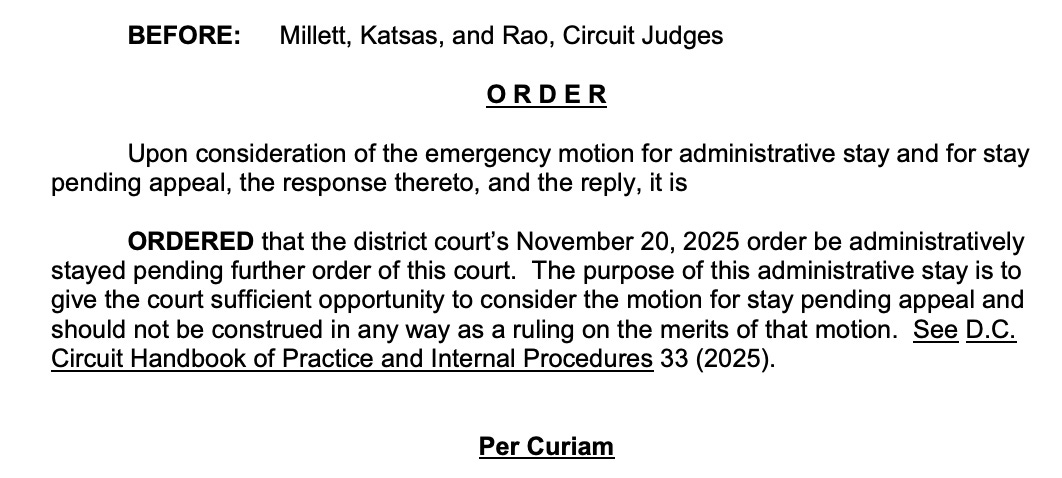
Under Cobb’s ruling in the case brought by the D.C. Attorney General Brian Schwalb on behalf of D.C., the National Guard deployment would have to end by December 11. Although the appeals court panel noted that the administrative stay “should not be construed in any way as a ruling on the merits“ of DOJ’s stay request, the practical effect of Thursday’s order is that National Guard troops will be able to remain deployed after December 11 if the administrative stay is still in place a week from now.
Unlike some prior D.C. Circuit administrative stay orders, no judge noted a dissent on Thursday, suggesting a possibility that the administrative stay will, in fact, be a short-lived stay used by the court so the judges will have sufficient time to give proper consideration to this important case.
Most notably, given the judges involved, Thursday’s order differed from when Katsas and Rao issued an administrative stay in April halting Chief Judge James Boasberg’s contempt inquiry regarding the Trump administration’s Alien Enemies Act flights. In that instance, Judge Cornelia Pillard, the third judge on the panel and another Obama appointee, noted her dissent. That administrative stay lasted months, with Katsas and Rao siding in August with the Trump administration in ordering that Boasberg’s initial contempt inquiry order be vacated and their “administrative” stay ultimately only ending in November when the full D.C. Circuit let the panel’s order stand.
On Thursday, in contrast, Millett did not note any dissent, so presumably agreed that an administrative stay was appropriate here — or, at least, was not so inappropriate as to merit her noting her dissent.
The hope, then, would be that a ruling on DOJ’s request for a stay of Cobb’s order pending appeal will be quickly forthcoming.
Two other factors, however, should not be ignored.
First, the shooting of two National Guard troops, including the killing of Sarah Beckstrom, was highlighted by both parties in their filings at the D.C. Circuit. Although not a legal change, both D.C. and DOJ lawyers point to the shooting as evidence that their arguments are correct.
In its opposition to the stay request, filed on December 2, D.C.’s lawyers wrote:
[T]he deployment impinges on the District’s home rule, requires the diversion of scarce police resources, and exposes both the public and Guard members to substantial public safety risks, as Defendants themselves acknowledged at the outset of the deployment, and as the horrific attack on two National Guard members last week tragically underscored.
In its reply filed on December 3, in contrast, DOJ claimed the shooting was proof of a “violent-crime emergency” in D.C.:
D.C. is suffering from a violent-crime emergency, as made starkly manifest by the recent horrific attack on deployed Guard members.
Second, although different statutory authority was used to deploy National Guard troops in D.C. than was used in the states, it is possible that the D.C. Circuit panel is hoping for guidance from the U.S. Supreme Court before it issues its ruling.
That guidance could come in an order out of DOJ’s stay request that has been pending at the high court in the case over the attempted deployment of National Guard in Illinois. That deployment effort was blocked by the district court and a stay was denied by the U.S. Court of Appeals for the Seventh Circuit, leading DOJ to ask the justices to step in.
Notably, DOJ asked for an “immediate administrative stay” in that case on October 17, along with a stay pending appeal. Nearly 50 days later, the Supreme Court is yet to act on those requests and the National Guard remains blocked from federal deployment in Illinois.
In the coming week, D.C. residents should get the same relief.
Another look at this week’s SCOTUS copyright case
I covered one aspect of the U.S. Supreme Court’s Monday oral arguments here at Law Dork, but I do recommend that people interested in the case go over and check out Cathy Gellis’s piece at Techdirt, in which she wrote about how Cox Communications v. Sony Music Entertainment should be a First Amendment case — and why that’s important.
This court no longer deserves to be called “Supreme”. It is just a subsidiary of the Republican Party at this point not meriting any more respect than the cheapest committee of party hacks. Court reform ASAP - and I meanwhile will be lobbying my Virginia Senator and Delegate to gerrymander the f*** out of our state.
What a joke the SC is-nothing more than McDonald trumps personal law firm -
As Alejandra Curable said “It's basically telling district court judges to abandon the law and become partisan hacks or else all their rulings will be overturned.”