

SCOTUS majority gives Alabama GOP a chance to use a map already found to be unconstitutional
Justice Sotomayor, for the three Dem appointees, noted in dissent that the majority acted "without regard for the confusion that will surely ensue." The primary election was to be held May 19.

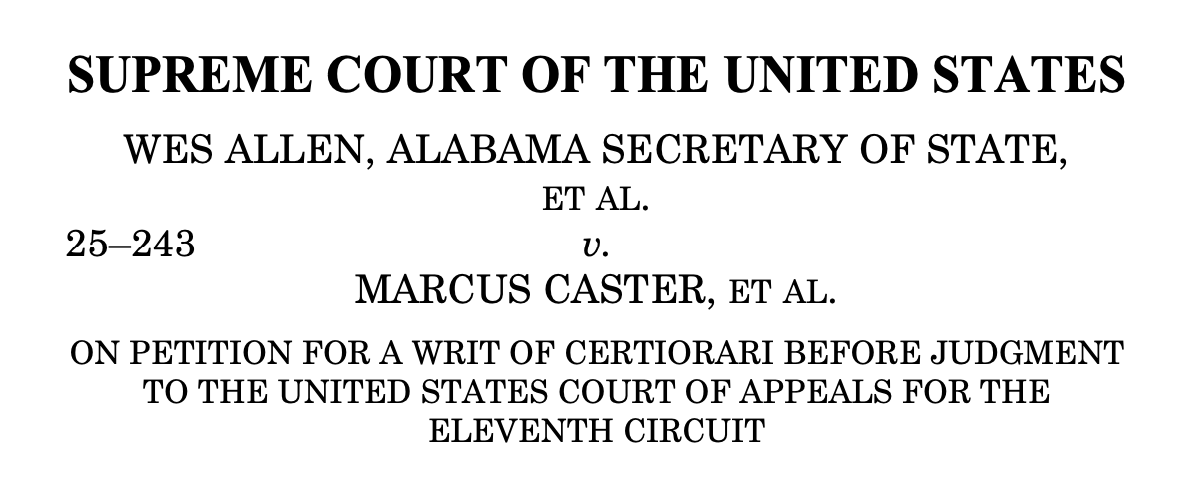
The U.S. Supreme Court’s Republican appointees gave Republicans in Alabama another shot at using a congressional map that has been blocked because a lower court found that it had violated Section 2 of the Voting Rights Act and intentionally violated the Fourteenth Amendment.
The court vacated the judgments in long-running challenges over Alabama’s congressional maps — effectively wiping out a 268-page opinion that blocked Alabama’s 2023 map in one paragraph — over a dissent from Justice Sonia Sotomayor that was joined by Justices Elena Kagan and Ketanji Brown Jackson.
And though Alabama already acted in the wake of April 29’s Louisiana v. Callais Supreme Court decision gutting what remained of the Voting Rights Act to move some primary elections if the courts cleared the way for them to do so, Sotomayor’s dissent on Monday suggested it might not be that simple.
[UPDATE, 12:20 p.m. May 12: Plaintiffs in Alabama on Monday night went to the district court seeking a temporary restraining order keeping the 2023 map blocked — essentially using the reasoning about their remaining constitutional claims and intentional constitutional violations as discussed by Justice Sotomayor (and covered below) in their motion.]
The Supreme Court’s unsigned, unreasoned order purported to be an application of Callais in what’s known as a grant, vacate, remand (or, GVR) order, but there are two key elements of this GVR that make it particularly troubling.
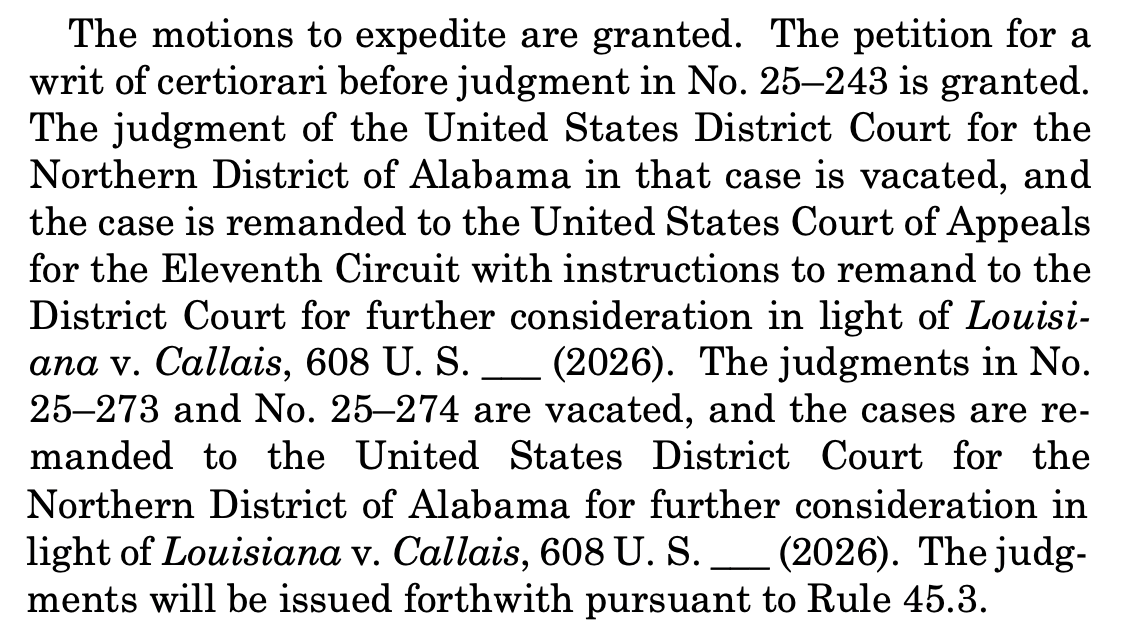
After an earlier Alabama map was blocked under Section 2 of the VRA — a ruling upheld by the Supreme Court in 2023 — Alabama was ordered to create a map with two opportunity districts (districts where minority voters have the opportunity to elect a representative of their choosing). Alabama did not do so, instead presenting a map that still contained only one opportunity district, and the litigation continued. As Sotomayor wrote in her dissent on Monday:
The District Court then held an 11-day trial on a renewed challenge to the legality of this new map. It heard testimony from 51 witnesses, received nearly 800 exhibits, and considered volume upon volume of written submissions. At the end of that trial, the District Court concluded “with great reluctance and dismay and even greater restraint” that Alabama had not merely spurned the opportunity to remedy past discrimination, but in fact had intentionally violated the Fourteenth Amendment.
Alabama again went to the Supreme Court, which has had these requests on the docket since August 2025 but only acted on Monday, one week before the primary, vacating the orders blocking the 2023 House map.
So, what are these two concerning problems?
First, as noted above, the Alabama case was not just about the Voting Rights Act (or the 1982 amendment’s effects test) — as the Callais decision was. This was also about the Fourteenth Amendment, and the trial included the finding of intentional discrimination.
Why does this matter? As Sotomayor wrote:
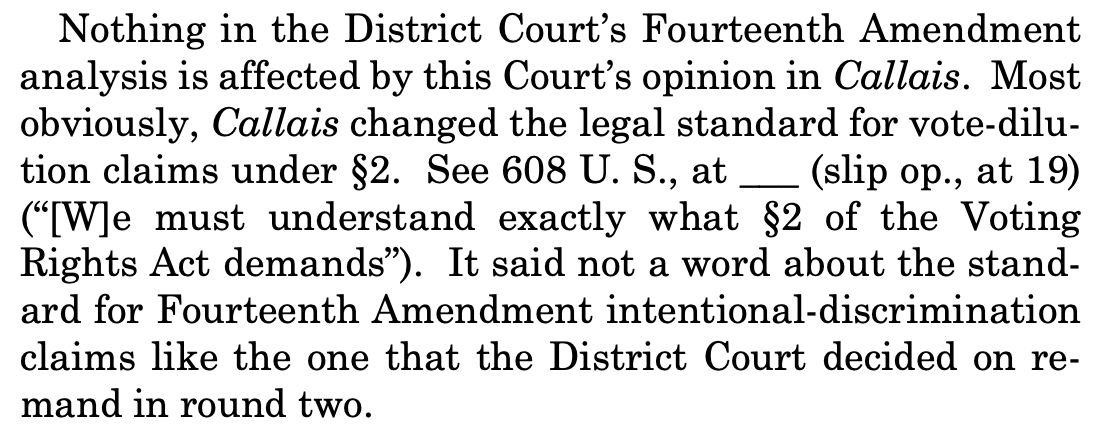
And yet, the judgment enforcing that decision was tossed out by the Supreme Court on Monday with no reasoning provided. (There’s a caveat here; keep reading.)
Second, absentee voting has begun and the primary election is scheduled for May 19:
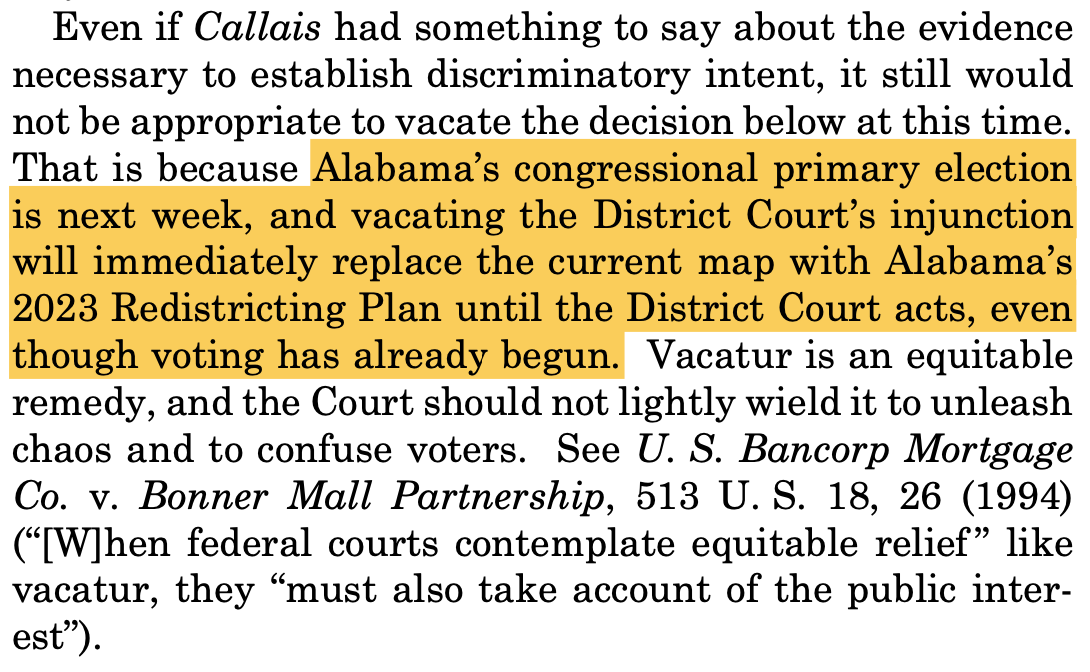
Twenty years ago, in another unsigned order, the Supreme Court created what has become known as the Purcell principle. Essentially, it means that courts should consider not changing voting rules close to an election to avoid voter confusion. But, in light of what the Supreme Court has done since Callais — in Louisiana and now Alabama — the actual words of Purcell are notable:
Court orders affecting elections, especially conflicting orders, can themselves result in voter confusion and consequent incentive to remain away from the polls. As an election draws closer, that risk will increase.
Purcell, then, is not just about confusing voters, which Monday’s order and the fallout certainly will do. It is also about the effect of that confusion as its own harm, creating a “consequent incentive to remain away from the polls.“
More than 40,000 people had already returned ballots in Louisiana before Gov. Jeff Landry suspended that election.
How many have done so in Alabama? How many are filling out their ballot at their kitchen table — or in some ship overseas in service of President Donald Trump’s war — right now?
Specifically, what message about the importance of voting did the Republican appointees of the Supreme Court send to such people with their Monday orders last week and this week? What “incentive” did they send out there?
All that said, Sotomayor did conclude her dissent with a note to the district court about its constitutional ruling:
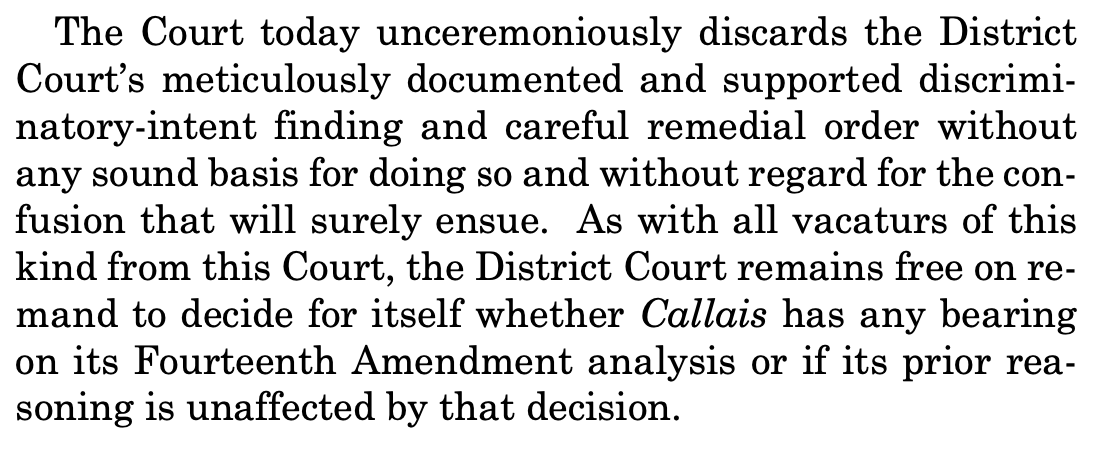
In other words: This is not necessarily a done deal.
Hmm … the reactionary Six seem more interested in procedure and supremacy than its actual effect on real people … yes, the smelly ones beyond the guarded gate.
Shameful on every level and even more so since "these requests [were] on the docket since August 2025. Oops, we forgot??? Political corruption knows no bounds with the six insurrectionist justices.