

SCOTUS changed the rules for bringing cases to the court because John Roberts won't sell his stocks
Roberts and Alito are the only two justices who own individual stocks. Also: A new lawsuit challenges the Trump admin's removal of the Pride flag at the Stonewall Monument.

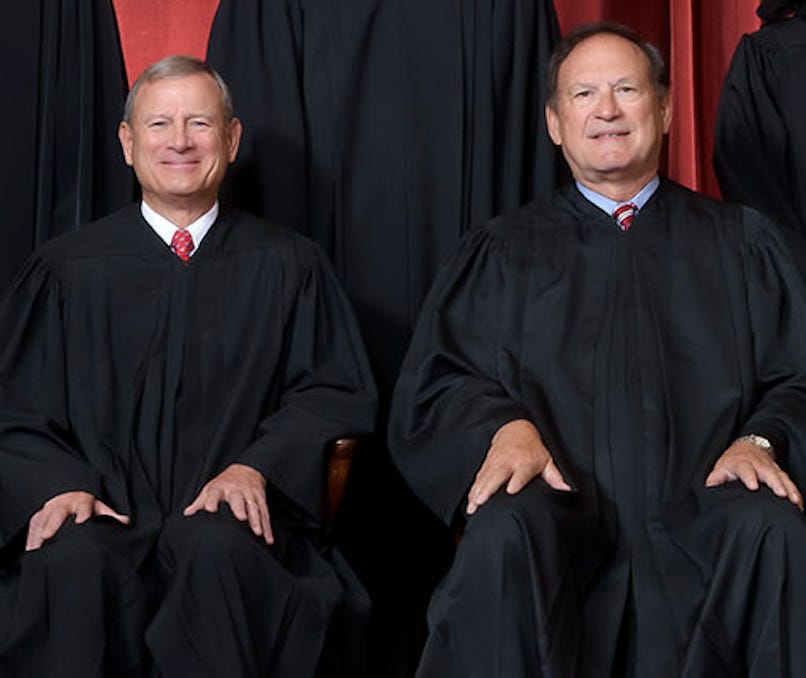
On Tuesday, the U.S. Supreme Court announced it is taking action to deal with the problems that arise from justices’ ownership of individual stocks, an issue that just this term led to the recusal of Justice Sam Alito days before oral arguments in a case and months after the justices voted on whether to hear the case at all.
What did the court do to address this ethical question?
Did the justices agree to divest from individual stock ownership — which would be the cleanest, most ethical, and easiest step, especially given that Chief Justice John Roberts and Justice Sam Alito are the only two justices who currently own individual stocks?
Of course not.
The Chief Justice of the United States will literally change the rules of the Supreme Court of the United States instead of divesting in individual stocks.
Really.
The primary revision to the rules is, at long last, a change to the way the court is going to identify conflicts of interest … by requiring parties to include stock ticker symbols in their briefs submitted to the court starting next month.
It is that embarrassing.
The Supreme Court issued an order announcing the adoption of the revisions to its rules on Tuesday morning.
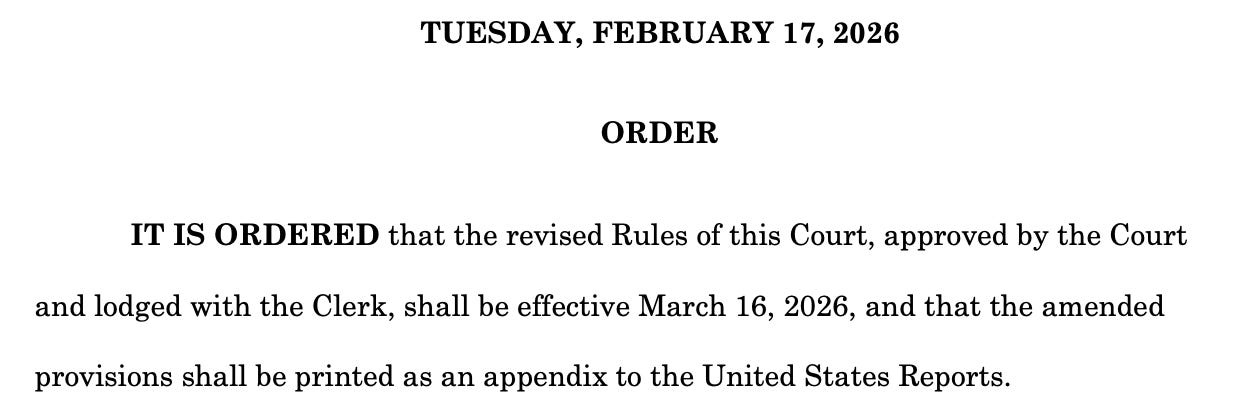
In fairness, then, it is not just Roberts — or even Roberts and Alito — who did this. At least a majority of the court agreed to this change. Because it is the rules of the court, I’d go so far as to guess that it likely was unanimous.
So, what is this change?
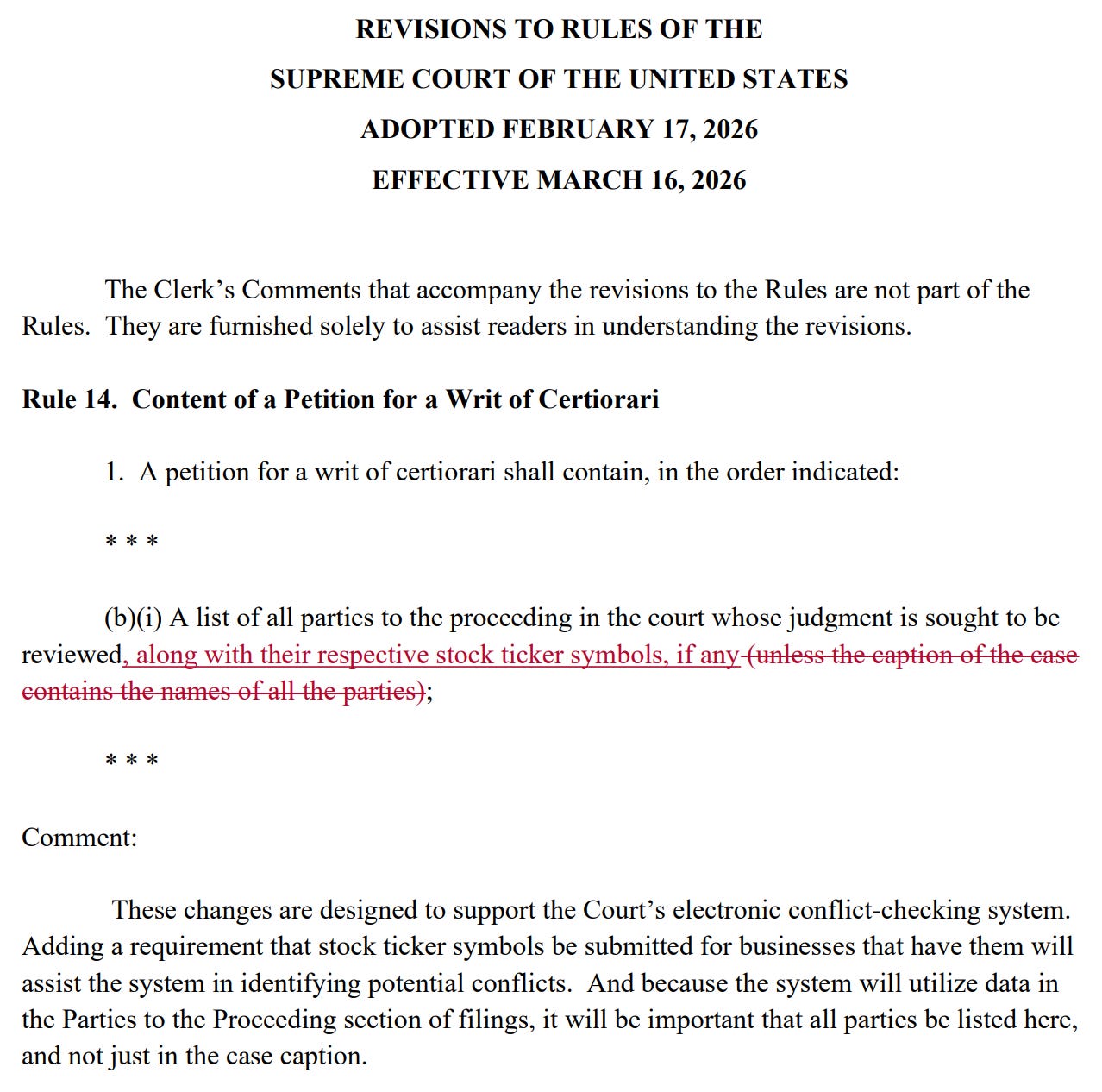
Four of the other five changes integrate this new “stock ticker symbol” requirement into different aspects of Supreme Court filings. The final rule change makes clear that electronic filing is sufficient to establish that a document is “timely filed.”1
The Supreme Court’s Public Information Office explained what this is aimed at in a news release:
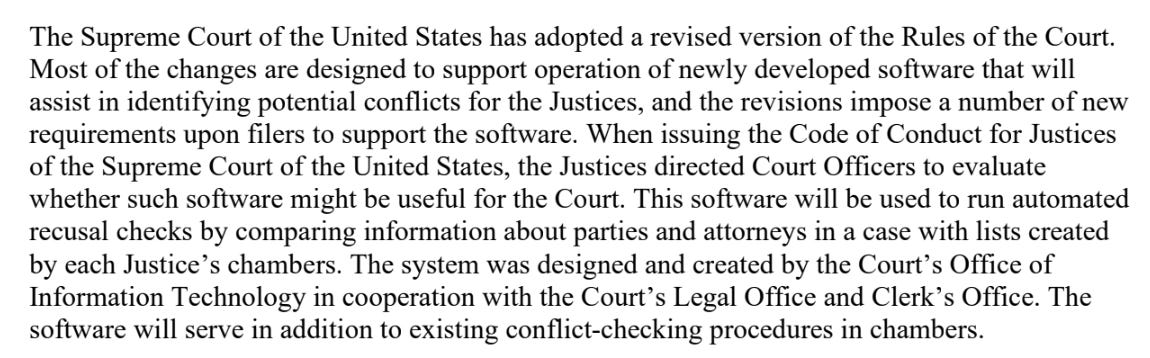
The Supreme Court of the United States spent time and money to create new software to run conflicts checks, and part of that includes checks relating to individual stocks owned by justices.
Because two justices own stocks — Roberts refuses to divest and Alito is apparently eagerly day-trading — the Supreme Court had to spend time and money in the development of this new system to integrate stock ownership conflict checks.
And now, starting in March, every party going to the Supreme Court is going to need to go along with this CNBC-style ticker-tape rule because of their intransigence.
Fix the Court’s Gabe Roth put it simply. “Public service requires certain sacrifices in the name of ethics, and going stock-free should be one of them for all branches of government,” he said in a statement. “If the justices wanted to institute a more effective change related to their ethics and their investments, they’d agree as a Court not to hold any stocks during their tenures, since all it does is cause unnecessary recusals. An investor-justice could own a blended fund, mutual fund or ETF and reap the same benefits with a far reduced conflict exposure. In fact, seven of the nine justices have made this very calculation.“
If the justices won’t do it themselves, Roth pointed to legislative efforts to ban individual stock ownership by federal judges.
As to the rules changes themselves, Roth also noted, “Public service also demands public input, and it’s a bit ridiculous that the Court can simply release new rules without a notice-and-comment period or opportunity for public views. It’s yet another example of the Court acting exceptionally in all the wrong ways.“
Indeed.
Public accountability and ethical questions are rarely addressed under Roberts’s leadership, as Law Dork has covered repeatedly in recent years.
The Stonewall flag lawsuit
On Tuesday, a lawsuit was filed challenging the Trump administration’s recent decision to remove the Pride flag from the Stonewall National Monument in New York City.
Nonprofit groups, represented by the Washington Litigation Group and Lambda Legal, are seeking an order that the government “immediately restore the official NPS Pride flag to the Stonewall National Monument.“
The lawsuit over the treatment of the first national monument recognizing the LGBTQ movement is relatively straightforward. After the area surrounding the Stonewall Inn, including Christopher Park, was designated as a monument in 2016, this happened:
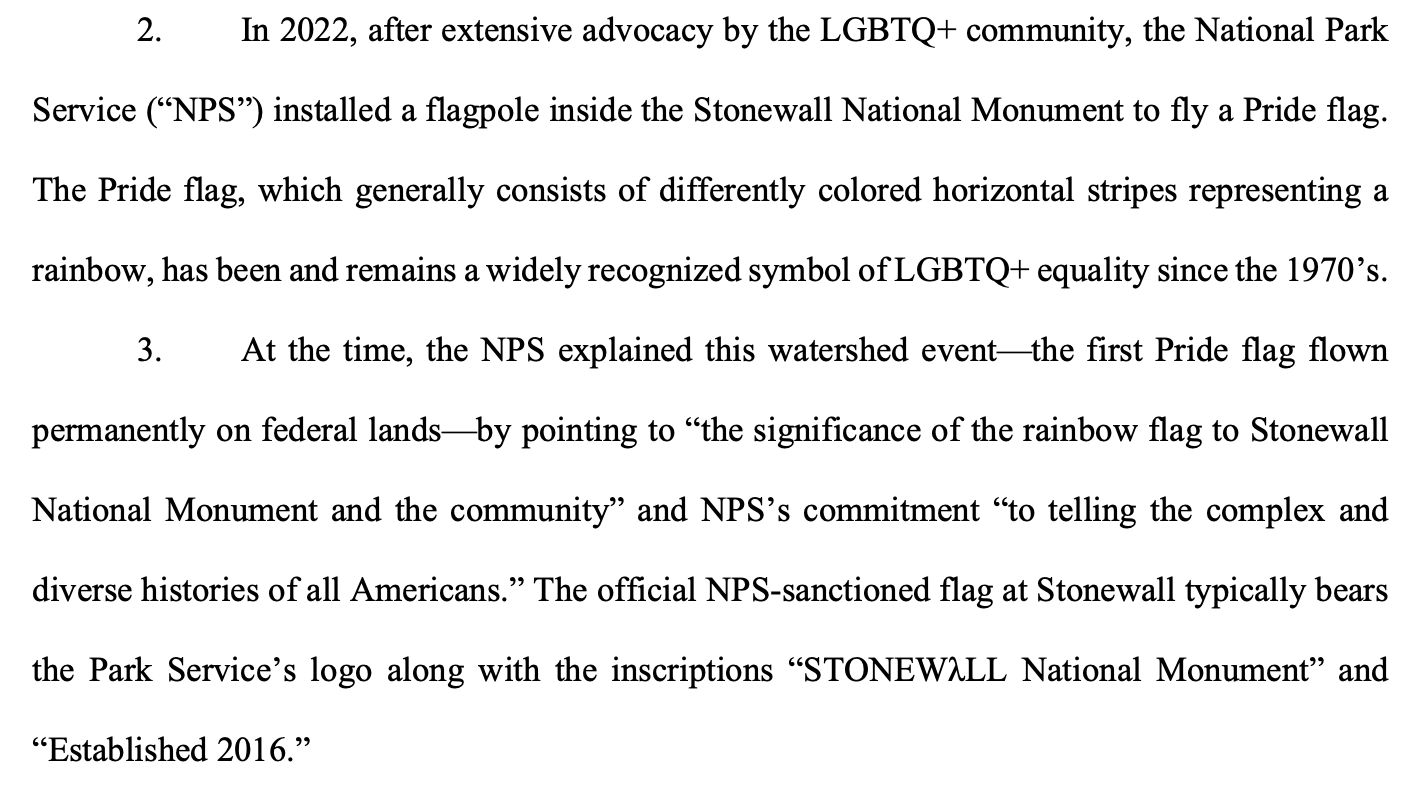
Then, with President Donald Trump in office, this happened earlier this month:
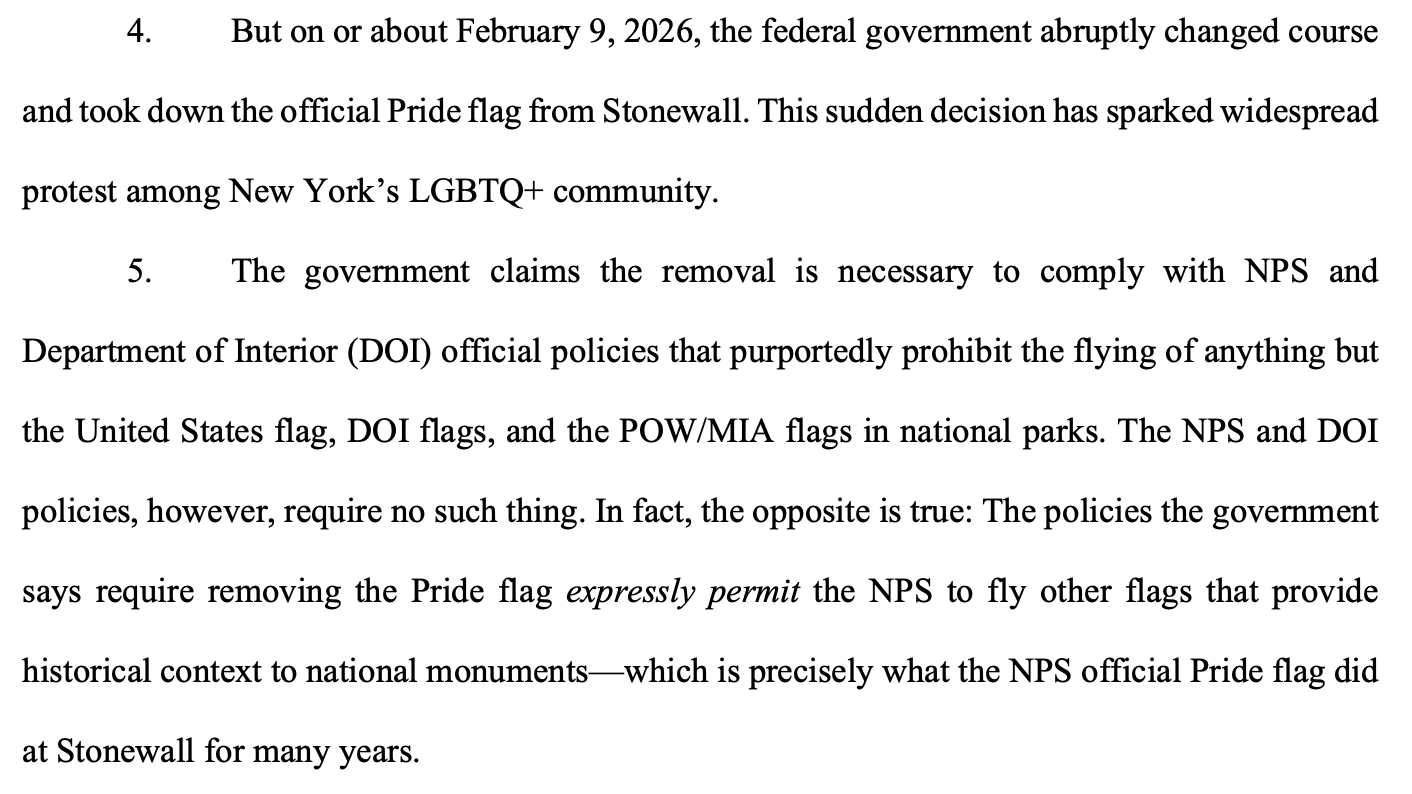
The lawsuit alleges that the action violates the Administrative Procedure Act for several similar reasons to those raised in the lawsuit challenging the Trump administration’s actions to remove material from Independence National Historical Park in Philadelphia.
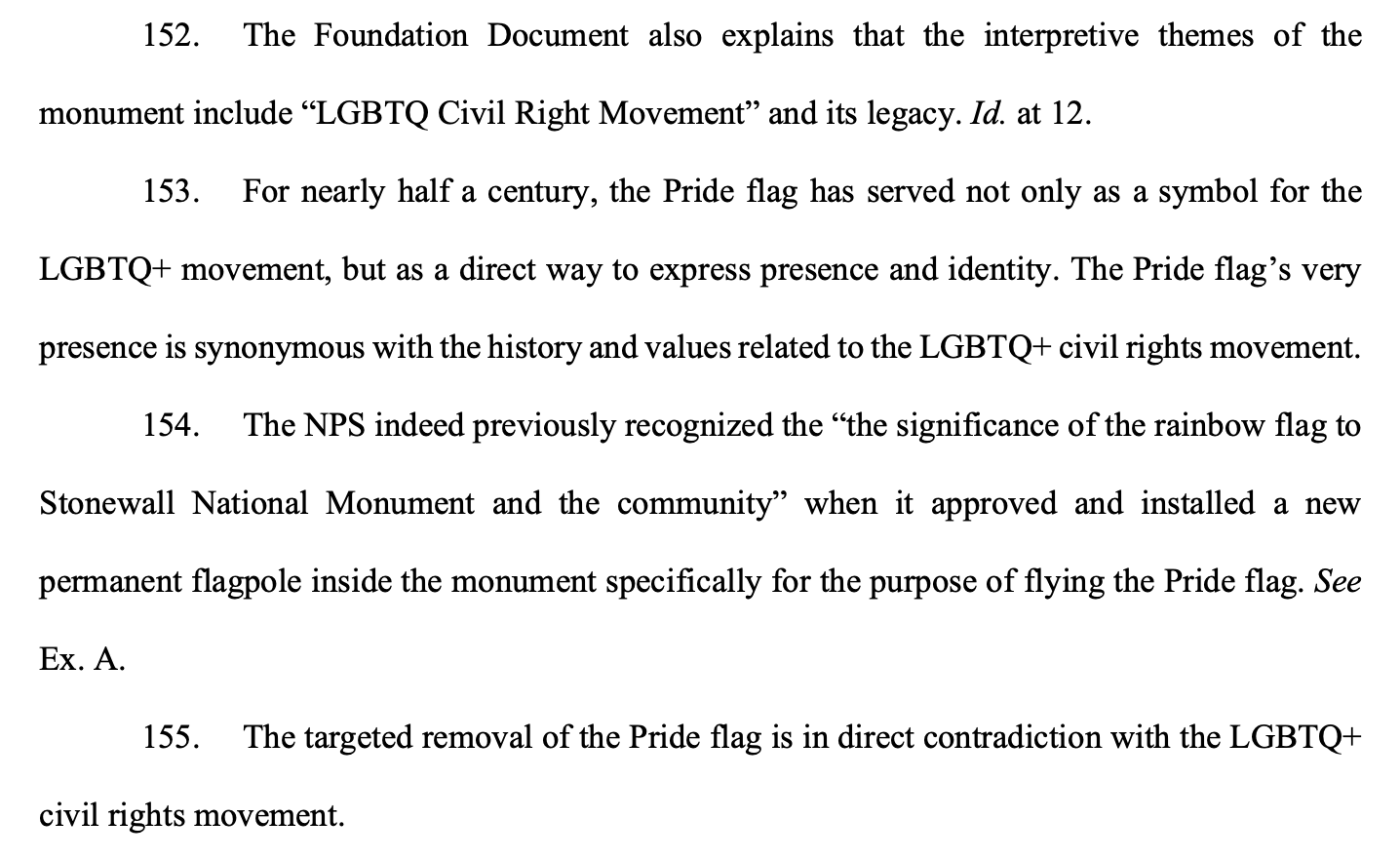
It’s not often that Law Dork will get to highlight a National Park Service Foundation Document two days in a row, so let’s take advantage of it while we can. The lawsuit detailed parts of the Stonewall National Monument’s Foundation Document — issued during the first Trump administration — in explaining why the Pride flag’s removal is contrary to the purpose of the monument.
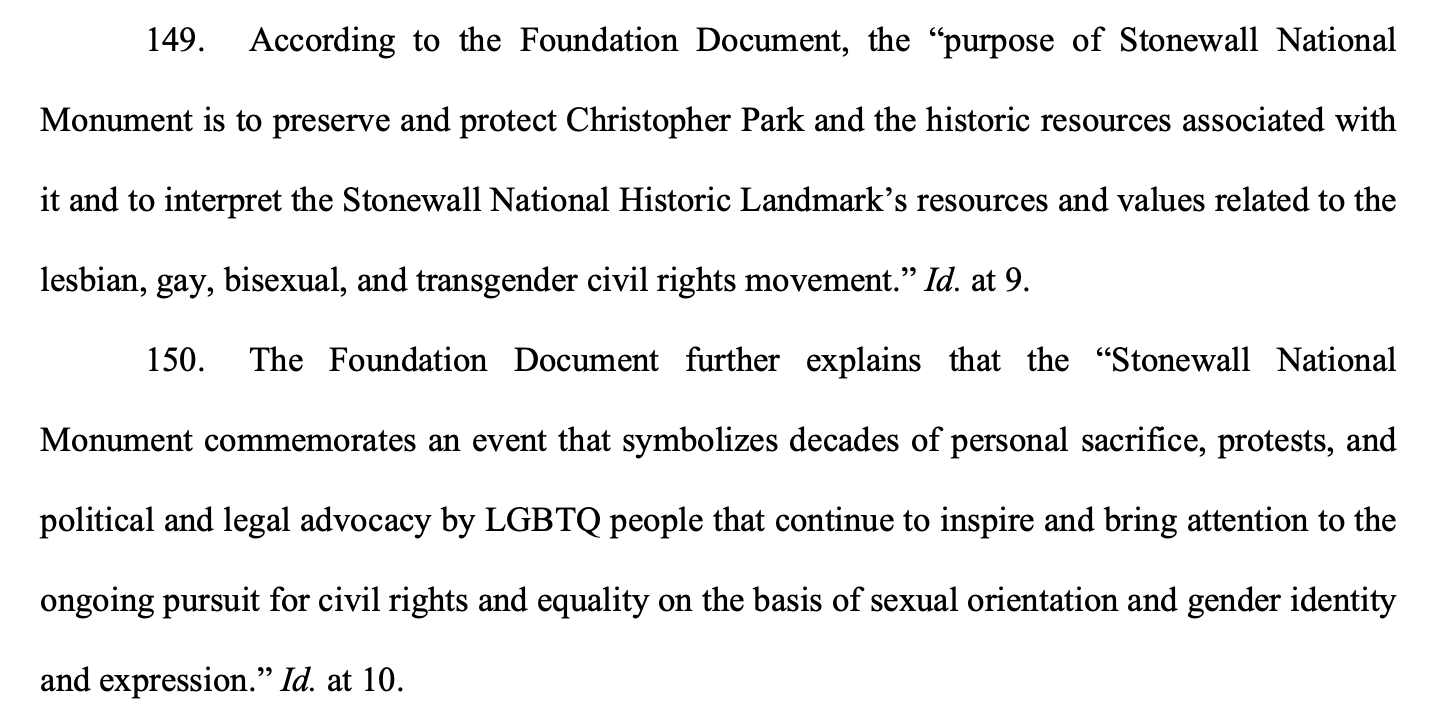
Specifically, it noted:
There are certainly more important anti-LGBTQ actions happening in the Trump administration, and I am covering them as well, but challenging these ridiculous efforts to erase history and symbols is important, too, in fighting some of the most extreme elements of this administration’s aims.
Note to my friends at the Supreme Court. There is a scrivener’s error there in that change that someone should fix.
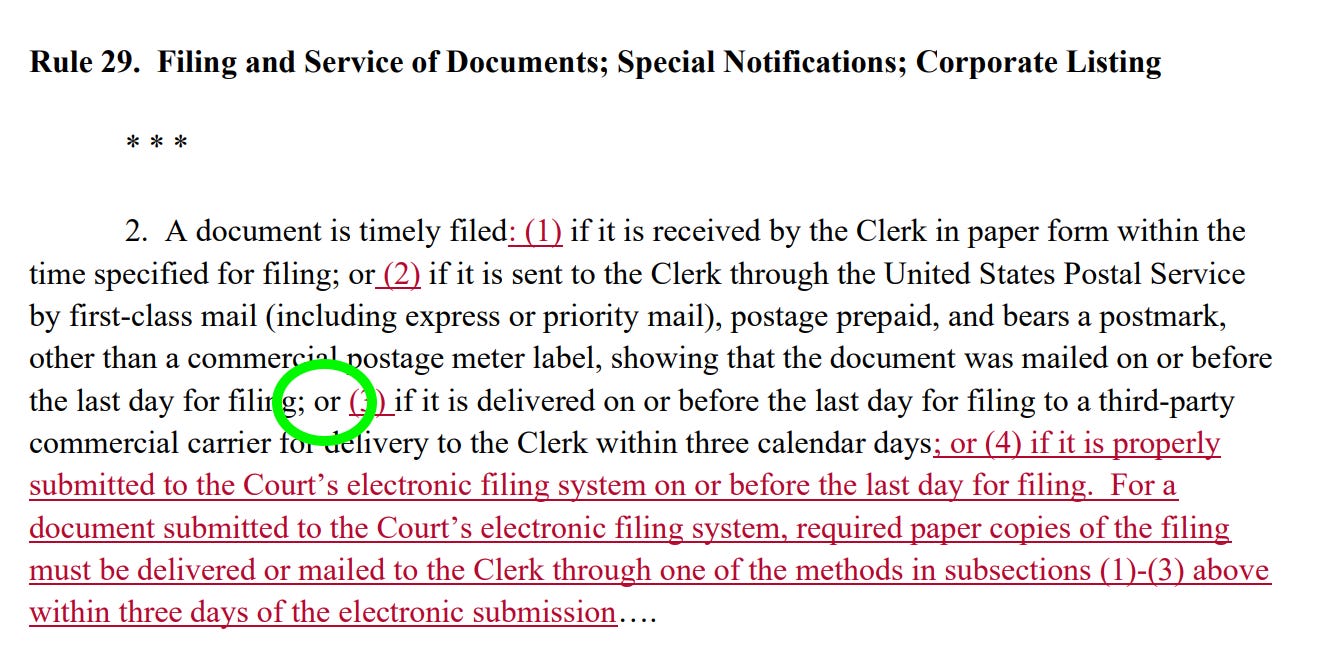
That “or” should be struck through in light of the addition of (4).
Update, at 7:15 p.m: OK, after someone pointed out the “or” before (2), I think that, in changing the format, it appears that this might intentional, although I still think it is surplusage. Several other times in the rules were there are semicolons and a list of numbers, only the final number is preceded by a conjunction. Out of an abundance caution here, however, despite adding in the numbers, it is possible they chose to keep the “or” to make absolutely clear a person only need do one of these to timely file a brief.
Paul Krugman, in his post today, coined a new term for our form of government: a "Quackistocracy"; it's a form of Kakistocracy (worst of the worst) but with a bunch of ideological quacks. Roberts, Alito, Thomas, Gorsuch and Kavanaugh all fall right in line with this new term. Krugman should win the Webster's Dictionary gold medal for best new word (defeating Trump's "equalize"; a word that's been in use since 1599). Quack!
Chief Justice Roberts: Ethics, schmethics—show me the money!