

Trans prisoners' medical care remains protected after a flurry of court rulings on Wednesday
A D.C. Circuit ruling would have allowed the Trump admin's anti-trans policy to go into effect, but a new district court injunction issued hours later blocked the policy yet again.

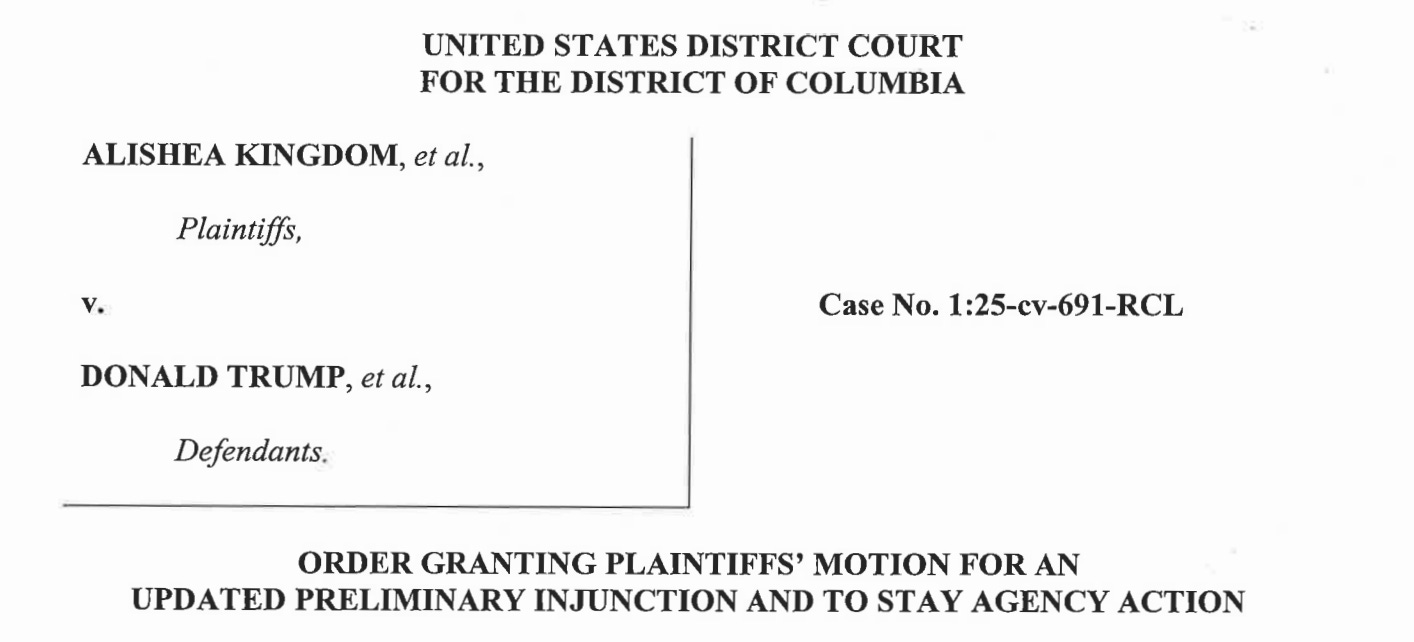
The Trump administration’s effort to end gender-affirming medical care for transgender people in federal prison is blocked again after a short lapse in protections on Wednesday.
About noon Wednesday, the U.S. Court of Appeals for the D.C. Circuit issued a 2-1 order that for two-and-a-half hours technically allowed the Trump administration to begin implementing the Federal Bureau of Prisons’s plan to “taper” — with a goal of ending — the provision of hormone therapy for transgender people in federal prison.
About 2:30 p.m., though, U.S. District Judge Royce Lamberth granted a request that had been pending from the plaintiffs challenging the BOP policy and issued a new preliminary injunction blocking the plan.
This was not the actions of a “rogue” judge or anything like that. The appeals court judges had even noted that the district court request was pending, but Judges Karen Henderson, a George W. Bush appointee, and Justin Walker, a Trump appointee, nonetheless issued the ruling on Wednesday — over the dissent of Judge Cornelia PIllard, an Obama appointee.
The D.C. Circuit move effectively forced Lamberth, a Reagan appointee, to act quickly if he wanted to keep the protections he had ordered in place.
He did so — continuing his role as the federal judge most clearly protecting the rights of trans people in prison.
What is going on?
The quick back-and-forth orders, though confusing procedurally, were a progression that all judges on the appeals court acknowledged was possible. Despite that, rather than just waiting for Lamberth to rule on the new request, the two Republican appointees on the appeals court who made up the majority stated that they wanted to issue a ruling now — likely in an effort to place new limits on district court judges in D.C.
The unsigned, per curiam order from Henderson and Walker stayed a May 26 preliminary injunction issued by Lamberth. The order stated:
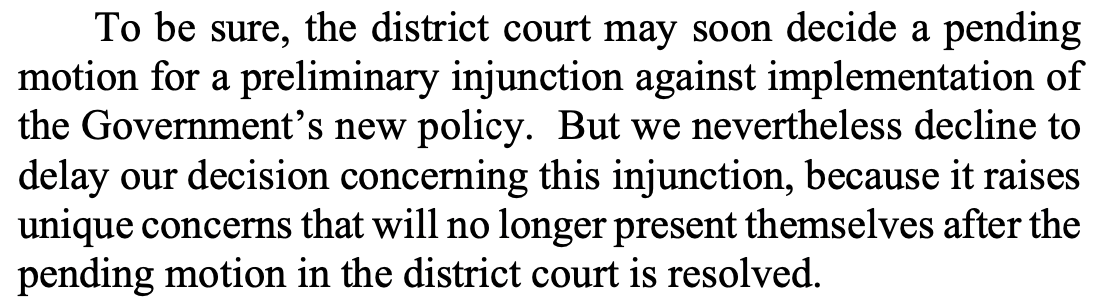
Lamberth has — since the first month of the second Trump administration — been issuing orders protecting trans people in prison from having their medical care discontinued and, for a smaller number of trans women, from being transferred to men’s facilities. Due to the confines of the Prison Litigation Reform Act, preliminary injunction orders can only last for 90 days, so, while the cases were proceeding, Lamberth has issued multiple 90-day preliminary injunctions in succession.
During the course of the litigation — which was initially prompted by President Donald Trump’s January 20, 2025 executive order — the BOP issued a new “program statement” on February 19, 2026, which included the “tapering” policy.
When the plaintiffs filed a request for an updated preliminary injunction addressing the changes in the new policy, DOJ opposed the request and arguments were set for May 27.
At the same time, given the 90-day PLRA limit, the plaintiffs also asked for that earlier preliminary injunction to be renewed one last time — providing protection while the new preliminary injunction request could be considered. DOJ opposed that request, but Lamberth granted it on May 26 and held the hearing on the new request the next day.
Nonetheless, DOJ went to the D.C. Circuit on May 29, asking for that May 26 preliminary injunction to to be stayed. The appeals court did not grant DOJ its requested administrative stay and set a briefing schedule over the next week and the plaintiffs opposed DOJ’s request.
On Wednesday, Henderson and Walker granted the stay pending appeal — even as they acknowledged its practical effect in the case could soon be (and was) rendered moot.
Why did the majority do this?
First, on the merits — the likelihood of success on the merits — the panel decided that Lamberth’s preliminary injunction order of May 26 “appears to have been an administrative injunction.” To that, they stated:
There does not appear to be any “discernible legal basis . . . for issuing administrative injunctions,” especially not in cases like this one involving the Prison Litigation Reform Act. Christopher D. Moore, So-Called “Administrative Stays” in Trump 2.0, 104 Tex. L. Rev. Online 1, 17 (2025); see also id. at 16–27 (canvassing potential legal bases); 18 U.S.C. § 3626(a)(2) (permitting the court to issue “a temporary restraining order or an order for preliminary injunctive relief,” not a standardless administrative injunction). Thus, the Government is likely to succeed on the merits of its challenge to this particular injunction.
Here is Moore’s article. Moore is a 2024 Harvard Law School graduated who clerked for Judge Andy Oldham, a Trump appointee on the U.S. Court of Appeals for the Fifth Circuit. He is currently a research fellow at University of Texas School of Law, per his LinkedIn.
Additionally, in addressing the irreparable harm factor, the majority — which included Walker — quoted from Walker’s dissent in the case over the Trump administration’s effort to end temporary protected status for people from Haiti.
![As to irreparable injury, "[t]he Government is irreparably harmed by an improper intrusion by a federal court into the workings of a coordinate branch of the Government.'" Miot v. Trump, No. 26-5050, 2026 WL 659420, at *4 (Mar. 6, 2026) (Walker, J., dissenting) (quoting INS v. Legalization Assistance Project of Los Angeles County Federation of Labor, 510 U.S. 1301, 1306 (1993) (O'Connor, J., in chambers)); see also id. at *4 n.6 (collecting authorities). That is especially true here where the Government (likely rightly) asserts that the injunction entered "exceed[ed]" the district court's equitable "authority." Trump v. CASA, Inc., 606 U.S. 831, 860 (2025). Compare Chaplaincy of Full Gospel Churches v. England, 454 F.3d 290, 303 (D.C. Cir. 2006) (explaining that "the irreparable harm analysis... assumes, without deciding, that the movant has demonstrated a likelihood" of success), with Miot, 2026 WL 659420, at *5 (Walker, J., dissenting) ("The Government's harm would be lightened, perhaps significantly, if the Government were unlikely to prevail on the merits.").](https://substackcdn.com/image/fetch/$s_!qmPv!,f_auto,q_auto:good,fl_progressive:steep/https%3A%2F%2Fsubstack-post-media.s3.amazonaws.com%2Fpublic%2Fimages%2Fa6e6eb12-ca88-49e2-af24-7df378649b54_1102x904.png "As to irreparable injury, \"[t]he Government is irreparably harmed by an improper intrusion by a federal court into the workings of a coordinate branch of the Government.'\" Miot v. Trump, No. 26-5050, 2026 WL 659420, at *4 (Mar. 6, 2026) (Walker, J., dissenting) (quoting INS v. Legalization Assistance Project of Los Angeles County Federation of Labor, 510 U.S. 1301, 1306 (1993) (O'Connor, J., in chambers)); see also id. at *4 n.6 (collecting authorities). That is especially true here where the Government (likely rightly) asserts that the injunction entered \"exceed[ed]\" the district court's equitable \"authority.\" Trump v. CASA, Inc., 606 U.S. 831, 860 (2025). Compare Chaplaincy of Full Gospel Churches v. England, 454 F.3d 290, 303 (D.C. Cir. 2006) (explaining that \"the irreparable harm analysis... assumes, without deciding, that the movant has demonstrated a likelihood\" of success), with Miot, 2026 WL 659420, at *5 (Walker, J., dissenting) (\"The Government's harm would be lightened, perhaps significantly, if the Government were unlikely to prevail on the merits.\").")
In other words, with a different panel, Walker literally turned his March dissent into a June majority. (That said, his own actions show how irrelevant that might be.)
The reasons for this aren’t absolutely clear beyond what the order stated, but it could be as simple as the fact that this was a three-judge panel that had two Republican appointees. The pair might have used the chance to craft a majority that could be used elsewhere to restrict district court judges in the future. Relatedly, it could represent part of an ongoing dispute on the D.C. Circuit about how to address the significant number of district court injunctions that come out of the D.C. District Court.
The dissent
In dissent, Pilliard explained that this is about “maintain[ing] the status quo by requiring the Bureau of Prisons (BOP or Bureau) to continue providing medical care it has so far afforded to these plaintiffs” — a harm ignored by the majority.
“At bottom,” she continued, “BOP’s theory of irreparable harm is that the Executive is irreparably injured by a temporary delay in effectuating its new policy.“ That, she wrote, is not the rule in the D.C. Circuit:
[T]his court has already repeatedly declined to adopt that “broad and seemingly novel proposition”—particularly when the order at issue maintains the status quo. Miot, 2026 WL 659420, at *4; see Make the Rd. N.Y. v. Noem, 2025 WL 3563313, at *31-32 (D.C. Cir. Nov. 22, 2025); Fed. Educ. Ass’n, 2025 WL 2738626, at *3.
Notably, Miot is the Haiti TPS case — where Walker dissented.
Pillard went on to note how absurd the government’s irreparable harm argument is — and, accordingly, her colleagues’ decision to go along with it — in light of the fact “[t]he government never appealed the original March 2025 preliminary injunction of the Executive Order. Nor did it appeal when the district court renewed the preliminary injunction thrice thereafter.”
In short, she wrote, “I would not intervene on an emergency basis here, when everything suggests that the district court is expeditiously considering plaintiffs’ challenge to the new policy.“
Lamberth, yet again
Despite the D.C. Circuit majority’s actions, Lamberth, yet again, came through to protect trans prisoners in a sharp opinion that is only technically a ruling on the Administrative Procedure Act claim brought by the plaintiffs but, in reality, cuts down virtually all of the Trump administration’s anti-trans arguments.
“With this Opinion, the Court has no intention of wading into the culture war being waged against transgender individuals,“ Lamberth wrote, insisting that “the Court simply decides whether the Bureau of Prisons followed mandatory administrative procedure when it issued its new policy concerning the provision of gender-affirming care to inmates diagnosed with gender dysphoria.”
And yet — this is what Lamberth did on Wednesday. In ruling that the plaintiffs will likely succeed in their APA argument that the program statement was arbitrary and capricious, he found three independent bases for this ruling:
“Despite providing gender-affirming care to inmates in its custody for years, the government cites in the Program Statement zero evidence from its own medical or mental health professionals to support its conclusions. Moreover, the government does not point the Court to evidence that gender-affirming care was ineffective or harmful to its own inmates diagnosed with gender dysphoria, or that providing this care previously led to security concerns at BOP facilities. … Post-hoc rationalizations during litigation1 cannot replace the type of reasoned analysis the government must undertake at the front end.”
“[The Program Statement] reaches a conclusion ‘so implausible that it could not be ascribed to a difference in view or the product of agency expertise,’ as evidenced by its explanation, which ‘runs counter to the evidence before the agency.’ … Instead of relying on BOP’s own medical or mental health professionals, the agency supports its new policy with a declaration by a doctor it retained specifically for this litigation, who has limited experience treating gender dysphoria, and who promotes a treatment for gender dysphoria that he himself acknowledges is not evidence based. … Banning evidence-backed care for an alternative that has no evidentiary support is an ‘implausible strategy’ to treat gender dysphoria … to say the least.”
“It is more likely, given the record before the Court, that the government disregarded significant evidence in its possession to reach the EO’s mandated result. The Court’s conclusions in subsections [1 and 2] provide further evidence of pretext. If the government intended to form a policy based on the evidence, one would expect it to have seriously considered its own experience providing gender-affirming care to inmates in its custody. … No length of consideration can convince the Court that a policy is anything other than pretext when the agency has not demonstrated that it considered the relevant evidence and drew a reasonable conclusion from that evidence.”
With that, Lamberth wrote, “Having found that BOP’s prohibition on gender-affirming care is likely arbitrary and capricious under the APA, the Court leaves Plaintiffs’ Eighth Amendment claims for another day.“
Additionally, in considering the question of irreparable harm, Lamberth examined “the efficacy of gender-affirming care,” after having described how the Trump administration is claiming there is a “debate” — scare quotes his — over the question.
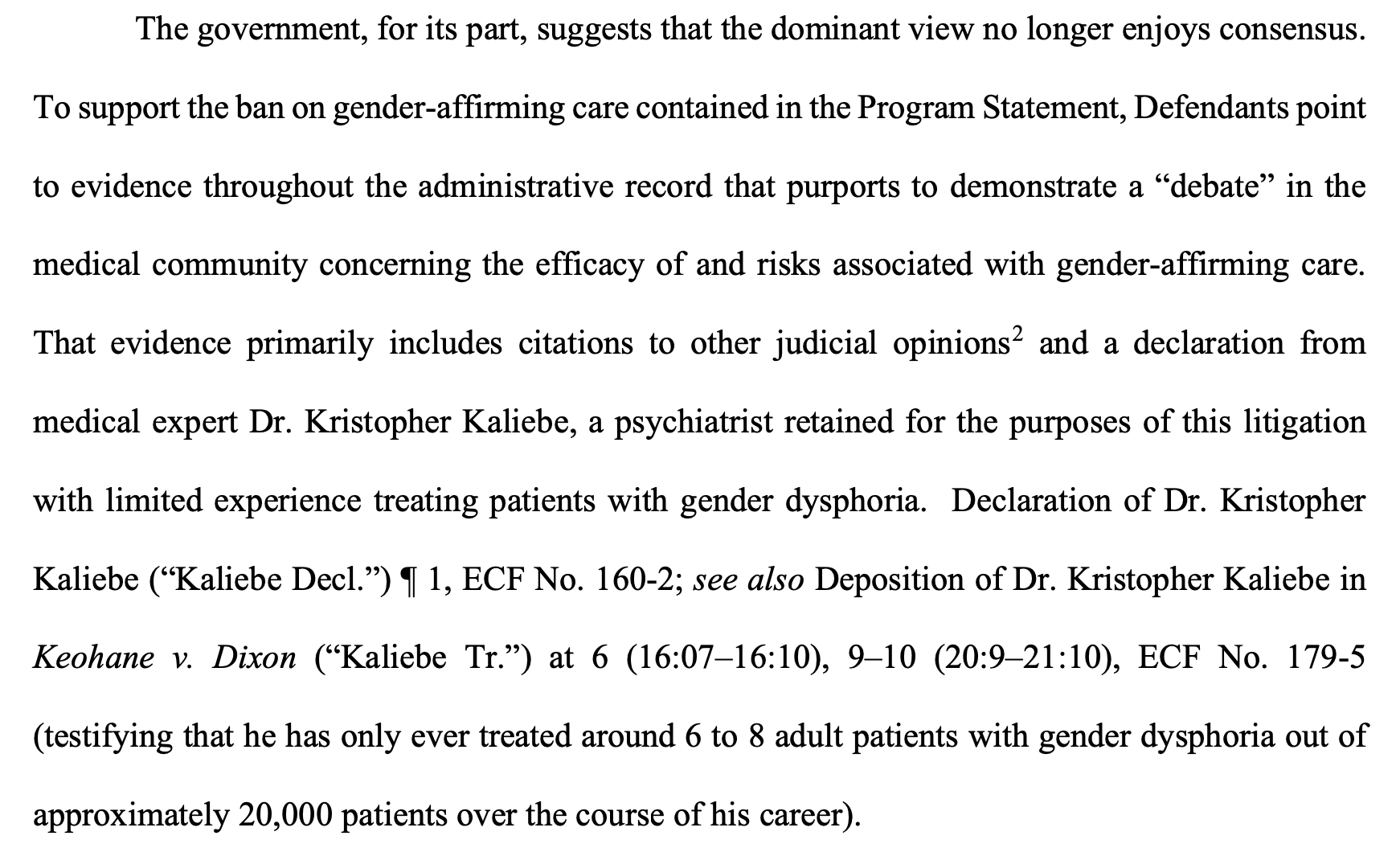
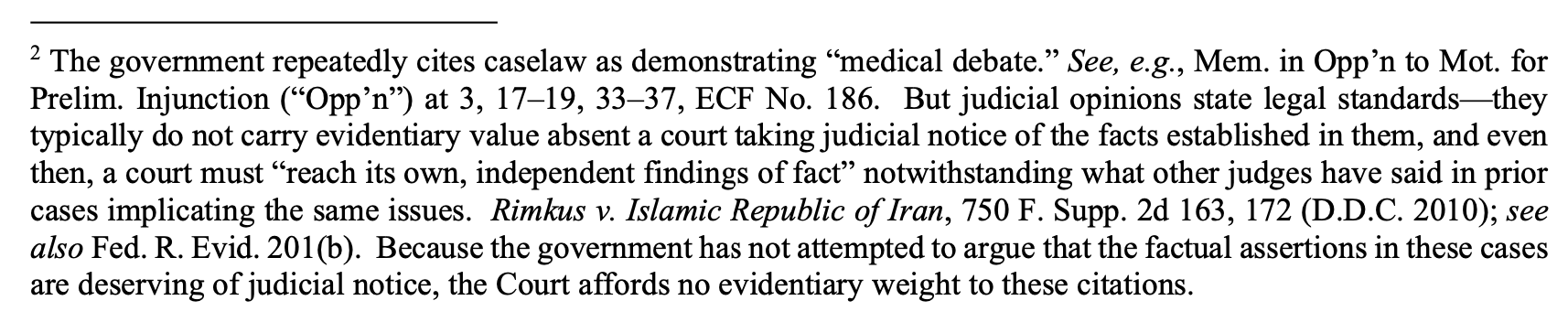
Law Dork raised this precise point in the report on the May hearing.
After then going through the evidence presented, Lamberth’s ruling on this point is exceptionally simple — and extremely important:
Based on this record, the Court concludes that Plaintiffs have demonstrated that gender affirming care is the only effective treatment for gender dysphoria.
Ultimately, Lamberth issued his new preliminary injunction, protecting the class:
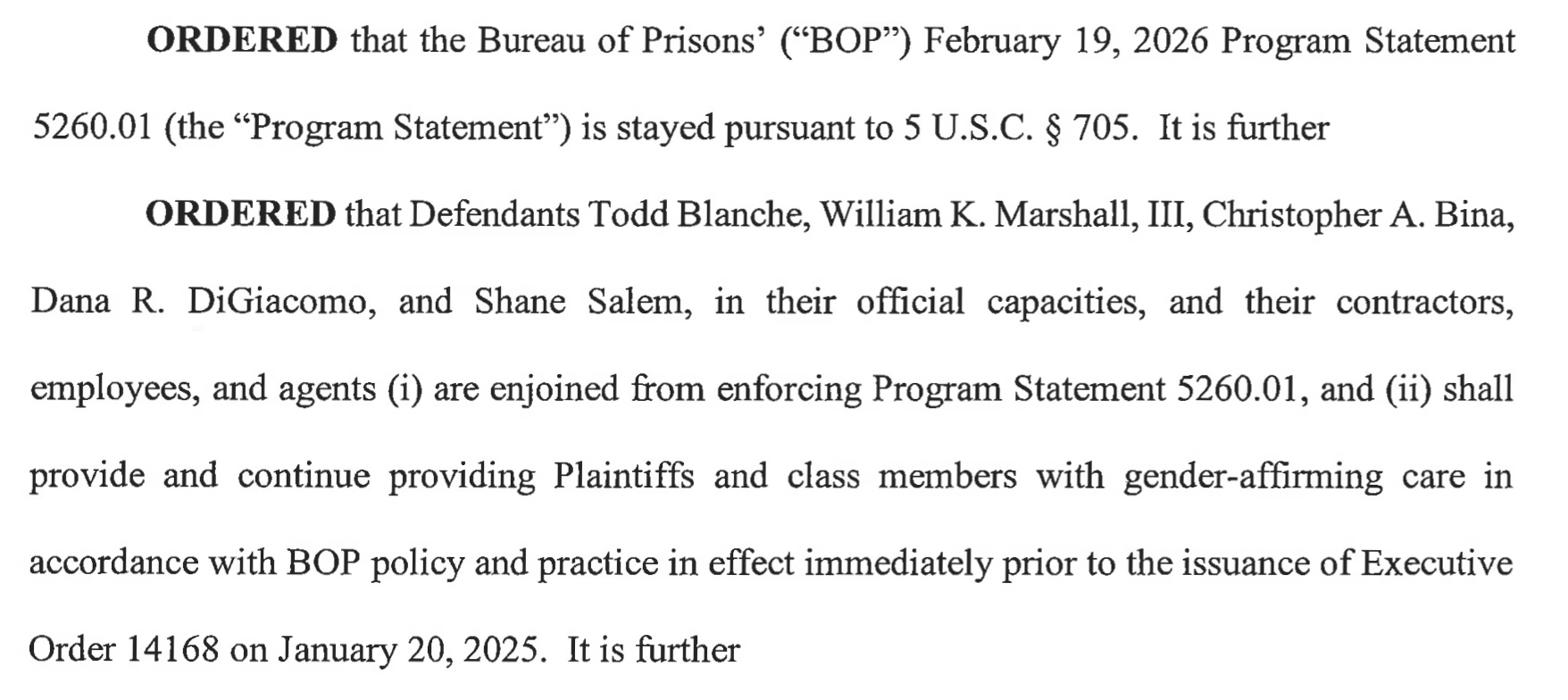
All in a days work for the 82-year-old senior judge — who is “not wad[ing] into the culture war being waged against transgender individuals,” mind you.
This is referencing a May 12, 2026 declaration from “BOP Medical Director Dr. Elizabete Stahl, which appears in the record for the first time as an attachment to Defendants’ opposition.”
Does this apply to all trans prisoners nationwide?
If only this “administration” were more interested in democracy than pettiness …