

Federal judge blocks Trump admin's effort to move 14 trans women to men's prisons
"[I]t is fundamentally unreasonable for prison officials to respond to serious risks ... by intentionally creating those risks and offering to treat them after they predictably occur."

A federal judge who has been steadfastly protecting the rights of transgender people in prison on Sunday night issued a ruling that blocked the Trump administration from transferring the small number of trans women assigned to women’s federal prisons to men’s prisons.
U.S. District Judge Royce Lamberth, who has been hearing a series of challenges to the Trump administration’s anti-trans prison policies, issued the preliminary injunction protecting the 14 trans women after assessing their individual circumstances, as the U.S. Court of Appeals for the D.C. Circuit required the district court to do following an earlier appeal of the case.
Lamberth, a Reagan appointee, concluded that the Trump administration’s plan to transfer the 14 transgender women already assigned to women’s prisons would likely violate their Eighth Amendment rights.
(Lamberth also has temporarily blocked the Trump administration’s efforts to “taper” hormone therapy for trans people in federal prison — with a goal of ending it — in a companion case. DOJ is seeking a stay of that order at D.C. Circuit, even as Lamberth considers new relief in that case — as he discussed in denying DOJ’s request for a stay at the district court.)
In concluding that the 14 trans plaintiffs are likely to succeed in their Eighth Amendment claims, Lamberth displayed a level of knowledge and understanding about transgender people’s lives that show just how disingenuous and cruel anti-trans efforts tend to be — and how flimsy the Trump administration’s arguments in defense of its anti-trans policies tend to be.
First, Lamberth contextualized all of this with numbers, citing the Federal Bureau of Prisons’s own data: “Plaintiffs represent less than one percent of the transgender population in the Bureau’s custody (14 individuals out of approximately 1,500) and transgender inmates as a group already account for only a small minority group among federal inmates (approximately 1,500 out of 154,000).“
In addressing the Eighth Amendment claim regarding their conditions of confinement — which requires objective evidence of “intolerable” risks and subjective evidence that the government acted with “deliberate indifference” to those risks — Lamberth stated that the plaintiffs’ two claimed risks were: “(1) the risk of physical and sexual violence from fellow inmates, and (2) the risk of severely exacerbated gender dysphoria.”
After noting that the Justice Department’s primary response was that the trans women would be sent to “Federal Medical Center (FMC) Rochester or Medical Center for Federal Prisoners (MCFP) Springfield—two prisons where the rates of assault are generally lower than those at the facilities where Plaintiffs are currently housed,“ Lamberth explained:
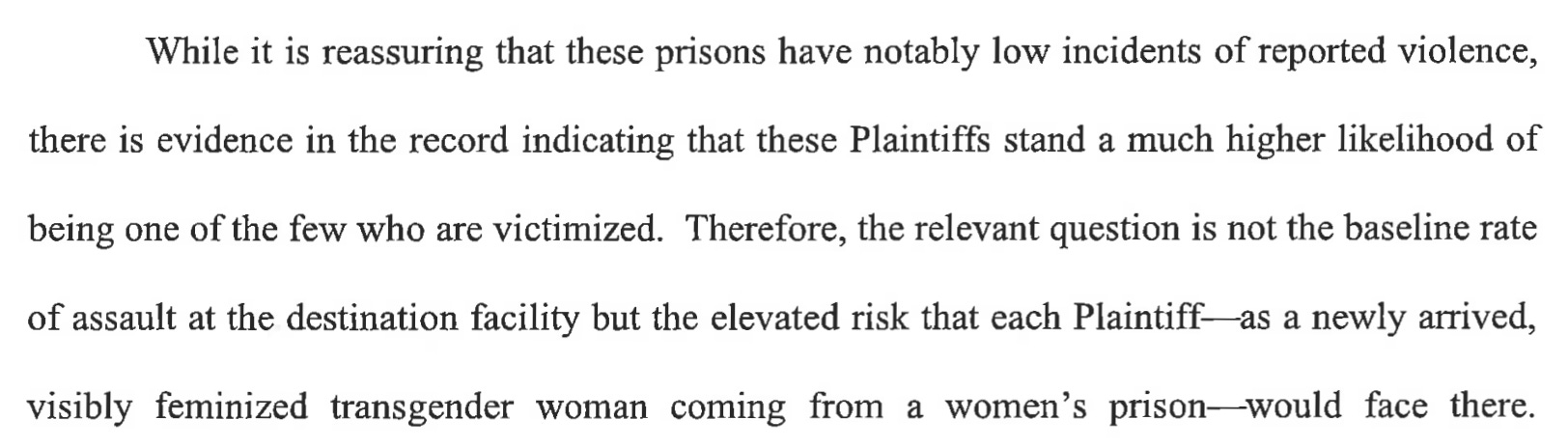
This is such a simple — and obvious — point, and yet it is and would be missing from most judges’ analysis. It represents Lamberth’s significant understanding of both the federal prison system and transgender people.
This is illustrated even more clearly as to the trans women’s second risk — that such a transfer would risk making their gender dysphoria worse. To that, Lamberth takes the government at its word — to show how insufficient that is:
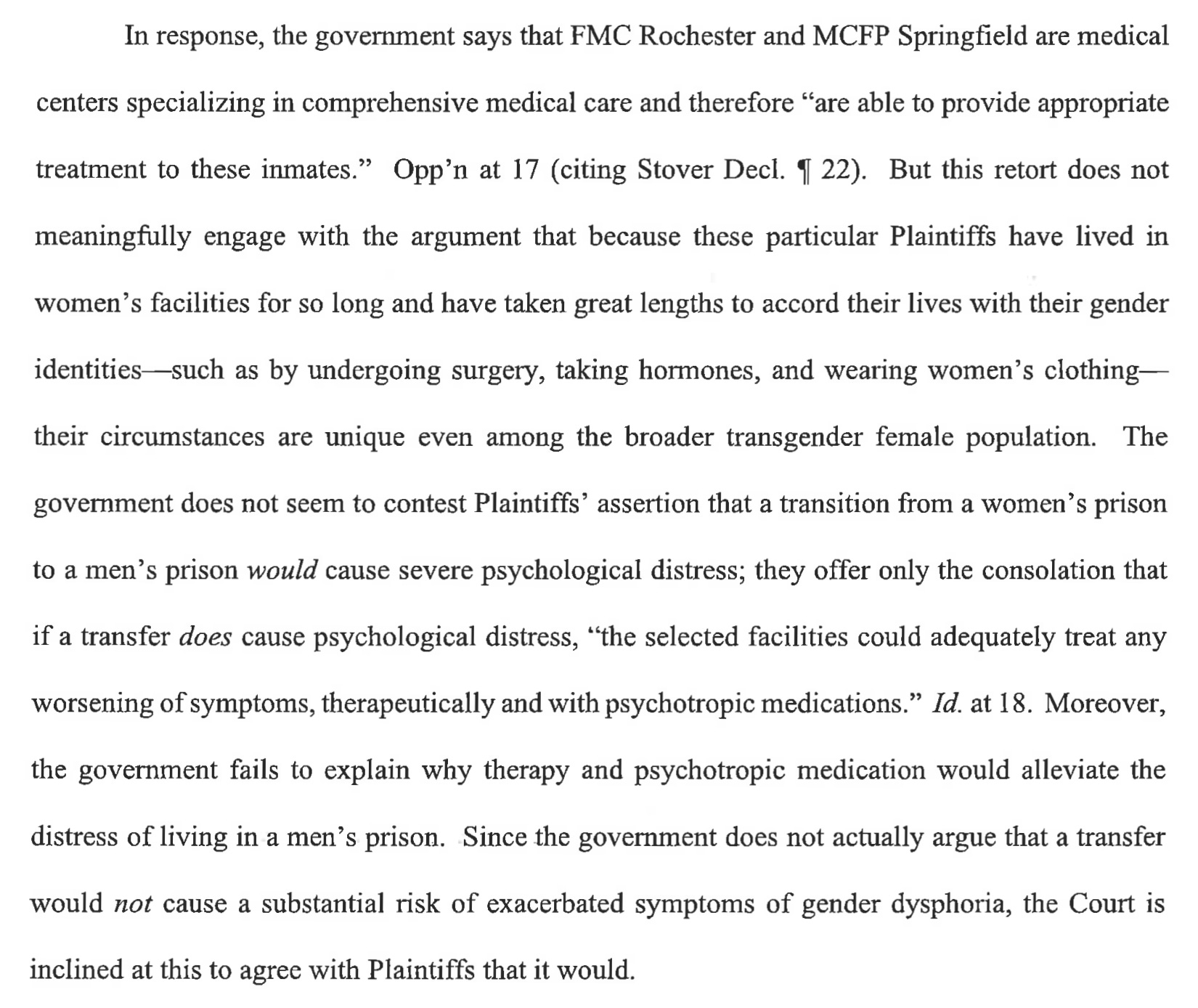
The government’s reliance on the two medical facilities went even further at the subjective phase of the analysis. Specifically, Lamberth wrote:
The government argues that those facilities are equipped to manage the deterioration in mental and physical wellbeing that Plaintiffs argue will predictably occur. In Plaintiffs’ words, “that argument concedes the critical point: BOP’s response did not determine whether transfer would expose Plaintiffs to a substantial risk of serious harm, but merely identified facilities purportedly capable of treating the foreseeable and avoidable consequences of that harm after it occurs.”
Lamberth agreed with the plaintiffs that the “the government has evidenced a subjective awareness of the objectively serious risks to Plaintiffs by presenting specific (though inadequate) plans to mitigate them.“
Ultimately, Lamberth found that the mandatory transfer to men’s prisons “was not a reasonable response” because “it is fundamentally unreasonable for prison officials to respond to serious risks such as mental health deterioration, self-harm, and suicidality by intentionally creating those risks and offering to treat them after they predictably occur.” Additionally, he found that “it is unreasonable, given the known risks, for the Bureau to adopt a categorical policy of transferring all transgender female inmates to men’s prisons without first considering whether it would be safer to house Plaintiffs in women’s facilities.“
He then engaged in 30 pages of redacted individualized consideration of each of the 14 plaintiffs, concluding the trans women are likely to succeed on their Eighth Amendment claims. He also found that the other preliminary injunction factors — irreparable harm, balance of the equities, and the public interest — favor an injunction.
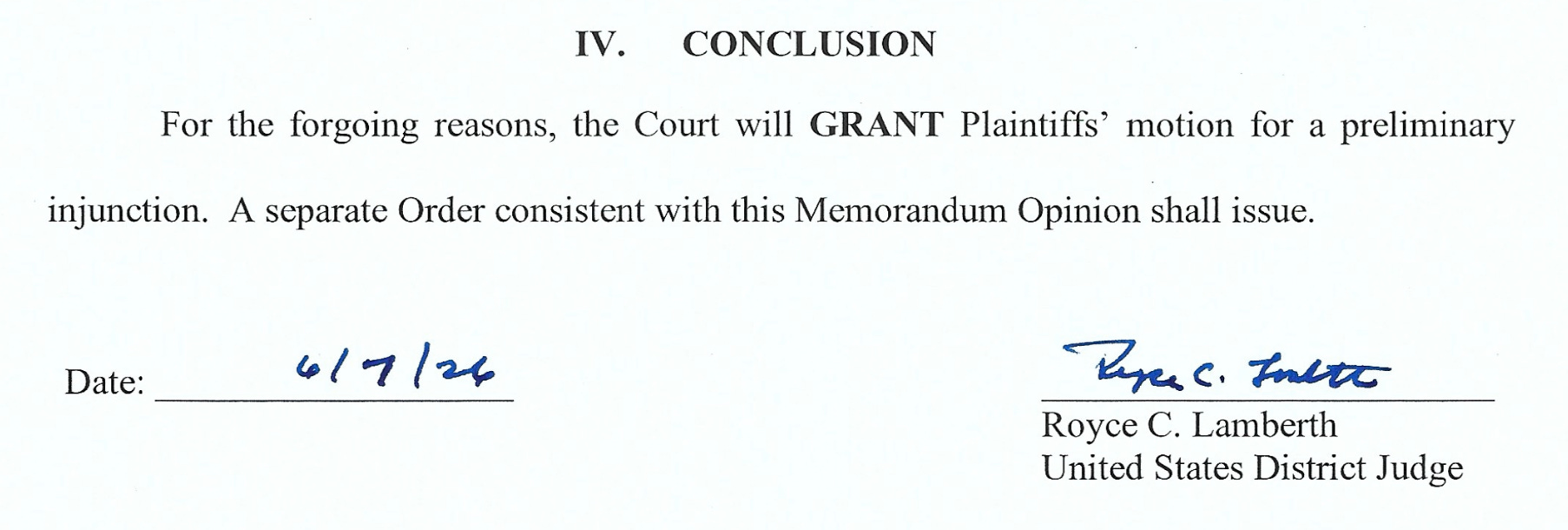
Finally, Lamberth does note a preliminary injunction issued in the Northern District of Texas on June 2 in a case, Fleming v. Rule, brought by cisgender women in federal prison assigned to Federal Medical Center (FMC) Carswell in Forth Worth, Texas. The injunction limits where transgender women can be housed in that facility and intersects with the case before Lamberth because four of the Doe plaintiffs are currently assigned to FMC Carswell. Lamberth, however, found that that injunction does not conflict with his injunction, which prohibits the transfer of those transgender women to men’s facilities.
Thank you for reporting this. 40 years ago, I was a young public defender. Even then, the jail understood the risks to transgender women and housed them in protective custody. I applaud Judge Lamberth.
The Eighth Amendment still exists. Kudos to Judge Lambeth. Now can his court take up the issue of prolonged solitary confinement? Denial of proper medical treatment and food and sanitary conditions in ICE’s taxpayer funded private detention centers?