

Thursday was the worst day for DOJ. So far.
DOJ withdrew its subpoenas issued to New York Times reporters, but the hearing that preceded that decision showed just how degraded DOJ has become.

The degradation of the Justice Department in the second Trump administration is clear, is having immediate effects, and will have long-term effects. Just how degraded DOJ has become was on full display in the Southern District of New York on Thursday.
To get why Thursday’s happenings are so central to understanding how bad things have gotten, know that the U.S. Attorney’s Office for the Southern District of New York is widely seen as one the preeminent U.S. Attorney’s Offices in the nation. Alumni of the office would say it was the key office, and it was openly (sometimes derisively) referred to as the “Sovereign District of New York,” due to the high view that members of the office held of the office.
Now, however, things look different. Over the past two weeks, the office tried to subpoena reporters from The New York Times and ensnared some of the reporters’ family members in a second set of subpoenas for phone records. When challenged, the office’s ability to carry out basic legal research and adhere to general ethical standards were called into question by U.S. District Judge Arun Subramanian in a sharp, hour-long hearing that ended with the Trump administration withdrawing the subpoenas rather than face the almost certain likelihood of Subramanian quashing them.
Inner City Press’s Matthew Russell Lee covered the hearing live on Bluesky, and Courthouse News Service covered the hearing as well, in addition to The New York Times’s report.
It was an altogether horrifying appearance in court for Deputy U.S. Attorney Sean Buckley, as well as Kevin Sullivan, a lawyer in the office who was initially sitting in the gallery but who, Lee reported, Subramanian called up to sit at counsel’s table because he was “on all the pleadings” — apparently relating to the phone provider subpoenas.
From the opening of the hearing, though, Subramanian, an Biden appointee, made it clear where things were ending.
After Buckley initially said the government didn’t want to withdraw the subpoenas but instead preferred to keep them held in abeyance while the investigation continued, Subramanian shot back, “Either we can quash the subpoenas, or you could withdraw the subpoenas,” as reported by the Times’s Michael Grynbaum and Jonah Bromwich.
But, the more fundamental problem, as Subramanian soon thereafter noted, is that “[s]ubpoenas are the last step, not the first step, but the last step” when dealing with efforts to subpoena reporters, as Courthouse News’s Erik Uebelacker reported.
Subramanian specifically referenced The New York Times v. Gonzales, a 2006 decision from the U.S. Court of Appeals for the Second Circuit — where appeals from New York’s federal courts are heard — laying out standards for addressing efforts to subpoena reporters’ phone records. Addressing a qualified privilege for journalists, the government in Gonzales had attested that it had “reasonably exhausted alternative investigative means“ of getting the information sought. The Second Circuit held that at least that step — even under compelling circumstances — was necessary before seeking reporters’ records.
Here, though, in opposing The New York Times’s motion to quash the subpoenas, the government acknowledged that “there are particular investigative steps that the Government is seeking to take in the near term that the Government anticipates will be material to this Court’s assessment of application of any qualified reporter’s privilege here.”
Hence, Subramanian’s “not the first step, but the last step“ comment.
That, however, was not all.
As Lee reported, Buckley said the subpoenaing of the phone records of the mother of a Times reporter and spouses was “an error,” adding, “We own it. We used a public source database.”
At that point, Subramanian shot back, “It seems like the inadvertent errors and ‘we should’ve done things differently’ are piling up,” as Courthouse News reported.
Then, regarding the phone records subpoena, Subramanian called Sullivan up, and matters got worse …
“Later we did legal research.”
Subramanian went so far as to note, per Lee, that he would ordinarily issue an order to show cause why he shouldn’t issue sanctions in a situation like this. Buckley pointed to a footnote in their filing addressing the non-disclosure order sought in the matter, Subramanian called that insufficient to resolve his concerns, and Buckley promised it would never happen again.
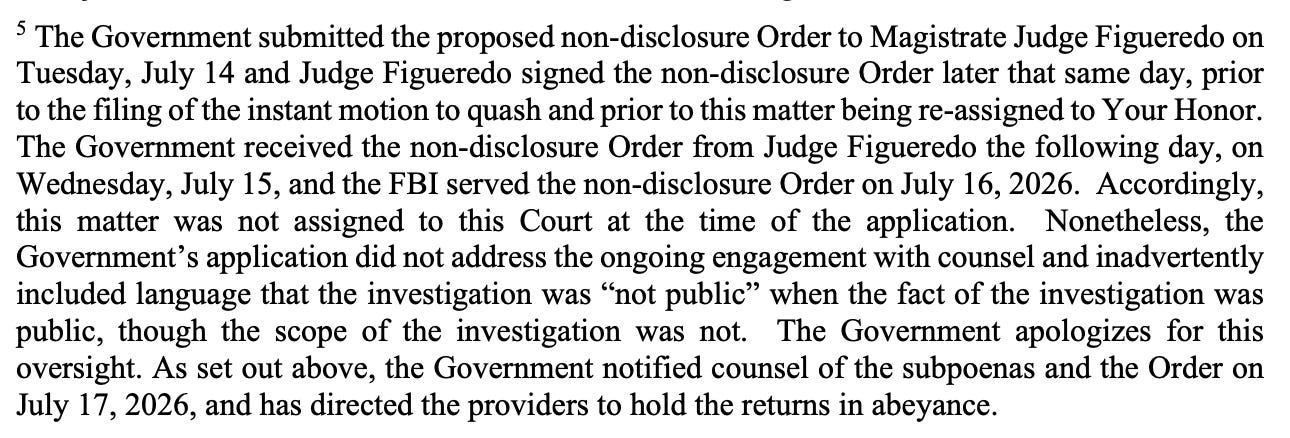
Somehow, it still got worse. When Buckley then told Subramanian about finding the Gonzales case — after seeking and getting the subpoenas — the judge’s question and Buckley’s answer spoke volumes:
Judge: You were not aware of the leading case in this field?
Buckley: No.
There was also further discussion about DOJ’s non-disclosure arguments and blame-shifting surrounding them, given that, as Subramanian noted …
“[Silence].”
After Buckley a short recess, everyone came back and DOJ agreed to withdraw the subpoena.
But, that was not the end of it. In addition to DOJ lashing out at Subramanian and insisting “this investigation remains ongoing,” the government’s actions here did have consequences for the Trump administration.
Subramanian issued an order later that, first, confirmed on the record that the Government withdrew the subpoenas.
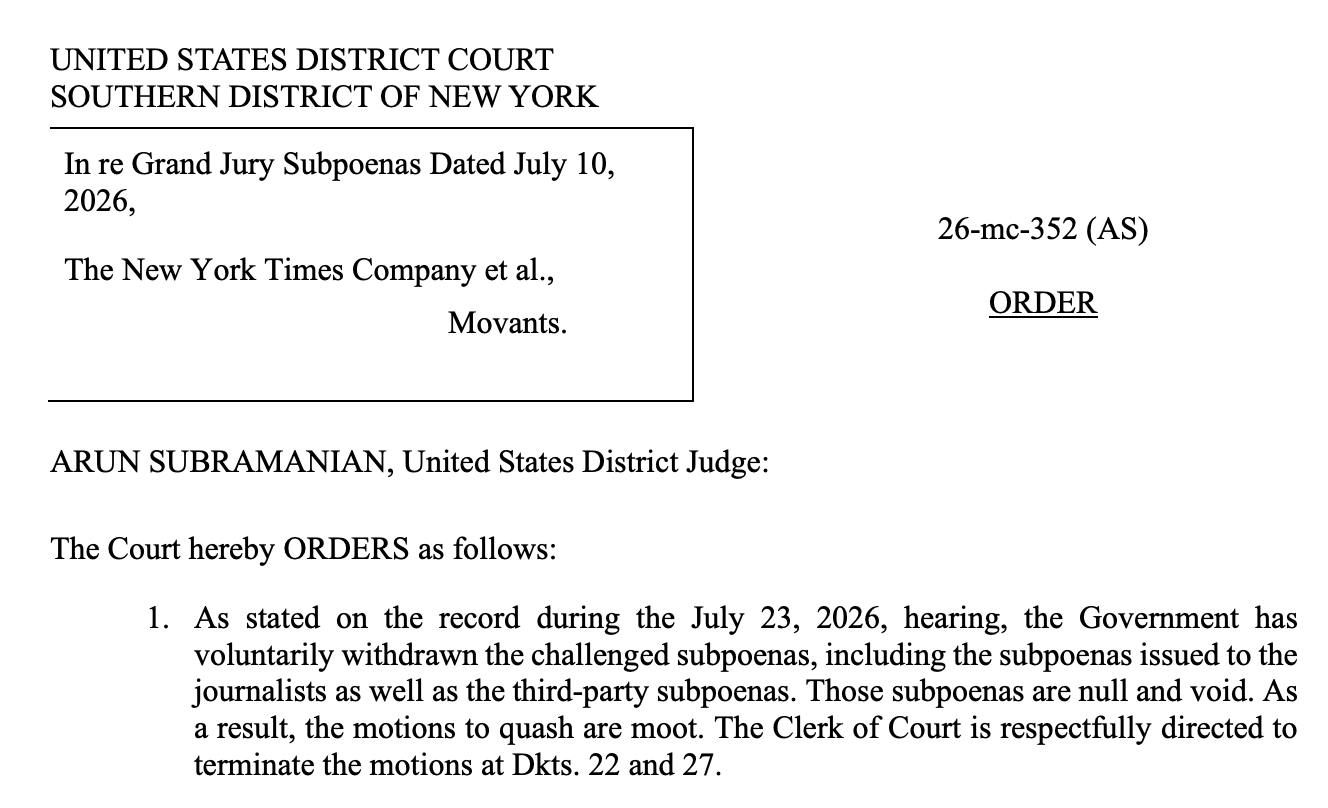
Additionally, though, he also issued three other provisions in the order.
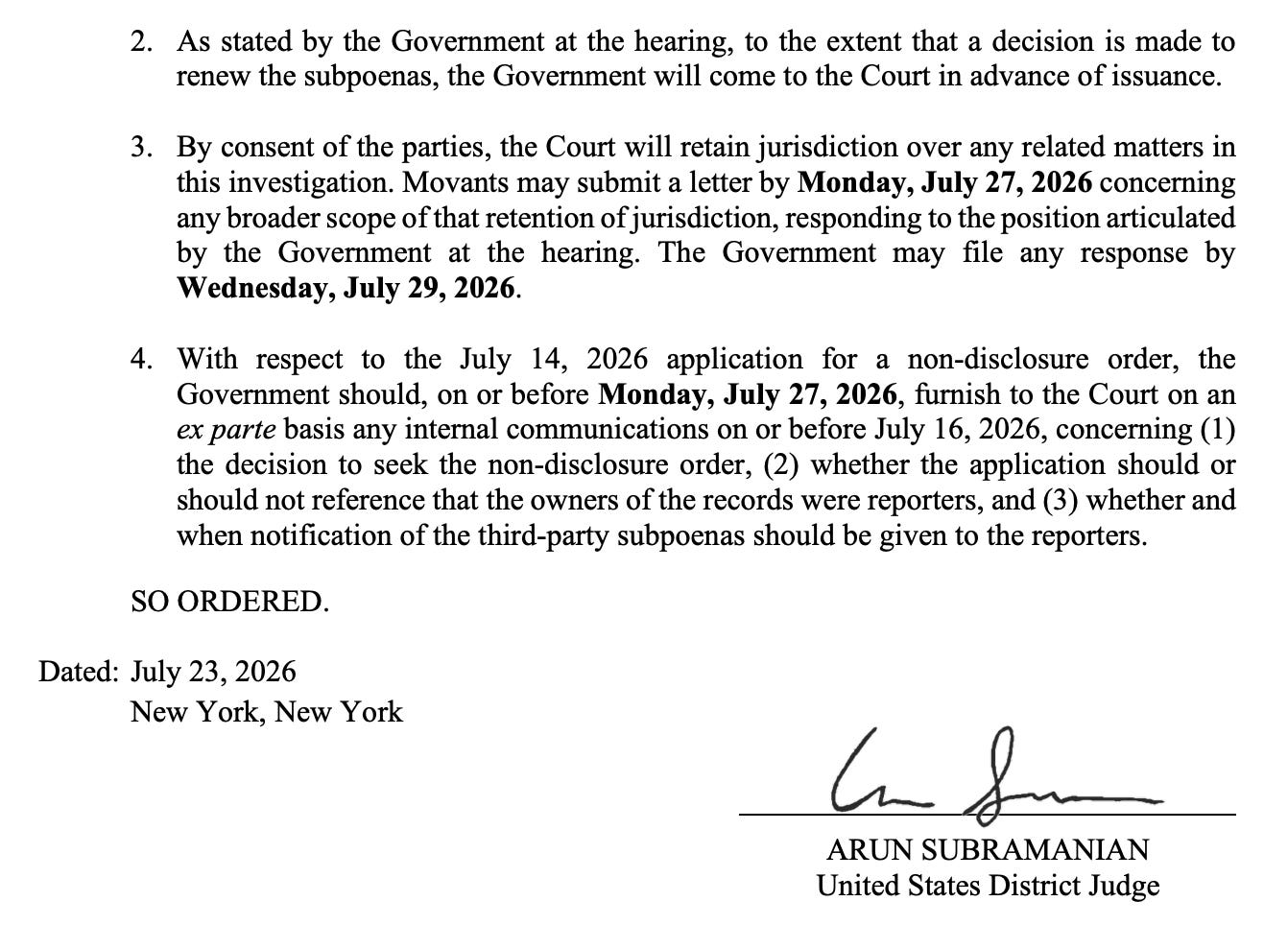
In sum: DOJ is ordered to come to Subramanian if they want to try with these subpoenas again; Subramanian will retain jurisdiction over "any related matters in this investigation," subject to further briefing on the scope of that retention; and Subramanian ordered DOJ to provide the court with additional information about the non-disclosure request by July 27.
I wrote in March about how “DOJ is barely even a functional law firm at this point.“
Over the past four months, there have been countless examples that it is not a functional law firm. Thursday provided the clearest evidence, however, of the wide spread of that dysfunction and, further, the spread of lawyering that raises both ethical and competence questions.
It couldn't have happened to a more deserving set of a-holes. They likely mocked the DOJ attorneys as timid and overly concerned with rules. In truth, good lawyers work their asses off before going to court. Defense counsels fear malpractice claims. Plaintiff counsel eat what they kill and can't afford to lose based on stupidity. Government attorneys have agency reputations to uphold. No, I want to see Bar Referrals.
today i saw several mentions re posts by Inner City Press’s Matthew Russell Lee and i cheered.
in his own right, a journo to watch, read and follow. thanks, all.