

Thursday was Sam Alito's big decision day. Was it his last?
Justice Alito had two decisions backing restrictive immigration policies and a ruling striking down a Hawaii concealed carry restriction. Is a retirement announcement coming next week?

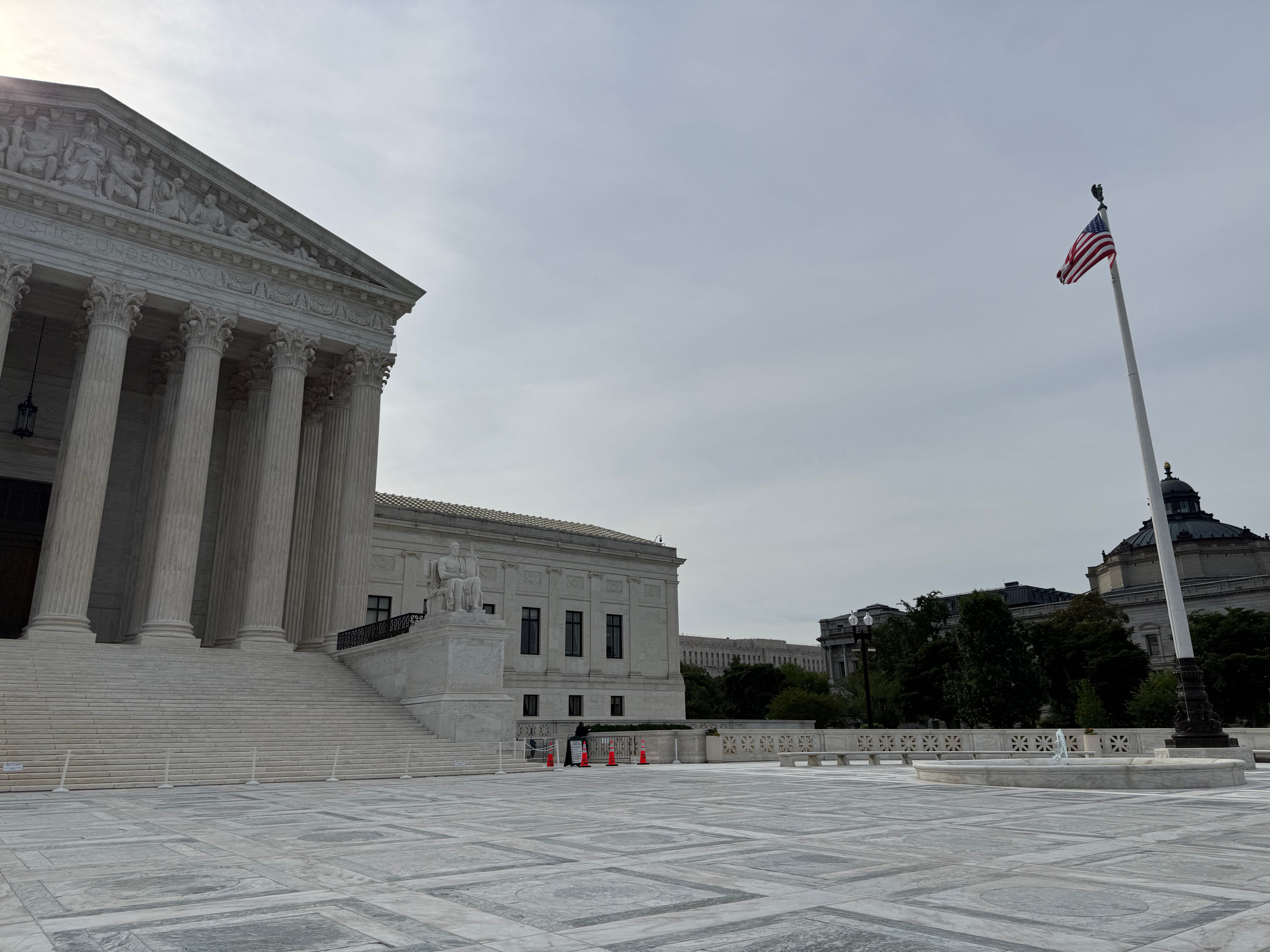
It was Justice Sam Alito’s big day at the U.S. Supreme Court.
He announced three decisions of the court on Thursday, all 6-3 decisions split along the same ideological divide that had loomed large over Tuesday.
He got to announce for the Supreme Court’s right-wing majority that President Donald Trump’s blatant racism regarding Haitians was not racism at all, that challenging decisions to end temporary protected status on statutory grounds is not allowed at all, that blocking people from stepping foot in the United States at the border is enough to relieve U.S. officials from needing to consider those people’s asylum claims at all, and that private property owners who generally open their property to the public can be forced to allow concealed carry holders on their property unless they explicitly prohibit it.
What’s more, he did it — in all three cases — in a very Sam Alito way.
If Alito was ever subtle — and, for the past 16 years that I’ve been covering the court in person, he hasn’t been — all subtlety was out the window on Thursday.
Outside of the cases decided on Thursday, the announcements highlighted another possibility that’s been bouncing around in my brain since January: Is Alito leaving?
I think he could be. (More on that at the end.)
Asylum blocked
In the case over the “metering” policy that has not been in effect for several years, which prevented people arriving at a port of entry from crossing the border into the United States, Alito’s majority opinion for the court dropped a footnote that condescendingly characterized Justice Sonia Sotomayor’s lead dissent as being centered with “an impassioned argument” on policy, not law.
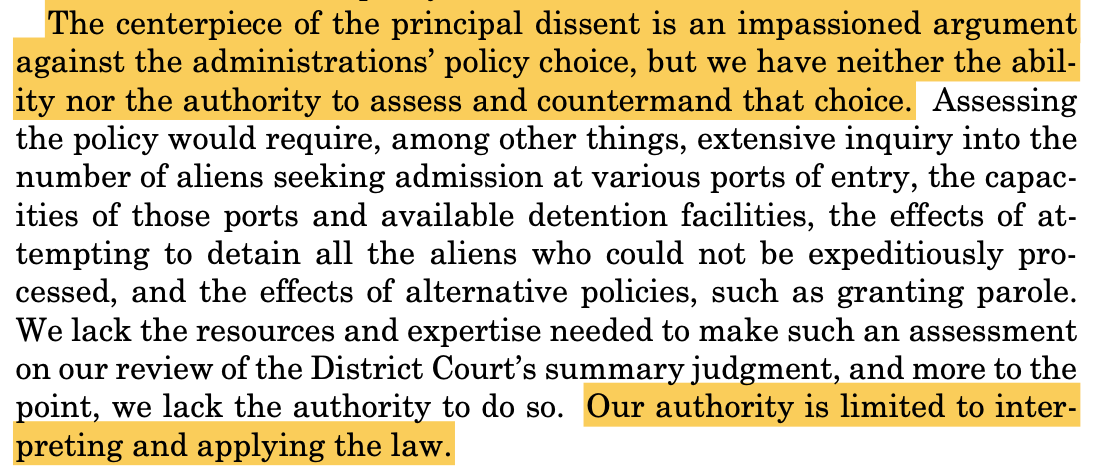
Sotomayor did not miss this slight, responding in a footnote of her own.
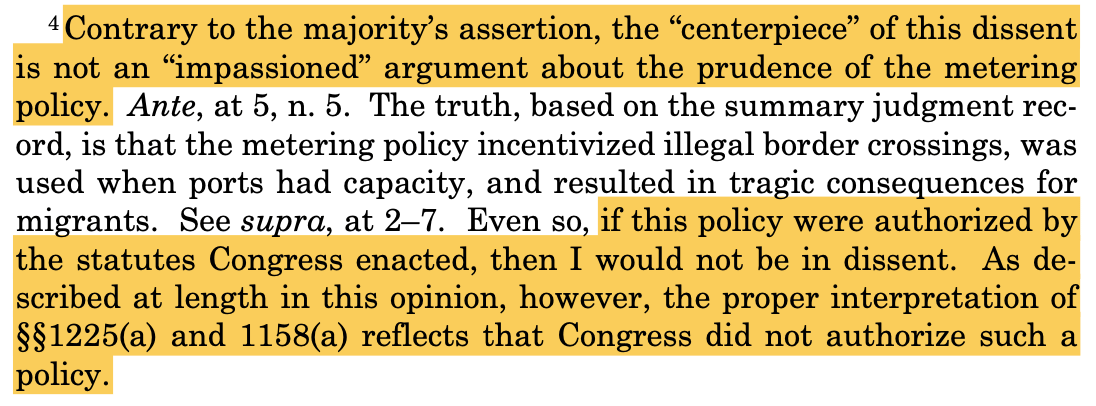
The matter carried over onto the bench. After Alito announced the court’s opinion, Sotomayor took the opportunity to read from her dissent. It was an extensive reading, but that fact was not particularly surprising. A justice reads from a dissent when they strongly disagree with the court’s decision and want to make a point of it.
Nonetheless, Alito on Thursday appeared to have been caught off-guard by Sotomayor’s lengthy bench dissent — or, at least, that is what he proclaimed when he took a step I have not seen in my time covering the court: He responded to Sotomayor’s bench dissent with a rebuttal statement of sorts.
It was, there is no other way to put it, really weird.
Insisting that, had he known Sotomayor was going to go on as long as she did, he would have read from more of his opinion, he then told the courtroom about how two prior administrations had implemented the metering policy and how they had decided it was the best approach to dealing with so-called border surges.
The closest example of anything similar happening that anyone in the pressroom Thursday morning could recall was when, as Mark Walsh recalled, then-Justice Antonin Scalia responded to then-Justice Stephen Breyer’s bench dissent in 2015’s Glossip v. Gross. There, however, Scalia had not authored the majority opinion — Alito had — and Scalia, in speaking up after Breyer, opened by noting that his concurrence was “responding essentially“ to Breyer’s dissent. In short, while unusual, the ordering of speakers made sense and appeared to have been decided ahead of time.
TPS gone
In the other immigration decision, Alito talked away racism in addressing the equal protection claim raised by those challenging the termination of Haiti TPS, and Justice Elena Kagan was the one who called him out.
Here’s how Alito described Trump’s comments about Haiti and Haitian immigrants:
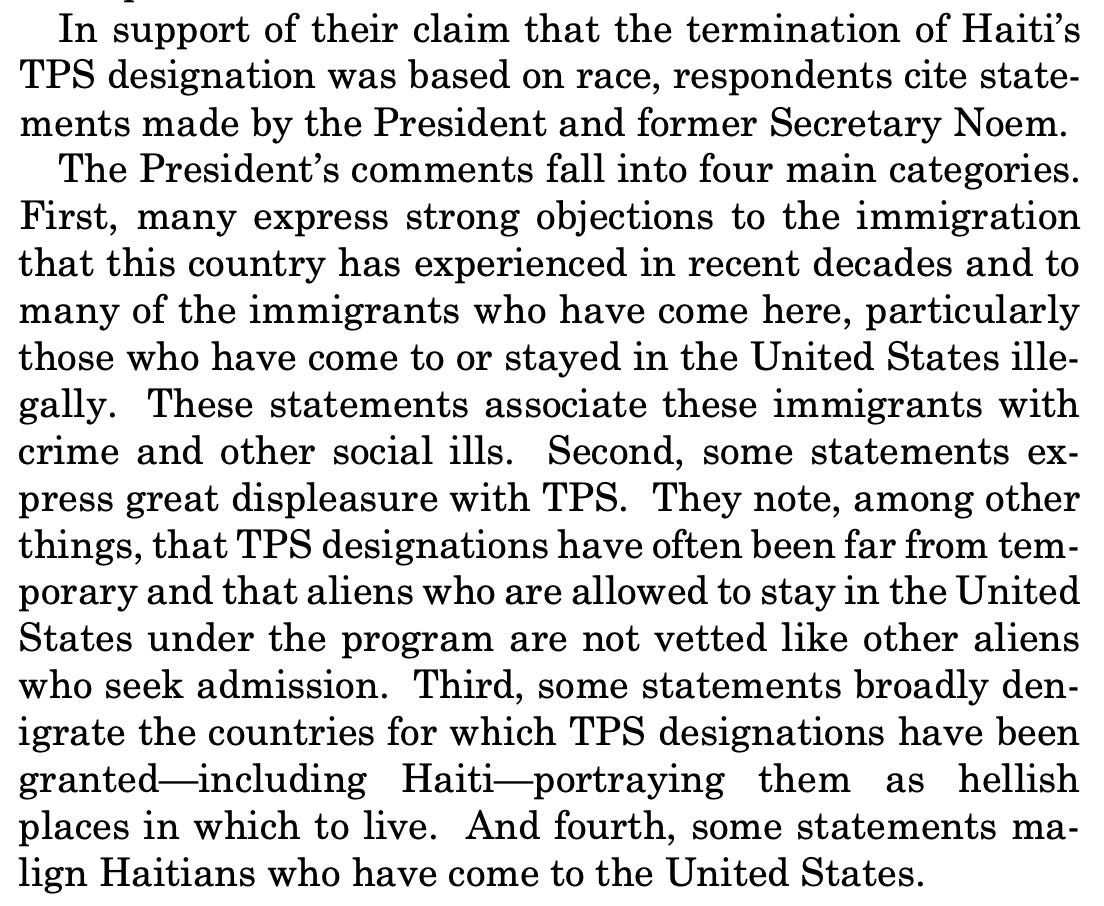
After noting that those challenge the Haiti decision “also cite statements by former Secretary Noem,” Alito concluded:
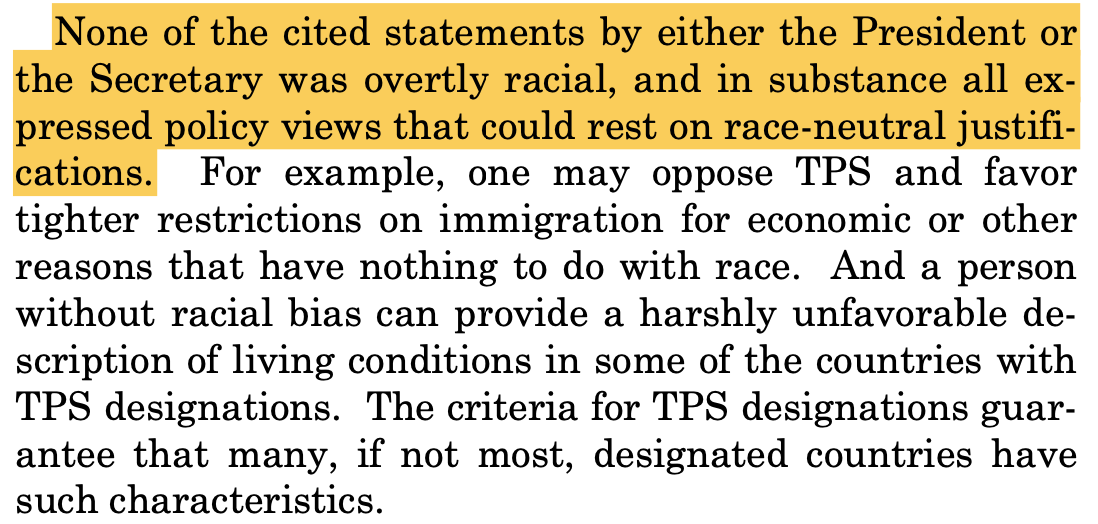
Kagan was not having it, writing at the top of her dissent:
[T]he majority claims to see no evidence that race played any role in the Haiti decision. But the evidence is there, plain to see, in the President’s statements, which the majority (and for that matter, his own lawyers) cannot even bear to repeat.
Later, given that the majority failed to acknowledge reality, Kagan included evidence submitted by those challenging the Haiti TPS termination in the record.
“The evidence they have offered includes statements by the President so repellent and racially inflected that the majority declines to put them in print,” Kagan wrote bluntly before stating, “So here are some of those statements.”
![So here are some of those statements. Haitians are "eating the dogs .... They're eating the cats. They're eating—they're eating the pets of the people that live [in Springfield, Ohio]." 2 App. 802; see id., at 644. And: Haitians are also eating "other things too that they're not supposed to be." Id., at 698-699. And: Haitians in the United States "probably have AIDS." Id., at 698. And: Haiti is a "shithole country," which is "filthy, dirty, [and] disgusting." Id., at 698-699. And: Haitian immigration is "like a death wish for our country." Id., at 698. And: Hai-tians, along with some others, are "poisoning the blood" of our country. Id., at 698. And: "Why is it we only take people from shithole countries" like "Haiti [and] Somalia"? "Why cannot we have some people from Norway [and] Sweden?" Id., at 699. The majority briefly replies that those remarks are not "overtly racial," ante, at 21, but it is hard to know what that means. Haitians are Black. (Norwegians and Swedes not so much.) The references— of filth, disease, and primitiveness—are shot through with racial stereotypes and tropes. It is hard to imagine the statements being made today of any White community. No very "sensitive inquiry," of the kind Arlington Heights compels, is needed to see them for what they are, 429 U.S., at 266; judges, as we often say, are "not required to exhibit a naiveté from which ordinary citizens are free," Department of Commerce, 588 U. S., at 785. The statements fairly shout, in their racial undertones and overtones alike, that race entered into the President's resolve to remove Haitians from this coun-try.](https://substackcdn.com/image/fetch/$s_!9tnI!,f_auto,q_auto:good,fl_progressive:steep/https%3A%2F%2Fsubstack-post-media.s3.amazonaws.com%2Fpublic%2Fimages%2Fbd751542-a6ca-4b0f-b05a-bd61494c7744_1096x1356.png "So here are some of those statements. Haitians are \"eating the dogs .... They're eating the cats. They're eating—they're eating the pets of the people that live [in Springfield, Ohio].\" 2 App. 802; see id., at 644. And: Haitians are also eating \"other things too that they're not supposed to be.\" Id., at 698-699. And: Haitians in the United States \"probably have AIDS.\" Id., at 698. And: Haiti is a \"shithole country,\" which is \"filthy, dirty, [and] disgusting.\" Id., at 698-699. And: Haitian immigration is \"like a death wish for our country.\" Id., at 698. And: Hai-tians, along with some others, are \"poisoning the blood\" of our country. Id., at 698. And: \"Why is it we only take people from shithole countries\" like \"Haiti [and] Somalia\"? \"Why cannot we have some people from Norway [and] Sweden?\" Id., at 699. The majority briefly replies that those remarks are not \"overtly racial,\" ante, at 21, but it is hard to know what that means. Haitians are Black. (Norwegians and Swedes not so much.) The references— of filth, disease, and primitiveness—are shot through with racial stereotypes and tropes. It is hard to imagine the statements being made today of any White community. No very \"sensitive inquiry,\" of the kind Arlington Heights compels, is needed to see them for what they are, 429 U.S., at 266; judges, as we often say, are \"not required to exhibit a naiveté from which ordinary citizens are free,\" Department of Commerce, 588 U. S., at 785. The statements fairly shout, in their racial undertones and overtones alike, that race entered into the President's resolve to remove Haitians from this coun-try.")
That was the dissent, though, and in both cases the court’s majority — through Alito’s words — was able to both further empower Trump’s anti-immigrant efforts and further shield those efforts from review.
Guns above property
In the final case, Alito got his go at addressing the problems in Justice Clarence Thomas’s 2022 New York State Rifle and Pistol Association v. Bruen decision, where Thomas held for the court that gun regulations can be upheld only if they are “consistent with the Nation’s historical tradition of firearm regulation.”
Alito’s answer was to go backwards — to the initial 2008 and 2010 cases redefining the Second Amendment as protecting an individual right. Notably, he did so in an outright Trumpian way, describing “the exceptionally high rate of violent crime in Washington, D.C.” as a part of the first case and the second case having been “brought by residents of Chicago, a city, like Washington, D. C., with a high rate of violent crime.“
Then, to get a little bit of paternalism in his opinion for the court — the law of the land — Alito cited to a decade-old concurrence he wrote about a case out of Massachusetts in order to take another weird step. In describing Hawaii’s law — which barred those with concealed carry licenses from carrying on private property open to the public (think, businesses) unless the owner explicitly allows it — Alito wrote that “Hawaii’s new default rule burdens those wishing to exercise their Second Amendment right.“ To explain this, he referenced that old case, which involved “a young Boston woman who wanted to carry a weapon to defend herself from a violent ex-boyfriend,” and then created “our hypothetical young woman“ to highlight what he saw as the problem with Hawaii’s “new default rule.”
Over the course of the next three pages — and, again, for the court — Alito referred to “our hypothetical young woman” repeatedly, for a grand total of six times. At some point in the middle there, it veered from weird to creepy.
In striking down Hawaii’s law, Alito closed the opinion by discussing the importance of the Second Amendment to “vulnerable blacks.”
In discussing the relevance of the post-Civil War Black Codes “that aimed to perpetuate the subjection of blacks” to the “original understanding” of the right to bear arms in the wake of the Fourteenth Amendment, Alito dismissed it as an argument that “cannot be taken seriously.”
This time, it was Justice Ketanji Brown Jackson who responded in dissent.
“The Second Amendment’s plain text, informed by history, simply does not protect a right to go armed onto private property without the property owner’s express consent,“ Jackson noted in her broad response to the majority.
Later, in addressing the Black Codes, Jackson pulled back and asked big questions that today’s court — today’s country? — is unlikely to answer.
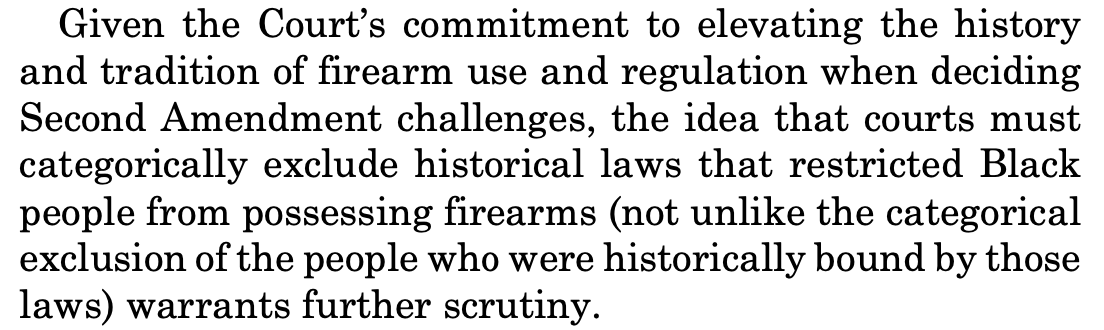
She explained two possible ways of examining this issue.
“First, it could be that the Black Codes regulated guns consistent with the Second Amendment but States chose to exercise their regulatory authority in a discriminatory fashion. … Under this framing, those gun regulations are not examples of an unconstitutional abridgment of the right to bear arms, but rather exemplify a violation of a different constitutional Amendment—the Fourteenth,” she wrote. “Alternatively, it could be that States did not have the constitutional authority under the Second Amendment to enact such regulations but did so anyway for discriminatory reasons. Under that framing, not only did the States violate the Constitution by acting on the basis of race; they also violated the right to bear arms.”
Here, however, Jackson concluded the court failed to explain itself.
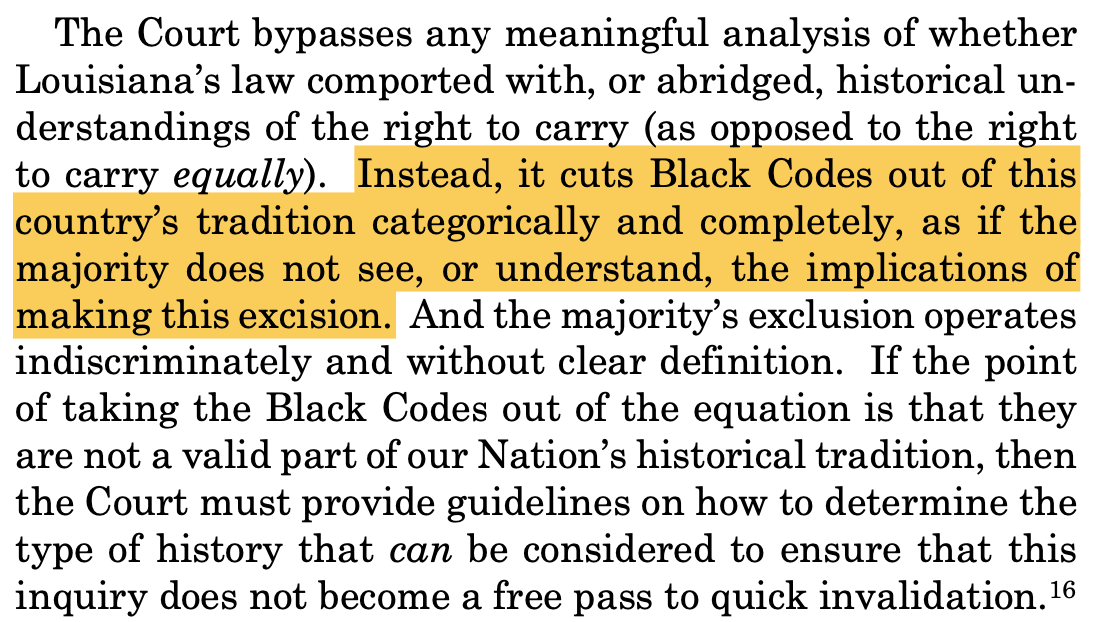
Alito had the votes, though, so no explanation was necessary.
There are eight cases remaining, with seven opinions expected. The next opinion day will be Monday, June 29, and it is not expected that will be the last opinion day as Chief Justice John Roberts did not announce it as such.
A retirement?
Since January, I’ve held the opinion that Justice Sam Alito had tentatively settled on retiring at the end of this term. He’s just seemed more OK with not being a part of all of this — and, dare I say, more happy having reached that decision.
I still think that’s so.
I can see a world in which he wanted his last opinions for the court out of the way before announcing his retirement next week. (And in which he was characteristically annoyed when Sotomayor broke his rhythm on the bench with her lengthy dissent.)
Although this is obviously not a fact I am reporting, it is a thought that makes sense to me. (And, yes, you can tell me I was wrong if it turns out I am.)
As of next month, Sam Alito will have gotten his paycheck from the federal government for the past 50 years — when he started clerking for then-Judge Leonard Garth on the U.S. Court of Appeals for the Third Circuit in July 1976.
He could have decided that, after more than 36 of those years as a judge and more than 20 of those as a justice, it’s time to hang up the robe.
The possibility of two, six, or 10 more years on the bench might be too much for him to contemplate — and those possibilities have to be there in his head — because there is no way Alito wants to be replaced by a Democratic president. (Of course, this is also true of Justice Clarence Thomas, but I just don’t see him retiring now. I could be wrong about that, too. We will see.)
In any event, there is much still to come, but I couldn’t write about Thursday’s decisions without putting them in the context in which I’m viewing them.
So, Alito is fine being a virulent racist so long as you don’t call him one? Pretty rich. All he has to do is muse about Trump wanting to suspend TPS for black and brown people, while expanding it for Afrikaners, and the answer is obvious. Of course he’s blind to all of that. He’s an awful person married to someone who might be even more awful. I’m old enough to know that conservatives on the court were not as intellectually dishonest in prior times.
I hate to say it... but hopefully after the midterm and or the presidential election in 2028... Along with Thomas.