

The six opinions in the birthright citizenship ruling have a lot to teach us about the U.S. today
The 5-4 decision was the least the court could do to keep the United States of America on a constitutional path.

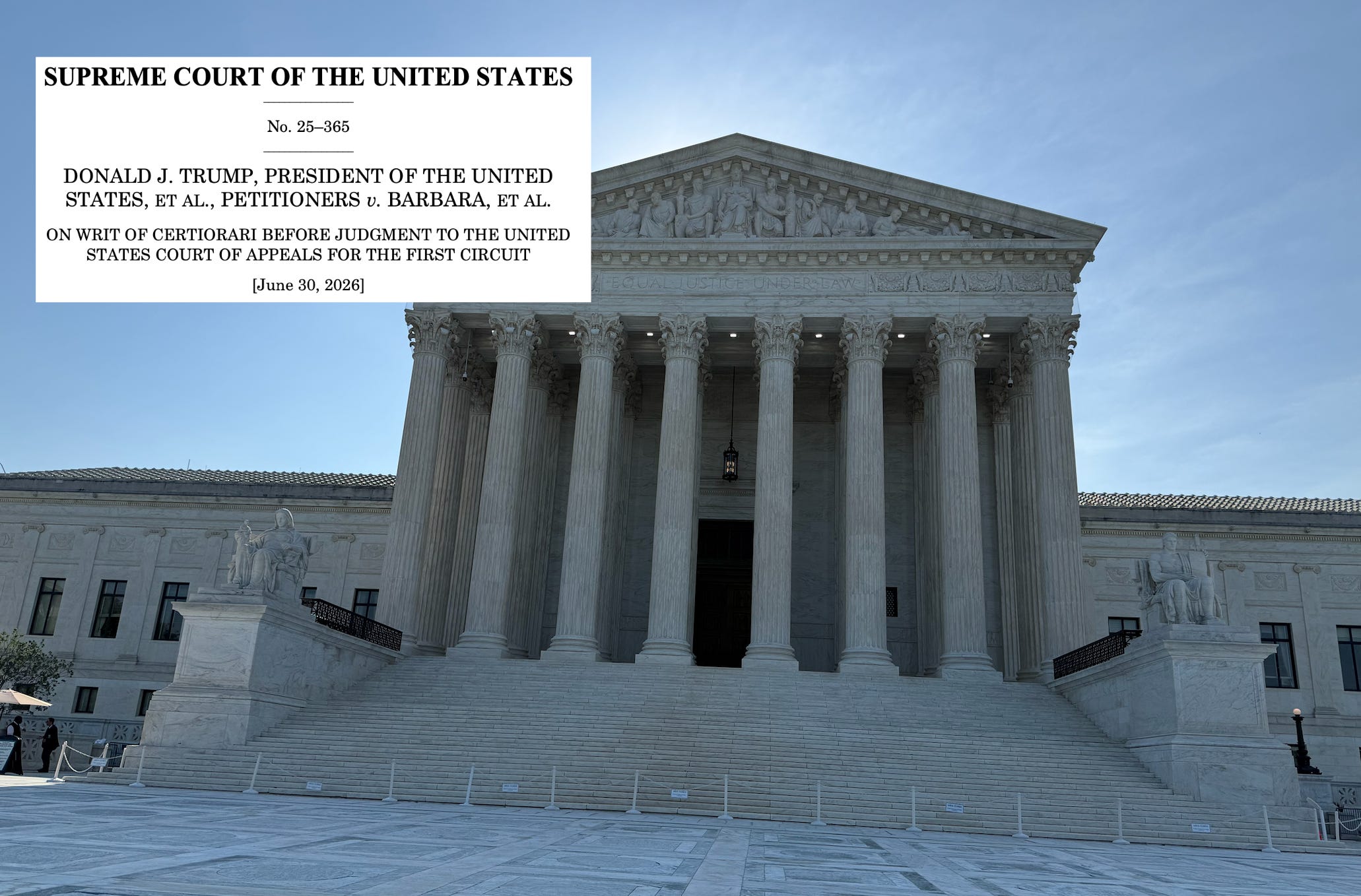
The U.S. Supreme Court’s birthright citizenship ruling — authored by Chief Justice John Roberts — was an undeniably good result.
It is a solid opinion affirming the unanimous view of every other court at every level of the federal legal system to consider the question: President Donald Trump’s January 20, 2025 executive order seeking to end birthright citizenship violates the Fourteenth Amendment.
As Roberts concluded in Trump v. Barbara:
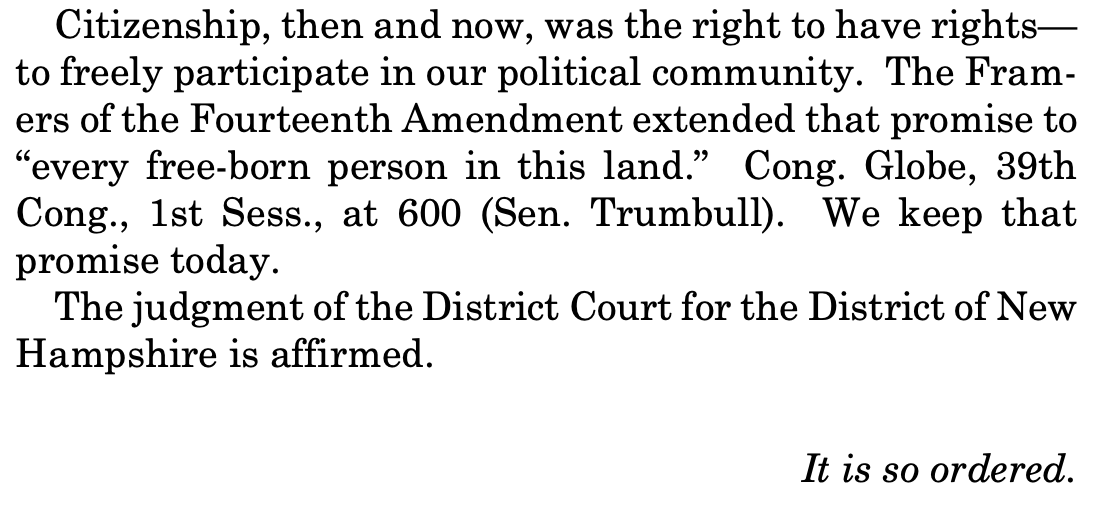
It was also — literally — the least the court could do to keep the United States of America on a constitutional path. Roberts’s 5-4 decision on the constitutional question — with support from Justices Sonia Sotomayor, Elena Kagan, Amy Coney Barrett, and Ketanji Brown Jackson — was an alarming reminder of how the far-right’s political aims can quickly become the far-right justices’ aims.
And, let there be no doubt, the disgusting charade that anti-immigrant forces used to get the four votes they got on the constitutional question — in part with the help of the so-called scholars who, at best, have sought to use others’ hate to put them in good standing with the Trump administration or otherwise advance their career — was politics.
Even the year and a half it took to get a ruling on the unconstitutionality of this executive order was politics — with the “universal injunction” ruling in the middle of that.
But, on Tuesday, when a ruling did come, five justices stood up for the Fourteenth Amendment and birthright citizenship.
Those four votes against, though, are worthy of investigation — from Justice Brett Kavanuagh, who concurred with the majority’s judgment on statutory grounds, and dissenting Justices Clarence Thomas, Sam Alito, and Neil Gorsuch — to understand the different ways in which that is playing out on the Supreme Court.
Kavanaugh’s basis for deciding the Fourteenth Amendment question is virtually unbelievable given, for example, his majority opinion in West Virginia v. B.P.J. that same day. In Barbara, Kavanaugh wrote:
The Constitution is an enduring document, and its principles were designed to, and do, apply to modern conditions and developments. The original constitutional principles do not change absent a constitutional amendment, but the relevant principles—both the rules and exceptions alike—must be faithfully applied not only to circumstances as they existed in 1787, 1791, and 1868, for example, but also to modern situations that were unknown or unanticipated by the Constitution’s Framers.
He went on to conclude that the children of undocumented people and temporary visitors are “relevantly similar” to traditional exceptions to birthright citizenships — such as the children of diplomats — and, hence, would appropriately be new exceptions to birthright citizenship.
Kavanaugh presenting a “living Constitution” argument for ending birthright citizenship is either an effort that highlights limitations of his reasoning skills or a troll. It’s hard to see it any other way.
To read Alito’s dissent, meanwhile, was to — as is increasingly the case — read a Tucker Carlson monologue with a few case cites thrown in.
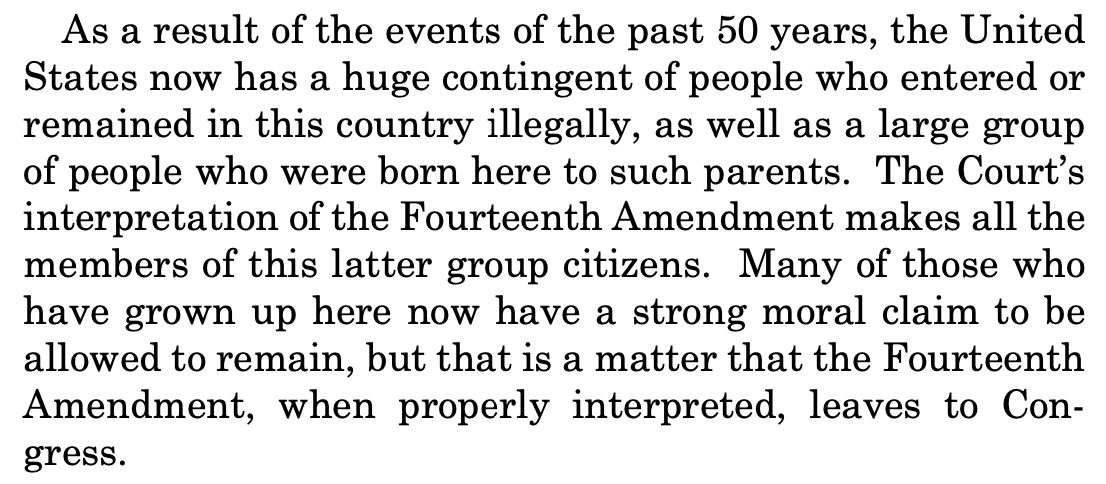
“As interpreted by the Court today,” Alito wrote in the second sentence of his 39-page dissent, “the Fourteenth Amendment confers citizenship on virtually everyone who happens to be born in this country, including the children of ‘birth tourists,’ women who come here solely for the purpose of giving birth to a child and then promptly return home.“
After eight pages of a Laura Ingraham immigration segment later in his dissent, Alito made it clear he was ready to retroactively declare people no longer citizens — unless Congress chose otherwise:
But, Alito’s screed was not Roberts’s primary focus. The four mentions it got in Roberts’s opinion for the court dwarfed the 16 times Roberts reference the “principal dissent” — authored by Thomas. Thomas’s dissent also prompted a concurrence from Jackson to address Thomas’s “narrow vision of the Fourteenth Amendment.“
Thomas’s 91-page novella dissent, in which he was joined by Gorsuch, sought to do so by presenting a narrow history of the amendment’s passage. Thomas also used those pages to express his derision for those who have used the amendment more expansively in the years since its 1868 adoption.
Addressing Tuesday’s decision, he wrote:
The Court today takes the extraordinary step of holding facially unconstitutional the President’s Order excluding from citizenship the children of foreign temporary visitors and illegal aliens. In doing so, the Court adds to the sad history of the Fourteenth Amendment, which was designed and understood to secure equal rights for the freed blacks but has instead been repurposed for political projects that the Reconstruction Congress did not support. Because many potential applications of the President’s Order are consistent with the original public meaning of the Citizenship Clause, I respectfully dissent.
After 50 pages of history, Thomas “proceed[ed] to the merits” and wrote more specifically that he believed Trump’s executive order was “consistent with the original meaning of the Citizenship Clause, at least insofar as it applies to children born to parents, here lawfully or unlawfully, who are not domiciled in the United States.“ Because of that, he explained, the order could not be facially unconstitutional.
Dropped in a footnote was an even more extreme position:

Thomas then highlighted how “[t]he Government and several scholars have suggested some reasons why, they believe, illegal aliens can never be domiciled here,“ but then also noted that “many others understandably have suggested that long-term resident illegal aliens satisfy the elements of domicile because they reside here with the intent to permanently remain.“
Thomas’s rare decision to hold back there might have been a requirement for him to keep Gorsuch on the dissent, because, and as Thomas noted, Gorsuch also wrote separately to address this issue. In a brief, three-page dissent that made three concise points, two of which were also made by Thomas — in other words, the only new position was the discussion in this, the third point — Gorsuch wrote:
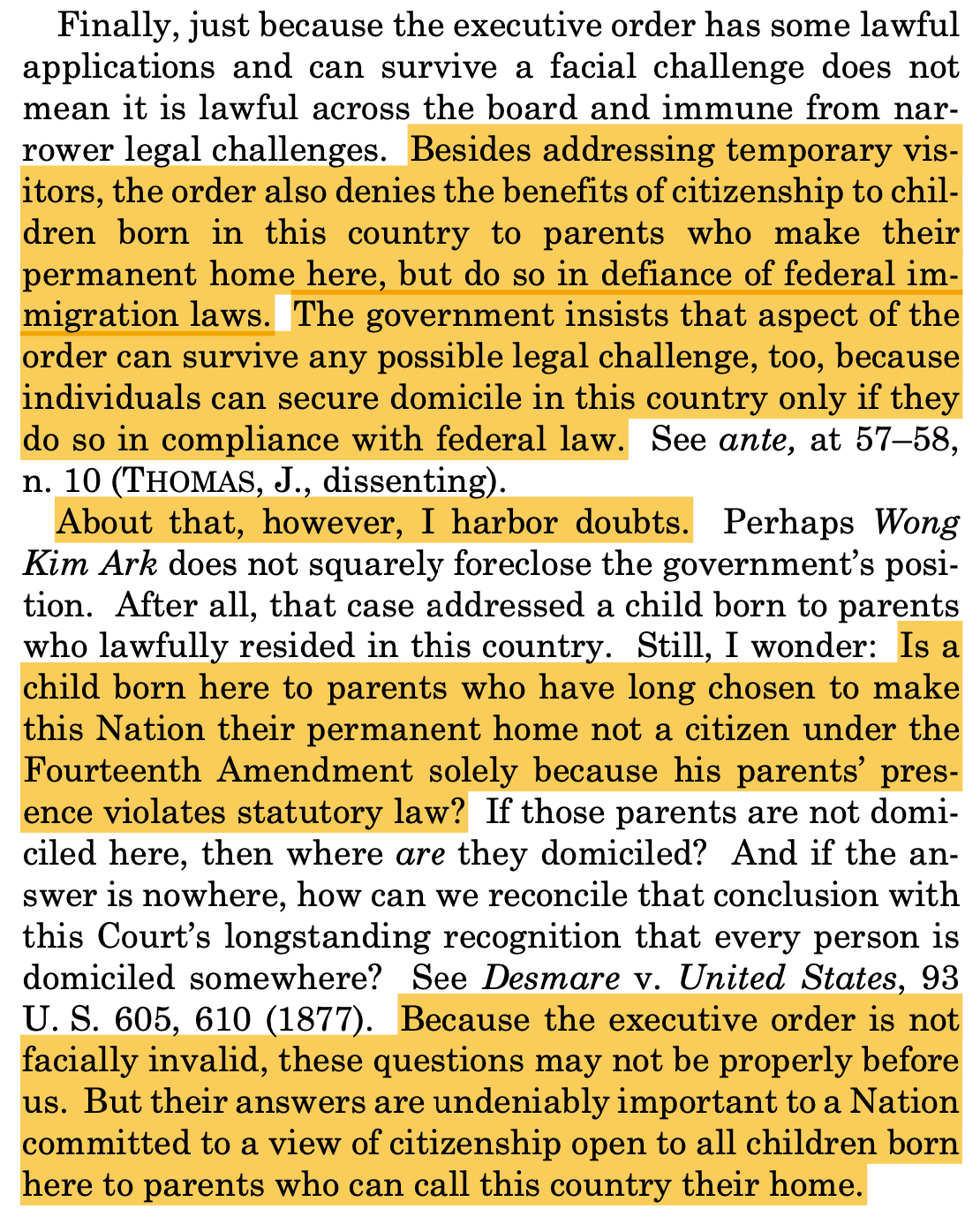
That is, undoubtedly, important, but that was just a Post-It note from Gorsuch voicing potential — potential — disagreement in comparison to Thomas’s tome, on which they were in complete agreement.
In concluding, Thomas returned to his narrow vision for the Fourteenth Amendment.
“The Fourteenth Amendment was enacted in the wake of the Civil War, ‘with the one pervading purpose’ of securing equal citizenship for the freed slaves,” he wrote. “This Court has time and again denied Americans that promise,“ he continued, citing decisions relating to gun rights and segregation before citing Brown v. Board of Education as a “narrow[]” correction of that “profound error” and quickly turning to criticism of busing, affirmative-action, and redistricting decisions. Then, the ending of the final opinion he authored in his 35th term on the court:
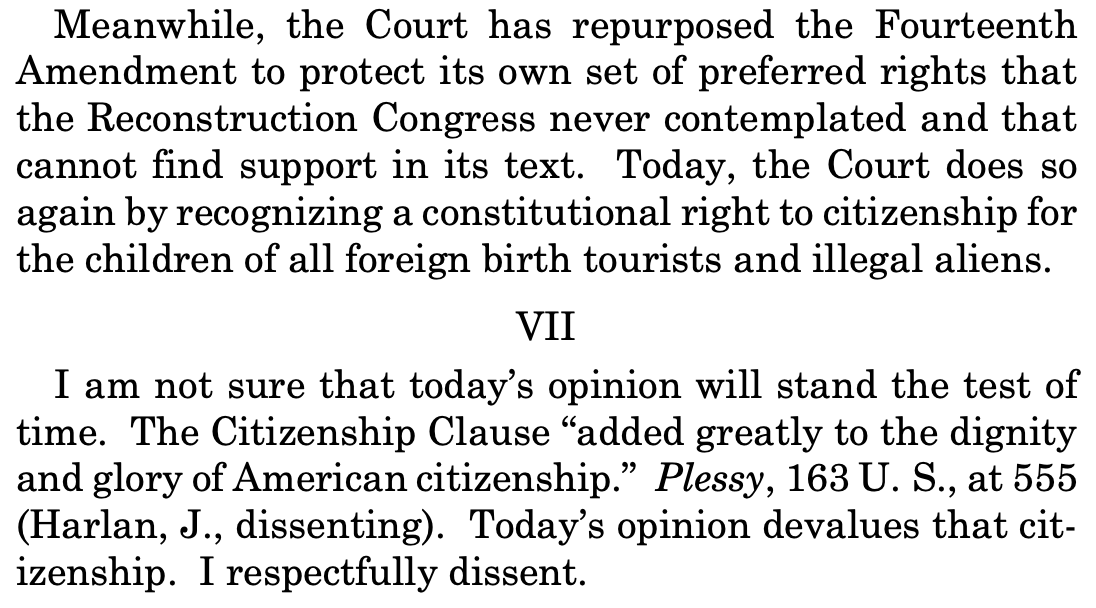
Thomas’s dissent not only prompted repeated responses from Roberts in the court’s opinion but also, as noted above, from Jackson, who explicitly wrote “to respond to some of the themes in the principal dissent.”
Thomas’s dissent, she wrote, presented a “narrow vision of the Fourteenth Amendment bears little relationship to the history of its ratification.“ More importantly, though, she added, “Even worse, JUSTICE THOMAS’s telling elides the entire point of the Second Founding: The Reconstruction Amendments were an anticaste, antisubordination reset for the Nation, not a mere spot treatment for the dark stain of slavery.“
From her first footnote, Jackson made clear her position. Referencing Thomas’s comment that the court “has time and again denied Americans that promise,” Jackson wrote:
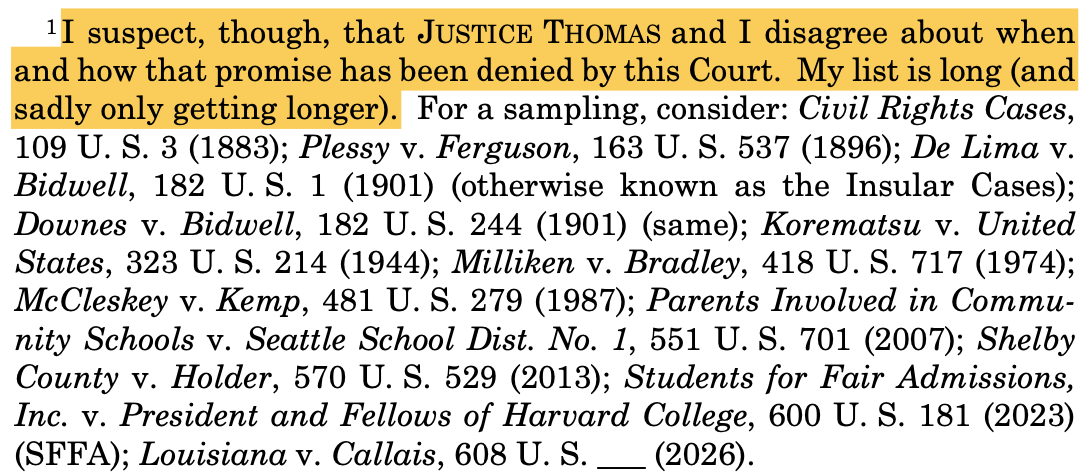
Of “those who championed the Fourteenth Amendment,” she wrote, “Their work product used ‘language that transcended race and region,’ and thereby ‘changed and broadened the meaning of freedom for all Americans.’2 Instead of the limited salve the principal dissent makes it out to be, the Citizenship Clause reflects this universalist approach.“
The second footnote direct readers to Eric Foner’s 1988 book, Reconstruction: America’s Unfinished Revolution 1863–1877.
Jackson goes on to discuss colonization, Black Laws, Black Codes, violence and the formation of the Ku Klux Klan, and the Colored Conventions — with similar references throughout.
All to advance her point: Those advocates settled on “universalist appeals.” Quoting Thomas again (this time, with Thomas quoting Frederick Douglass), she wrote:
Yes, Black Americans had suffered a singular wrong. And yes, they had “‘fought and bled’” for the Union, paying a steep price for their freedom. But the delegates did not rest on these laurels. Rather, they drew upon the moral and political force of the universal principles that were already core to the Nation’s identity.
Going on to discuss the Civil Rights Act of 1866 and the Fourteenth Amendment’s Citizenship Clause, Jackson concluded, “When ratified, the Citizenship Clause … vindicated the universalist vision of the delegates at the Colored Conventions and their allies in Congress.“
It was, she wrote, “a new font of legitimacy and vitality” for the United States.
It is an important — and comparatively brief — 20-page concurrence, joined in that history discussion by Sotomayor.
In addition to its importance in Trump v. Barbara, I highlight it here because it also serves to provide an excellent reading list for all who might wish to use this Fourth of July holiday to better understand the United States and how “[t]he [Fourteenth] Amendment caused a paradigm shift in the trajectory of our Nation.“
On a 5-4 vote Tuesday, the Supreme Court kept the country on the trajectory. Barely.
Law Dork all over the media
It’s the end of term, so, I’ve been all over.
Here’s me talking with Sam Seder on Monday about last week’s immigration decisions over temporary protected status and “metering,” as well as some other Supreme Court happenings:
Here’s my discussion with Imara Jones from Tuesday about Tuesday’s West Virginia v. B.P.J. decision upholding trans sports bans:
And, finally, on Wednesday morning, I was at Georgetown Law, and I’ll share video of that excellent Supreme Court term in review discussion when available.
I enthusiastically second your recommendation of Justice Jackson's concurrence as an outstanding lesson/sermon for the 250th birthday.
What a strange combination of junk science (eugenics 2.0) and “I got mine, screw you” and the brown paper bag test. This is the wisdom of the master race?