

Supreme Court rejects Alabama's request to let it kill Jeffery Lee with nitrogen gas this week
Two lower courts had earlier refused Alabama's request to let the state proceed with its plans to use the method of execution declared unconstitutional on Tuesday.

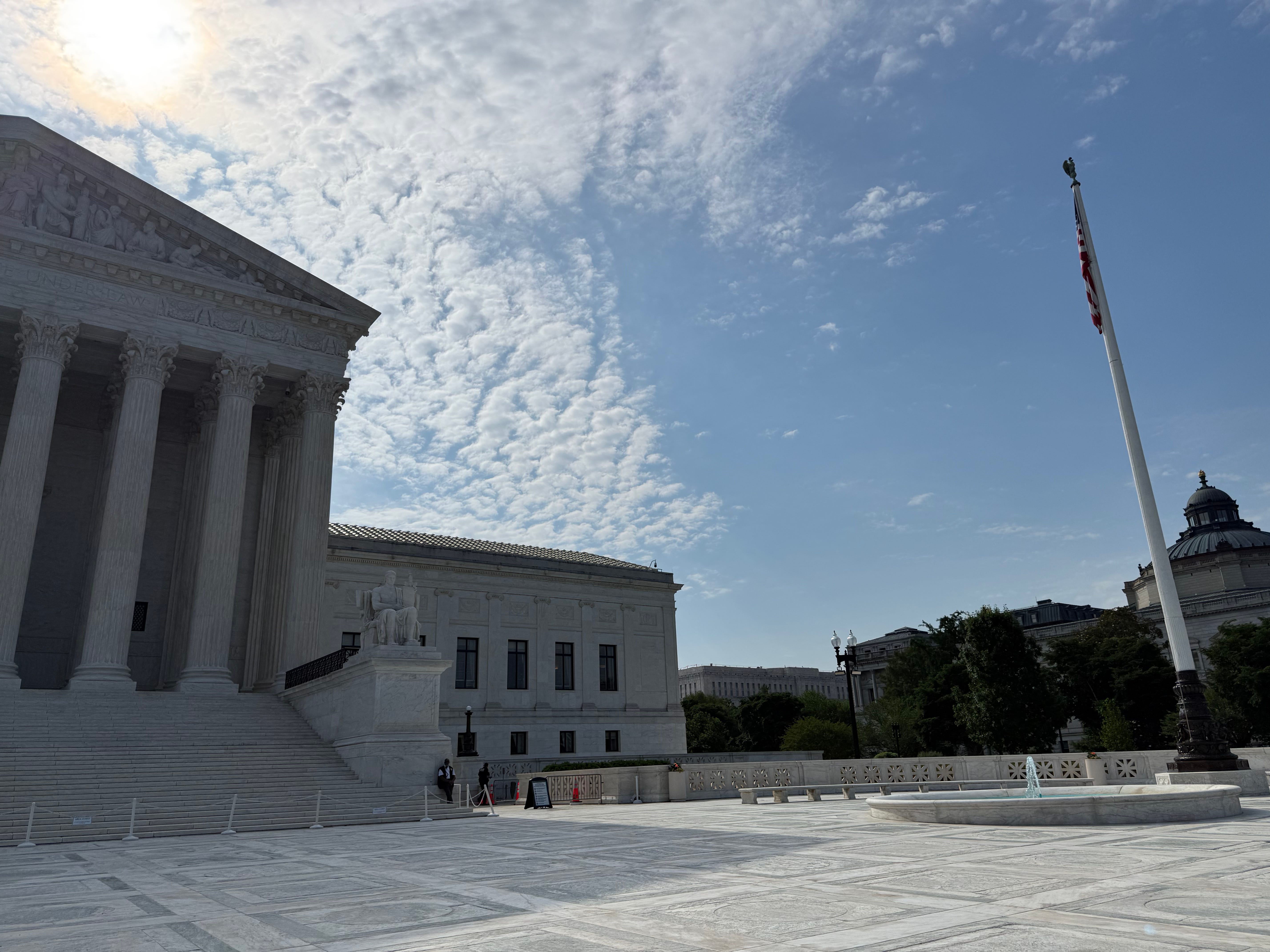
The U.S. Supreme Court denied Alabama’s request for the justices to intervene on Thursday so that the state could go forward with an execution scheduled for Thursday.
Alabama planned to kill Jeffery Lee using its “nitrogen hypoxia” protocol, but a series of rulings from the district court and appeals court had led U.S. District Judge Emily Marks to declare that protocol to be unconstitutional on Tuesday.
On Wednesday, both Marks and, later, a 2-1 panel of the U.S. Court of Appeals for the Eleventh Circuit denied Alabama’s request for a stay of the ruling. In this posture, a stay would have allowed the state to proceed with the execution.
On Thursday, Alabama went to the Supreme Court, asking it to stay or vacate Marks’s ruling. In addition to the opposition filed by Lee’s lawyers at Arnold & Porter Kaye Scholer LLP, Trial Lawyers for Justice filed an amicus brief on behalf of Georgetown Law professor Steve Vladeck explaining why the final judgment issued by Marks in this case made it a different situation than in most other last-minute death penalty litigation.
A little past 9:00 p.m. ET Thursday, the Supreme Court issued its order denying Alabama’s request.
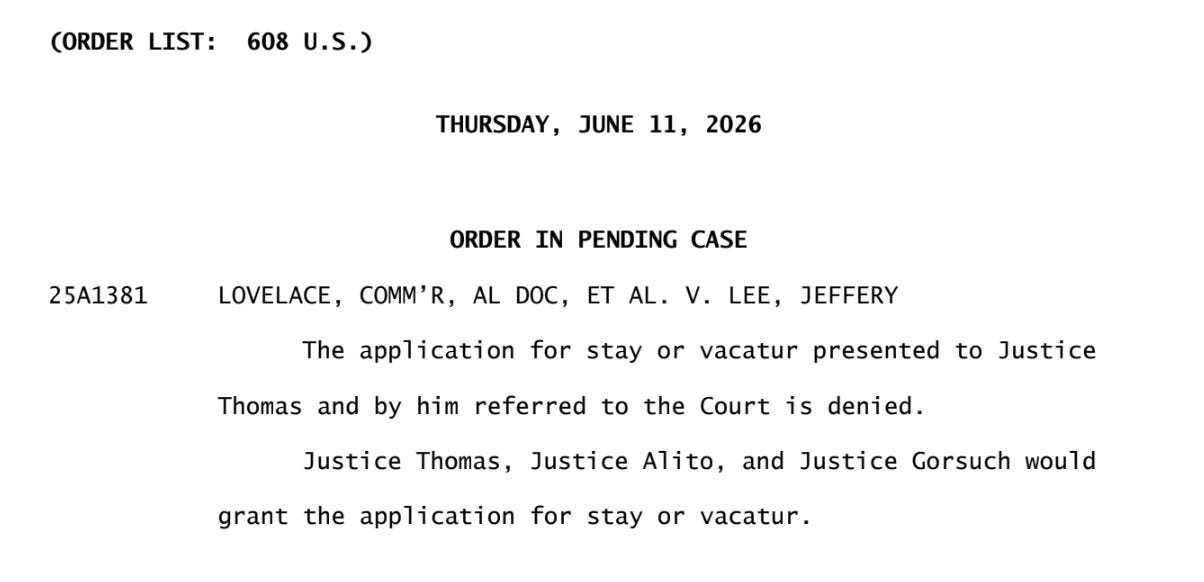
Justices Clarence Thomas, Sam Alito, and Neil Gorsuch noted their dissent.
Neither the majority nor the dissenting justices wrote any explanation for their ruling or votes, so it is not clear why the majority rejected Alabama’s request or, technically, who all was in the majority. (Justices do not need to note their vote on the shadow docket.)
Nonetheless, the outcome meant that — as Lee Hedgepeth reported — Alabama would not be proceeding with Lee’s execution on Thursday.
This is not the end of things; it’s not even the end of this case challenging the nitrogen gas method of execution.
Alabama could continue fighting the merits of that appeal, or it could seek to use another method of execution — including the firing range method Lee proposed as a less painful alternative.
To do so, however, would take the time of putting in place the new protocol, training staff, and addressing any challenges.
For now, though, Alabama will not be killing Jeffery Lee.
This is a breaking news report. Check back at Law Dork for the latest.
Many states, and many nations in Europe have eliminated the death penalty. For years, these populations have stumbled along without executing anybody. How do they cope?
1. Sometimes a person is wrongly executed because of mistakes or prejudice in court proceedings. Who can determine fairness?
2. If a person has committed heinous crimes, it would be more punishing to imprison them for life.
3. How is it determined that the means of execution are not torture? It’s impossible to interview a deceased person about their experience.
4. How has Europe survived without the death penalty and remained sovereign and relatively safe?