

The Supreme Court's Republican appointees end civil rights redistricting protections
The majority invoked “our colorblind Constitution” to expand and transform April's Callais decision. Sotomayor, in dissent, highlighted the "grave harms" the majority "inflicts."

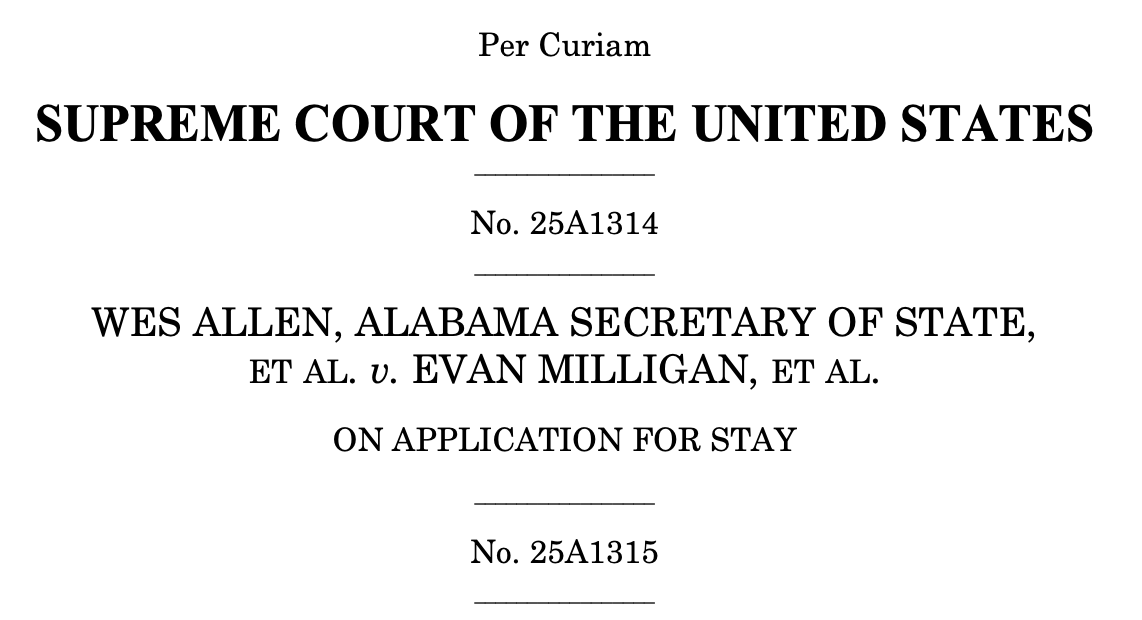
The U.S. Supreme Court’s Republican appointees used the shadow docket on Tuesday to dramatically expand the scope and effect of April’s Louisiana v. Callais Voting Rights Act decision — using a challenge over Alabama’s congressional map to make it all but impossible in practice to successfully challenge any map for diluting the votes of or even intentionally discriminating against minority voters.
The unsigned, per curiam opinion will allow Alabama to use a map that has twice been blocked — both before and since the Callais decision — under both Section 2 of the VRA and the Fourteenth Amendment. The map would eliminate one of two majority-Black districts in the state — itself a creation of the long-running litigation.
Tuesday’s decision was issued over a strong dissent from Justice Sonia Sotomayor for the Democratic appointees.
“[J]ust as Alabama doubled down on racial discrimination, the Court today doubles down on chaos,” Sotomayor wrote. “Because I choose to defend the rule of law and the right of all Alabamians to participate equally in democracy, I respectfully dissent.”
Although the April Callais case was primarily about the “effects test“ 1982 amendments to the Voting Rights Act, Tuesday’s order transformed that decision into an all-encompassing ruling that ends the use of the VRA — or, apparently, the Fourteenth Amendment — to protect minority voters from having their voices shut out of elections through discriminatory redistricting.
Back in April while ending the effects test, Justice Sam Alito insisted that “§2 imposes liability only when the evidence supports a strong inference that the State intentionally drew its districts to afford minority voters less opportunity because of their race.“
On Tuesday, on the shadow docket, with no names attached, the same six justices — Chief Justice John Roberts, Alito, and Justices Clarence Thomas, Neil Gorsuch, Brett Kavanaugh, and Amy Coney Barrett — allowed a fundamentally different principle to take hold.
“In Louisiana v. Callais, 608 U. S. ___ (2026), to resolve the tension between vote-dilution claims under §2 of the Voting Rights Act of 1965 and our colorblind Constitution, we updated the standards for §2 liability established by Thornburg v. Gingles, 478 U. S. 30 (1986),” the court stated.
The word “colorblind” did not appear once in Alito’s 37-page opinion for the court in Callais or even in Thomas’s two-page concurrence. For that matter, it also did not appear once in Kagan’s 48-page dissent.
But, on Tuesday, that is what the court retroactively shifted the April 29 decision into meaning.
The issue was back at the Supreme Court in the wake of the Callais decision because of the Supreme Court’s own post-Callais action in the Alabama case — which it had been holding since 2025. Following Callais, the Republican appointees to the Supreme Court vacated the earlier injunction issued blocking the Alabama map and sent the case back to the lower court to reconsider the case in light of Callais. The lower court did so and — given that there was finding of intentional discrimination in the Alabama case — still found the injunction against the use of Alabama’s map to be proper.
Alabama immediately went back to the Supreme Court, bringing us to Tuesday’s order.
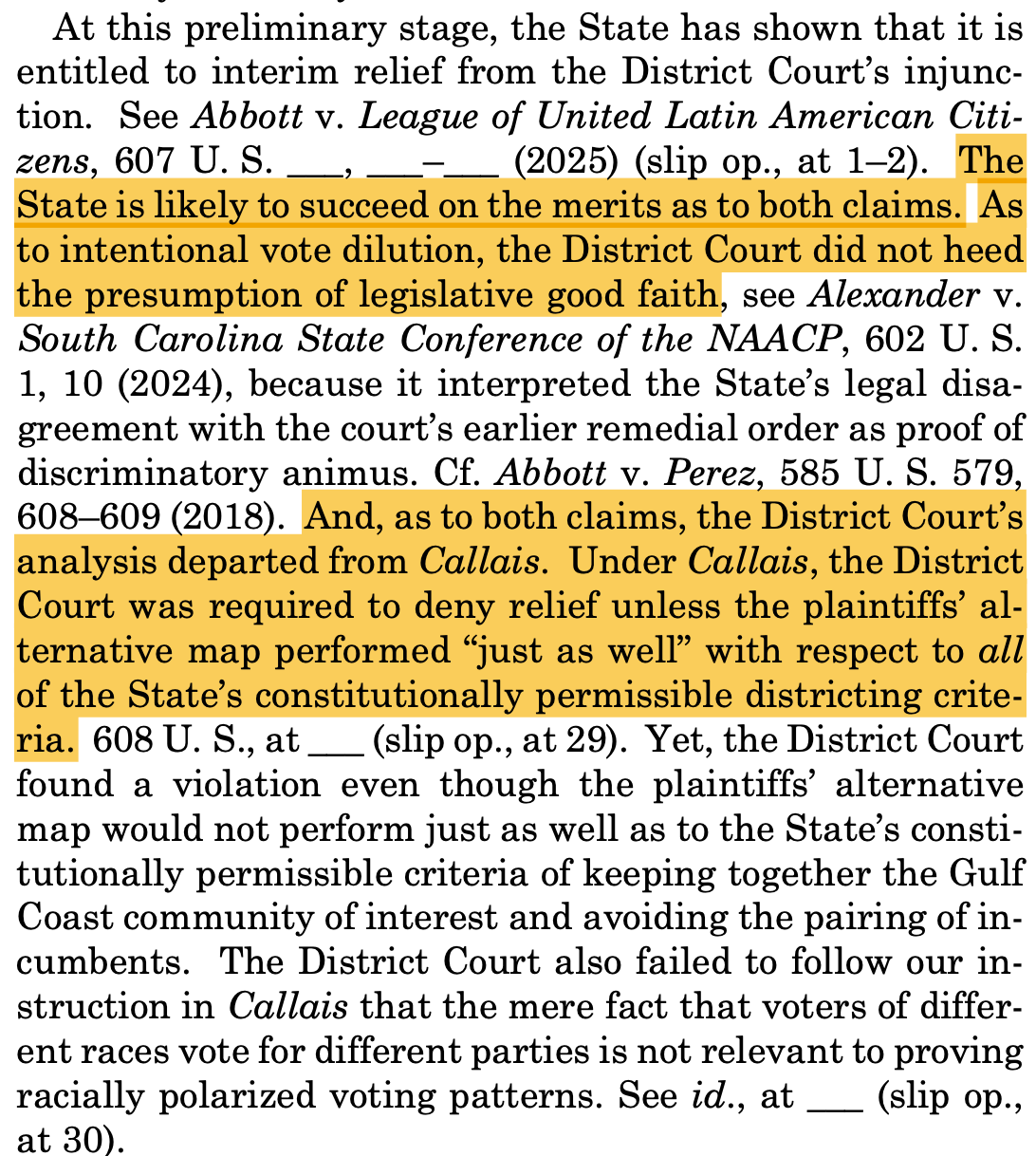
With the supermajority’s newly expanded understanding of Callais, the unsigned court opinion declared that Alabama “is likely to succeed on the merits as to both claims“ — both the VRA claim and the Fourteenth Amendment claim. In one paragraph, the court essentially ended civil rights redistricting protections:
In dissent, Sotomayor — who also authored the dissent when the majority sent the Alabama case back down after Callais — was both blunt and comprehensive.
“This is now the third time these cases have come before the Court. See Merrill v. Milligan, 595 U. S. ___ (2022); Allen v. Milligan, 599 U. S. 1 (2023); Allen v. Caster, 608 U. S. ___ (2026). Each turn reveals just how unconscionable the Court’s action is today,“ she wrote.
After detailing the history and the state’s recent actions, Sotomayor declared that “the State has no legitimate interest in enforcing an unconstitutional map, while vast harms will likely arise from upending the status quo, sowing chaos in Alabama, and rewarding Alabama’s gamesmanship.“
Of course, though, that’s exectly what the majority did on Tuesday — if not intended when it sent the case back after Callais.
Sotomayor went on to detail how Alabama officials worked to avert and ignore court rulings in the ongoing restricting case, as well as how the district court “did not clearly err when concluding that Alabama acted with discriminatory purpose” and “more than adequately accounted for the presumption of legislative good faith.” Specifically, she continued:
The reason the District Court found intentional discrimination even after affording such deference to the Alabama Legislature is simple: The record is crystal clear. Even if Alabama may have unintentionally drawn the first racially discriminatory map, when it later adopted redistricting criteria that made it mathematically impossible to remedy racial discrimination, the District Court drew the obvious (and certainly not implausible) inference that Alabama intended to discriminate. If the District Court clearly erred by doing so, then there is no realistic case in which the presumption of legislative good faith can ever be rebutted.
That, it appears, is what the majority intended with Tuesday’s shadow docket order. Not just for Alabama and now, but for the United States going forward.
In addition to the majority’s degradation of voting rights with Tuesday’s order, Sotomayor also noted the broader problems of the order:
In addition to being wrong on the merits, the Court’s decision inflicts two grave harms on the public. It debases the democratic process by upending Alabama’s entire election in the name of permitting Alabama to discriminate against Black Alabamians. It also corrodes the rule of law by rewarding Alabama’s gamesmanship and outright defiance of court orders.
The Republican appointee supermajority on the Supreme Court did corrode the rule of law on Tuesday, debasing not just the “democratic process” but also the court by short-circuiting its precious processes and undermining its legitimacy — all to let Alabama kick a Black person out of Congress.
That is what “our colorblind Constitution” apparently requires under Chief Justice John Roberts’s leadership.
When the majority is "unconscionable," I wouldn't add "respectfully" to the dissent.
Since when was our Constitution, written at the time by and for white men, color-blind?