

Here's the Law Dork filing you can't access on PACER. All of this refugee case's filings should be online.
A magistrate judge denied Law Dork's request for online access to the docket in a significant refugee rights case in Minnesota. Law Dork's lawyers filed their objection on Tuesday.

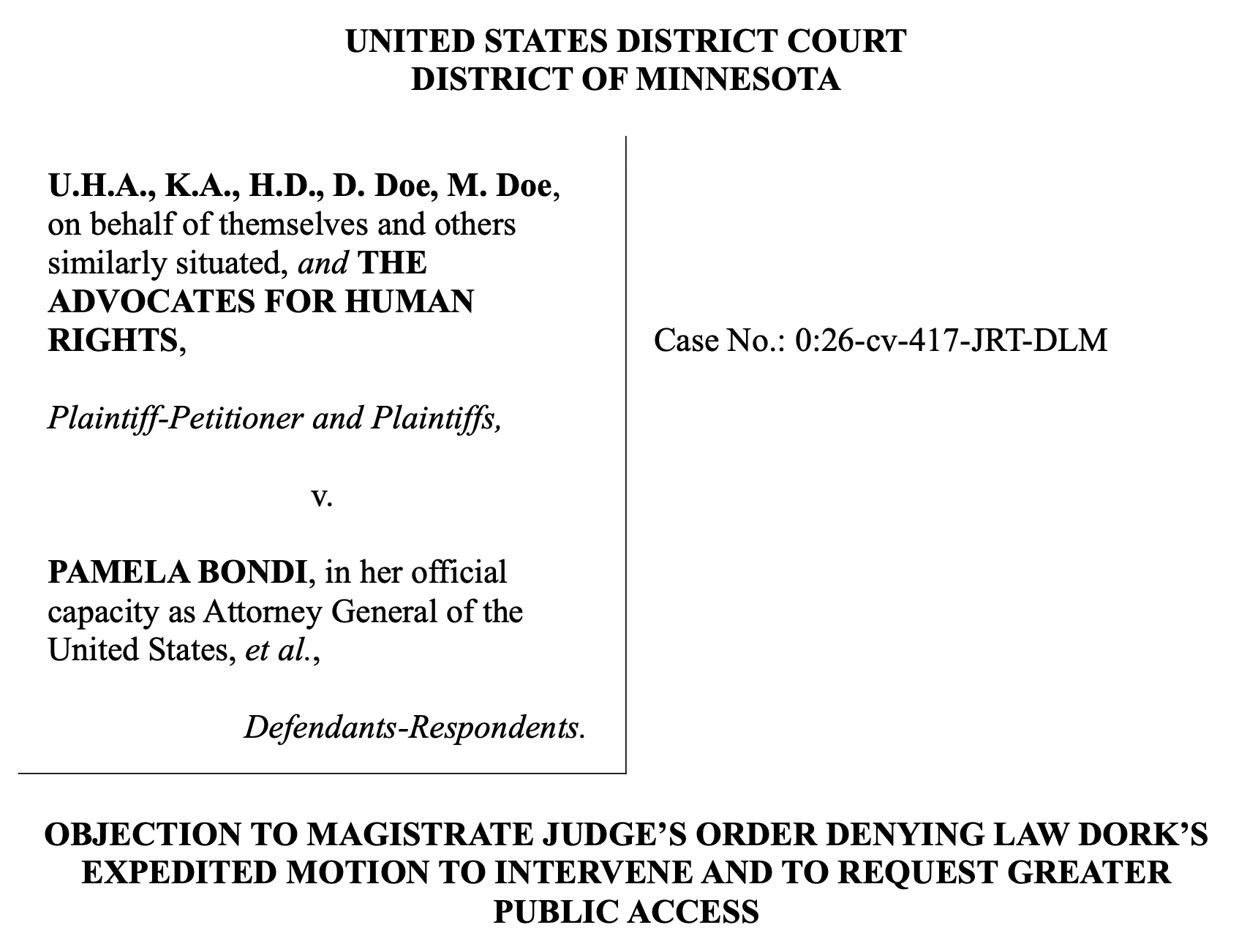
On Wednesday, lawyers for Law Dork objected to a magistrate judge’s decision denying Law Dork’s request to intervene in litigation in Minnesota over the treatment of refugees. Law Dork is seeking to intervene to make the case and filings in it more accessible to the public.

The filing was made in a significant case in Minnesota over the Trump administration’s effort to arrest and detain refugees who have not adjusted to lawful permanent resident status after being in the country for more than a year — policies against which classwide relief has been granted in the case.
Ironically, despite the high-profile nature of the case, the only way you would have been able to read the filing from Law Dork’s lawyers is if you happened to be in Minnesota and were able to get to the courthouse, while it’s open, and if you knew where to go to find the terminals where you can search out the relevant filings.

Law Dork, with support from its lawyers at Public Justice, had asked for three things back in February: opening the docket in the case to allow remote access to all of the filings, adding a public-access line for future hearings, and not allowing for the sealing of documents in the case without proper justification.
U.S. District Judge John Tunheim took care of the third request on his own, reversing his sealing order two days after Law Dork’s original motion was filed. “The Court will remove the requirement that such documents be filed under seal,” he wrote in an order filed on the docket.
Importantly, this is why we learned about the Department of Homeland Security’s two memos attempting to reverse longtime government policy not allowing the detention of refugees who have done nothing wrong and simply have not obtained LPR status.
But, as to Law Dork’s other requests, Magistrate Judge Douglas Micko denied Law Dork’s intervention request on February 18, stating that “each of Law Dork’s requests has been satisfied.“ The problem is, that’s wrong, and Law Dork has now asked U.S. District Judge John Tunheim to fix that.
Under Federal Rule of Civil Procedure 5.2, the default rule in deportation cases and cases over “immigration benefits or detention“ is that the only the docket itself and the judge’s orders and opinions are available remotely.
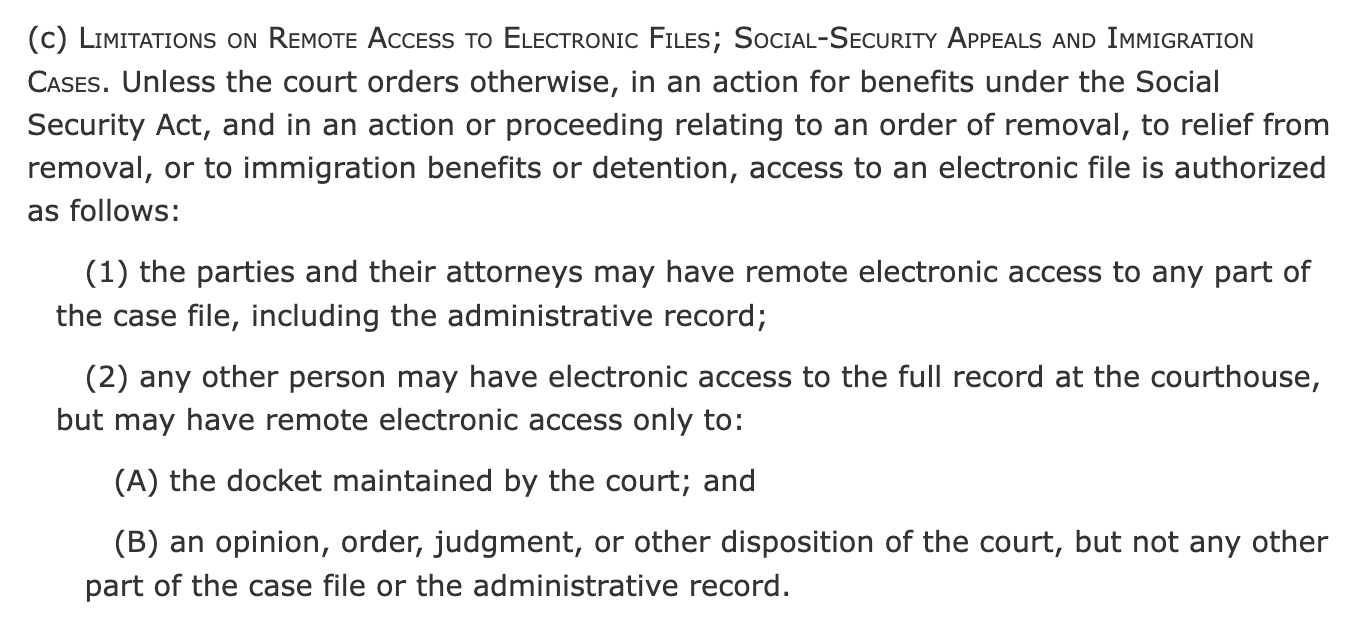
But, that is only the default rule. Under the terms of the rule itself, judges can “order[] otherwise“ — and they often do, particularly in cases of public interest.
In denying Law Dork’s request, Micko simply noted that “the public may already access filings in this case through the public terminals available at each federal courthouse in the district.“
In Wednesday’s objection to Micko’s order, however, Law Dork’s lawyers stated:
Though the interest in this case is national, because of this restriction, public access is limited to those few who can afford to visit the local courthouse. For that reason, the Court should reject the Magistrate Judge’s Order and grant Law Dork’s Motions to Intervene and To Request Greater Public Access.
The objection also reiterates the request for “greater public access“ with a public-access line for hearings: “The Court should take advantage of the technological means at its disposal to promote the public’s ability to track this case.”
You can read the rest, but I do want to highlight one last point that I think is particularly important.
This is a case in which classwide relief has been granted. Any refugee subject to the Trump administration attempted policy reversal is covered by Tunheim’s order.
It is essential that the government’s filings in such a case are easily accessible (as well as the filings from the plaintiffs’ lawyers). There are many reasons, but, importantly, such filings should be available in case the government isn’t following the order and a refugee needs help in the middle of the night, and a lawyer who is contacted and previously uninvolved in the case needs to get caught up on the case and arguments quickly.
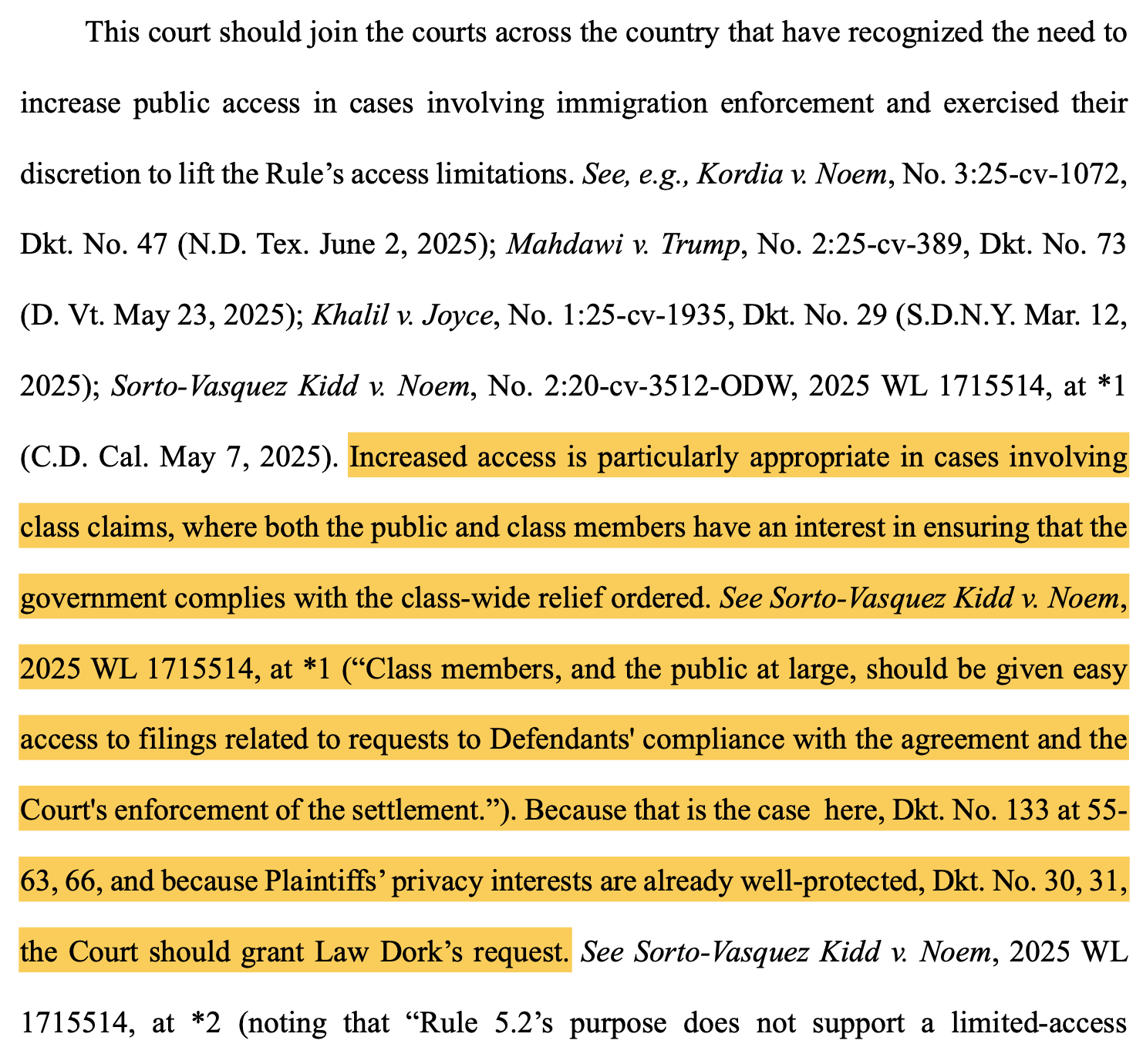
Beyond that, though, once classwide relief is ordered, the public has an even greater interest in the case than it already has in public access to the courts. As Law Dork’s lawyers stated in asking for the remote access:

Thanks, again, to Law Dork’s lawyers from Public Justice and, in Minnesota, Apollo Law LLC, for supporting this effort.
Thank you. I’m a retired attorney from California and have no experience in Federal Courts. Your commentary is excellent. I access your links to the pleadings and orders. You educate me.
And you’ve got great lawyers.
I appreciate all that you do.
I keep hoping for consequences for misuse, contempt, or delays by litigants in immigration cases. It appears that subjects are detained for extended periods, are transported far from family and legal representation sometimes resulting in life-changing consequences. Courts should not tolerate these actions.