


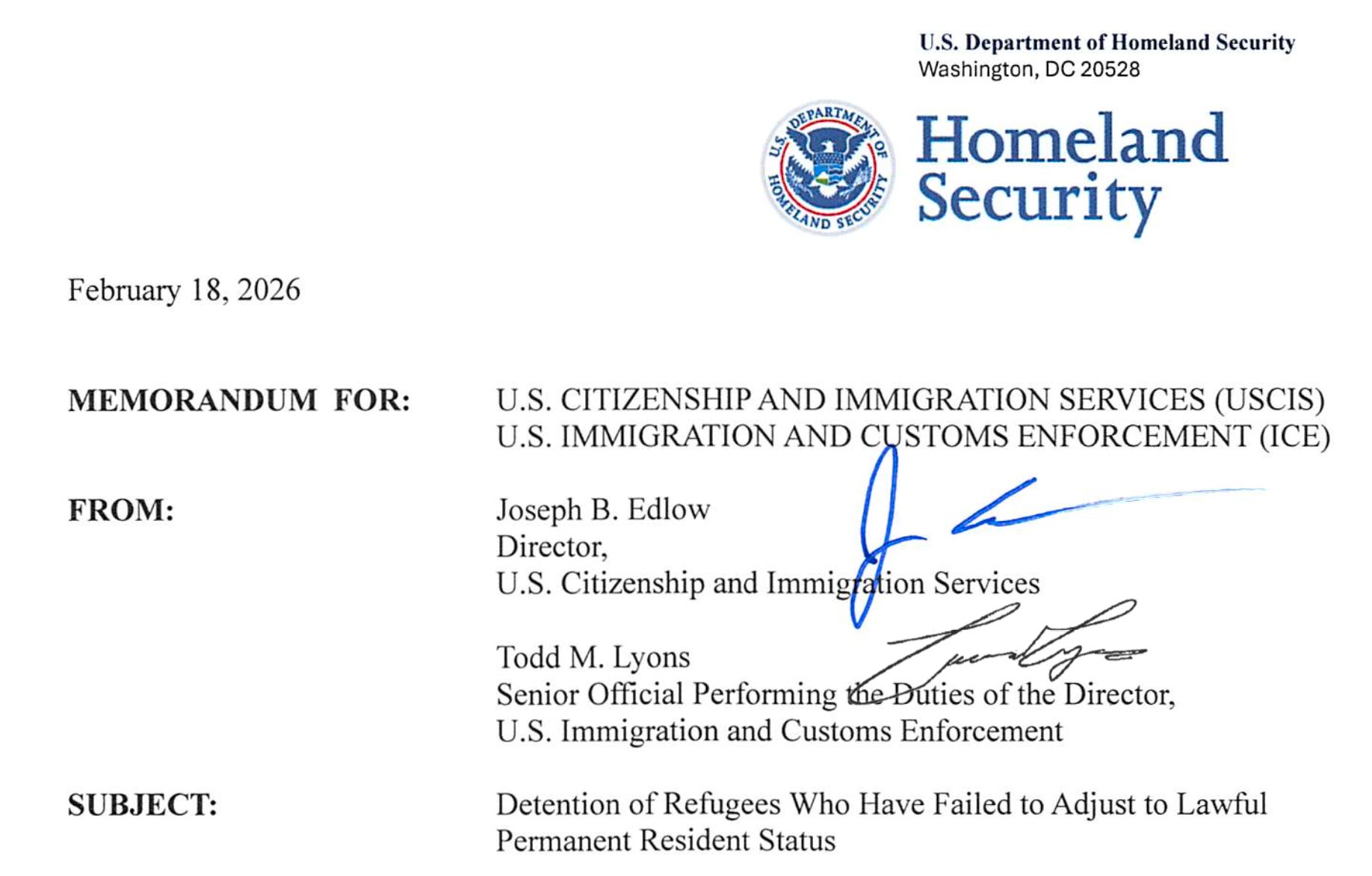
Two senior officials in the Department of Homeland Security on Wednesday issued a new, significantly more detailed memorandum seeking to justify rounding up and detaining certain refugees in America — six days after the Justice Department filed a one-paragraph DHS memo from December in court to justify the actions.
Joseph Edlow, the director of U.S. Citizenship and Immigration Services, and Todd Lyons, the “senior official performing the duties of the director” of U.S. Immigration and Customs Enforcement, issued the joint memo on Wednesday, the day before a key hearing in a case challenging the Trump administration’s treatment of refugees in Minnesota. DOJ filed the memo in the case later Wednesday.
The memo — from two of the three DHS leaders who testified before a House committee at a contentious hearing last week — addresses the treatment of refugees who have been in the U.S. for more than a year but have not yet obtained lawful permanent resident (LPR) status. Under prior interpretation of the relevant provision of the Refugee Act of 1980, most recently detailed in a 2010 DHS memo, detention is not appropriate on that basis alone.
As Law Dork reported last week, DHS purported to have rescinded the 2010 memo on December 18. On January 9, DHS announced a new program that includes “reverification” of refugees who entered the country after President Biden took office. That program included targeted detention of law-abiding refugees in Minnesota who do not yet have LPR status, which led to a class-action lawsuit, which led U.S. District Judge John Tunheim to issue a classwide temporary restraining order barring the detention of such refugees through February 25.
Then, as DOJ began opposing the requests, Tunheim ordered DOJ to turn over relevant documents. Due to the fact that this is a case relating to immigration detention, a federal default rule means filings in the case are not remotely available to journalists or the public at large but can only be obtained at the federal courthouse where the case is filed. The default rule can be changed — and remote access can be made available if “the court orders otherwise.“ Law Dork filed a motion to intervene in the case this past week and asked the court to do so.
On Wednesday, U.S. Magistrate Judge Douglas Micko denied Law Dork’s motion to intervene, asserting that “each of Law Dork’s requests has been satisfied.“
Relevant to Wednesday’s news, Micko wrote:
Law Dork seeks to intervene in this case to obtain public access to the docket in this case. It states that it is a news agency, and granting unrestricted electronic access to court records will protect the public’s right of access to court proceedings. But the public may already access filings in this case through the public terminals available at each federal courthouse in the district.
First of all, Law Dork’s request noted specifically that I am “located in Washington, DC and rel[y] on remote access to case dockets and proceedings.“ More importantly, Micko apparently believes that in-person, time-limited access at a courthouse to filings in a case addressing statewide and national refugee policies in which classwide relief has been granted is sufficient to “satisf[y]” the need for access to such an important case.
I strongly believe that is wrong, and many courts to have faced this question agree — a point also noted in Law Dork’s request.
As if to prove the point of Law Dork’s request, Micko’s order came hours after DOJ filed the new memo. Under Micko’s ruling, journalists and the public at large do not have remote access to the memo on the case’s docket — despite it being filed about 24 hours before the summary judgment hearing.
Law Dork, however, obtained and is publishing the memo.
In the “New Policy” section of the memo, Edlow and Lyons declare that refugees who do not obtain LPR status — obtain a green card — after a year either need to return to DHS or DHS will arrest and detain them for “inspection and examination for admission as an LPR.”
Then, the new policy states, “DHS may maintain custody for the duration of the inspection and examination process.“

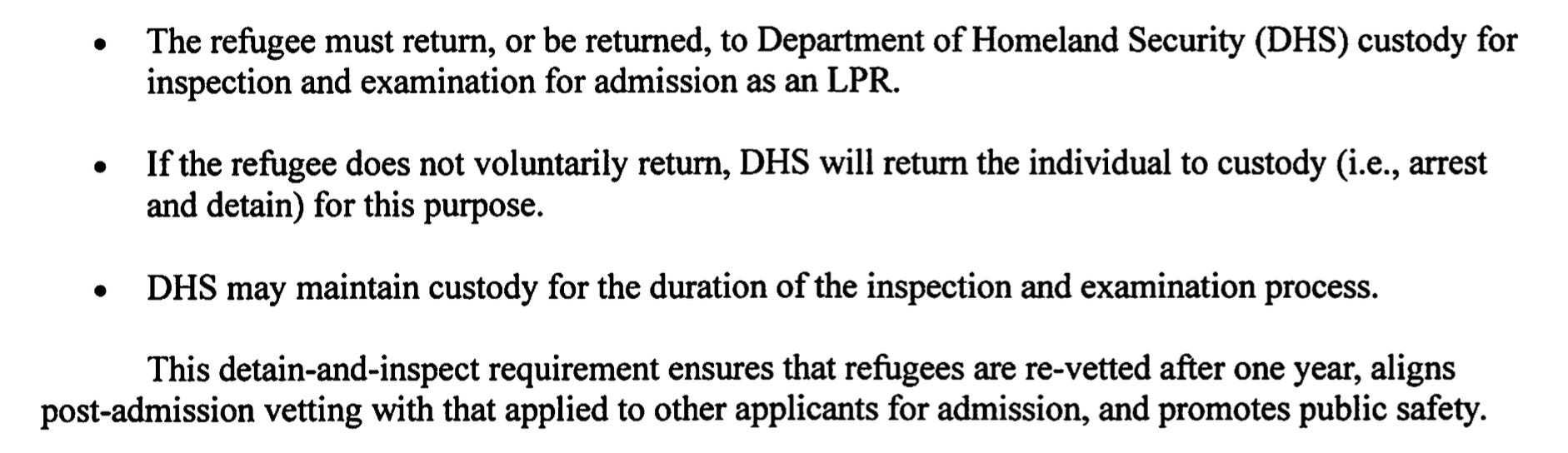
That’s not all. The Edlow-Lyons memo goes further, stating that detention for this purpose “is not indefinite, but also is not limited to merely 48 hours.”

There was no authority for this detention at all for this purpose before DHS claimed to have found such authority this year. Now, DHS is claiming authority for detaining refugees for some “reasonable” amount of time between 48 hours and “indefinite.”
Under the 2010 memo’s discussion, decisions about “whether to release” refugees permitted to be arrested under the earlier standard “or to commence removal proceedings” had to be made within 48 hours.
The new memo is extremely vague about whether a refugee having applied to adjust their status is even sufficient to avoid detention.
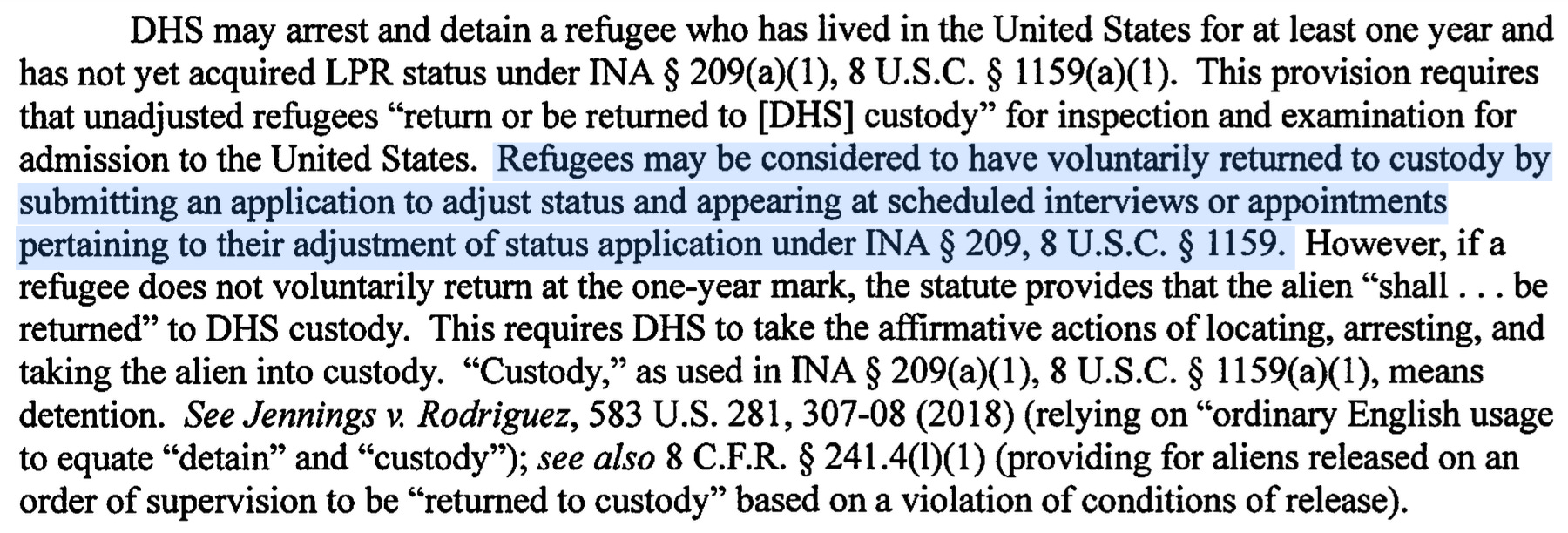
This is a significant issue when, as Law Dork reported last week, under a different memo, DHS began holding all LPR applications as of November 21, 2025.
In addition to claiming that this new review and detention is necessary under the “statutory framework” of the 1980 law — something identified out of thin air and contrary to all prior policy — the Edlow-Lyons memo now claims that a “[r]eturn to custody for inspection is critical to ensuring full and thorough vetting.”
As the memo details:
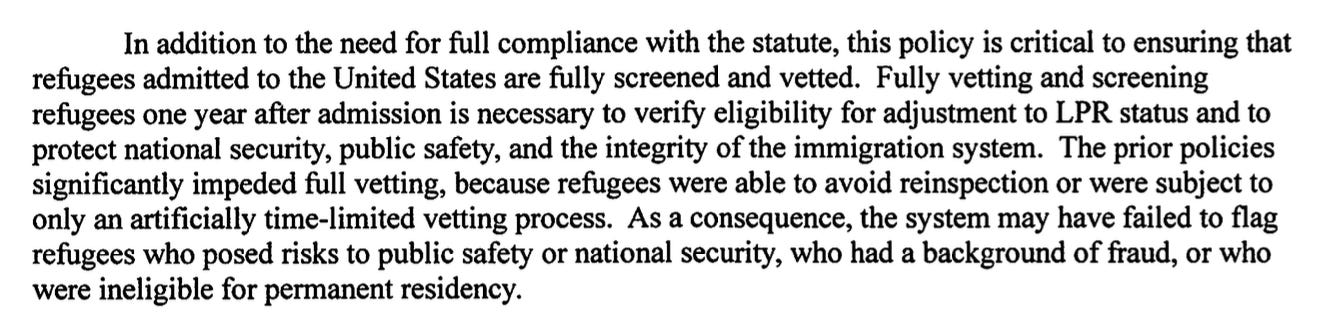
Edlow and Lyons claim that “[a] USCIS review of recently admitted refugees from just the Western Hemisphere illustrates some of the failures“ under “the prior policies, which prioritized speed and volume of refugee admissions over depth and quality of refugee adjudications.”
Edlow and Lyons claim, vaguely, that of “31,000 refugees admitted to the United States from Ecuador, El Salvador, Guatemala, Honduras, and Venezuela from 2021 to 2024,“ the review determined that “[o]ver 42% had been insufficiently vetted to determine whether or not they presented a public safety concern.“
No explanation was provided detailing what that means or how that was defined. The same review information cited in the memo was previously cited in a declaration submitted earlier in the case by a USCIS official. That, too, included no further information about the review.
About 24 hours after submitting this new memo, the case brought by one refugee who was detained, another who was detained and eventually released out of state, and others who fear detention will have a key hearing.
Credentialed media, including Law Dork, will have remote access to Thursday’s preliminary injunction hearing in the case.
The public, however, will not have remote access.
“The Court, by policy, does not offer remote hearing access to the public; members of the public are welcome to attend in-person proceedings,“ Micko wrote Wednesday in denying Law Dork’s request for intervention and a public-access line for hearings in the case.
Unless I misremember, some 92% of immigrants admitted into the country kept all their appointments. It's interesting, too, that it's only those who are admitted under Biden fall under this new rule - part of the effort to de-legitimize every action taken by that administration.
Explains all the detention camps they want in every state.