

Appeals court set to review a key, harsh Trump administration deportation policy this spring
The First Circuit stayed a lower court ruling over third country removals, but also set quick merits review. Also: A mid-week legal round up. And, for paid subscribers: Closing my tabs.

One of the most dramatic anti-immigrant policies of the Trump administration has been the expansive use of third country removals — deportation to a country other than where a person was born or otherwise has legal status.
People are being sent to countries in which they have no prior connection — and often face danger by being sent there.
Over the past year, U.S. District Judge Brian Murphy has repeatedly sought to rein in the use of those third country removals, with the U.S. Supreme Court blocking a key preliminary ruling in the case last June — with the conservative majority providing no reasoning (and later blocking related enforcement efforts as well) but empowering the Trump administration to expand the practice over the months since.
Most recently, Murphy, a Biden appointee, issued a final judgment and accompanying opinion in the case on February 25. Murphy has ordered the Trump administration to provide people with “meaningful“ due process before carrying out third country removals.
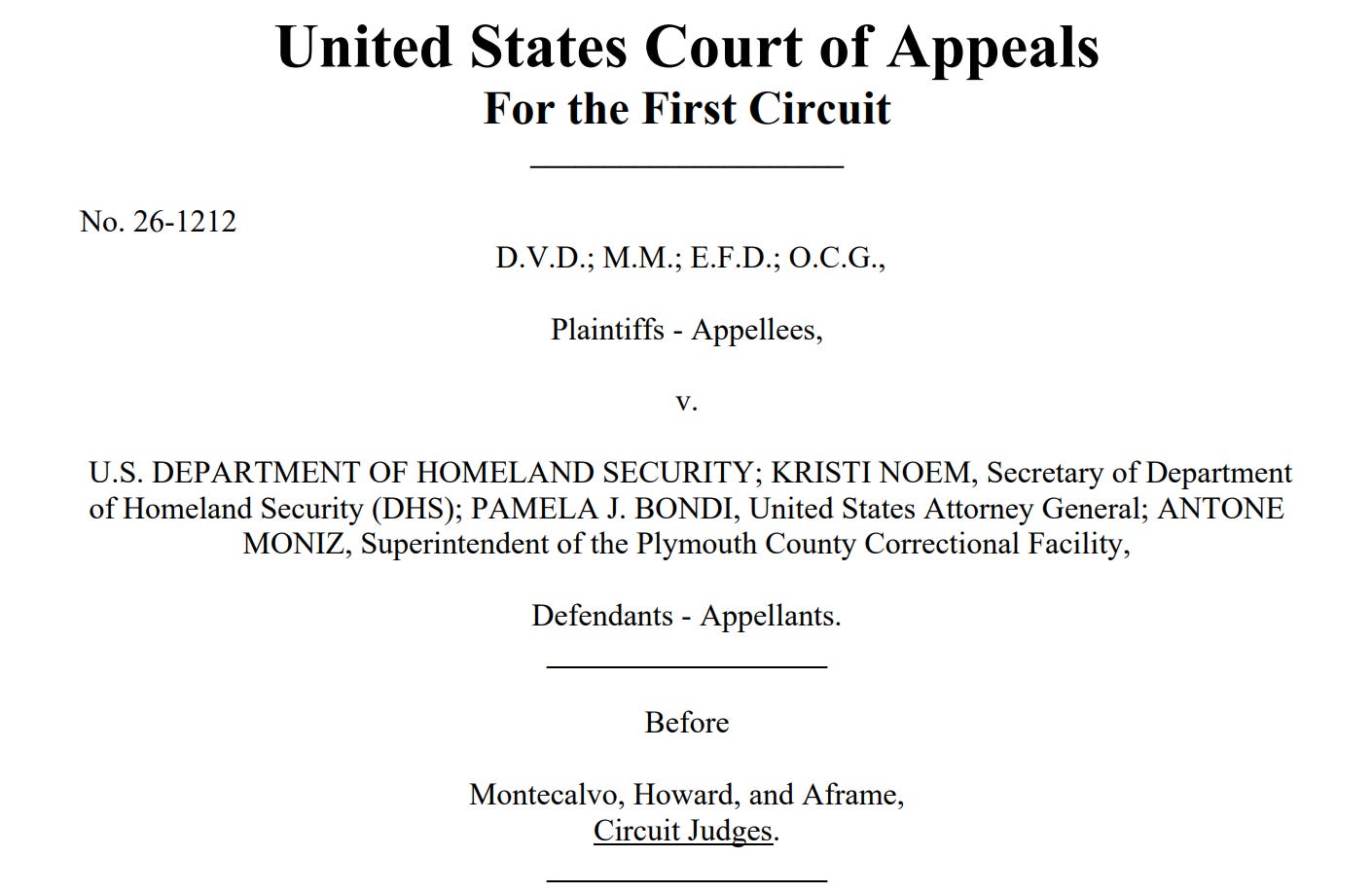
On Monday, the U.S. Court of Appeals for the First Circuit, on a 2-1 vote, issued a stay pending appeal in the case. Judge Seth Aframe, a Biden appointee, joined with Judge Jeffrey Howard, a senior status George W. Bush appointee, in voting for the stay, while Judge Lara Montecalvo, another Biden appointee, would have denied the stay.
The court provided no reasoning, but it did set an expedited briefing for the consideration of the government’s appeal. DOJ’s brief is due by March 30, the plaintiffs’ response is due 14 days later, and any reply is due 7 days after that. “The Court intends to hold oral argument soon after briefing is complete,” per the order.
Looking at this strategically, in light of the Supreme Court’s prior shadow docket order, the stay grant prevented the case from going to the Supreme Court now — allowing the First Circuit to fully consider these questions and issue a full merits ruling before this important case goes back up to the Supreme Court.
That, of course, is no relief to those people subject to third country removals in the meantime, but it might ultimately be the most strategic path to reining in at least some of the extremism of this administration in this regard.
Wednesday legal round-up report
A lot has happened over the past week that is important and should be noted but that I haven’t been able to get to in the midst of everything else. Rather than dragging things out, or missing stories altogether, I’m going to do something slightly different here, running down those stories in a more abbreviated fashion than normal — with links to my colleagues across the media where appropriate.
ACIP ruling: U.S. District Judge Brian Murphy also is overseeing a major challenge to the Trump administration’s vaccine-related policies, and on Monday issued a broad preliminary injunction, blocking Health and Human Services Secretary Robert F. Kennedy Jr.’s move to replace members of the Advisory Committee on Immunization Practices (ACIP), all votes taken by that reconstituted ACIP, and “the January 2026 Memo revising the CDC’s childhood immunization schedule.“ Reuters’ Nate Raymond, Ahmed Aboulenein and Leah Douglas covered the ruling here.
Voice of America ruling: On Tuesday, U.S. District Judge Royce Lamberth ruled that the Trump administration impermissibly halted Voice of America and related broadcasting — under the auspices of the U.S. Agency for Global Media — and impermissibly placed associated employees on administrative leave. He ordered the employees be allowed to return to work by March 23 and for broadcasting to resume. The Washington Post’s Scott Nover covered the ruling here. The final judgment in the case followed a recent, related ruling from Lamberth, a Reagan appointee, that the Trump administration’s effort to claim that Kari Lake was the “acting CEO” of the USAGM was unconstitutional and violated federal law.
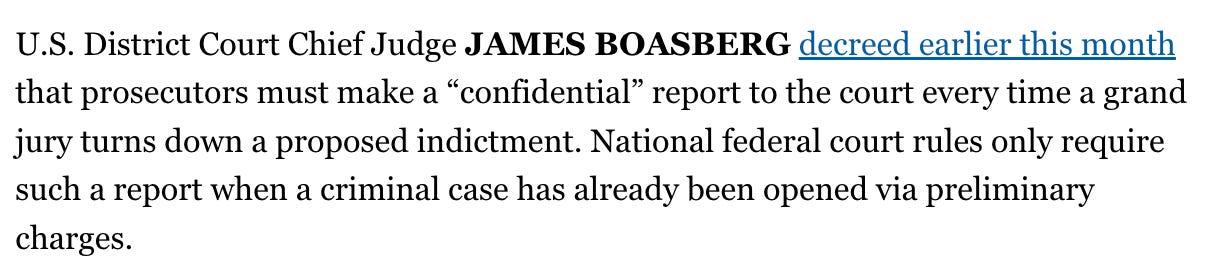
Grand jury order in D.C.: On Monday, Politico’s Josh Gerstein reported that Chief Judge James Boasberg issued an order on March 4 for the federal courts in D.C. to ensure “consistency and transparency“ with regards to the increasing number of times where grand juries are declining to bring charges sought by the Justice Department.
This is the evisceration of the “presumption of regularity” that people have talked and written about — including here at Law Dork — over the past 14 months.
SCOTUS auditioning reaches new, appalling levels: In a case in which the U.S. Court of Appeals for the Ninth Circuit had, on a 2-1 vote, affirmed the dismissal of a First Amendment challenge brought by two Korean spas to the application of the Washington Law Against Discrimination to the spas’ biological-women-only entrance policy, Judge Lawrence VanDyke — a Trump appointee — made headlines for his vulgar, childish, anti-trans screed in dissenting from the court’s refusal to rehear the case en banc. It began, “This is a case about swinging dicks,“ and went downhill from there.
Over at Slate, Dahlia Lithwick and Mark Joseph Stern discussed this disgusting display.
It did, thankfully, led to significant pushback from his colleagues — including from five Republican appointees. Twenty-seven judges of the court, in a statement authored by Judge M. Margaret McKeown (the senior status Clinton appointee who authored the panel opinion), stated that VanDyke’s “language makes us sound like juveniles, not judges, and it undermines public trust in the courts,“ noting as well that it “ignores ordinary principles of dignity and civility and demeans this court.” That statement was joined by Judges Milan Smith (George W. Bush) and Eric Miller (Trump), as well as by two senior status George W. Bush appointees, Judges Richard Clifton and Jay Bybee. VanDyke’s dissent also prompted Judge John Owens, an Obama appointee, joined by Judge Danielle Forrest, a Trump appointee, to issue a one-sentence statement: “Regarding the dissenting opinion of Judge VanDyke: We are better than this.“
But, as Mark warned in his discussion with Dahlia, it got VanDyke attention. Here’s his warning, which I think should be noted as, if I suspect, SCOTUS retirement watch continues to build in the coming months: “If Trump’s problem with his first three justices was that they weren’t loyal enough to him, VanDyke is saying: I’m not just going to be loyal to you on the bench. I will be you on the bench. I’m sure that’s an appealing pitch.“
Closing my tabs
There also has been a lot of important journalism adjacent to my work this past week, and I’d like to highlight some of those stories here.
For those who don’t know what this is, it’s my effort to give a little thank you to paid subscribers. “Closing my tabs” is, literally, me looking through the stories and cases open — the tabs open — on my computer and sharing with you all some of those I was unable to cover during the week but that I nonetheless want to let you know that I have on my radar. Oftentimes, they are issues that will eventually find their way back into the newsletter as a case discussed moves forward or something new happens that provides me with a reason to cover the story more in depth.
This Wednesday, these are the tabs I am closing:
