

Trump admin effort to claim Kari Lake had power over Voice of America was illegal, judge rules
"The Court declines Lake’s invitation to do such violence to the statutory and constitutional scheme," Judge Lamberth ruled on Saturday. And, for paid subscribers: Closing my tabs.


The federal courts are never truly Monday-through-Friday operations, although the Trump administration has tested the all-hours reality of being a federal judge.
The latest need for weekend action came as U.S. District Judge Royce Lamberth ruled on Saturday that the Trump administration effort to install Kari Lake as the “acting CEO“ of the U.S. Agency for Global Media (USAGM), the parent organization of the Voice of America, was unconstitutional and violated federal law.
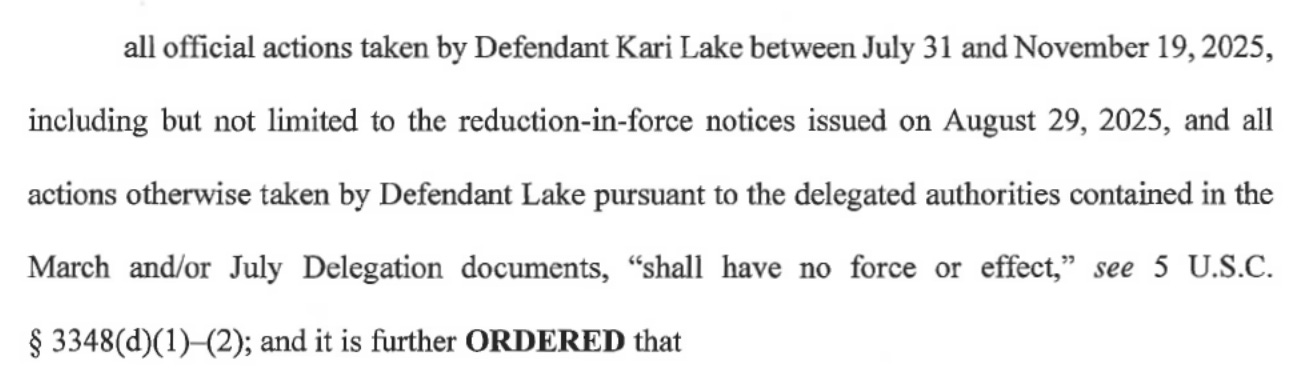
Because of that, Lamberth, a Reagan anppointee, ordered that, among other acts, Lake’s effort to put in place a Reduction in Force (RIF) across the agency is void.
The ruling came two days before a Monday deadline for a renewed Deferred Resignation Program that employees were given on February 26 — along with a tacit threat related to Lake’s continued plan to implement the RIF.
Specifically, per the plaintiffs’ court filing in the case, the February 26 notice informed employees that the agency “RIF noticed in August 2025 is currently suspended due to court order, and the Agency still intends to carry out a significant RIF as soon as [it is] able” to do so.
To that, the plaintiffs noted, “Defendants’ threat to carry out a significant RIF in order to induce current employees to resign is concerning ….” They asked for a ruling on the validity of Lake’s appointment before the March 9 deadline because “a decision from this Court could significantly influence employee decisionmaking by providing valuable information before the deadline to respond.“
After considering Lake’s argument in defense of her appointment, Lamberth (yes, same judge) was blunt in his Saturday ruling: “The Court declines Lake’s invitation to do such violence to the statutory and constitutional scheme.”
What is the violence Lamberth is saying that Lake is inviting?
The constitutional and statutory schemes — of the Appointments Clause and the Federal Vacancies Reform Act, respectively — lay out how the executive branch is staffed by placing requirements on how people are able to be put in different roles, depending on the amount of authority they exercise and who they are answerable to.
The plaintiffs argued in a supplemental complaint that the effort to make Lake acting CEO of the USAGM violated both.
Whether the Trump administration could do so in the way they did was not a particularly difficult one to answer, Lamberth found.
Quoting from the Federalist papers, Lamberth noted early on, “[A]s Alexander Hamilton explained, the Senate’s advice-and-consent role serves as a check on the unilateral installment of ‘candidates who ha[ve] no other merit than that . . . of being, in some way or other, personally allied to [the President], or of possessing the necessary insignificance and pliancy to render them the obsequious instruments of his pleasure.’“
Yeah, it was not going to go well for Lake here.
Under the FVRA, there are three possibilities for how a person could take on an “acting” role for a position that normally requires presidential nomination and Senate confirmation:

Here, Lamberth noted, 2 and 3 are easily out:

Then, as to Lake’s argument that she should be able to serve under 1, this s what Lamberth concluded:
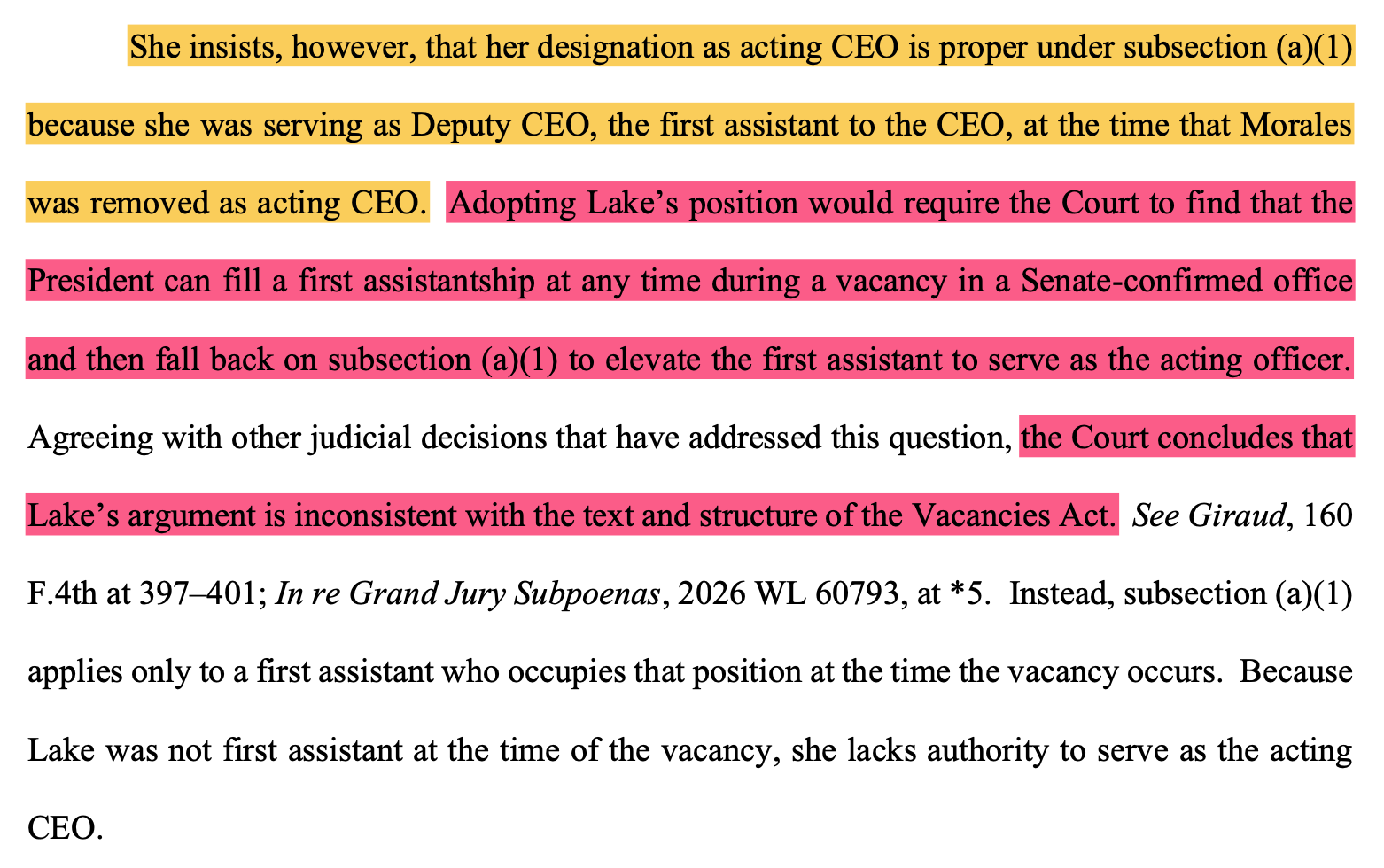
In discussing the problem with this argument later, Lamberth laid out the case plainly:
“[W]hile subsections (a)(2) and (a)(3) narrowly constrain who ‘the President (and only the President)’ may direct to take an acting role,” Lake’s reading of subsection (a)(1) would allow the President “to, in effect, appoint almost anyone, whether or not the person is previously Senate-confirmed to another role, and whether or not the person has any recent experience in the agency,” merely by installing them as a non-Senate-confirmed first assistant.
It was this argument that Lamberth said would do “violence” to the law.
He wasn’t done, though.
As to Lake’s fallback argument that she could still exercise the extensive delegation she was given by the last proper acting CEO, Lamberth wrote, “This argument falters out of the gate.”
Specifically, he found that the law relied upon by the government doesn’t allow the delegation the government is claiming and, in any event, another provision in the FVRA bars it.
Here’s where things got very interesting.
This is what DOJ argued in its filing on March 4, submitted by D.C. U.S. Attorney Jeanine Pirro and Assistant U.S. Attorney Samantha-Josephine Baker:

To that, Lamberth wrote, “The problem for Lake is that the provision she cites says not one word about delegation by the CEO.“
What does it say?
Here’s the original law — the provision DOJ cited “specifically” in its brief:

It remains the law today and, as Lamberth wrote, “the Act provides that ‘[t]he Secretary,’ meaning the Secretary of State“ could carry out such delegations.
Then, in a sentence that might be doing both too much and not enough, Lamberth concluded:

Yes, “the gap.”
Baker, the AUSA who signed the brief, joined DOJ in December 2025 after having worked as a lawyer in Florida government — the Florida Attorney General’s Office and then Florida Department of Corrections — for more than a decade.
As to the delegation argument, Lamberth ultimately found “that these expansive delegations were an unlawful effort to transform Lake into the CEO of U.S. Agency for Global Media in all but name, and therefore violated § 3347(b) of the Vacancies Act.”
Finally, and as noted in Lamberth’s opinion and made more clear by what he required in his order, it is unknown to the court who the acting CEO of USAGM is at this moment.

Just another weekend of being a judge in the Trump era.
Closing my tabs
For those who don’t know what this is, it’s my effort to give a little thank you to paid subscribers. “Closing my tabs” is, literally, me looking through the stories and cases open — the tabs open — on my computer and sharing with you all some of those I was unable to cover during the week but that I nonetheless want to let you know that I have on my radar. Oftentimes, they are issues that will eventually find their way back into the newsletter as a case discussed moves forward or something new happens that provides me with a reason to cover the story more in depth.
This Sunday, these are the tabs I am closing:
