

Federal judge blocks new DHS policy that would allow arrest of thousands of legal refugees
"The new policy turns the refugees’ American Dream into a dystopian nightmare," Judge Tunheim wrote.

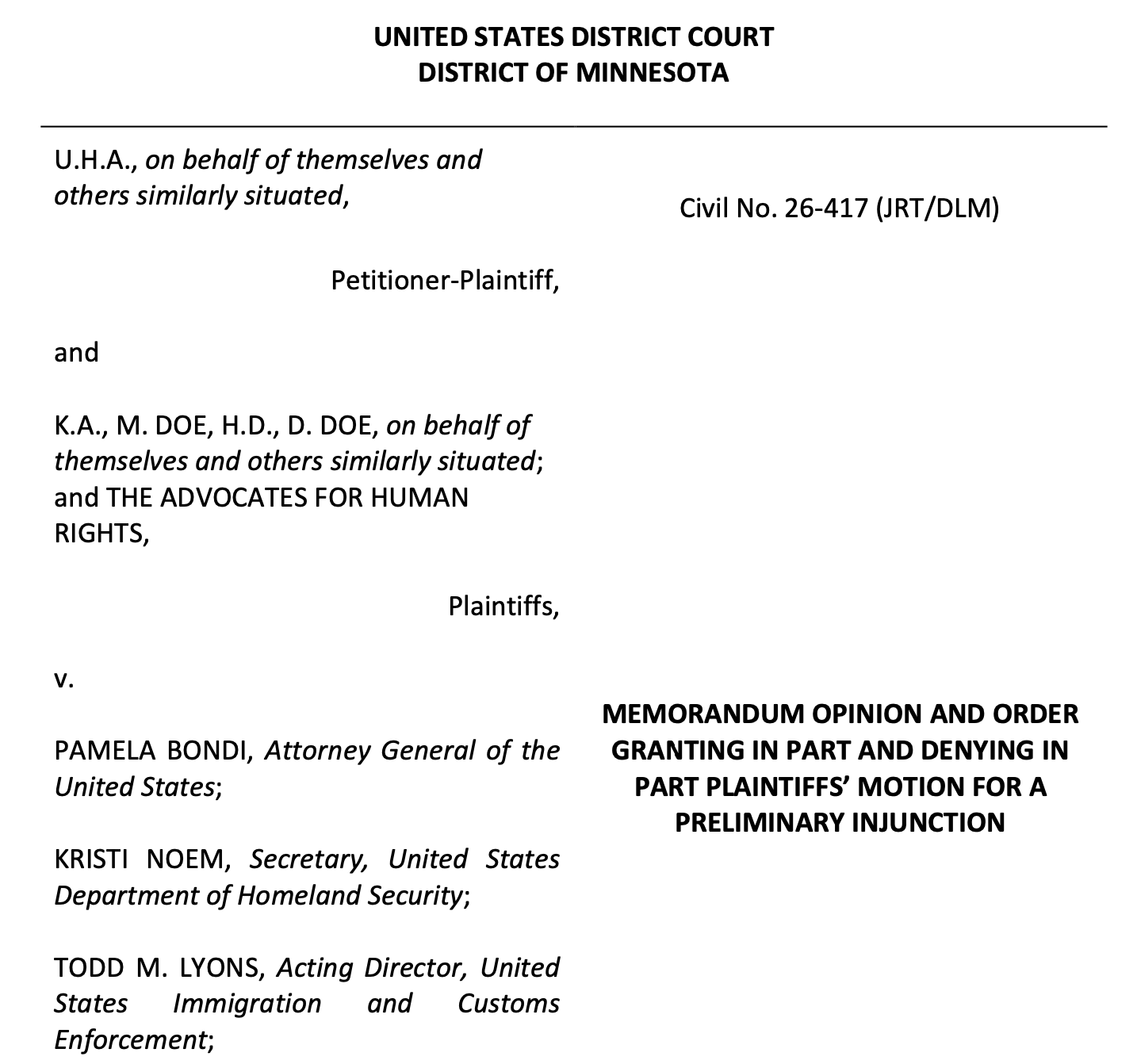
In a key challenge to the Trump administration’s new policy to round up, arrest, and detain thousands of refugees, a federal judge in Minnesota on Friday blocked the effort in the state during litigation, declaring the effort “turns the refugees’ American Dream into a dystopian nightmare.“
In noting that the purpose of the refugee program was to provide “a new beginning in safety,“ U.S. District Judge John Tunheim wrote the officials in the Trump administration instead “seek to transform a system built on promised opportunities and freedom into one of uncertainty and indefinite confinement.“
The longtime government policy has been that refugees — vetted and legally admitted individuals — who are yet to adjust to lawful permanent resident status cannot be detained on that basis alone.
With Operation PARRIS (Post-Admission Refugee Reverification and Integrity Strengthening), the Trump administration wants to change that.
In a pair of memos issued in December 2025 and February 2026 — which Law Dork has covered extensively — the Department of Homeland Security has purported to change that policy by rescinding and re-rescinding the 2010 U.S. Immigration and Customs Enforcement policy that most recently enunciated that policy for applying the relevant provision — 8 U.S.C. 1159 — of the Refugee Act of 1980.
“The Government’s startling theory—that the statute silently grants DHS the power to seize a refugee the moment the clock strikes midnight on the 366th day after admission—is wrong,“ Tunheim wrote. “This theory finds no support in the text, the history, or the purpose of § 1159(a)(1) and marks a sharp break from more than four decades of agency practice.”
Tunheim, a Clinton appointee, granted a classwide preliminary injunction on Friday on five grounds, finding that the plaintiff refugees are likely to succeed on their statutory claims about the Refugee Act provision, as well as procedural due process, substantive due process, Fourth Amendment, and Administrative Procedure Act claims.
Tunheim previously had blocked the arrests and detentions with a temporary restraining order.
“The Government’s actions in this case beg the question: Why?“ Tunheim wrote. “The Government suggests that they are looking for terrorists, but there is not a shred of evidence in the record that the Named Plaintiffs or the putative Class they seek to represent pose serious national security risks.“
Tunheim’s conclusions
As to the Refugee Act provision itself, Tunheim concluded for seven reasons “that the phrase ‘return or be returned to custody’” in the Refugee Act provision “does not permit the arrest and detention of unadjusted refugees that have not been charged with any ground of removability.”
As to procedural due process, Tunheim noted that “the limited record before the Court demonstrates the probability and magnitude of the risk of erroneous deprivation,“ citing, for example, plaintiffs’ evidence of a refugee who was “arrested on January 11, 2026, without a warrant, transported to a detention center in Minnesota, then flown in shackles to Texas, where he was questioned about his refugee status.”
In finding that the plaintiffs are likely to succeed in their substantive due process claim — the liberty interest protected by the Fifth Amendment against the federal government — Tunheim noted the record before the court and concluded that “Defendants’ sweeping and severe deprivations of liberty are not narrowly tailored to the interests they assert.”
As to the Fourth Amendment, Tunheim wrote that “the Court concludes that the plain text of § 1159 creates no offense which unadjusted refugees have committed such that their arrest could be reasonable under the Fourth Amendment.”
Further still, he noted:
[E]ven if the Court were to construe § 1159 to permit arrest and detention of some kind, the record before the Court provides no evidence that Defendants’ warrantless arrests of refugees in furtherance of Operation PARRIS have been based upon individualized probable cause inquiries.
Finally, as to the APA, Tunheim found that “neither the December Rescission Memo nor the February Re-Rescission Memo addresses—or even reflects—the Policy that has actually been implemented in Minnesota“ and, beyond that, the policy “exceeds Defendants’ authority under 8 U.S.C. § 1159 and infringes on Plaintiffs’ constitutional rights under the Fourth and Fifth Amendments.“
Tunheim similarly found remaining factors for granting a preliminary injunction — irreparable harm and public interest — favored the plaintiffs.
“The Court does not have to look far to see the grave and immediate threat of irreparable harm facing Plaintiffs,” Tunheim wrote. “Refugees who have already been detained and released, as well as those who fall within the putative Class but have not yet been arrested, face a concrete and ongoing risk of arrest or re-arrest absent preliminary relief. This fear is neither exaggerated nor speculative; it is a logical and entirely legitimate response to what has occurred.“
In conclusion, Tunheim took a step back:
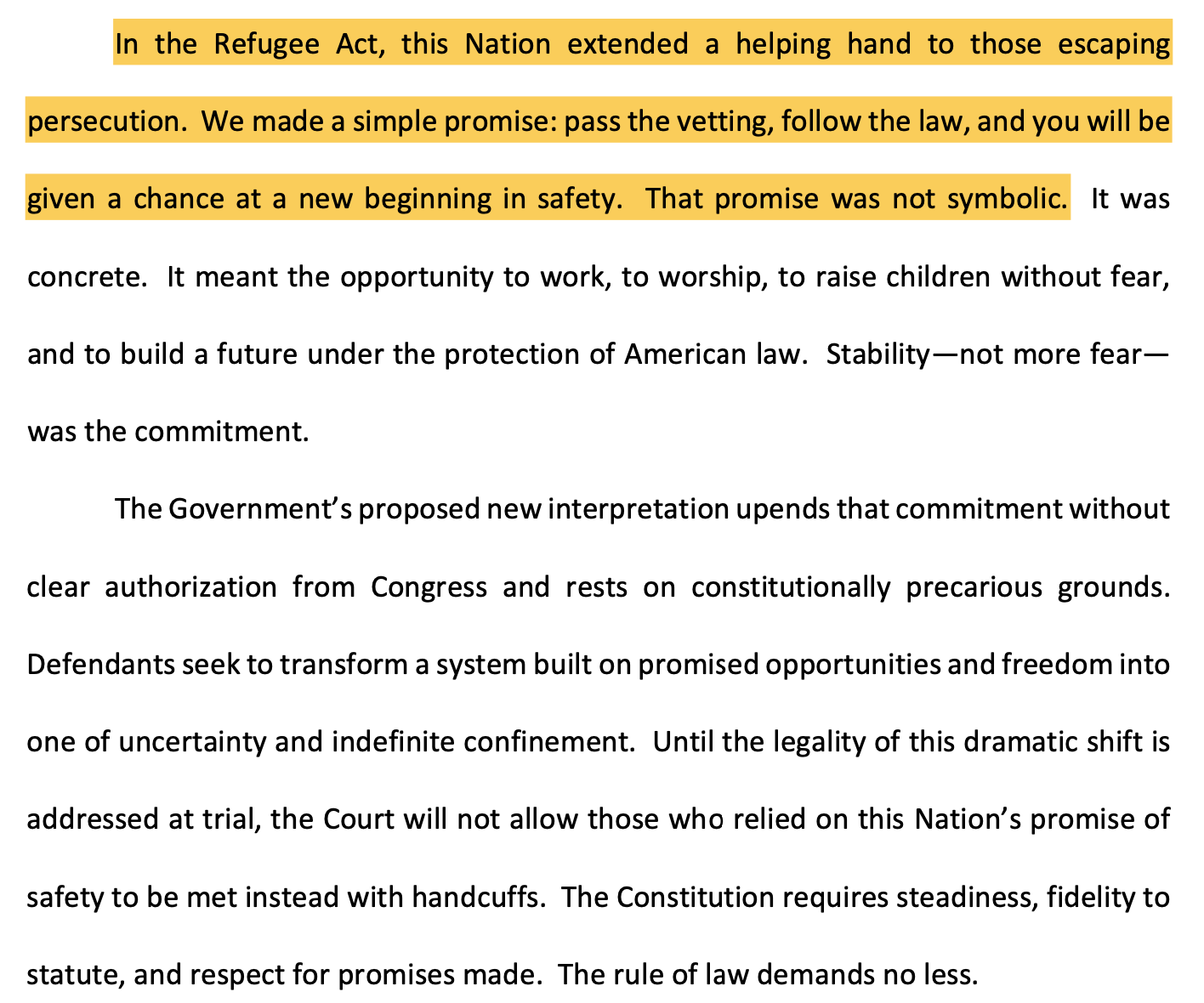
“Until the legality of this dramatic shift is addressed at trial, the Court will not allow those who relied on this Nation’s promise of safety to be met instead with handcuffs,” Tunheim stated.
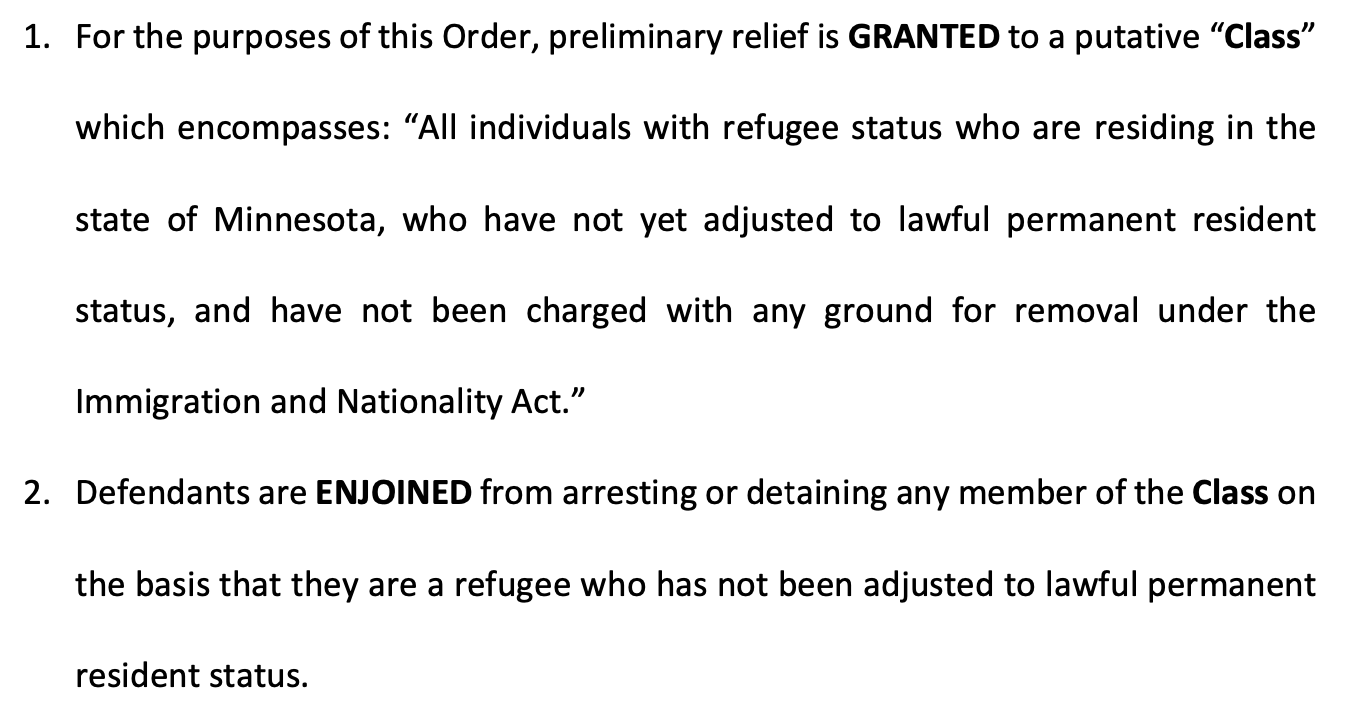
As such, Tunheim granted the classwide relief barring the arrest and detention of “[a]ll individuals with refugee status who are residing in the state of Minnesota, who have not yet adjusted to lawful permanent resident status, and have not been charged with any ground for removal under the Immigration and Nationality Act.“
In his ruling, Tunheim denied the request for a second class-based preliminary injunction that would have ordered the release of all detained pursuant to the new policy — but only did so because no one is detained under the policy and all who had been have been released.
Precisely. Our country made a promise. People trusted us to keep our word. They acted on it. Our country acted on it. Both invested in it. Now a random hateful regime wants to unilaterally wholesale reverse into cruelty and what amounts to destroying people’s lives, not to mention the communities they have woven into.
Every time any court, at any level, anywhere in this country finds against this horrific, overreaching, cruel, mindless, and lawless administration's agenda, it is cause for celebration. Although the misnamed government has deep pockets, multitudes of inept greedy lawyers, and unmitigated gall, We the People can draw strength, courage, and renewed resolve to keep on fighting for the Constitution, the rule of law, and our rights and freedoms. Stand firm, patriots! Defiance til death!