

James Comey posted a picture of seashells by the seashore. Trump's DOJ indicted him for it.
Another Comey indictment in this altogether embarrassing day for DOJ. Also: The Second Circuit creates a circuit split, blocking the Trump admin mandatory detention policy.

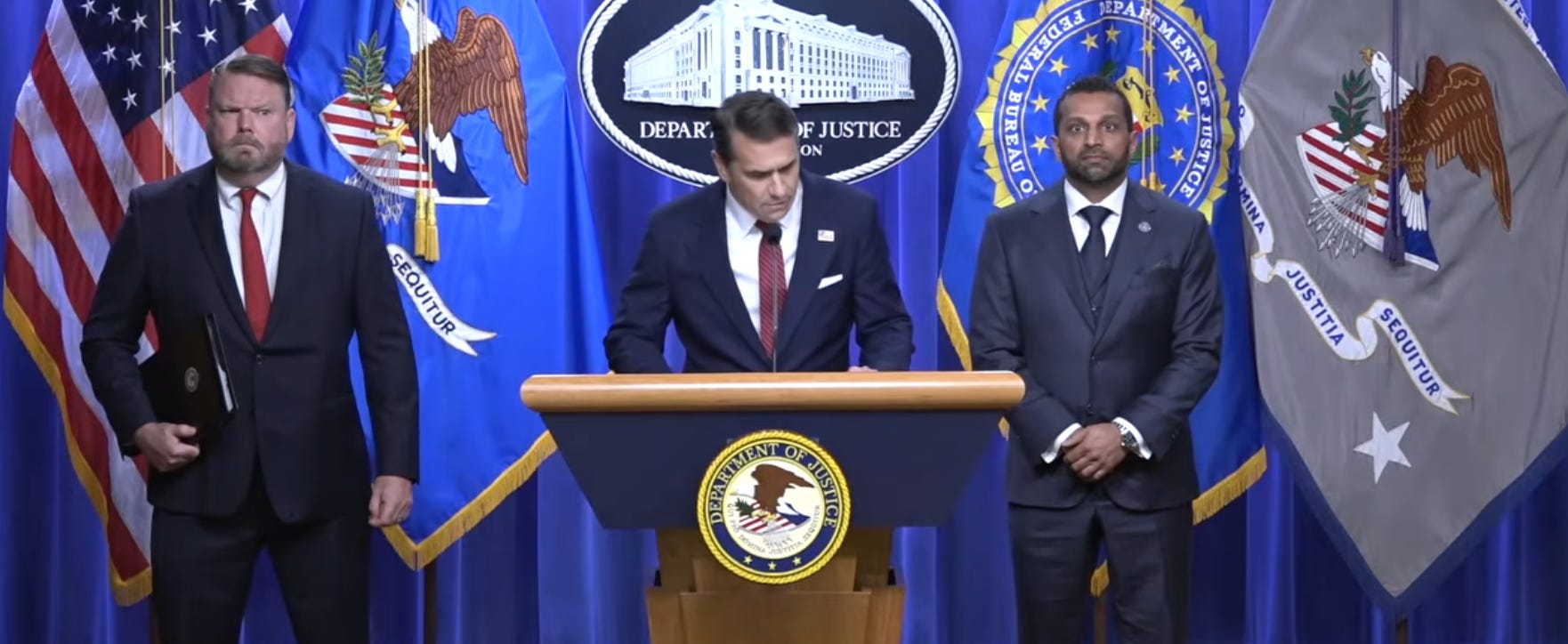
The most embarrassing 24 hours (yet) of the Justice Department in President Donald Trump’s second administration continued apace on Tuesday, when Acting Attorney General Todd Blanche announced another indictment of James Comey, the former FBI director. This time, Comey — targeted by President Donald Trump as a political enemy — was indicted in North Carolina in connection with his since-deleted Instagram post showing a photo of seashells laid out in the shape of the numbers “8647.”
Flanked by Eastern District of North Carolina U.S. Attorney W. Ellis Boyle and FBI Director Kash Patel, the trio discussed the two-count indictment obtained Tuesday, which charges Comey with making a threat against Trump by way of the Instagram post, which he later deleted once he heard that people aligned with Trump were saying that it was a call for violence.
Trump has said it meant “assassination,” which Comey said he had not known or intended in an interview with then-MSNBC’s Nicole Wallace at the time. In the interview, Comey said he took down the May 15, 2025 post — a picture of the shells that he said he and his wife saw when walking on the beach — because, “Even if I think it’s crazy, I don’t want to be associated with violence of any kind.”
Referencing the use of “86” in restaurants to mean an item is off the menu and his recollection of it being used to mean it was time to leave a place, Comey told Wallace he thought it was “a clever way to express a political viewpoint.”
DOJ — which already unsuccessfully indicted Comey once — instead decided to try again, following what Blanche said was an ongoing investigation that already took 11 months, using this since-deleted Instagram post as the basis for a count alleging that Comey “ma[d]e a threat to take the life of, and to inflict bodily harm upon, the President of the States.“
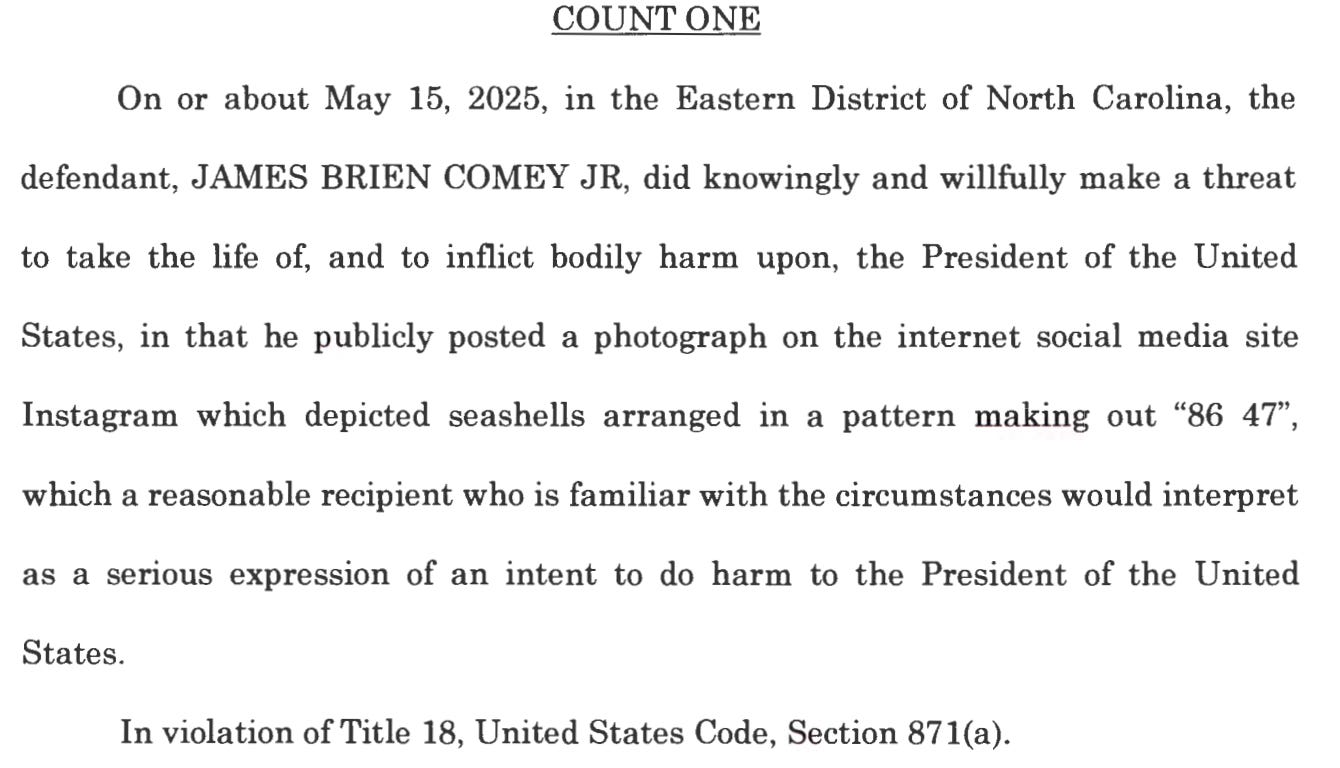
The second count is that Comey did so via Instagram — “transmit[ting] in interstate and foreign commerce a communication“ containing the alleged threat.
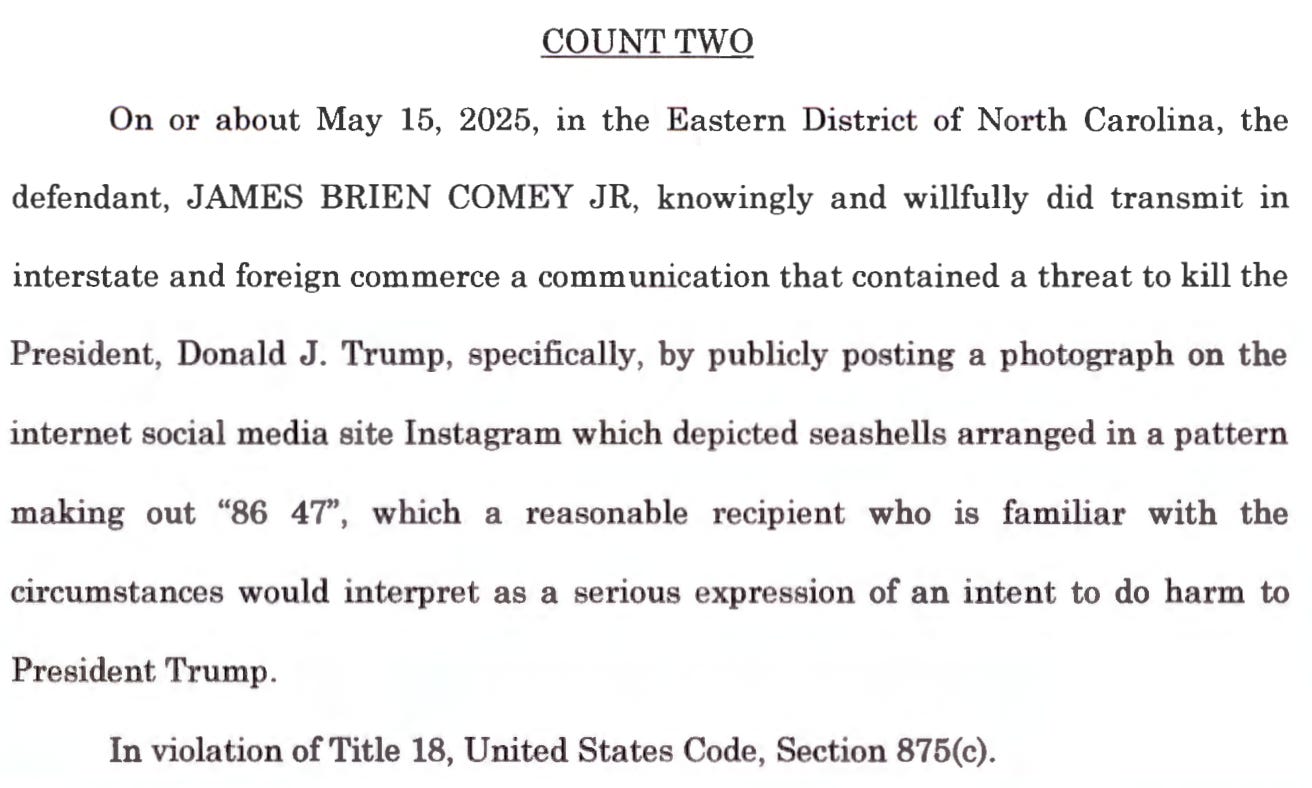
The two primary difficulties with the indictment — which are, essentially, the whole ballgame — are what comes before and after those descriptions of the action:
Recipient: DOJ alleged and would need to prove under the law that “a reasonable recipient“ of the image of “8647” posted by Comey “who is familiar with the circumstances would interpret” the post “as a serious expression of an intent to do harm” to Trump — which will be difficult to prove given the many meanings of the term “86.”
Defendant: DOJ alleged and would need to prove under the law that Comey did so “knowingly and willfully” — which will similarly be a difficult standard to prove even if, somehow, they could get over the first hurdle given Comey’s actions and statements in the aftermath of his posting it.
Shortly after the Instagram posting last year, Alan Rozenshtein and Ben Wittes at Lawfare posted an analysis of the legal questions surrounding the post, concluding, “James Comey could have gone a lot stronger than ‘8647’ and still not risked jail.“
In part, they wrote:
Even if this absurdly ungenerous interpretation of a picture of seashells were the correct one, there would still be no justification for, as Tulsi Gabbard put it, Comey to go to jail. If the administration wants to condemn Comey’s post, fine. If we thought there was even a small chance that Comey was encouraging violence, we’d join the condemnation. …
But what’s not remotely plausible is treating this as a criminal matter.
They then cited the two provisions under which Comey was charged on Tuesday. So, what of it? They concluded that, even if the post was “interpreted in the light least favorable to Comey,” it still wouldn’t be a threat — which is the charge. At most, they wrote, it would “arguably” be “a call to violence.”
Here’s where the First Amendment comes in:
In Brandenburg v. Ohio, the Court held “the constitutional guarantees of free speech and free press do not permit [a law] to forbid or proscribe advocacy of the use of force or of law violation except where such advocacy is directed to inciting or producing imminent lawless action and is likely to incite or produce such action.” The key point is that even exhortations to violence cannot be criminalized unless they are detailed and the threat of lawlessness is imminent.
But, as to the actual threat statute under which DOJ nonetheless sought Tuesday’s indictment, the First Amendment “true threats” doctrine — most recently explained by the U.S. Supreme Court in 2023’s Counterman v. Colorado — would apply and the statute’s objective (recipient) element and subjective (defendant) element would need to be proved beyond a reasonable doubt.
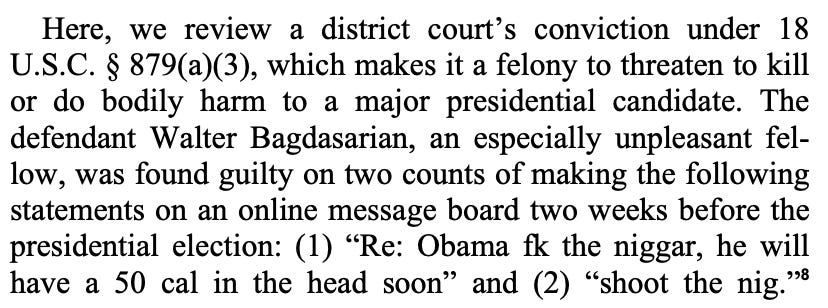
To that end, and as others have pointed to on Tuesday, the U.S. Court of Appeals for the Ninth Circuit overturned a conviction back in 2011 under a related statute — despite the charged conduct containing far more violent and direct language — when a man posted on a message board that then-candidate Barack Obama “will have a 50 cal in the head soon,“ later posted “shoot the nig,” and posted other racist, offensive language as detailed in Judge Stephen Reinhardt’s opinion for the court:
Reinhardt continued:

Why? This was key:
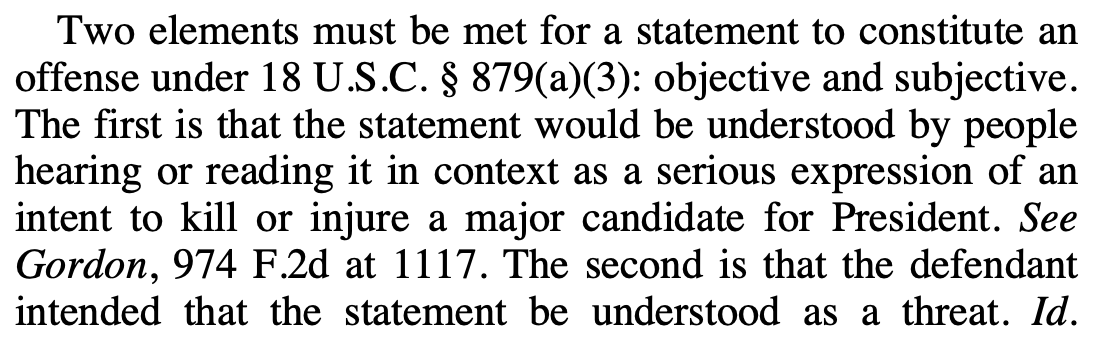
The majority there found that neither element was met.
That test, of course, is essentially what I referenced above, and, when analyzed under the “true threat” rubric — as the Ninth Circuit’s case did — it is next to impossible to see how the seashells post could be seen as a threat, either as to Comey’s intent or as to any reasonable recipient’s response to it.
The history of Trump’s attacks on Comey, DOJ’s prior efforts to indict Comey, and Tuesday’s politicized news conference all suggest the aim was to please Trump and intimidate Comey and other opposition to Trump — not to enforce the law.
For his part, Comey has already responded.

“Well, they’re back,” Comey said in a short video, adding, “I’m still innocent, I’m still not afraid, and I still believe in the independent federal judiciary, so let’s go.”
The case has been assigned to U.S. District Judge Louise Flanagan, a George W. Bush appointee.
Second Circuit blocks Trump admin mandatory detention policy
On Tuesday, the U.S. Court of Appeals for the Second Circuit blocked the Trump administration’s mandatory immigration detention policy in a unanimous panel decision that creates a circuit split, making U.S. Supreme Court review almost certain.
The opinion from Judge Joseph Bianco, a Trump appointee, was joined by both Judge José Cabranes, a Clinton appointee who also wrote separately, and Judge Alison Nathan, a Biden appointee.
As Law Dork has detailed previously:
Prior to now, the understanding of the Illegal Immigration Reform and Immigrant Responsibility Act of 1996 (IIRIRA) has been that people present in the country who were never legally admitted here are subject to a section of law that allows release and requires bond hearings (absent exceptions in the law) if the government seeks to deport them — and not a different section of law that requires mandatory detention. That second section has been applied only to “arriving aliens,” which just so happens to be the language used in that title of the U.S. Code.
Not so, said the Trump administration, which argues that everyone who was never legally admitted to the country is subject to the mandatory detention provision. The bond-hearing section, they argue, essentially only applies to people who overstay their visas.
After detailing all of that, Bianco held for the Second Circuit that on all fronts, the administration’s argument failed:
The government’s attempt to muddy these textually clear waters defies the statute’s context, structure, history, and purpose; contradicts the Supreme Court’s dicta in [an earlier immigration case] and longstanding Executive Branch practice; and its interpretation of the statute raises serious constitutional questions that should be avoided even if the statutory language were ambiguous.
This is, as Cabranes wrote in his concurring opinion, “good news.“
For now and for the Second Circuit — which includes Connecticut, New York, and Vermont — it is. For the swath of nine states from Minnesota all the way down to Louisiana within the U.S. Courts of Appeals for the Fifth Circuit and Eighth Circuit, however, the Trump administration — on two 2-1 appeals court rulings — would be allowed to carry out its mandatory detention policy.
The question on the horizon, though, is what happens when one or more of these cases get to the Supreme Court — but that will not likely come until sometime next term, which begins in October. Given where things stand with the various cases, it’s not likely that a case would even be heard until 2027.
As with most aspects of both the Trump administration and the Supreme Court, however, all of that could change tomorrow.
So reassuring that the Department of Justice is on the job protecting America from seashells and sand.
I want to know what the grand jury was told. It seems impossible they would have indicted on the flimsy BS on paper.