

Eighth Circuit, on a 2-1 vote, sides with Trump admin's mandatory immigration detention policy
The dissent, from a Trump appointee, highlighted the extreme nature of the Trump admin's policy, which has been rejected by district court judges across the country.

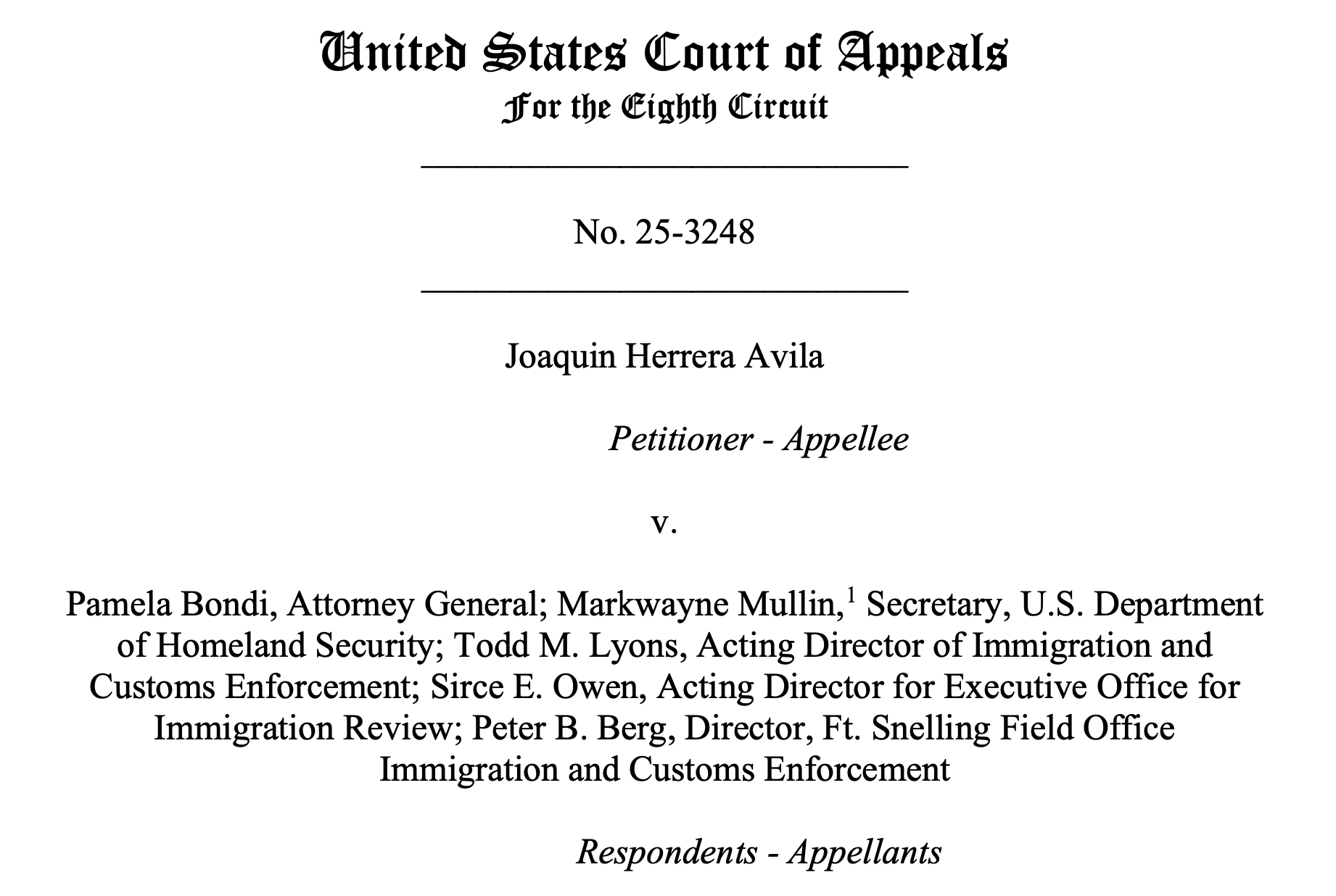
On Wednesday, in a case out of Minnesota, a 2-1 panel of the U.S. Court of Appeals upheld the Trump administration’s new interpretation of federal law to allow it to implement its mandatory immigration detention policy.
Although only a second appeals court ruling, and one that raises significant questions, it is an important win for the Trump administration that executive officials are hoping will help supercharge the administration’s effort to detain immigrants without legal status. Attorney General Pam Bondi called the decision a “MASSIVE COURT VICTORY against activist judges and for President Trump’s law and order agenda!” — and vowed, “Our attorneys @thejusticedept will never stop fighting for President Trump’s agenda.“
If it stands, the ruling would pair with a similar 2-1 ruling from the U.S. Court of Appeals for the Fifth Circuit, en banc review of which was sought on March 23, to empower the Trump administration’s immigration enforcement within much of the middle of the U.S. — including a line of states from Minnesota down to Louisiana.
At the Eighth Circuit, Judge Bobby Shepherd, a George W. Bush appointee, was joined by Judge Steven Grasz, a Trump appointee, in upholding the administration’s view that the Illegal Immigration Reform and Immigrant Responsibility Act of 1996 (IIRIRA) that requires mandatory detention of all undocumented immigrants it is seeking to deport — a view contrary to the implementation of the law since its passage.
Judge Ralph Erickson, another Trump appointee, dissented. In his dissent, he highlighted a major caveat to the ruling: the Due Process Clause. Quoting from a 2001 U.S. Supreme Court decision, he noted that “once an alien enters the country, the legal circumstance changes, for the Due Process Clause applies to all ‘persons’ within the United States, including aliens, whether their presence here is lawful, unlawful, temporary, or permanent.”
He then dropped a footnote all but encouraging district court judges within the Eighth Circuit to consider the path taken by a district court judge within the Fifth Circuit recently:

It is not immediately clear the next steps for this case. Although en banc review could be sought, the eleven active judges of the Eighth Circuit only include one Democratic appointee.
What is this?
As I’ve explained previously at Law Dork:
Prior to [the Trump administraton], the understanding of the Illegal Immigration Reform and Immigrant Responsibility Act of 1996 (IIRIRA) has been that people present in the country who were never legally admitted here are subject to a section of law that allows release and requires bond hearings [8 U.S.C. 1226] (absent exceptions in the law) if the government seeks to deport them — and not a different section of law that requires [8 U.S.C. 1225] mandatory detention. That second section has been applied only to “arriving aliens,” which just so happens to be the language used in that title of the U.S. Code.
Not so, said the Trump administration, which argues that everyone who was never legally admitted to the country is subject to the mandatory detention provision. The bond-hearing section, they argue, essentially only applies to people who overstay their visas.
As to that, Shepherd summed up the issue as such: “[T]he central inquiry is whether an alien who is an ‘applicant for admission’ is also ‘seeking admission’ under § 1225(b)(2)(A). If the phrases are equivalent, then, generally, any ‘alien present in the United States who has not been admitted’ ‘shall be detained.’”
To answer that inquiry, Shepherd largely hews to the Fifth Circuit opinion from Judge Edith Jones, a Reagan appointee and one of the furthest-right judges on the far-right Fifth Circuit.
“[W]e agree with the Fifth Circuit that the ordinary meanings of the phrases ‘applicant for admission’ and ‘seeking admission’ are the same,” Shepherd wrote, later quoting from Jones’s opinion repeatedly, including her agreement with the Trump administration that all of the evidence of past. executive enforcement under the relevant laws simply shows that “the Executive was … declining to exercise its full enforcement authority [under § 1225]” — not limits under the law.
It is important that Wednesday’s dissent came from Erickson, a Trump appointee on the Eighth Circuit. (In the Fifth Circuit, the dissenting opinion came from Judge Dana Douglas, a Biden appointee.) This is so due not only to the makeup of the appeals court specifically, but also more broadly for showing the extremism of the Trump administration’s position.
As Erickson wrote of Joaquin Herrera Avila, whose request was before the court on appeal:
For the past 29 years, Avila would have been entitled to a bond hearing during his removal proceedings. The court now holds that Avila—and millions of others—are subject to mandatory detention under 8 U.S.C. § 1225(b)(2)(A). In doing so, the court does not rely on recent Congressional action or a change in the regulations governing detention but rather engages in a novel interpretation of “alien seeking admission” that eluded the courts and five previous presidential administrations.
Erickson does not ignore the extreme position taken by the Trump administration — and his colleagues — in his dissent.
“All three branches of government understood the IIRIRA to maintain the distinction between unadmitted noncitizens in the interior and those arriving at the border for detention purposes. Five presidential administrations, including the first Trump administration, and most immigration judges interpreted § 1225 to apply only to those arriving at the border,” he noted. “This conduct is something courts ought to consider.”
Douglas and Erickson’s dissents more broadly reflect the vast majority of the district court decisions — reached by dozens and dozens of judges in courts across the nation appointed by multiple presidents from both parties — than by the four judges on two of the most conservative appeals courts to side with the Trump administration.
The Trump administration’s effort to push these appeals in two of the most conservative appeals courts in the nation, however, is likely intended to do two key things (or, at least, is being done with the awareness of these possibilities).
First, focusing appeals in more conservative circuits has increased the likelihood of creating “good law” for the administration before the question even reaches the Supreme Court. Second, to the extent the administration succeeds at the appeals court level and immigrant parties decide not to seek Supreme Court review, the administration would have wide swaths of “mandatory detention” states — and could seek to quickly move people to those states before lawsuits can be filed by individuals detained elsewhere seeking release.
Oh boy—look for the construction of privately-run permanent concentration camps! Not just for (Latino, Haitian, Somali) immigrants but for Muslims too (the new Sharia Free America caucus), uppity Negroes, LGBTQ, and anyone the wrong color, religion or gender.
There is a part of me that thinks all of this is tied to their grift. More detainees means greater need for additional facilities which lines his friends' pockets.