

California case over trans students' privacy rights heads to appeals court
An administrative stay on Friday blocked a district court ruling that would upend state protections. Also: Law Dork 2025 thoughts. And, for paid subscribers: Closing my tabs.

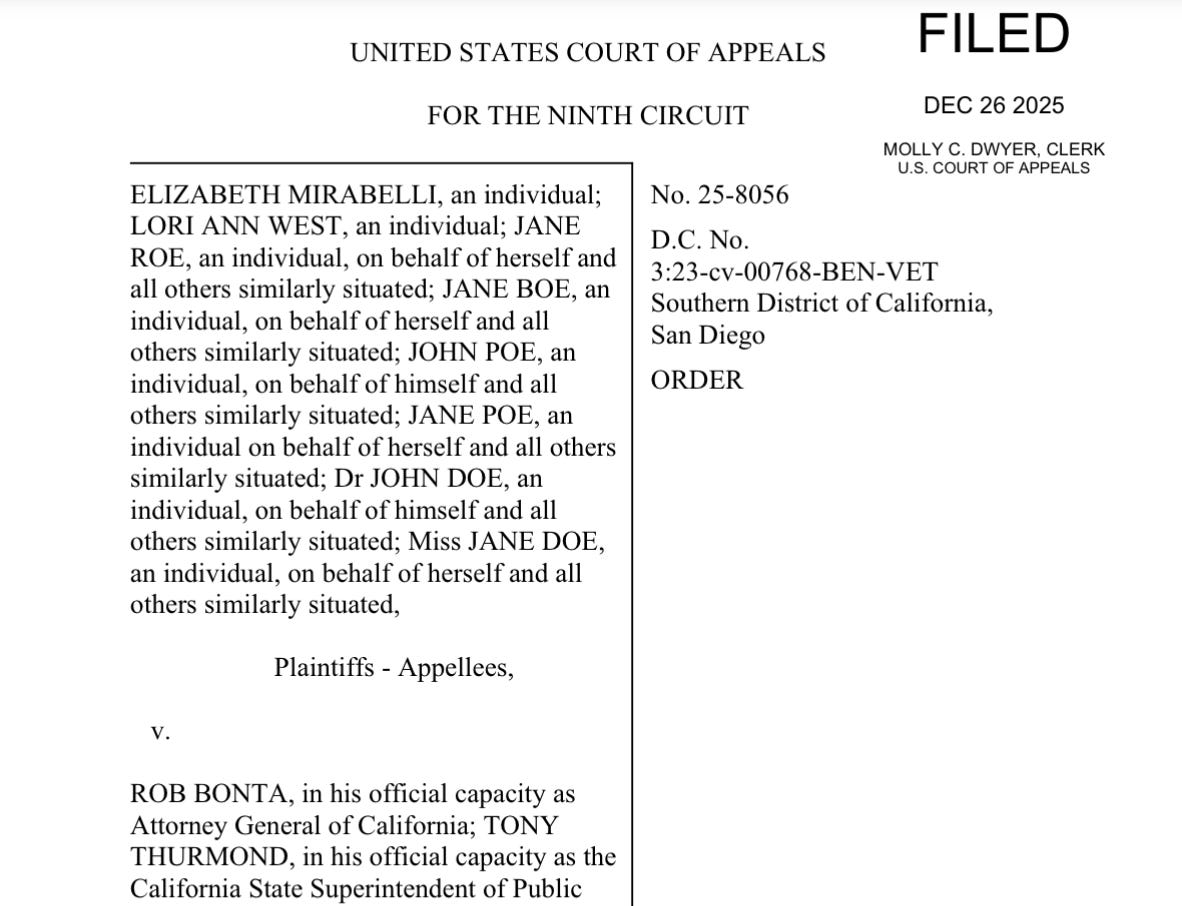
A long-pending case in California over policies preventing school officials from sharing information about a child’s gender identity with the child’s parents without the consent of the student has moved forward significantly over the past week — with further action likely to come early in the new year.
After a federal judge’s ruling last week threatened to upend that state policy, the U.S. Court of Appeals for the Ninth Circuit on Friday issued an administrative stay blocking the district court ruling while it considers the state’s stay request. (I first saw news of the Ninth Circuit’s administrative stay from Erin Reed, who covered it earlier Sunday.)
After a preliminary injunction had been entered back in 2023 regarding the Escondido Union School District’s policy, the case expanded to include a full defense from the state, as class-action litigation had proceeded in the time since.
On December 22, U.S. District Judge Roger Benitez issued a summary judgment ruling and class-wide permanent injunction that would effectively turn the student-focused policy on its head, requiring school officials to inform parents of any “gender incongruence” expression if such information is sought and allowing teachers to do so even if the parents aren’t seeking the information:
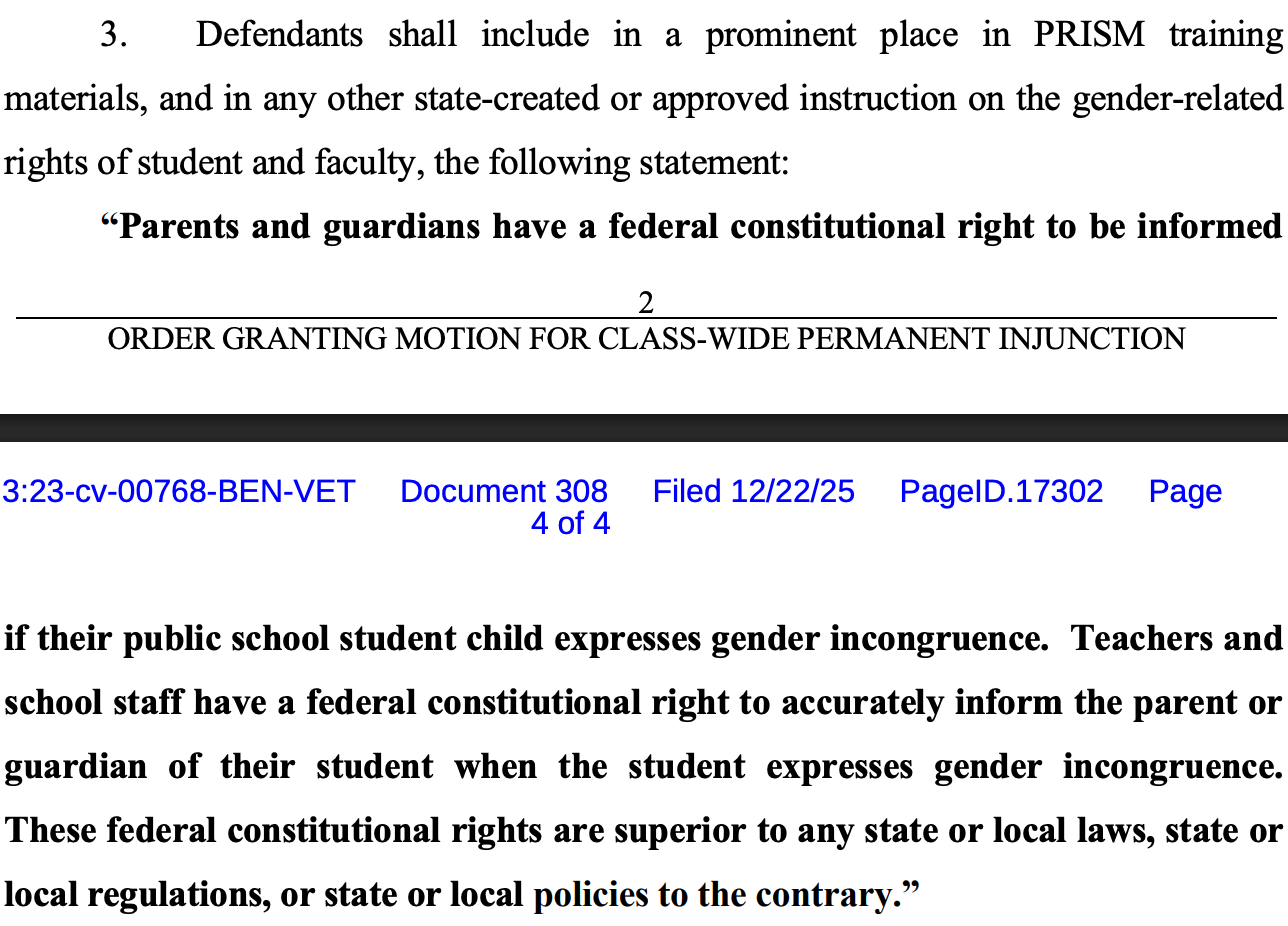
Additionally, among the provisions in the class-wide injunction, Benitez would prohibit the state from implementing any policy “in such a manner” as to:

This is outright lawmaking from the bench, although it’s not a big surprise coming from Benitez — best known for striking down California gun laws but also reprimanded previously for “ordering a U.S. marshal to handcuff a 13-year-old girl to scare her into not doing drugs and to avoid becoming a criminal defendant like her father,“ as Reuters’s Nate Raymond reported in 2024.
After Benitez also denied a stay of his ruling in the school policy case pending appeal, the state went to the Ninth Circuit. A three-judge panel — consisting of Chief Judge Mary Murguia (Obama) and Judges Andrew Hurwitz (Obama) and Salvador Mendoza (Biden) — issued the administrative stay on Friday.
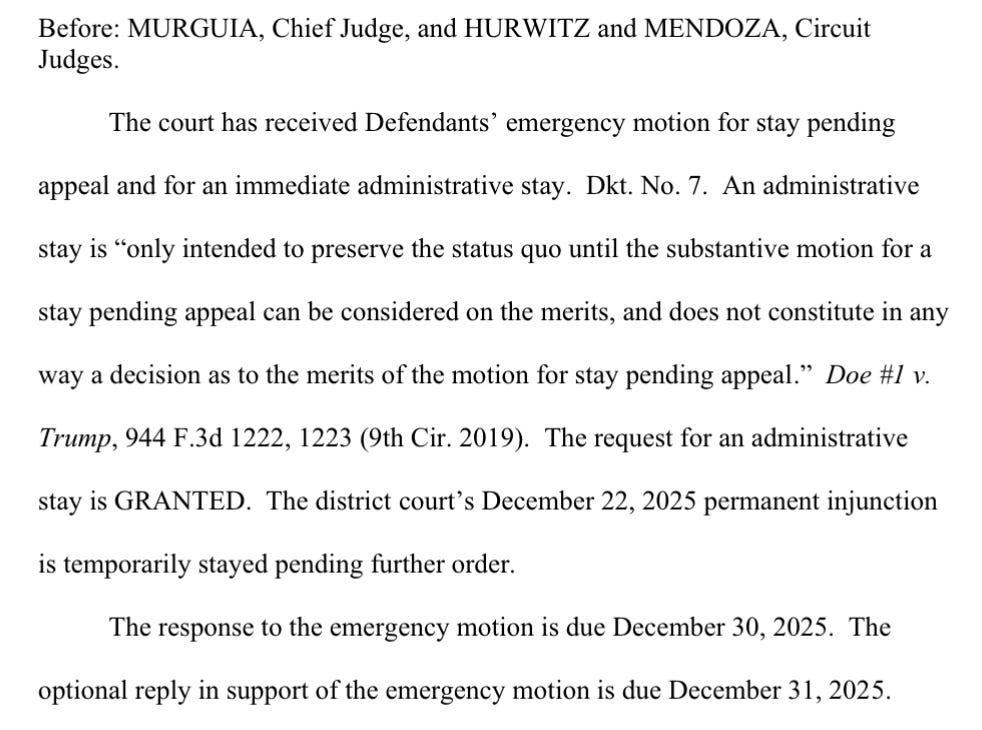
The panel also set a quick timeline for briefing on the stay request, ordering a response to be filed by the plaintiffs by Tuesday and any reply to be filed by Wednesday.
A Law Dork look at 2025 — and thanks
Depending on what happens over the next few days, I will have published about 250 posts at Law Dork this year — a big increase on the roughly 150 posts I had originally envisioned publishing here each year when I launched back in June 2022.
Thus far in 2025, I’ve published 229 posts since President Donald Trump took the oath of office and returned to the presidency on January 20, in addition to 16 posts here before then this year — from the birthright citizenship executive order on day one and the lawsuits challenging it that immediately followed to the Alien Enemies Act to the law firm executive orders to the National Guard deployment efforts to impoundment to firings to the boat-strike murders through to my Christmas Day coverage of a court order pushing back at the anti-transgender attacks of this administration (with too much to recount in between).
I also have covered the U.S. Supreme Court throughout 2025 — a difficult time for covering the court, a time when precedent and procedure seem less and less important to the Republican-appointee majority as Trump, the Justice Department, Republican-led states, and right-wing advocacy groups seek to push the law further and further to the right or directly into authoritarianism.
Perhaps Justice Sonia Sotomayor put the challenge of 2025 for the left and those otherwise opposed to Trump’s authoritarian project into sharpest focus in dissenting to a shadow docket order allowing the Trump administration to “effectively dismantle“ the Education Department. “When the Executive publicly announces its intent to break the law, and then executes on that promise, it is the Judiciary’s duty to check that lawlessness, not expedite it,“ she wrote in July.
Of course, the Supreme Court did step in this week to continue blocking Trump’s National Guard deployment effort in Illinois and make clear that his larger efforts to send troops into American cities will face skepticism from the court. Such moments — though few and far between, in 2025 at least — have provided some sign of limits that the court appears to be willing to place on Trump in service of their larger aims.
I’ll be writing more about that — about where the court, government, nation, and even world have been in 2025 and could be going in 2026 — later this week, but I just wanted to take a moment this weekend to look at Law Dork — and thank all of you for joining me.
It has been a complicated time and will continue to be so, but Law Dork has provided me with exactly what I think I need now: A platform that gives me the freedom to cover the stories that I think need to be told; the ability to report on the news how I think it needs to be reported; the capacity to publish when — and with the context that — I think is necessary; and the space to tell you — and the world — what I think matters about what we’re living through.
I can’t imagine having covered this year — or covering next year — anywhere else.
Thank you for making this possible with your subscriptions and support, your news releases and phone calls and messages, your willingness to share stories with me about what the government is doing in our name. And, thank you to my friends and family, for their support.
Closing my tabs
For those who don’t know what this is, it’s my effort to give a little thank you to paid subscribers. “Closing my tabs” is, literally, me looking through the stories and cases open — the tabs open — on my computer and sharing with you all some of those I was unable to cover during the week but that I nonetheless want to let you know that I have on my radar. Oftentimes, they are issues that will eventually find their way back into the newsletter as a case discussed moves forward or something new happens that provides me with a reason to cover the story more in depth.
This Sunday, these are the tabs I am closing:
