

Federal prison officials face civil contempt hearing, as ICE is threatened with criminal contempt
Orders from two Republican judicial appointees Thursday show greater willingness to push back with increasingly harsh tools in the face of continued Trump admin lawlessness.

A federal judge has ordered the warden of a federal prison in North Carolina to explain by Tuesday why he shouldn’t be held in civil contempt over claims that a transgender woman is facing harsh retaliation for her involvement in a lawsuit against the Trump administration.
The order from U.S District Judge Royce Lamberth came after a hearing in which the Reagan appointee dressed down the Justice Department lawyer representing the Trump administration for his lackluster response to ongoing questions about retaliation against witnesses in ongoing federal litigation challenging the Trump administration’s treatment of transgender people in prison.
“You don’t know anything. There’s nothing to ask you,“ Lamberth — who has been on the bench for more than 38 years — told the Justice Department’s Jared Littman, questioning whether Littman even cares about the claims against the government.
“It’s not that I don’t care,“ Littman responded meekly, telling the judge that he is working with the Federal Bureau of Prisons to carry out the court’s orders.
Lawyers for the plaintiffs had alleged on Wednesday that one of their clients, Grace Pinson, has faced retaliation in the days since Lamberth issued an order specifically barring any further retaliation against plaintiffs or witnesses in the case.
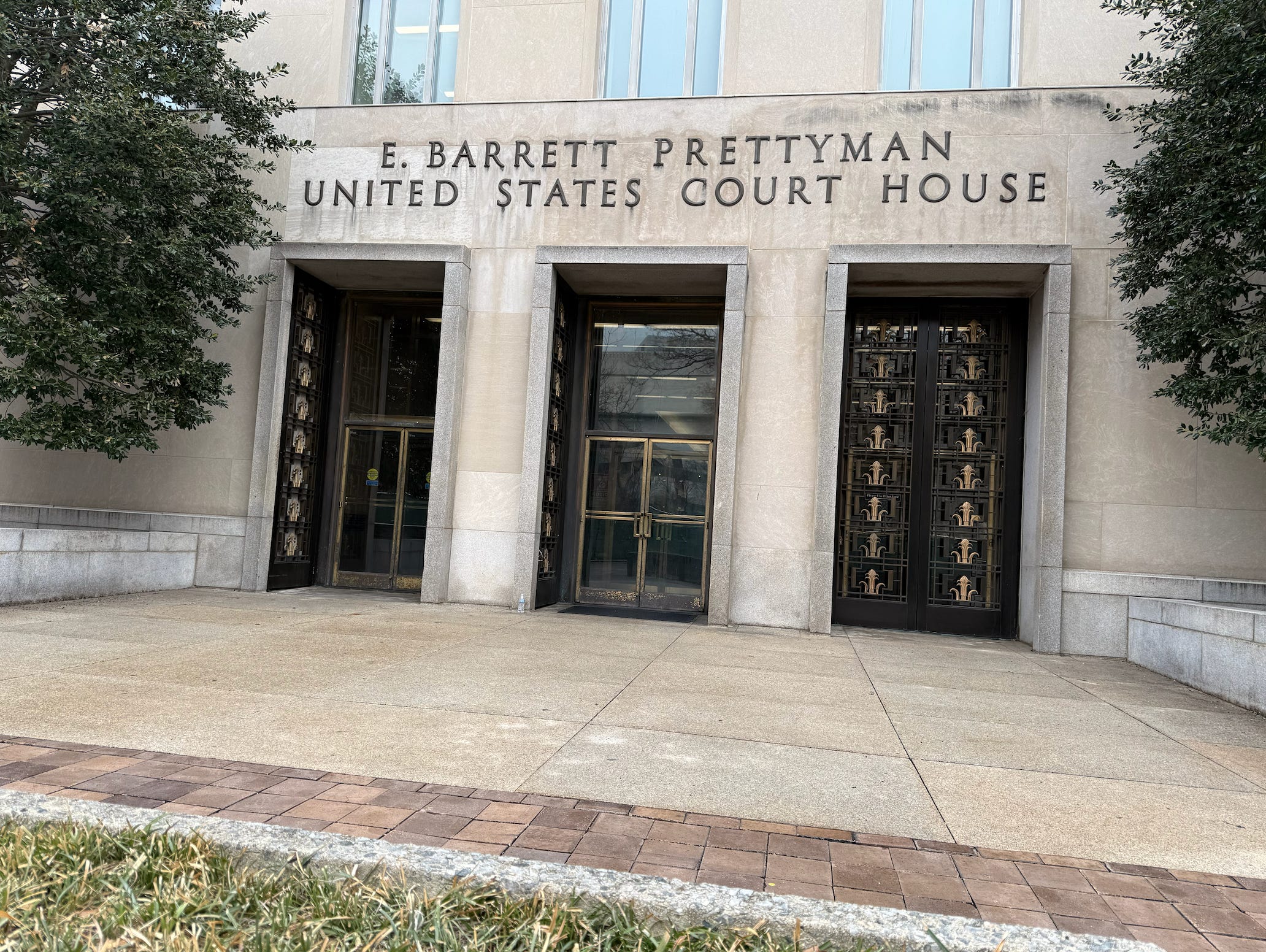
Lamberth quickly responded, on Thursday morning calling the parties together for an in-person hearing at 2:30 p.m. Thursday on the sixth floor of the E. Barrett Prettyman Courthouse.
After brief opening statements from Michael Perloff from the ACLU of DC for the plaintiffs and Littman, it didn’t take long for Lamberth, who has blocked significant parts of the Trump administration’s efforts to restrict trans inmates’ rights over the court of the past year, to get to the heart of the matter.
Noting that Littman “didn’t have the facts” regarding the alleged retaliation at the hearing on February 19, which had led Lamberth to issue the protective order barring any further retaliation, Lamberth told Littman, “You still don’t know the facts.”
When Littman repeated a claim he provided in his opening statement — that there is an internal investigation ongoing into the retaliation claims — that set off Lamberth.
“I’m not going to depend on an internal affairs report,“ he shot back, repeating that he wants to know the facts and reminding Littman — as he had noted at the hearing on February 19 — that if the allegations from the plaintiffs’ lawyers are true, the action represents “blatant disregard of this court.”
When Littman said he didn’t know the name of the warden at FCI Butner, where Pinson is in custody, that appeared to be a further turning point. Lamberth went on to muse whether the warden has “turned a blind eye“ to the retaliation against Pinson, which has been detailed in declarations provided in status reports in the case dating back into 2025.
In an abrupt moment before he took a recess, Littman told Lamberth that DOJ is planning to seek reconsideration of Lamberth’s February 19 protective order. Lamberth shot a sharp look to Littman, almost rhetorically asking whether Littman actually thought that — in light of the most recent filing and Thursday’s hearing — “I’m going to reconsider“ that order.
In his reply, Perloff added to the initial show cause request, moving on the spot for a temporary restraining order to protect Pinson and Elmer Armando Moreno, Pinson’s former roommate who also submitted a declaration in Wednesday’s filing, under the Eighth Amendment. Perloff asked for Pinson to be moved to a halfway house, as he said was earlier planned, and for Moreno to be returned to the prison’s general population. Alternatively, Perloff sought a “detailed plan“ be produced for how Pinson and Moreno would be protected.
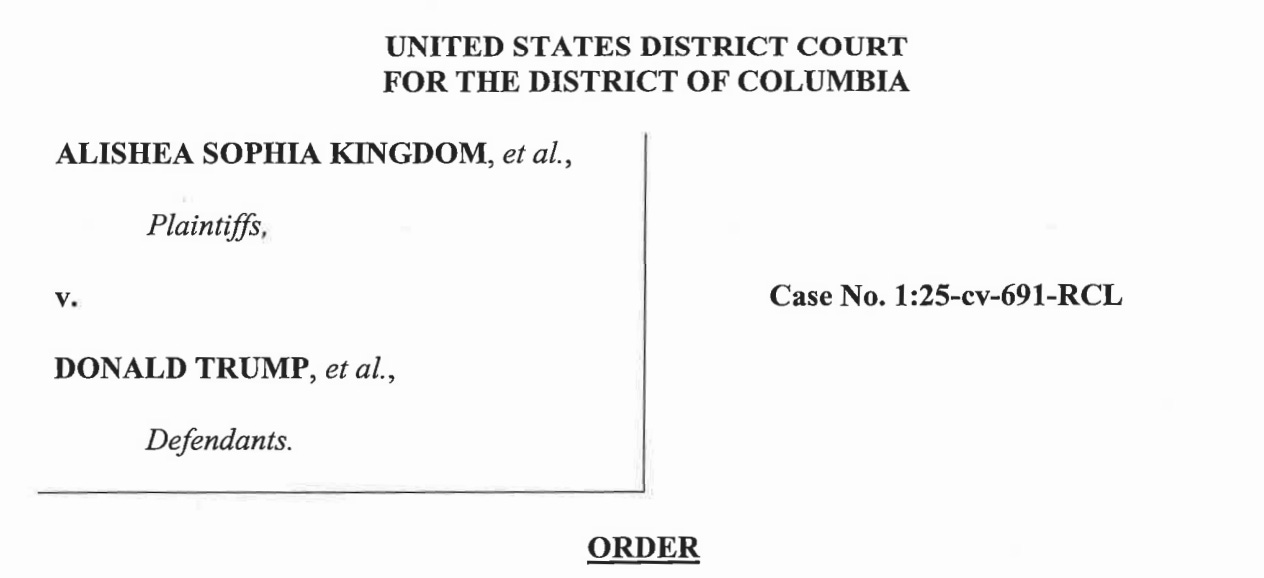
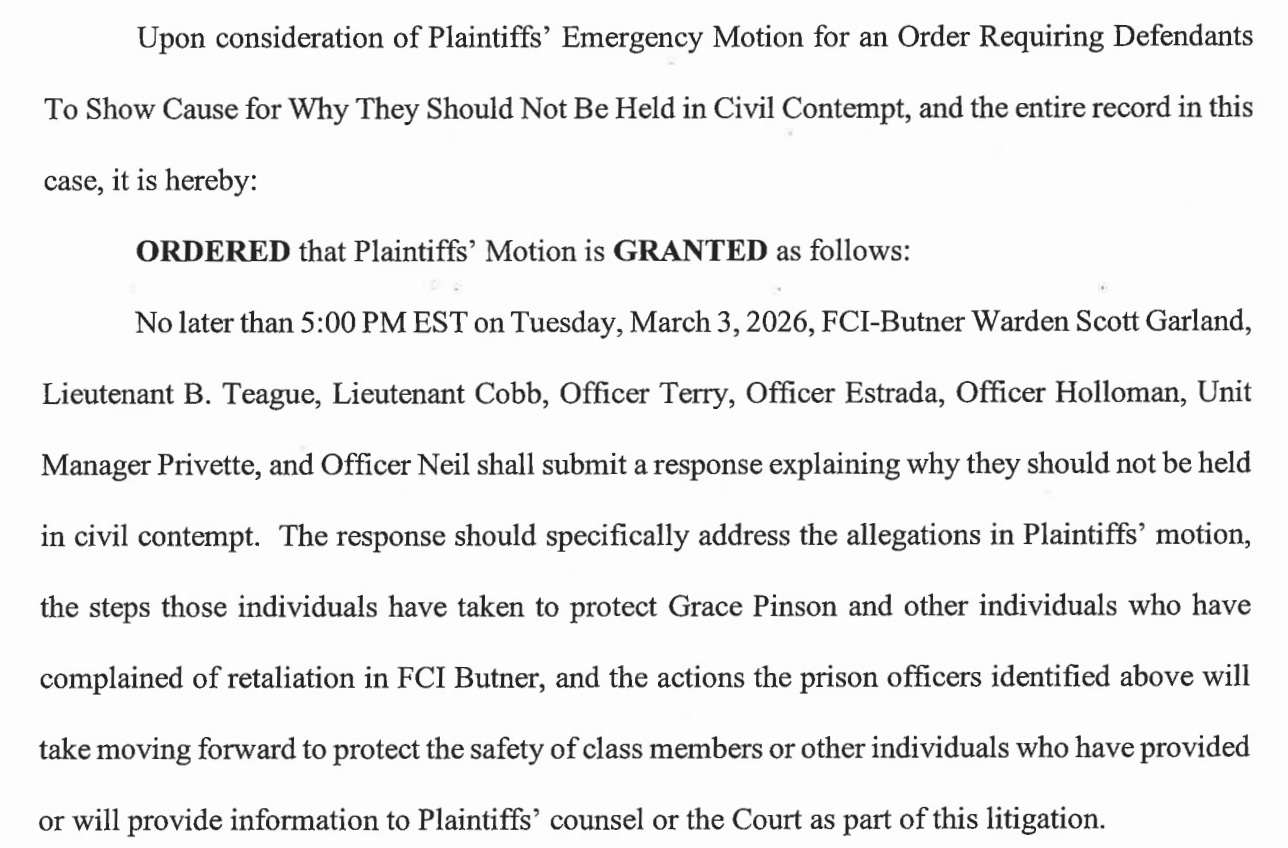
After a recess, at the conclusion of the hearing, Lamberth granted the motion to show cause, ordering the Warden Scott Garland, along with all of the prison’s employees named in the plaintiffs’ filing, to respond to the claims by Tuesday and explain why they should not face civil contempt, with a hearing set for 11:00 a.m. Wednesday.
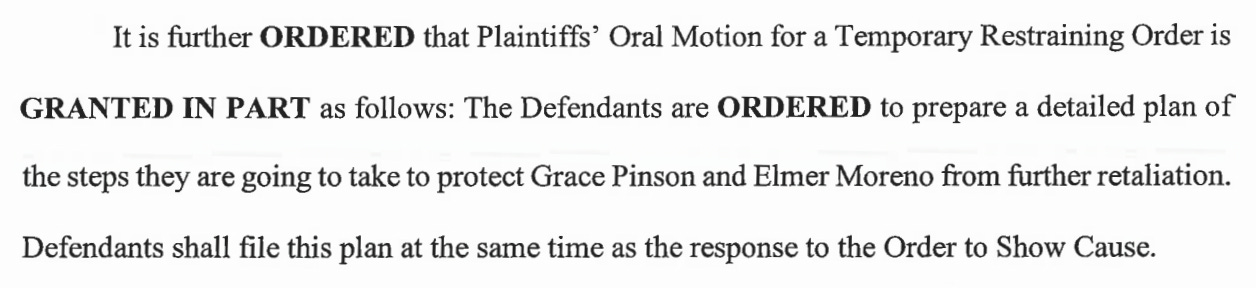
Lamberth also partially granted the TRO request, ordering that the “detailed plan” be submitted by Tuesday as well.
In the days before that plan can be presented and approved, Perloff asked to ensure ready communication with Pinson. As to that, Lamberth told the parties to reach an agreement on how to do so by Friday morning or to present proposals and said he would rule by noon Friday on that.
It was a remarkable hearing, highlighting just how far the Trump administration — and, specifically, the Justice Department — has fallen in the eyes of the courts.
Not only was a show cause order issued less than 24 hours after a motion was filed, but a TRO requested in the final minutes of arguments was partially granted.
No, these are not — in and of themselves — solutions. But they are steps, and Littman, and the two other Justice Department attorneys who made appearances, Jean Lin and Alex Yun, are on notice.
And, as another step halfway across the country on Thursday showed, first steps can lead to further steps.
Judge Schiltz’s latest step
Just shy of a month ago, U.S. District Judge Patrick Schiltz in Minnesota published a list of “96 court orders that ICE has violated in 74 cases“ in conjunction with an order in one of the countless habeas corpus cases Minnesota judges have been fielding in the wake of Operation Metro Surge.
The order from Schiltz, a George W. Bush appointee who has written repeatedly about ethics and the law, made a splash and was followed soon thereafter by the hearing before another federal judge in Minnesota in which a government lawyer acknowledged that “the system sucks.“
U.S. Attorney Daniel Rosen, a Trump appointee in Minnesota who had no prosecutorial experience before taking office in October 2025, did not like Schiltz’s order.
In a supplemental order issued Thursday, Schiltz — who will have been on the bench for 20 years this April — announced, “Unfortunately, the government’s response to the Court’s order was not to do a better job complying with court orders, but instead to attack the Court.” Via a February 9 email, Schiltz wrote on Thursday, Rosen “accused the Court of wildly overstating the extent of ICE’s noncompliance with orders.“
How did Rosen draw this conclusion? He surely reviewed the 96 orders in the 74 cases, right?
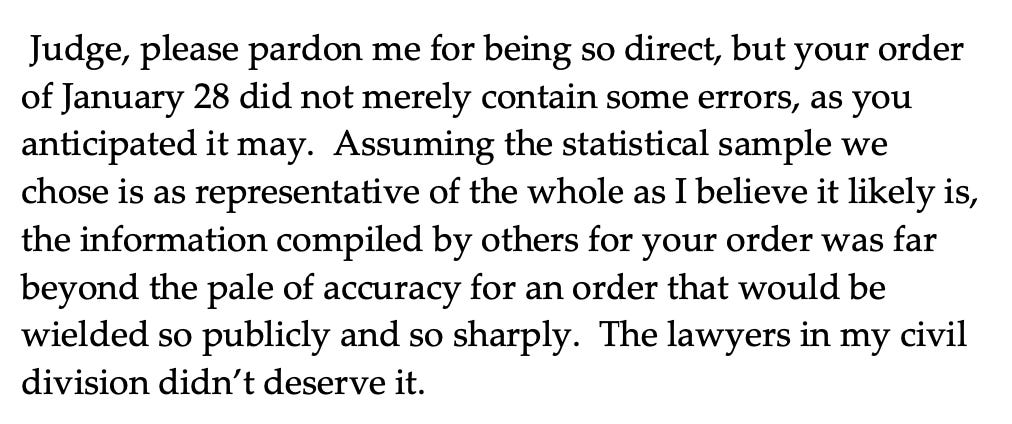
No. Instead, as Schiltz wrote on Thursday, “Rosen said that he had asked a lawyer in his office to review ‘a statistically strong sample of the 75 cases’ listed in the appendix to the Court’s January 28 order. That ‘statistically strong sample’ consisted of the first 12 cases on the list.“
Rosen then put in his email to Schiltz the following:
On Thursday, Schiltz responded — publicly.
“Because Rosen made serious allegations against the undersigned and the other judges of this District, the undersigned asked each judge to revisit the cases that he or she had submitted for inclusion in the appendix,“ which was then further reviewed by Schiltz’s clerks, the judge wrote, leading to a new Appendix A. Acknowledging the the original list did include “some mistakes,” Schiltz wrote that it “cut both ways.”
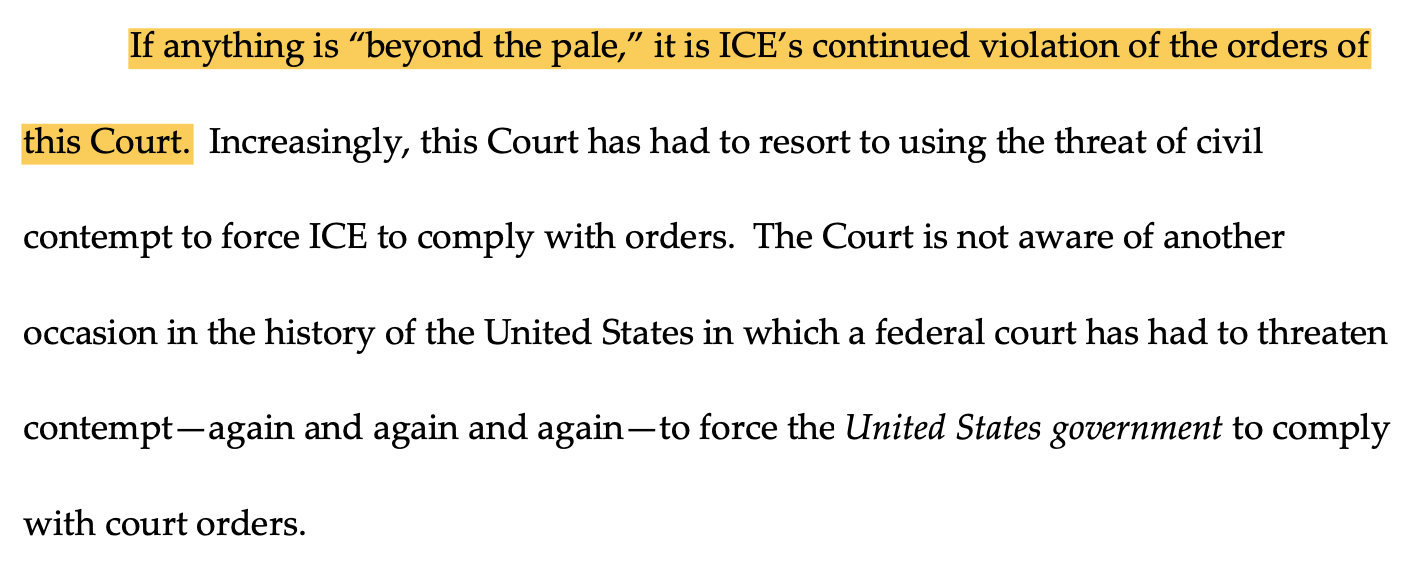
“[T]he bottom line is that ICE violated 97 orders in 66 of the cases referred to in the January 28 order,“ Schiltz explained, instead of 96 orders in 74 cases, as initially stated. “Obviously, the January 28 order was not ‘beyond the pale of accuracy,’ as claimed by Rosen.“
Schiltz was not done. Noting that Rosen also told him in the email that “efforts we have already been undertaking for weeks have led to considerable improvement—efforts which have apparently gone unrecognized by some on the bench, even though the numbers prove them out,“ Schiltz responded.
“This, too, appears to be untrue,” the judge wrote, providing Appendix B. “Appendix B documents 113 additional orders that ICE has violated in 77 additional cases—again, above and beyond the 97 orders that ICE violated in the 66 cases identified in Appendix A,“ Schiltz explained.
Summing up this supplemental order, Schiltz wrote:
Looking forward, Schiltz made it clear that he is not done:
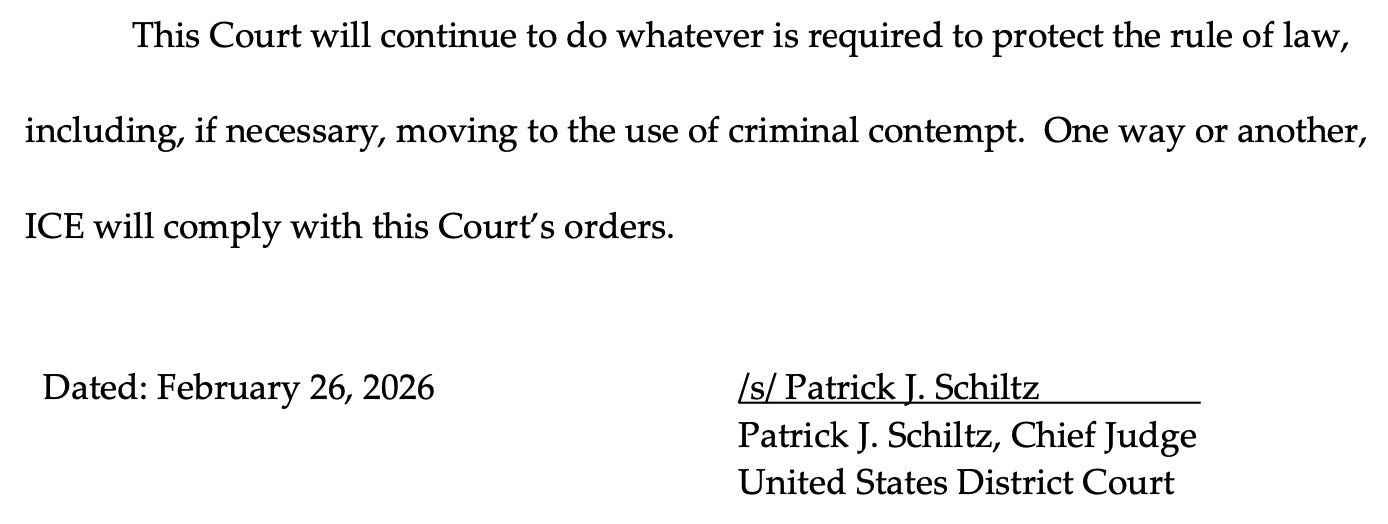
It is a statement that would have been almost impossible to imagine even a few years ago. Except, perhaps, for Schiltz, who wrote before the start of the new millennium about the problems facing lawyers and the legal profession. “The legal profession will be no happier or healthier until more lawyers bring better perspective to their lives,“ he wrote in the Minnesota Law Review in 1999.
As an academic, he wrote then of teaching character to law students, “We can do it well, or we can do it poorly. We should choose to do it well.”
Schiltz may not have realized how strongly he would be called upon to live out those words later in his life, but he does appear to be ready for the task.
In my many years litigating in Federal courts, I saw on some few occasions some inexperienced lawyers out of their depth. I never saw this degree of bad lawyering, unethical conduct and disregard for the responsibilities members of the bar owe the courts and their profession.
ICE is used to working with immigration judges who are political appointees and employees of the executive branch, and who generally function as part of the prosecution team. They seem truly stunned to have to deal with real judges who care about fair and neutral application of the law.