

The Trump administration's authoritarian house of cards is starting to fall down
Kilmar Abrego Garcia is "[o]n his way home." Another grand jury rejected DOJ's effort to indict Letitia James. And, Indiana Republicans said no to Trump's redistricting pressure.

It’s not over. Not by a long shot. It could — and likely will — still get worse on many fronts in many ways before this is all over.
But, on Thursday, a series of developments only connected insofar as they are pieces in President Donald Trump’s authoritarian project show the reality: Trump’s authoritarian gambit is a house of cards.
The power Trump and allies are seeking is real — but so much of the power they claim to already have is imagined.
It’s sleight of hand pushed out by lawless executive orders, by visuals like Gregory Bovino stormtrooping into city after city, and by social media tirades. Trump is a worn-out magician who still has die-hard fans but is losing his ability to keep the audience under his spell. And though House Speaker Mike Johnson is Trump’s eager assistant in Congress and the Supreme Court’s Republican appointees appear at times to be little more than Trump’s plants in the judicial branch, the cards are starting to fall.
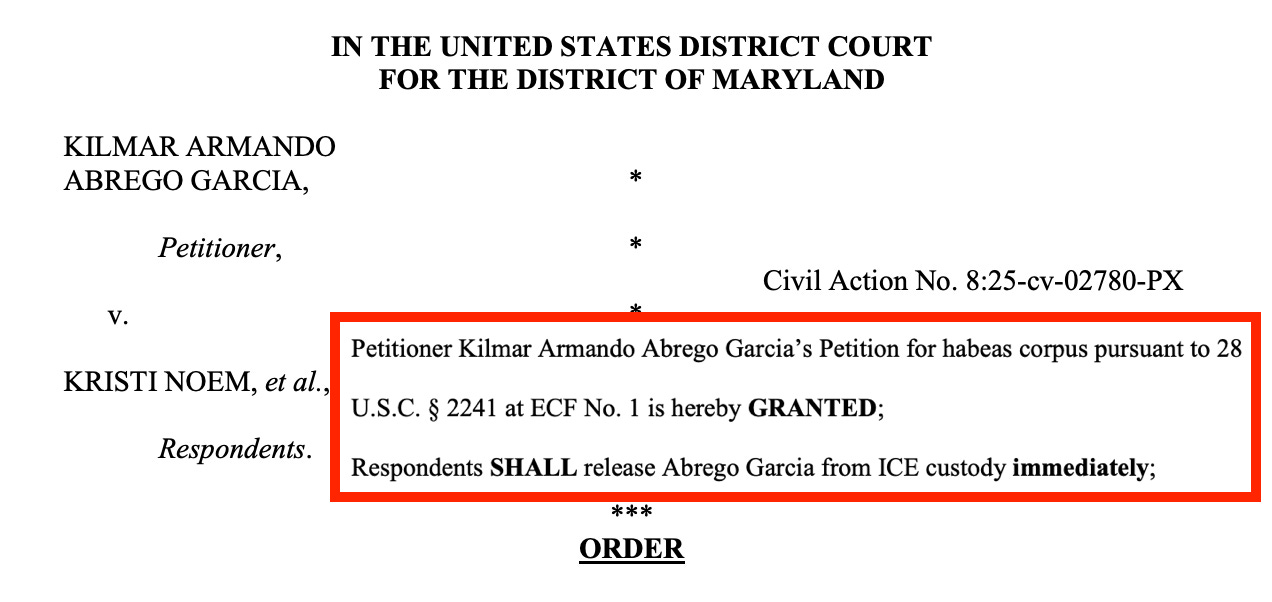
On Thursday morning, U.S. District Judge Paula Xinis ordered the immediate release of Kilmar Abrego Garcia from ICE custody.
By close of business, his lawyer told NBC News that Abrego Garcia had been released from custody.
One of Abrego Garcia’s lawyers in his criminal case confirmed the news to Law Dork.
“On his way home.”
Abrego Garcia was sent to El Salvador’s CECOT prison on March 15 in what the administration initially acknowledged was an “administrative error” — because an order existed barring his deportation to El Salvador. He was returned to the U.S. only after DOJ secured a questionable — and challenged — indictment against him for past conduct in Tennessee. After being released from being held on those charges, he was shortly thereafter detained by ICE, where he was as of Thursday morning when Xinis ruled on his habeas corpus petition.
Xinis ultimately determined that Abrego Garcia “has been held without a removal order, and thus without lawful authority.” She also held that the Trump administration’s repeated efforts (or, more accurately, claims of intention) in recent months to send Abrego Garcia to various African nations — despite Costa Rica having been willing to accept him — provided further support for her decision ordering his release on Thursday. She wrote:
[The government’s] persistent refusal to acknowledge Costa Rica as a viable removal option, their threats to send Abrego Garcia to African countries that never agreed to take him, and their misrepresentation to the Court that Liberia is now the only country available to Abrego Garcia, all reflect that whatever purpose was behind his detention, it was not for the “basic purpose” of timely third-country removal [as required by law].
Yes, “misrepresentation” is a significant word for a judge to use — and Xinis was aware of that. As to the Liberia removal effort, specifically, she wrote, “[W]hen the Court sought information about Liberia and Costa Rica so to fairly assess the validity of Abrego Garcia’s claims, Respondents did not just stonewall. They affirmatively misled the tribunal.“
Earlier, she had laid out specifically what the Trump administration did in that regard:
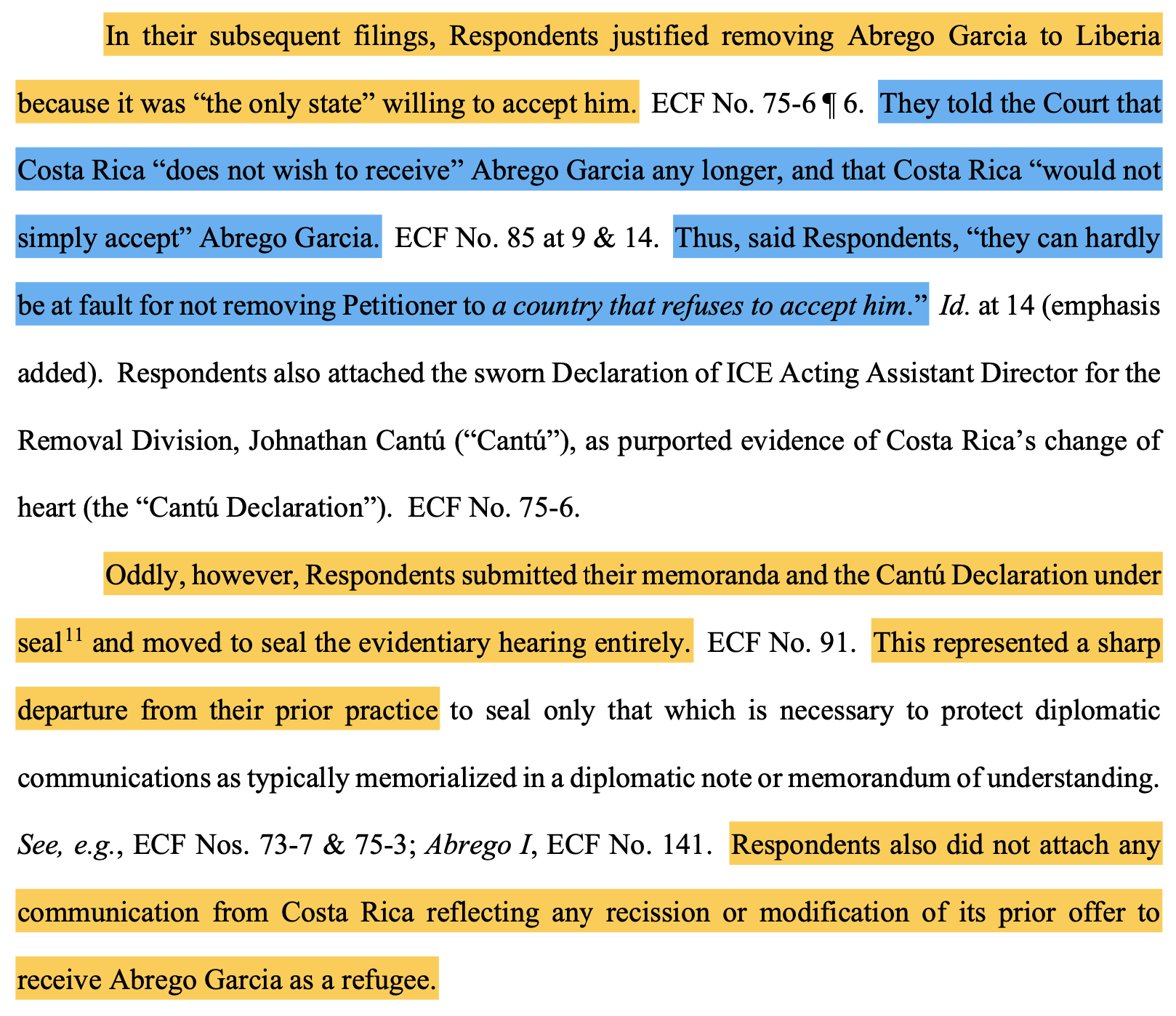
She went on to detail the testimony Cantú later gave in the case, in which “Cantú candidly admitted, for example, that he had no prior involvement in Abrego Garcia’s case and spent approximately five minutes preparing to testify.“ This, Xinis wrote, was further evidence that the Trump administration had “defied this Court’s orders“ in Abrego Garcia’s case.
Although that evidence was used on Thursday for the purpose of deciding Abrego Garcia’s habeas petition, Xinis also made clear she is not done with the Trump’s administration’s actions in this case.
In a footnote, she stated that there will be more to come:

Meanwhile, Erez Reuveni, the since-fired DOJ lawyer who was the lawyer originally appearing for the Trump administration in the Abrego Garcia case before Xinis, has become a whistleblower since his firing. He is set to testify on Monday in front of Chief Judge James Boasberg’s contempt proceedings regarding the March 15 Alien Enemies Act flights that took off the same day as Abrego Garcia was sent to El Salvador.
Nine months ago Friday, Abrego Garcia was pulled over by ICE agents and arrested for no credible reason detailed by the government — a point made by Xinis on Thursday.
On Thursday, however, his legal team told NBC News around 5:00 p.m. that he was out of ICE custody.
“He has left the center,“ they told NBC News.
That alone is notable given the way the administration fought — up to the Supreme Court and through several more rounds in the lower courts — to keep Abrego Garcia from even returning to the U.S.
Cards. Falling.
But, there was much more happening on Thursday.
Another no bill
In the early afternoon, news broke that DOJ — again — could not get a grand jury to indict New York Attorney General Letitia James.
The Washington Post’s lede said it all:
The Justice Department once again failed to persuade a grand jury to indict New York Attorney General Letitia James, an embarrassing loss for a law enforcement agency that has repeatedly tried to charge the president’s foe in a mortgage fraud case that career prosecutors have long viewed as weak.
As Abbe Lowell, James’s lawyer — referencing the dismissal of the initial indictment and last week’s failure to secure a second indictment — said in a statement: “This case already has been a stain on this Department’s reputation and raises troubling questions about its integrity. Any further attempt to revive these discredited charges would be a mockery of our system of justice.”
Of course, they very well might do so. But, on Thursday, it was another no bill.
Cards. Falling.
Finally — for now — news came out of Indiana around the time Abrego Garcia was leaving ICE detention.
No redistricting in Indiana
Republicans in the Indiana Senate rejected Trump’s efforts to force a mid-decade, political redistricting — ignoring far-right threats as they did so.
The Indianapolis Star’s key liveblog update was as ground-shifting as it was concise:
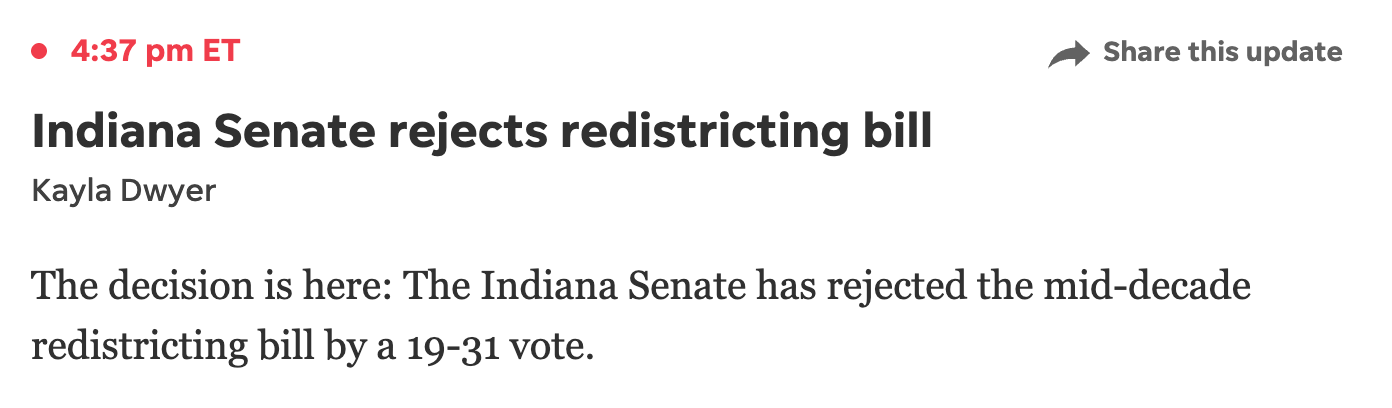
Although other states have gone along with Trump’s machinations, and although the U.S. Supreme Court allowed Texas’s new map to be used in 2026, more than enough Indiana Republicans said no to Trump that he did not get his way in the Hoosier state.
Not only did the full chamber vote down the bill to allow the redistricting, but, as The New York Times reported, a majority of the Republicans in the Senate voted against the effort. It was a bare majority — 21-19 — but a majority it was.
Cards. Falling.
Also Leader Thune and Dean of the Senate Grassley rebuked President Trump’s call for eliminating the blue slip. I think this has been the single worst day for the administration.
The Indiana vote was a genuine shock and about the last thing I would have expected. Hopefully it's a harbinger.