

The Trump admin DOJ went to a secretive deportation court this week
After the first hearing ever convened by the Alien Terrorist Removal Court, the judge concluded DOJ still had more work to do to make its case. Also: Law Dork on MS NOW.

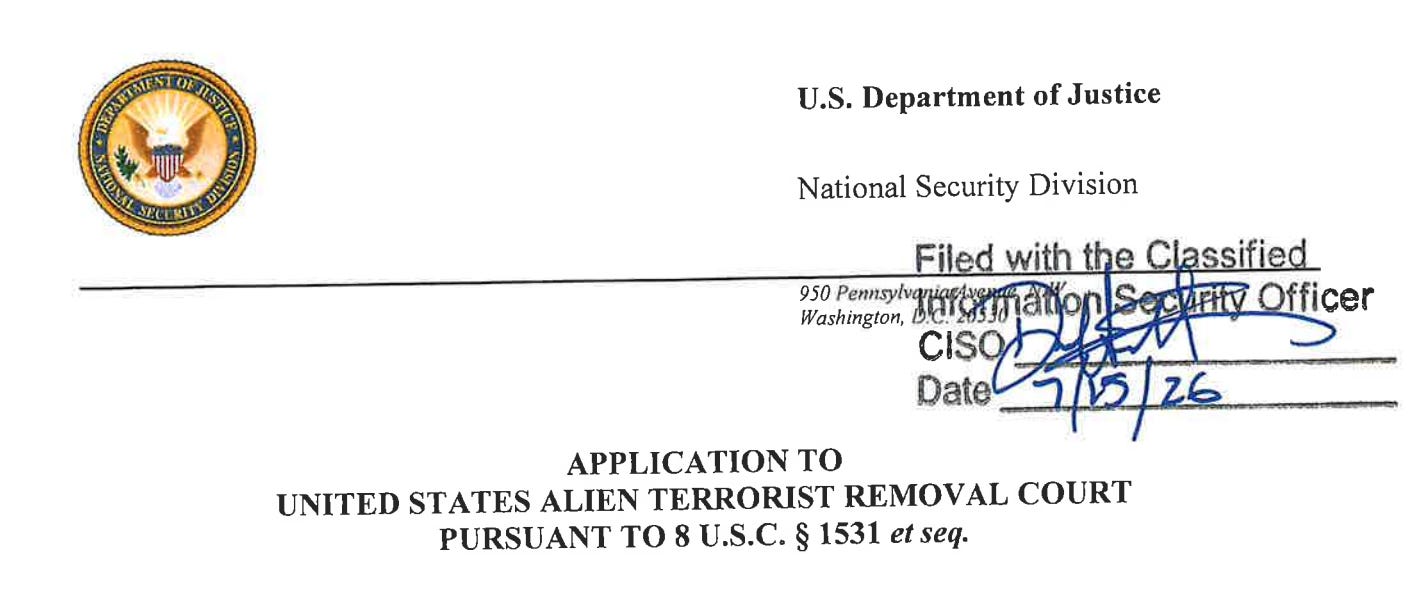
More than 30 years after the Clinton administration successfully pressed Congress to give it more authority to use classified information to deport people it suspected of terrorism, the Trump administration took the first case to the Alien Terrorist Removal Court this past week.
Under the law, the Justice Department’s application to the court is submitted under seal and without notice to the person who they are seeking to deport.
In this first application ever filed to the ATRC, the federal judge assigned to sit on the court concluded after a July 16 hearing that the administration had more work to do — despite the substantial powers given to the administration under the law that established the court.
The application, which requires a certification from the attorney general or deputy attorney general that the requirements of the law are met, was submitted to the court on July 15 — the same day that Deputy Attorney General Todd Blanche, the acting attorney general and President Donald Trump’s nominee for attorney general, was testifying before the Senate Judiciary Committee regarding his nomination.
On Friday night, Seamus Hughes — who runs CourtWatch — caught the filings and later wrote about it here. Over at Politico, Kyle Cheney and Josh Gerstein followed with a report earlier Saturday.
The court — created as part of the Antiterrorism and Effective Death Penalty Act of 1996 (AEDPA) — consists of five district court judges who are selected by the chief justice. Under the law establishing the ATRC, the Justice Department needs to show three elements to proceed to a removal hearing and they need to be certified to “by the Attorney General or the Deputy Attorney General.” They are:
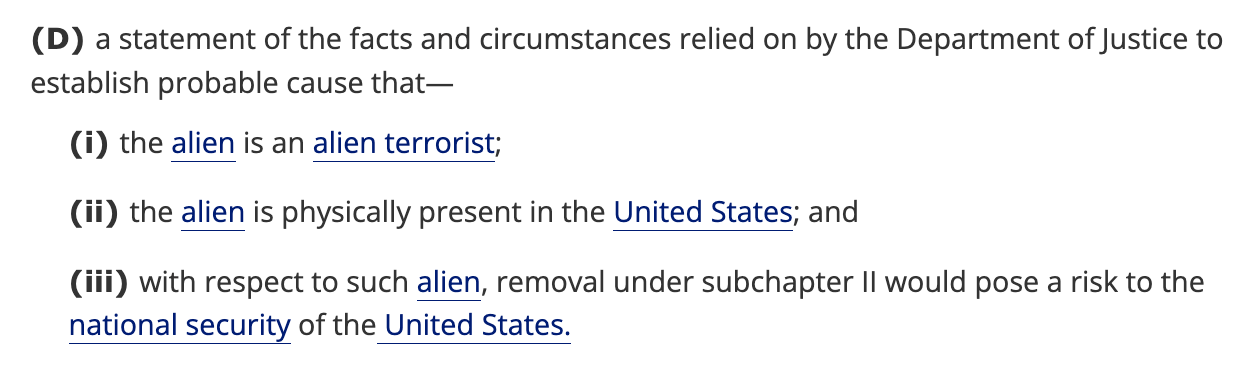
“An application under this section shall be submitted ex parte and in camera, and shall be filed under seal with the removal court,“ the law continues.
If a judge on the court “finds that there is probable cause to believe“ that DOJ showed those three items, then they “shall” grant the application, which then leads to an “expeditious” and “public” removal hearing at which the person who is targeted for deportation does have some limited rights. If the judge denies the application, they are to “prepare a written statement of the reasons for the denial.“ Any appeals go to the U.S. Court of Appeals for the D.C. Circuit.
But, again, the court’s jurisdiction had never been invoked until July 15.
There is a good reason for that: Many people have thought that the law created an unconstitutional court, at least in some circumstances. One of the first law review articles published about the law, from David P. Kopel and Joseph Olson, opened with a not-so-subtle quote:

The quote comes from Leo Tolstoy’s War and Peace. Substantively, the article, “Preventing a Reign of Terror: Civil Liberties Implication of Terrorism Legislation,” went on to detail concerns with the ATRC, including that “[n]o evidence may be excluded because it was illegally obtained, no matter how flagrantly the law was broken.”
As even a 1998 Senate majority staff report, issued under Republican Sen. Jon Kyl, acknowledged — while criticizing DOJ’s “failure” to use the court even then as “disappointing” — “the wrong case“ brought to it “could mean the constitutional nullification of the ATRC.“

The report went so far as to detail, via footnote, what the “most likely constitutional challenge” would be:

The criticism did not die down — despite the fact that it was not being used. Fifteen years after the law’s passage, Stephanie Cooper Blum wrote, “Many scholars have argued that the ATRC deprives aliens of procedural due process under the Fifth Amendment; hence, its non-use may reflect a fear that if it was used to remove aliens based on classified evidence, it may be struck down as unconstitutional. In this respect, it may be a case of ‘use it and lose it.’“
In addition to the constitutional questions, legal changes — including the passage of the PATRIOT Act in October 2001 — decreased the need to rely on the hypothetical use of the ATRC.
Until, apparently, this past week.
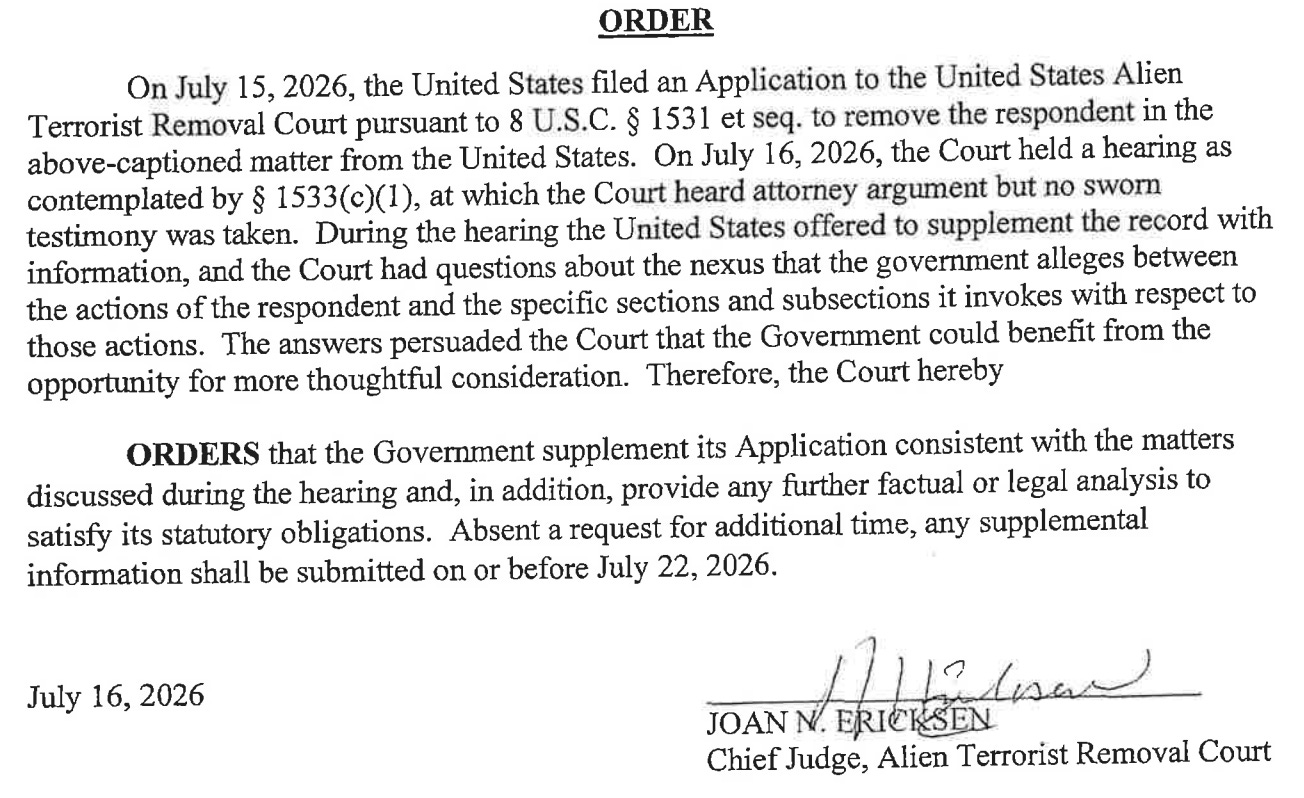
In response to DOJ’s application, filed on July 15, Judge Joan Ericksen, the chief judge of the ATRC, held a hearing the next day. At the hearing, however, DOJ failed to convince her to grant the application. Instead, she wrote in the order, issued on June 16, that DOJ’s “answers persuaded the Court that the Government could benefit from the opportunity for more thoughtful consideration.”
Ericksen, a George W. Bush appointee to the District Court of Minnesota, went on to order DOJ to “supplement its Application” with “any further factual or legal analysis” by Wednesday.
In the meantime, there is still no public information about who is the subject of the application.
The ATRC‘s makeshift website is its own sign of the court’s disuse. It posted the public portion of DOJ’s application — which is simply information that it was filed on July 15 by the Justice Department’s National Security Division — and Ericksen’s order in the case on the simple website below the “Court Rules and Procedures” section, which is itself simply a link to the same statutory provision website Law Dork linked to above. The bottom of the site notes, “This site is maintained by the United States District Court for the District of Columbia on behalf of the Alien Terrorist Removal Court of the United States.”
The Federal Judicial Center, however, still does not reflect the latest development. In its description of the court, it states, “As of 2026, the removal court had never received an application from the Attorney General for the removal of an alien terrorist, and had therefore conducted no proceedings.”
This was expanded after initial publication to provide more information about the Alien Terrorist Removal Court and DOJ’s application, with the final update at 1:50 a.m. July 19.
If you know more about the Justice Department’s use of the Alien Terrorist Removal Court, please reach out to Law Dork, via Signal, at crg.32
Law Dork on MS NOW
I was on MS NOW on Saturday morning, discussing this week’s congressional testimony from Justices Elena Kagan and Amy Coney Barrett, which was ostensibly about the court’s budget request but became about bigger court issues and questions — including ethics.
It was great to join Jacob Soboroff, along with Hofstra School of Law Professor James Sample, on Connect to discuss this issue, which I’ve covered repeatedly over the years here at Law Dork.
Also, I must say it’s great for Jacob to have a show like this, that can really spend some time on important issues like this that don’t get the coverage they deserve and need.

Check it out!
I just watched that program. The professor was right. Jacob's monologue was amazing. This was a really great discussion by the three of you. Thanks for linking us to it.
Great job, Chris!!!