

Trans West Virginians ask full appeals court to revisit alarming ruling in Medicaid coverage case
"Left to stand, the panel’s reasoning could amount to judicially-endorsed regulation of transgender people’s liberty to be themselves," lawyers for the plaintiffs wrote.

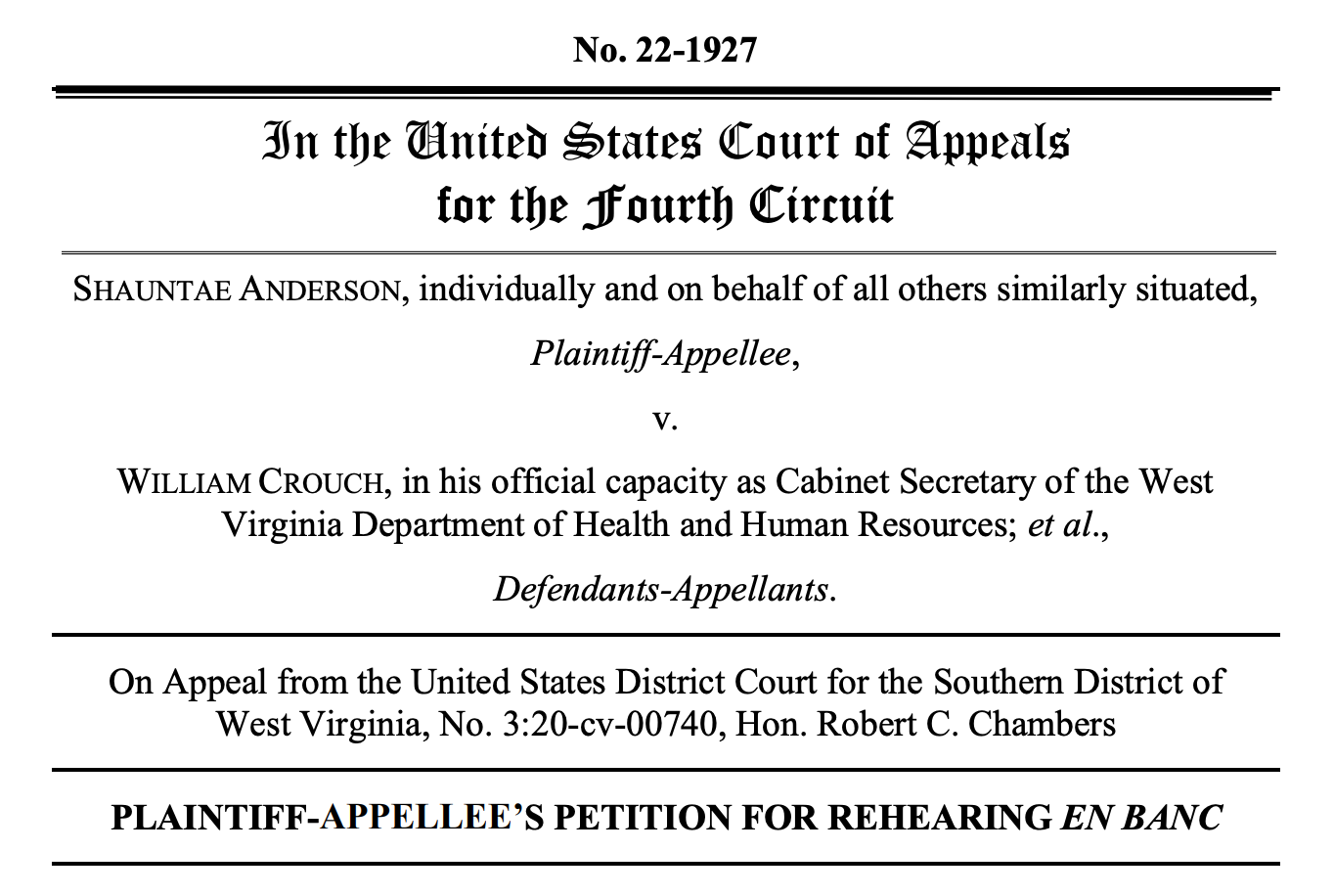
Transgender people who sued West Virginia over its policy excluding coverage of gender-affirming surgery from its Medicaid program on Tuesday asked the full U.S. Court of Appeals for the Fourth Circuit to reconsider an alarming ruling from a three-judge panel earlier this month that would uphold the state’s exclusionary policy — and do so in a manner that could have far-reaching consequences.
“Left to stand, the panel’s reasoning could amount to judicially-endorsed regulation of transgender people’s liberty to be themselves,” the lawyers from Lambda Legal, joined by Anna P. Prakash of Nichols Kaster and Walt Auvil of The Employment Law Center, wrote in Tuesday’s en banc petition. “However, ‘[t]he Constitution promises liberty to all within its reach,’ which ‘includes certain specific rights that allow persons, within a lawful realm, to define and express their identity.’ Obergefell v. Hodges, 576 U.S. 644, 651-52 (2015). En banc review is necessary.“
The en banc petition provides five (really six) reasons why the full court must revisit the panel’s decision — which was authored by Judge Julius Richardson, a Trump appointee, and joined by Judge Paul Niemeyer, a George W. Bush appointee, and Judge Allison Rushing, another Trump appointee.
The petition makes a compelling, and necessary, case for why the full court — with nine Democratic appointees1 and six Republican appointees — should wipe the dangerous opinion off the books.
[Update, 2:30 p.m.: A response was requested by the Fourth Circuit to the en banc petition, due from West Virginia officials on Monday, April 6.]
The panel opinion
The long-running case — originally brought in 2020 — initially led to the exclusion policy being struck down, a decision upheld by the Fourth Circuit, sitting en banc, in April 2024 on an 8-6 vote.
West Virginia sought Supreme Court review, and the court held the case while it considered U.S. v. Skrmetti — the case over Tennessee’s ban on gender-affirming medical care for minors. After the court upheld the Tennessee ban on a 6-3 vote in June 2025, the court took a not-unusual action in the West Virginia case. Referred to as a GVR, the court granted the petition for review, vacated the lower court decision, and remanded the case “for further consideration in light of“ Skrmetti. The court regularly GVRs cases after big decision and did so with four cases in the aftermath of Skrmetti.
When the case got back to the Fourth Circuit, it was assigned to a three-judge panel. The problem that it consisted of three of the judges who dissented from the 2024 en banc decision, including Richardson — who wrote the lead dissent in 2024.
Now, for the three-judge panel, Richardson wrote the court’s opinion on March 10. In it, Richardson expanded the reasoning and scope of Skrmetti while claiming to be simply applying it, set forth rationales for upholding West Virginia’s exclusion policy that could be used to permit virtually any anti-trans policy or law, and — at points — used extremely anti-transgender language and framing to do so.
Richardson held for the panel that “Skrmetti compels the conclusion that the policy violates neither the Equal Protection Clause nor the [nondiscrimination rule in the] Affordable Care Act.“
The opinion took bits and pieces of the Skrmetti ruling — regardless of how they were used in Chief Justice John Roberts’s opinion for the court — to, at times, create entirely new, anti-trans legal principles.
In key part, Richardson applied Roberts’s opinion about a law that banned care for trans minors to West Virginia’s exclusion of Medicaid coverage for adults’ transgender medical surgical care:
[S]urely, as Plaintiffs argue, policies that use the words “sex change” and “transsexual” facially discriminate based on sex or transgender status, right?
Not so. The Exclusion uses the terms “sex change” and “transsexual” as adjectives to describe “treatment” or “surgery,” not to describe types of people who cannot receive coverage. Mere mention of these words does not constitute facial discrimination. Skrmetti, 605 U.S. at 511–12. On its face, therefore, the Exclusion does not deny someone coverage for medical services based on the person’s sex or transgender status. Rather, it denies coverage to everyone for certain services when sought to treat a given medical diagnosis.
But, it was a later claimed application of Skrmetti to the West Virginia case where Richardson went furthest afield — and most concerningly so. He wrote:
West Virginia also cites efficacy and necessity concerns as one of its reasons for the Exclusion—concerns which the Supreme Court cites approvingly in Skrmetti. 605 U.S. at 522–23 (stating Tennessee’s finding “that it was likely that not all harmful effects associated with [sex-change procedures] are fully known” provided a rational basis for SB1 (internal quotation marks and citations omitted)).
First, for all that Roberts did in Skrmetti, it is shocking how Richardson selectively quoted Roberts here — in a way that is key to his effort to use Roberts’s opinion more broadly.
Here is what Roberts — quoting the Tennessee finding — actually wrote:
It further found that it was “likely that not all harmful effects associated with these types of medical procedures when performed on a minor are yet fully known, as many of these procedures, when performed on a minor for such purposes, are experimental in nature and not supported by high-quality, long-term medical studies.”
Yes, Richardson doubly-eliminated Roberts’s language — and Tennessee’s language — about “minors” in claiming that the Supreme Court “cite[d] approvingly” language that is far more expansive and happened to fit in with what Richardson — and West Virginia — were claiming here.
Second, after this sentence, Richardson dropped a lengthy, offensive, and legally dangerous footnote:
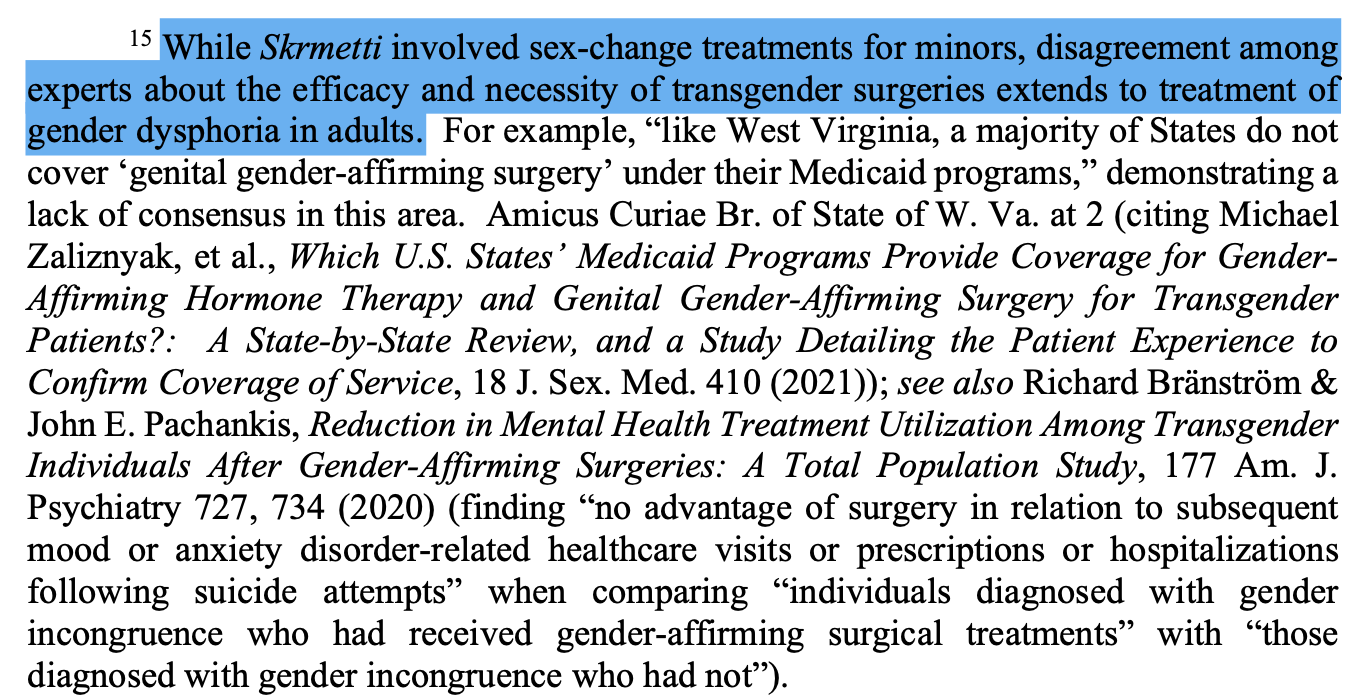
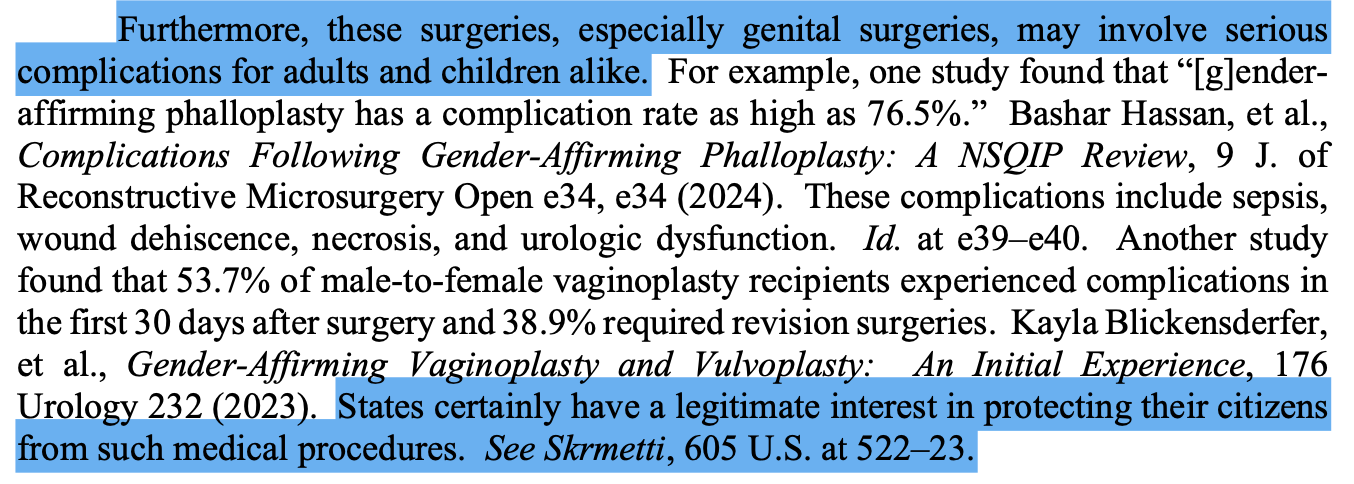
This was nothing less than an attempt to expand Skrmetti and allow for a national, constitutional permission slip for all-age anti-trans discrimination so long as it’s framed as being about a “medical diagnosis” or medical treatment.
In a final sign of how Richardson sought to expand Skrmetti, there was a turn of phrase that appeared twice in his opinion:
Toward the beginning of the decision, he stated that “recognizing biological reality is ‘not a stereotype,’“ citing a 2001 immigration case decision that allowed differential treatment based on sex in a case about the immigration process for foreign-born children of unwed parents when one parent is a U.S. citizen. (The 5-4 decision was bad, but it was, ultimately, very much tied to motherhood — upholding a policy requiring a person whose U.S. citizen parent is their father to take additional steps to obtain U.S. citizenship.)
By the end of Richardson’s opinion, this had morphed into a full-fledged principle: “The different coverage accorded to treatments for different diagnoses is therefore based on medical judgment of biological reality, which is ‘not a stereotype,’” he wrote.
This, on the other hand, was an opening footnote from Roberts about how he would be using language in Skrmetti:

In fact, the phrase “biological reality” appeared nowhere in any of the Skrmetti opinions.
The en banc petition
In Tuesday’s petition for en banc review, however, the trans West Virginians affected by the policy explained why Richardson’s ruling is and wrong — and must be overturned.
“The panel’s decision in this case conflicts with precedents of the Supreme Court, this Court, and other Courts of Appeal, as well as raises questions of exceptional importance that warrant rehearing by the en banc Court,“ the request began, laying out the standard for en banc review — and the multitude of reasons why en banc review is needed here.
As to the ACA ruling — which involves Section 1557 — the en banc petition argued:
The panel’s opinion improperly applies the framework of Geduldig v. Aiello, 417 U.S. 484 (1974), and Skrmetti to Plaintiff’s claims under Section 1557 of the Affordable Care Act. The opinion does so even though Congress has rejected the application of Geduldig’s reasoning to statutory claims, which the Supreme Court has acknowledged, see Newport News Shipbuilding & Dry Dock Co. v. E.E.O.C., 462 U.S. 669, 678 (1983), and even though the text and legislative histories of Section 1557 and Title IX demonstrate that Geduldig’s reasoning does not apply.
Since the Supreme Court overturned Roe v. Wade in 2022, Justice Sam Alito’s one-paragraph mention of Geduldig — a 1974 case holding that California’s decision to exclude “normal pregnancy” claims from its disability insurance program was not sex discrimination under the Fourteenth Amendment’s Equal Protection Clause — has breathed new life into the case. Here, however, Richardson applied it to both the Equal Protection Clause and Section 1557 — and there is extensive evidence that Geduldig’s reasoning, even to the extent Alito resurrected it, should not apply to statutory claims like Section 1557.
The implications of letting Richardson’s opinion stand are stark. “Under the panel’s holding extending Geduldig and Skrmetti’s reasoning to the statutory context, however, discrimination based on pregnancy would be lawful under Title IX and Section 1557,” the petition noted. “Thus, the panel’s decision creates a conflict with a whole body of law that is of grave importance.”
As to Richardson’s analysis of discrimination, the petition explained two ways in which the panel opinion is wrong and must be reviewed:
[T]he panel’s opinion analyzed proxy discrimination under a standard that this Circuit previously rejected and that conflicts with precedent. … So, too, with pretext. The panel’s opinion ignores Supreme Court precedent on the applicable standard ….
The petition goes through Supreme Court and circuit precedent for considering both proxy discrimination and pretext and argued how Richardson got it wrong, and why those rulings must be revisited by the full court.
Then, addressing the most alarming part of Richardson’s opinion, the petition argued:
The panel’s opinion also conforms to debunked stereotypes about transgender people and, in doing so, conflicts with this Circuit’s precedent on sex stereotyping. The panel’s opinion also improperly expands Skrmetti beyond its limited holding in a manner that reaches all transgender adults without a legal basis or any limitation.
This is listed as one reason for review in the petition, but it really makes two key points — including about that footnote in Richardson’s opinion.
As to the first, it explained:
Reducing transgender people to their birth sex treats “gender identity [a]s a choice,” privileging it over “medically confirmed, persistent and consistent gender identity.” Grimm, 972 F.3d at 610. These “misconceptions … themselves reflect stereotypic notions.” Id. (quotation omitted). The panel’s opinion ignores all of this.
As to Richardson’s efforts to “improperly” expand Skrmetti, the petition noted:
Skrmetti found that the Tennessee legislature’s specific legislative findings did not evince sex stereotyping: the state could “conclude that kids benefit from additional time to ‘appreciate their sex’ before embarking on body-altering paths” as adults. Id. at 517 (emphasis added). Here, however, the panel’s opinion expands this standard to all adults, and would allow, without any limiting principle, “legislature[s]” to claim an interest in “encourag[ing] citizens to appreciate … and not become disdainful of their sex.”
Finally, in a sign of how aggressive Richardson was in advancing the anti-trans narrative he wanted to set forth in the opinion, the plaintiffs noted:
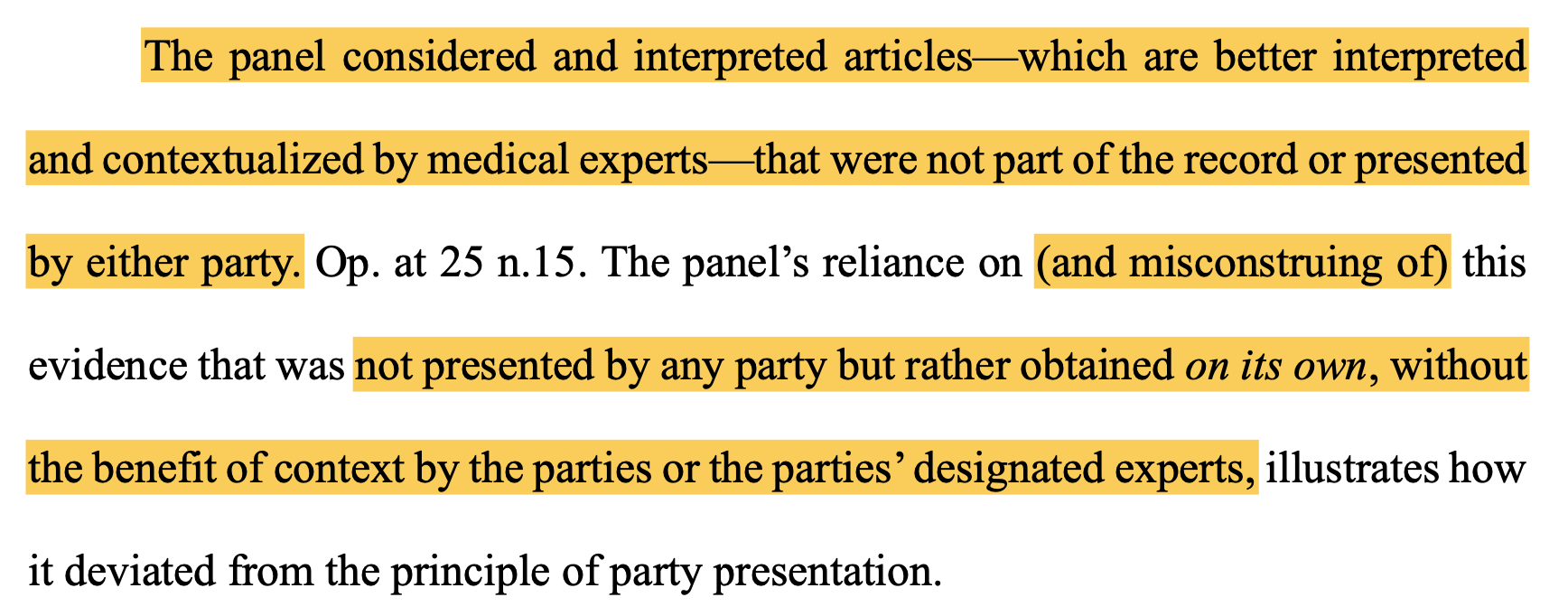
[T]he panel relied upon “evidence” it obtained on its own and which was not presented by any party. The panel did so while ignoring established evidence that is actually part of the record.
This, the filing explained, was more than just finding a simple statistic or easily known fact. Citing the footnote reproduced above, they noted in their petition how this “deviated” from “fundamental principles” of “party presentation” — the idea that courts are to be “neutral arbiter of matters the parties present.”
Here, however, the petition explained:
Finally, as to that “biological reality” language, not only was it anti-trans framing that Richardson chose to insert in the opinion, the lawyers explained in the petition two other problems:
[T]he panel reduced gender dysphoria to a “mental disorder,” Op. at 6, that deviates from “biological reality,” id. at 22, and not a medical condition that has physical and biological bases and consequences. Id. at 20-21 & n.12. Again, this is contrary to the record. … It is also contrary to case law.
The bottom line
The Fourth Circuit can and should take up trans West Virginians’ request for en banc review.
Roberts’s Skrmetti opinion was bad — morally and as a matter of law — but what Richardson (joined by Niemeyer and Rushing) have tried to do would be even worse — expanding its reasoning to people of all ages, pulling within its reach laws that were in no way a part of the Skrmetti decision, and making sharply anti-trans language a part of the law.
Judge Roger Gregory was initially nominated by then-president Clinton but was not confirmed, although Clinton gave him a recess appointment toward the end of his time in office that would have only been for a limited time. Gregory later was renominated by then-president George W. Bush and confirmed by the Senate, so, technically, is a “Bush appointee,” but is — for vote-counting purposes — better considered a Democratic appointee.
I banned a user and deleted their comments because I do not accept dehumanizing comments, and that includes people seeking to use my space to claim that trans people don't exist.
Oh lord, that panel had gotten past my radar. Gee. if a law is OK if " it denies coverage to everyone for certain services when sought to treat a given medical diagnosis" then exclusion of prostate surgery from Medicaid would be just fine, right? No issue of discrimination against males at all.