

Three rulings in the past week show the scope and breadth of efforts to fight anti-trans attacks
A Montana Supreme Court decision protecting birth certificates, a ruling on Trump's anti-trans prison policies, and final judgment vacating RFK Jr.'s anti-trans "declaration."

A trio of court rulings over the past week — one state court decision and two federal court decisions — show the breadth of attacks that transgender people are facing in the United States and the strong way trans people and lawyers supporting them are fighting back in courts.
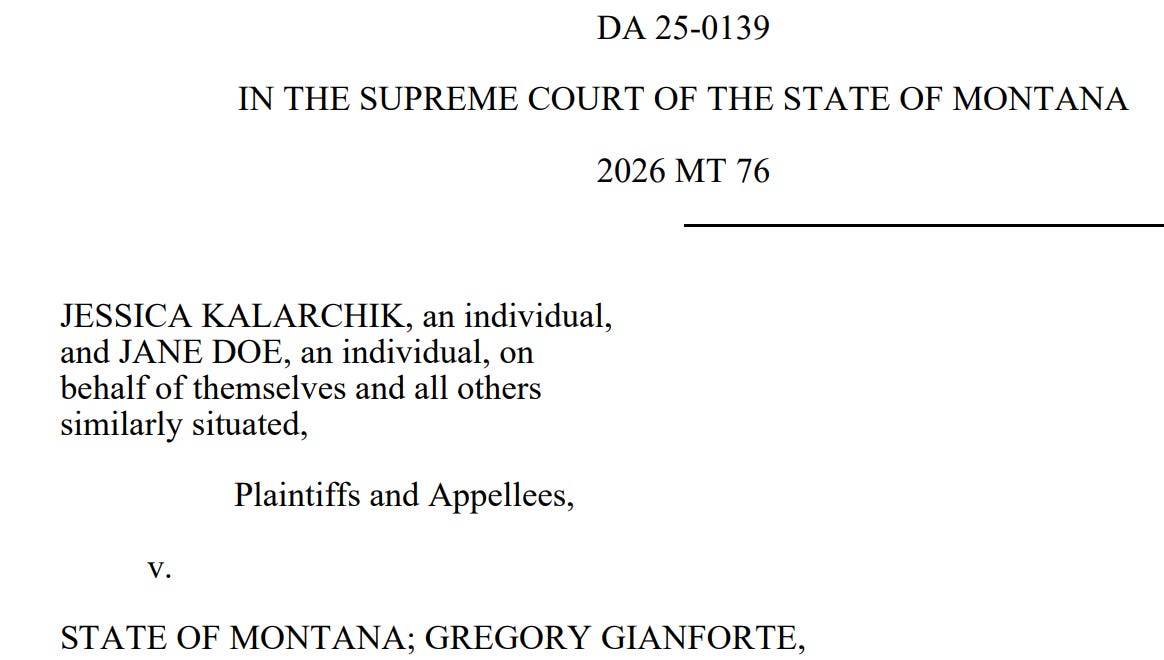
On April 14, the Montana Supreme Court upheld a preliminary injunction blocking Montana’s enforcement of a policy — implementing a state law — “that it would not amend birth certificates based on ‘gender transition, gender identity, or change of gender.’”
One of the plaintiffs in the case, identified by the pseudonym of Jane Doe, is a 25-year-old transgender woman who lives in Montana.
As the court’s opinion, by Justice Laurie McKinnon, explained, “Ms. Doe’s appearance has changed significantly and no longer matches the photo or sex designation on her Montana driver’s license.“ Because of the policies, she has been unable to change her birth certificate and, accordingly, her license.
Ms. Doe had a prolonged interaction with law enforcement during a traffic stop because the officer could not verify her identity based on her pre-transition driver’s license photo and sex designation. …
As she continues her transition, Ms. Doe fears that not having a driver’s license that accurately portrays how she holds herself out to the public will put her at risk of criminal prosecution because her driver’s license will no longer be effective to verify her identity should she be required to do so.
This is the reality for many trans people now, and McKinnon’s opinion, as well as a concurring opinion by Justice Beth Baker, make clear how attuned some judges are to the harms of that reality — a sharp split from the U.S. Supreme Court’s majority.
After detailing how Montana’s Constitution “allow[s] for even more individual protection than the Equal Protection Clause of the Fourteenth Amendment of the United States Constitution” in its Individual Dignity Clause, including explicit sex discrimination protection, McKinnon explained in this context what Chief Justice John Roberts and the majority refused to see in last year’s decision upholding Tennessee’s ban on gender-affirming medical care for trans minors:
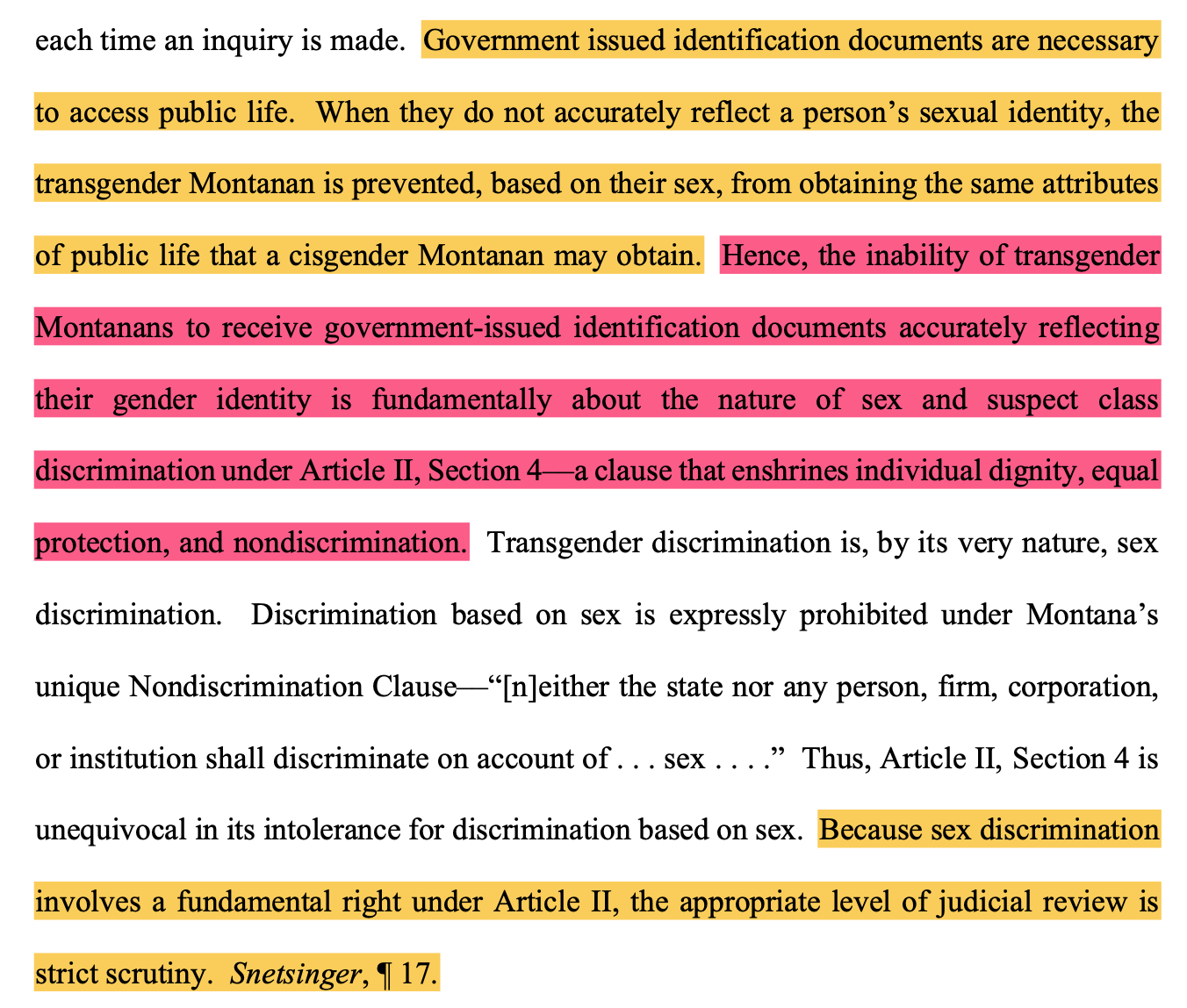
With that understanding, the court easily concluded that “the State’s position ignores that only transgender persons are discriminated against when they are not allowed to have identification documents that match their gender identity and that this constitutes discrimination based on sex, a category specifically identified in Montana’s Nondiscrimination Clause.”
The five justices in the majority — and their language of understanding — was offset somewhat harshly by Justice Jim Rice’s 20-page fever-swamp dissent, which Chief Justice Cory Swanson joined.
His first sentence was literally: “Today’s decision forces the State to issue falsified legal documents.“
I’m not going to detail much of the dissent, but I will give you one example that really shows you what we’re dealing with here. Upset that McKinnon discussed how the policy treated cisgender and transgender Montanans differently, Rice wrote:
[T]his use of “cisgender”—a term that is not only inaccurate but potentially offensive, as explained below—mistakenly theorizes that all people living consistent with their birth sex have made a deliberate “gender identity” decision to adopt such a lifestyle. … There is no evidence whatsoever that every such person [living consistent with their biological birth sex] has made a “gender identity” decision, as it is completely unnecessary. The need to “gender identify” arises only when people want to live a lifestyle inconsistent with their biological origin.
Later, in a footnote, Rice provided his explanation of the alleged offensiveness of the term:
[W]hile it may be appropriate to label people as belonging to a gender identity category who have expressly chosen and embraced such label, including “cisgender,” it is highly inappropriate to label people as belonging to a gender identity category who have made no such choice, particularly, those people who do not believe in or who object to such choices. For those people, the “cisgender” label is false, as well as offensive to some, and the Court’s use of it is factually incorrect.
The entire time I read it, I’ll be honest, I just kept imagining Rice saying he’s not “straight,” he’s just “normal.”
That — and far worse — language is finding its way into court decisions, but also into governmental policies targeting trans people for worse treatment under the law.
But, as we saw in two cases in the federal courts, people are fighting back — as tough as it might be in this environment.
Trans women in prison
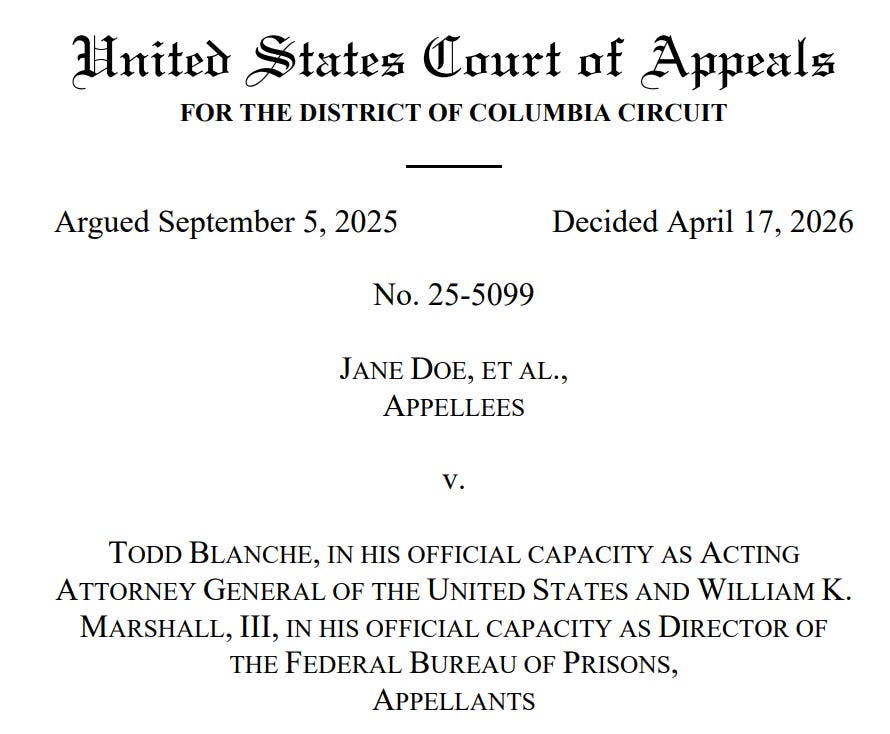
On Friday, April 17, the U.S. Court of Appeals for the D.C. Circuit issued a difficult ruling in the challenges to President Donald Trump’s executive order requiring federal prisons not to allow transgender women to be housed in women’s prisons.
The 18 transgender women in women’s facilities had their transfers reversed or stopped with a series of preliminary injunctions issued by U.S. District Judge Royce Lamberth, a Reagan appointee. On Friday, though, the D.C. Circuit, in a 2-1 decision, vacated the injunctions and sent the case back to Lamberth for further proceedings.
However, what happened was — it appears — likely the best scenario for the 18 women.
The majority opinion by Judge Cornelia Pillard, an Obama appointee, was joined by Chief Judge Sri Srinivasan, another Obama appointee. Judge A. Raymond Randolph, a senior status George H.W. Bush appointee, dissented.
First addressing restrictions under the Prison Litigation Reform Act of 1995, Pillard held that the plaintiffs could bring their claim over the effort to transfer them to men’s prisons despite a PLRA provision blocking review of “a designation of a place of imprisonment“ by the courts. She also rejected the arguments of the Trump administration and Randolph that the plaintiffs failed to meet the PLRA’s “exhaustion” requirement — a rule that plaintiffs must pursue and exhaust any administrative remedies available to them. Here, Pillard concluded they were not “available” to the plaintiffs because Trump executive controlled what the Bureau of Prisons could do.
As to the merits, though, Pillard explained that the preliminary injunctions were all based on a generalized Eighth Amendment claim finding that “transgender persons are at a significantly elevated risk of physical and sexual violence relative to other inmates when housed in a facility corresponding to their biological sex.”
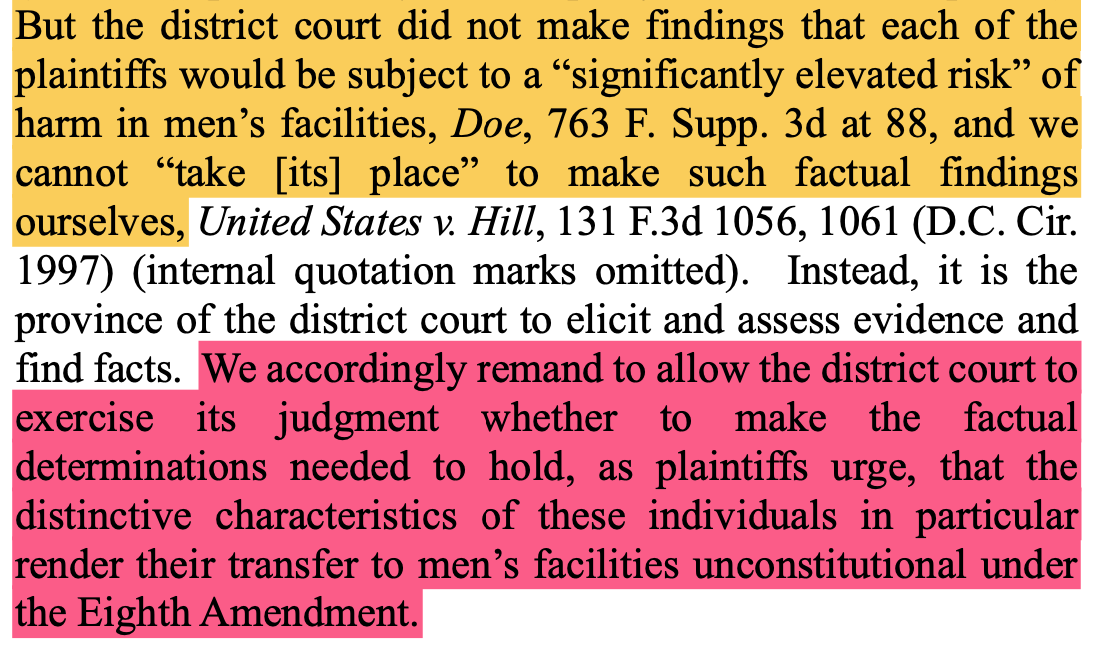
On appeal, the plaintiffs disclaimed the broader theory (likely, at least in part, due to how the U.S. Supreme Court continues to take steps signaling how skeptically it is viewing broad-based trans claims). Arguing instead for “a narrower ground for upholding the injunctions—namely, that they are entitled to relief based on their specific characteristics,” the appeals court held that it couldn’t uphold the injunctions on those grounds because “the district court did not identify each individual plaintiffs’ risk-elevating characteristics, such as their having undergone sex reassignment treatment or their experiences of assault or self-harm in men’s prisons.“
Because of that, Pillard wrote, the court had to vacate the preliminary injunctions and send the case back to the district court:
Randolph dissented, writing that the PLRA “compels an end to these consolidated cases, not a remand that encourages the district court to repackage relief under alternative theories.“
Specifically, he wrote that the plaintiffs’ case should have been dismissed for failure to exhaust their administrative remedies and, additionally, argued that a PLRA rule that limits preliminary injunctions to 90 days meant that Lamberth could not renew them — a position contrary to most courts to have considered it (which he acknowledged was so).
While the trans plaintiffs in this case now go back to the district court in D.C., a final decision came across the country on Saturday, April 18.
RFK Jr. declaration
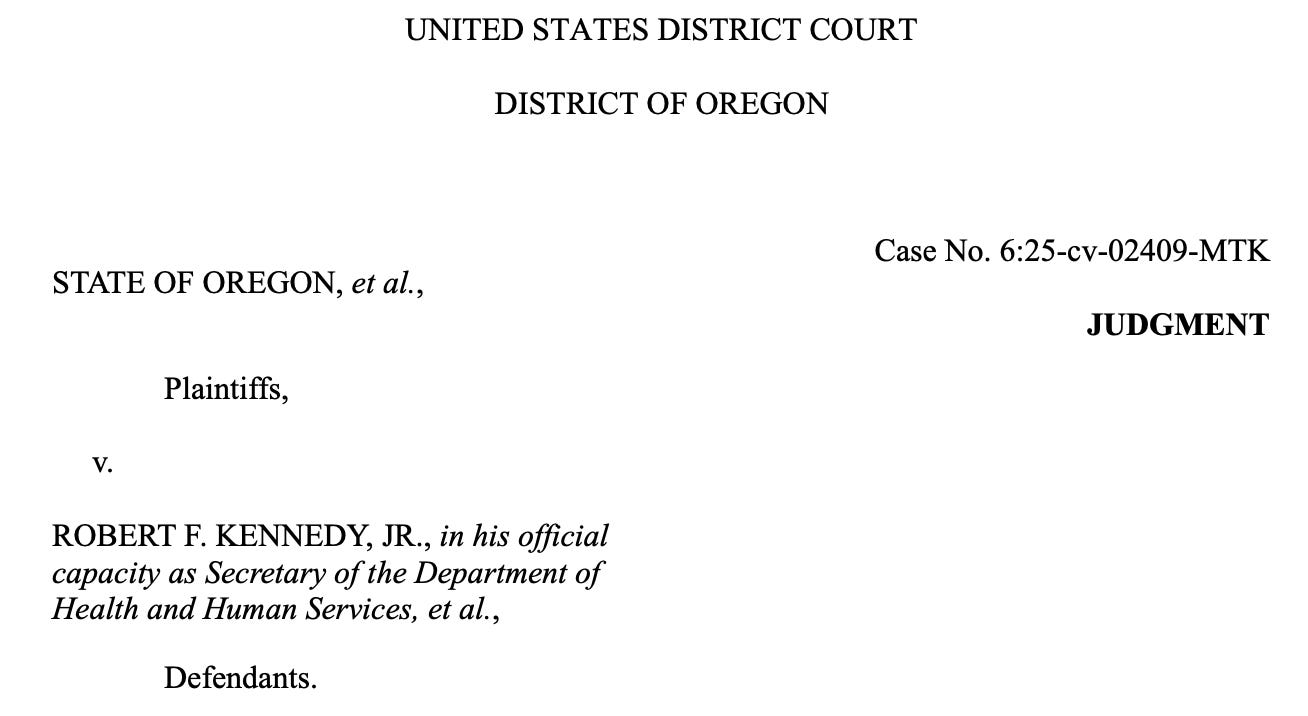
In the third case, a federal judge in Oregon found that Health and Human Services Secretary Robert F. Kennedy Jr. “unlawfully issued a declaration threatening to cut federal funding to medical providers who provided gender-affirming care to minors.”
U.S. District Judge Mustafa Kasubhai minced no words in his opinion:
Secretary Kennedy’s utter failure to promulgate rules in accordance with statutory authority, but instead threaten to cease federal funding to medical providers almost immediately after the declaration, caused chaos and terror for all those people and institutions of our great nation. Secretary Kennedy’s unlawful declaration harmed children. This case illustrates that when a leader acts without authority and in the absence of the rule of law, he acts with cruelty.
It was a good reminder that — in the midst of it all — their are clear-eyed judges willing to call out Trump administration anti-trans attacks for what they are.
In his final judgment, in addition to vacating the declaration, he blocked enforcement of similar action with a permanent injunction as well:
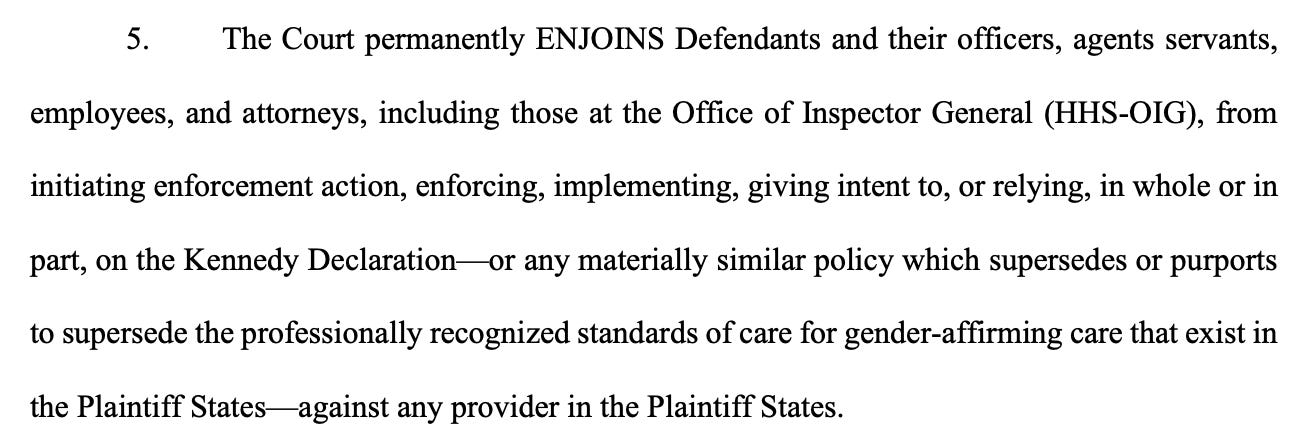
As Kasubhai, a Biden appointee, explained in his opinion, “Considering Defendants’ arguments in this case and this administration’s repeated flouting of court orders and the rule of law, the Court finds that declaratory relief alone is insufficient; injunctive relief is warranted here because, unlike declaratory relief, it is ‘backed by the power of contempt.’“
Each day presents the possibility of a ruling that effects the lives of trans people in a state, in a circumstance, or across the nation due to the vast amount of anti-trans lawmaking and policymaking in recent years.
While it can be difficult to keep up, I hope this look into three decisions over the past week show how steadfastly people are pushing back.
The Montana case had me holding my breath. I was finally able to update my Montana Birth Certificate last year, but I’ve lived in constant fear it would be reversed in court. Thank you for covering these cases, it feels like my humanity is literally being litigated every hour and it is a nightmare to open my phone each morning to see what has happened each day, mainstream media ignoring us doesn’t help things.
An important update, thank yiou. Could we get updates on the Kilmar Abrego Garcia and Liam Ramos deportation cases please?