

The 2016 Supreme Court memos and the mess that John Roberts has made of his court
The New York Times scoop about the Clean Power Plan case SCOTUS memos highlights the conservative justices' brazen disregard for their own rules — both then and now.

On Saturday, The New York Times published a story about the U.S. Supreme Court’s actions a decade ago blocking the Obama administration’s Clean Power Plan on what has become known as the shadow docket.
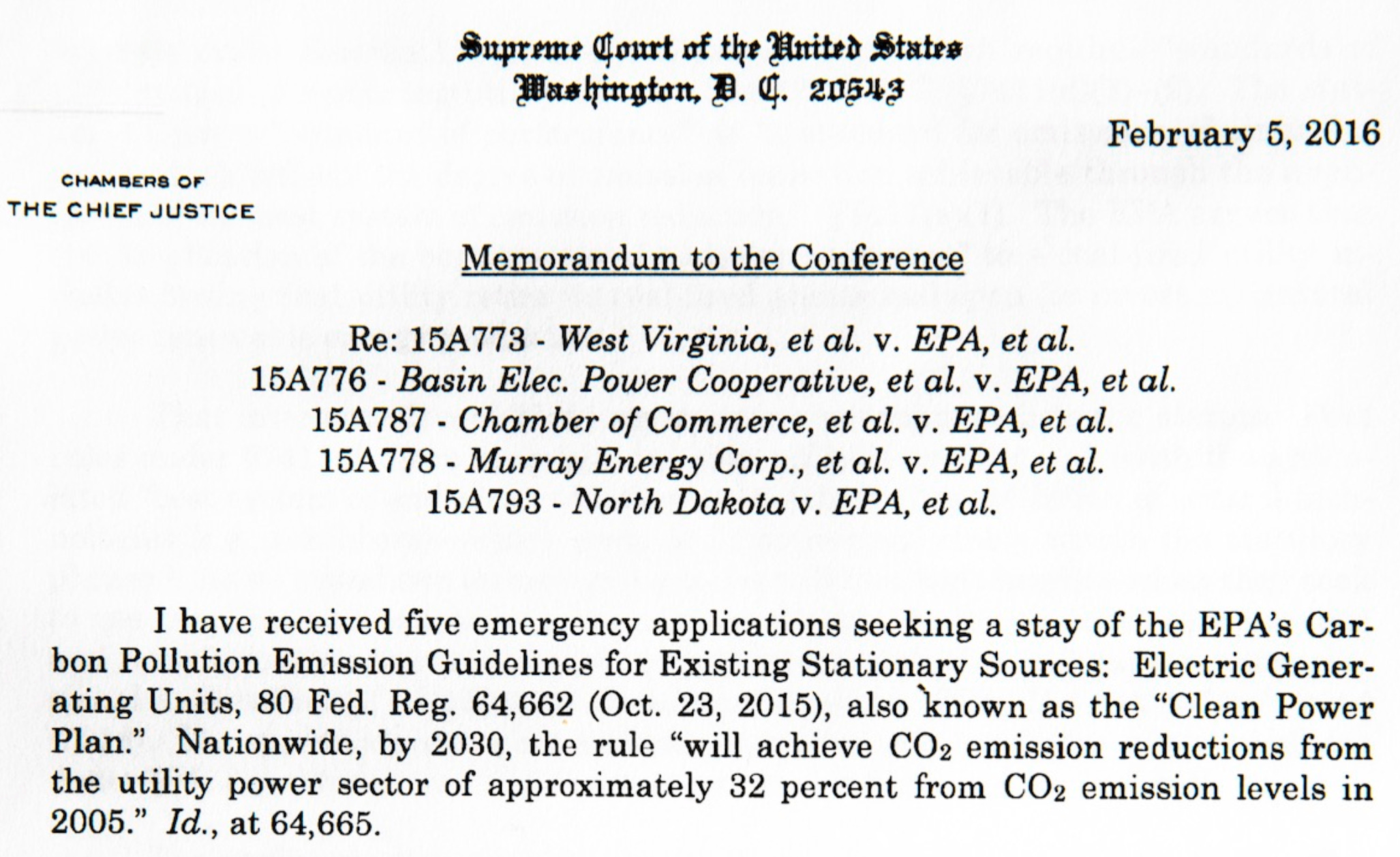
Though most of the general facts were known previously, the Times story made a big splash by revealing and publishing a handful of internal memos from the justices to one another (including as a PDF) — beginning with Chief Justice John Roberts’s February 5, 2016 memo bringing five applications for a stay of the Clean Power Plan to the full court with a brief explanation of his vote that the stay requests be granted.
The scoop highlights the conservative justices’ brazen disregard for their own rules — both then and now — and the ways in which they are now ignoring the concerns that allegedly animated their action a decade ago.
As the Times detailed, Justice Stephen Breyer responded to Roberts the same day — proposing a different solution and stating his lack of understanding for the rush. The next day, Justice Elena Kagan noted that this was new.
“As far as I can tell, it would be unprecedented for us to second-guess the D. C. Circuit’s decision that a stay is not warranted, without the benefit of full briefing or a prior judicial decision,“ she wrote.
Ultimately, Justice Anthony Kennedy cast the tie-breaking vote for a stay on February 9, and the Supreme Court issued its order that evening.
After Breyer simply wrote that it would be “unusual” for the court to issue a stay in this posture, Roberts responded that he “recognize[d] that the posture of this stay request is not typical, but review is sought of what has been described as the most expensive regulation ever imposed on the power sector.” The Times understandably focused in on this, later noting that “in the entire chain of correspondence obtained by The Times, not a single justice, conservative or liberal, mentioned the dangers of a warming planet as one of the possible harms the court should consider.“
Outside of that, the Times story is framed around “[t]he birth of the Supreme Court’s shadow docket.” And I get that, too, specifically when understood as the modern use of the court’s emergency docket.
In light of the past 15 months, however, I’d like to look at two statements from those 2016 memos — one from Roberts and one from Justice Sam Alito — compared to the court’s orders made in the second Trump administration.
In Roberts’s second memo, responding to Breyer, he doubles down and at one point explains away taking action before the appeals court had ruled because “it is highly doubtful that this Court will bless the EPA’s expansive definition ….“
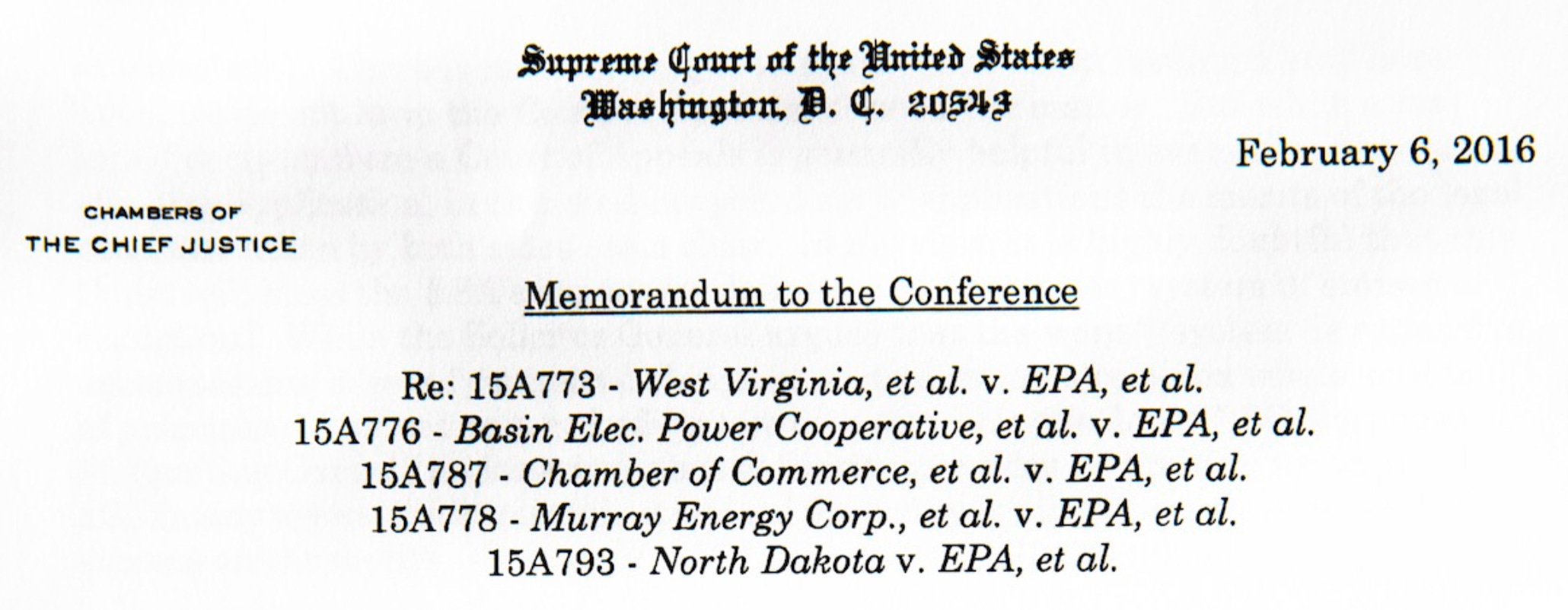
On January 26, 2016, the court received an application from states challenging the Clean Power Plan. The next day, Roberts requested a response by February 4 — just eight days later. On February 5, the states submitted their reply. That same day, Roberts sent his first memo.
By February 6 — 11 days after the matter got to the Supreme Court on the emergency docket — Roberts had decided it was “highly doubtful” the Clean Power Plan would be upheld.
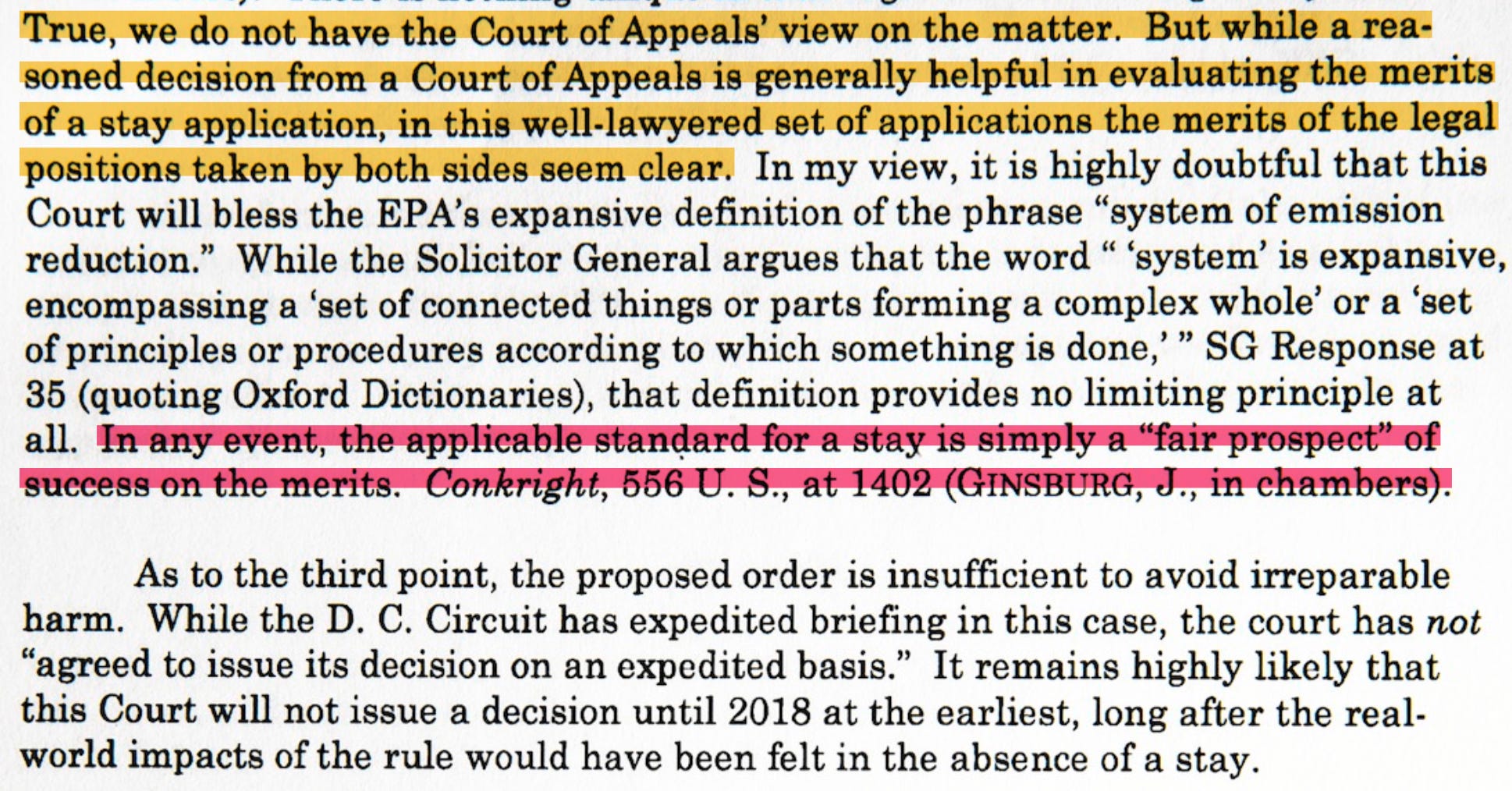
In this challenge to the Obama administration’s environmental plan, Roberts wrote of the ordinary rule for a stay, noting that “the applicable standard for a stay is simply a ‘fair prospect’ of success on the merits.“
In addressing “irreparable harm,” he went on discuss his concern about how long a final decision could come under Breyer’s proposal, “long after the real-world impacts of the rule would have been felt in the absence of a stay.“
In 2025, the Republican appointees — almost certainly including Roberts — wrote in a per curiam, unsigned order last May that a 90-year-old precedent could be sidestepped on the shadow docket to give Trump his way based on “our judgment that the Government faces greater risk of harm from an order allowing a removed officer to continue exercising the executive power than a wrongfully removed officer faces from being unable to perform her statutory duty.”
When Trump was trying to tear down regulatory agencies by firing Democratic members of those agencies for no reason even though Congress had specifically directed that there had to be cause for the president to do so, the conservatives ignored the ordinary rules and created a new rule.
When Obama was trying to create regulations, the conservatives ignored the ordinary rules of the emergency docket and created a new rule.
As to those “real-world impacts” that Roberts was concerned about when business interests were at stake, I’d like to highlight Justice Ketanji Brown Jackson’s dissent from this past May, in which the Supreme Court allowed then-Homeland Security Secretary Kristi Noem’s effort to end immigration parole status for about 500,000 people to go into effect by blocking a lower court’s order.
Jackson wrote:
While it is apparent that the Government seeks a stay to enable it to inflict maximum predecision damage, court-ordered stays exist to minimize—not maximize—harm to litigating parties. …
No one disputes that social and economic chaos will ensue if that many noncitizen parolees are suddenly and summarily remanded. …
At a minimum, granting the stay would facilitate needless human suffering before the courts have reached a final judgment regarding the legal arguments at issue, while denying the Government’s application would not have anything close to that kind of practical impact.
Despite those “real-world impacts,“ Roberts did not appear to vote against the stay.
Then there’s Alito.
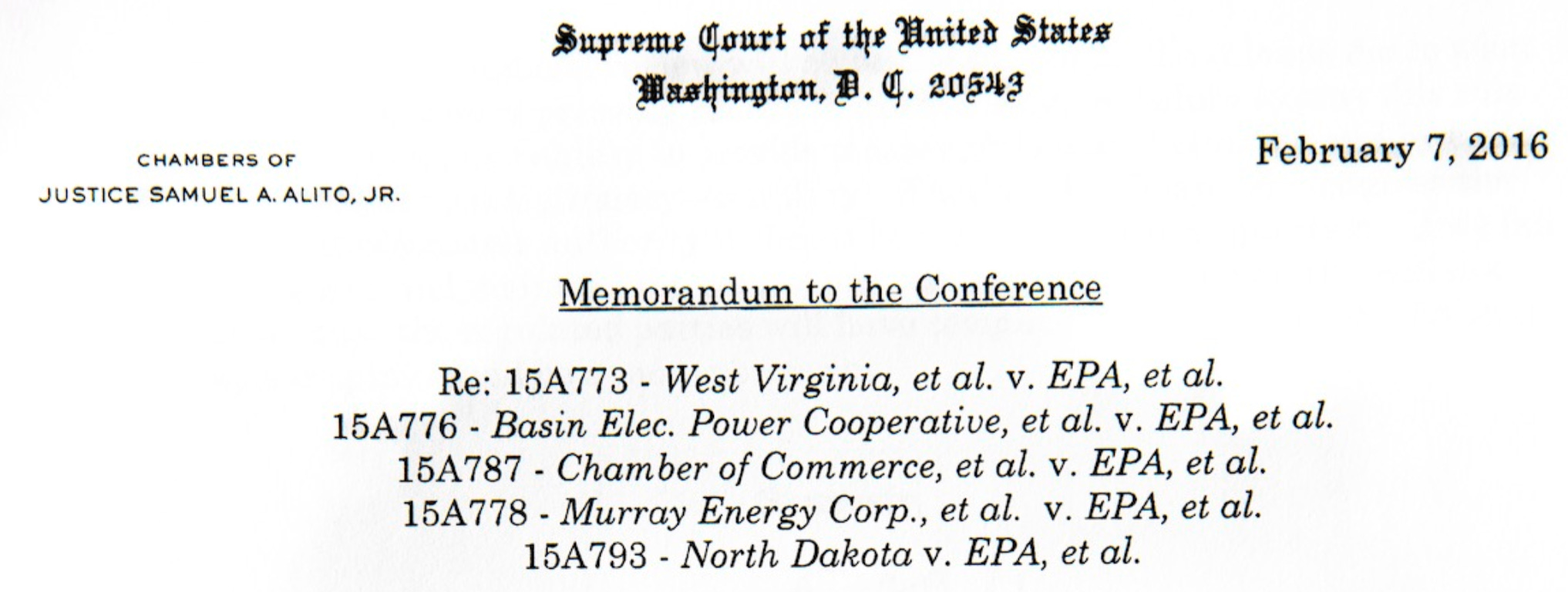
In his February 7, 2016 memo, Alito closed on an aggressive note, insisting that “failure to stay this rule threatens to render our ability to provide meaningful judicial review — and by extension, our institutional legitimacy — a nullity.”
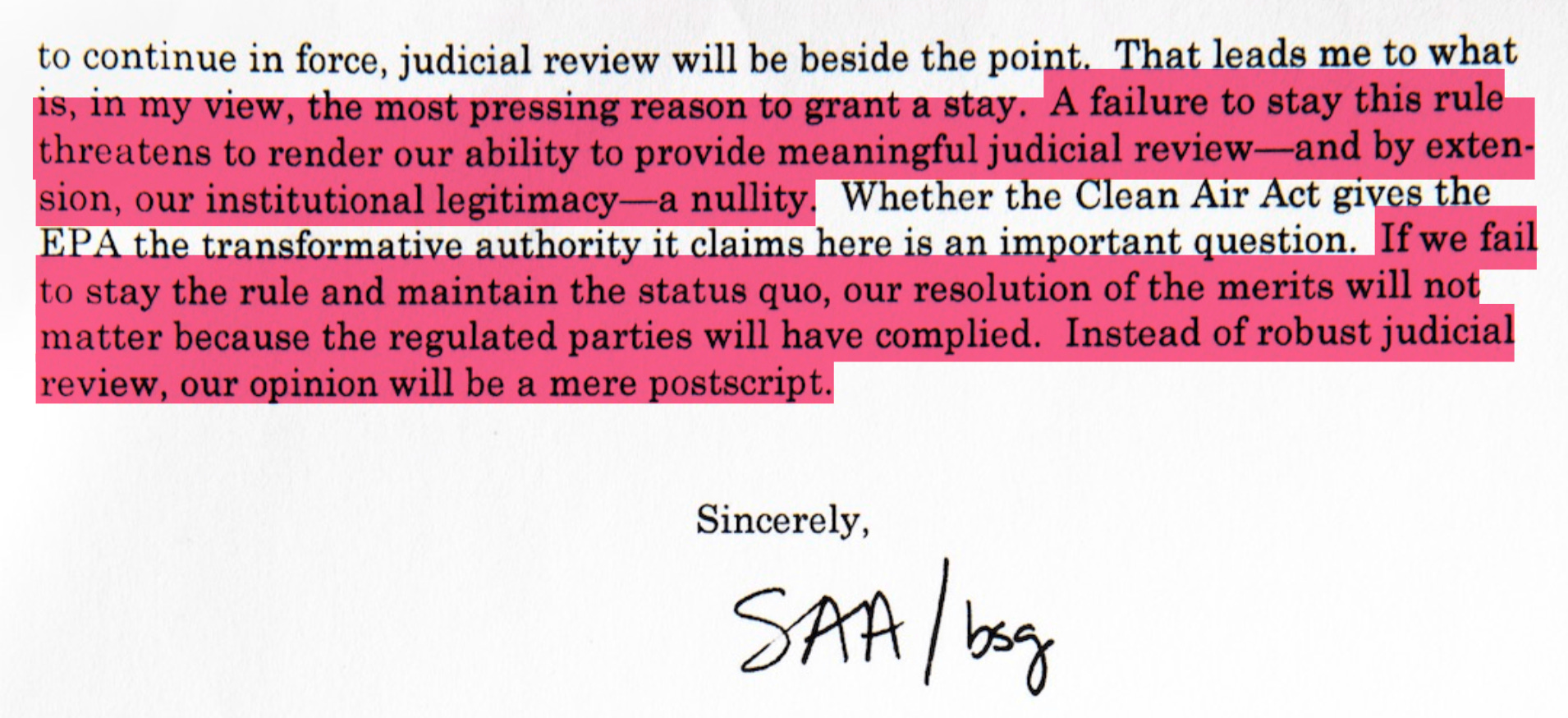
“If we fail to stay the rule … our resolution of the merits will not matter1,” he wrote — ignoring the fact that the Supreme Court had never taken such a step at that point in litigation.
To return to Jackson’s May 2025 dissent, she explained the impact of granting a stay in the immigration parole case:
[Those whose parole Noem is seeking to cancel] now face two unbearable options. On the one hand, they could elect to leave the United States and, thereby, confront “dangers in their native countries,” experience destructive “family separation,” and possibly “forfei[t] any opportunity to obtain a remedy based on their ... claims,” as the District Court found. App. 18a. On the other, they could remain in the United States after parole termination and risk imminent removal at the hands of Government agents, along with its serious attendant consequences. …
Either choice creates significant problems for respondents that far exceed any harm to the Government, should this Court decline the stay request. Both options might also deprive this Court of jurisdiction to decide respondents’ pending claims.
Here, the Supreme Court’s decision to allow government action — where it blocked it in 2016 — would have the very effect of which Alito warned.
That is not the only shadow docket ruling that illustrates this point.
This past October, when Justice Amy Coney Barrett went on Fox News to defend the Supreme Court’s September shadow docket order allowing racial profiling in certain immigration enforcement efforts by the Trump administration — yes, the Kavanaugh stops ruling — I called bullshit because Barrett tried to talk away the decision as “preliminary” and “not cases in which the court has had full briefing and made a final judgment.”
What I wrote than bears repeating now in light of Alito’s 2016 comments:
Barrett’s academic insistence that a shadow docket ruling needs no explanation because “in none of these cases have we finally resolved the issue,“ requires a response.
Tell that to the fired Education Department employees — and elsewhere across the federal government.
Tell that to the men sent to South Sudan and to others sent to countries where they had no prior association.
Tell that to Mary Boyle, Alexander Hoehn-Saric, and Richard Trumka Jr. — fired members of the Consumer Product Safety Commission — not to mention the Americans who believed that a bipartisan CPSC would be there, as established by Congress, to protect their kids.
Tell that to the health researchers whose funding has been canceled — sometimes midway through years-long research.
Tell that to the people protected by the Federal Trade Commission’s bipartisan stability for the past 90 years.
Tell that to the Venezuelan immigrants whose legal status in America was stripped from them.
Tell that to the people who would have benefited from the foreign aid funding that Trump unilaterally cut.
In other words, given his 2016 concerns, Alito must be extremely concerned now about how his votes have “render[ed]” the court’s “ability to provide meaningful judicial review — and by extension, our institutional legitimacy — a nullity.”
The Supreme Court returns on Monday for its final two-week oral argument sitting of this term.
A transcription error here (mine) initially had “merit” where it should have been — and now is — “matter,” as was clear from the image about it. Apologies for the error.
So clarification of Roberts’ memorable statement from his confirmation hearing, job is calling ‘balls’ for Republican administrations & corporations and calling ‘strikes’ for Democratic administrations & individuals’ rights and also to pitch and bat to achieve his desired outcome.
The six conservative justices, like gods grandly pronouncing, seem to care little for the lives their opaque shadow docket decisions affect. O to be elite as they!