

Supreme Court, on another 5-4 vote, tosses out another death sentence
On Thursday, Justice Kavanaugh wrote his second majority opinion for the court upholding protections against racial discrimination in jury selection.

For the second time in two weeks, the U.S. Supreme Court issued a ruling tossing out a death sentence. Again, it was a 5-4 decision.
In both cases, the Democratic appointees — Justices Sonia Sotomayor, Elena Kagan, and Ketanji Brown Jackson — were joined by Justice Brett Kavanaugh in voting to vacate a death sentence imposed decades earlier. In both cases, Justices Clarence Thomas, Sam Alito, and Neil Gorsuch voted to uphold the death sentence.
On Thursday, Chief Justice John Roberts joined Kavanaugh’s opinion for the court holding that the Mississippi Supreme Court and, later, the U.S. Court of Appeals for the Fifth Circuit got the law wrong in Terry Pitchford’s challenge over the prosecutor’s decision to remove four of five Black potential jurors from the jury in Pitchford’s murder trial. Roberts had joined Alito’s dissent in last week’s decision in a case about standards for judging intellectual disability.
Justice Amy Coney Barrett, who provided the fifth vote tossing out Joseph Clifton Smith’s death sentence last week, joined Gorsuch’s dissent in Thursday’s decision in Pitchford’s case.
First, it is important to note, as Kavanaugh did, that Pitchford, then 18, did not fire the “fatal shots” in the robbery where Pitchford’s accomplice, then 16, shot and killed the store owner. His accomplice, however, “reached a plea agreement and received a 20-year sentence for the homicide.” Pitchford, however, was charged with capital murder, convicted, and sentenced to death.
It was Kavanaugh’s second majority opinion upholding the protection of what is referred to as a Batson challenge after the 1986 case, Batson v. Kentucky, establishing that a prosecutor cannot remove a juror solely on the basis of race. Kavanaugh’s first such opinion, Flowers v. Mississippi, came in his first term on the court in 2019.
On Thursday, as was clear at arguments, Kavanaugh was not buying Mississippi’s arguments, accepted by the Mississippi Supreme Court and Fifth Circuit, that Pitchford had “waived” his Batson argument.
Specifically addressing the third step of the Batson inquiry — when a defendant can rebut the race-neutral reasons given by a prosecutor (at the second step) to counter the prima facie showing of the defendant that a juror was excluded based on race (at step one) — Kavanaugh wrote:
[T]he [Mississippi] trial court did not afford Pitchford’s counsel a sufficient opportunity to rebut the prosecutor’s proffered race-neutral reasons for striking the four black jurors and never determined whether the prosecutor’s stated reasons were pretextual. And as the U. S. District Court further stated [in Pitchford’s habeas case], the Mississippi Supreme Court’s conclusion that Pitchford waived his opportunity to rebut the prosecutor’s proffered race-neutral reasons was unreasonable.
Simplifying things, Kavanaugh later wrote:
After a prosecutor asserts race-neutral reasons for a peremptory strike, the defense counsel must at least have an opportunity to argue that the asserted race-neutral reasons were not the actual reasons—that is, the reasons were pretextual.
That is the standard.
Gorsuch dissented, focusing on the restrictions put in place by the Antiterrorism and Effective Death Penalty Act of 1996 (AEDPA) as to when federal courts can weigh in on state court decisions, but essentially agreed with Mississippi’s argument that the defense lawyer’s repeated spoken and written efforts to preserve Pitchford’s Batson objection did not suffice to preserve an argument that the prosecutor’s race-neutral reasons for excluding the jurors were pretextual.
Gorsuch wrote in dissent:
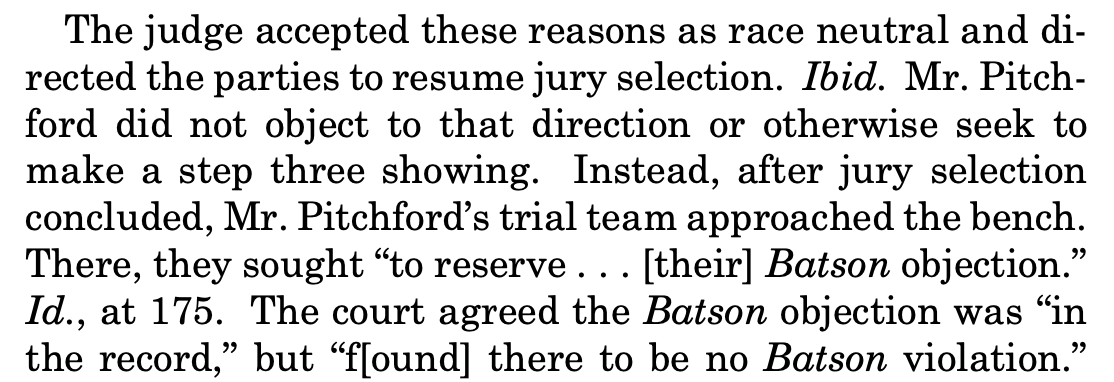
Compare that with Kavanuagh’s discussion for the court:
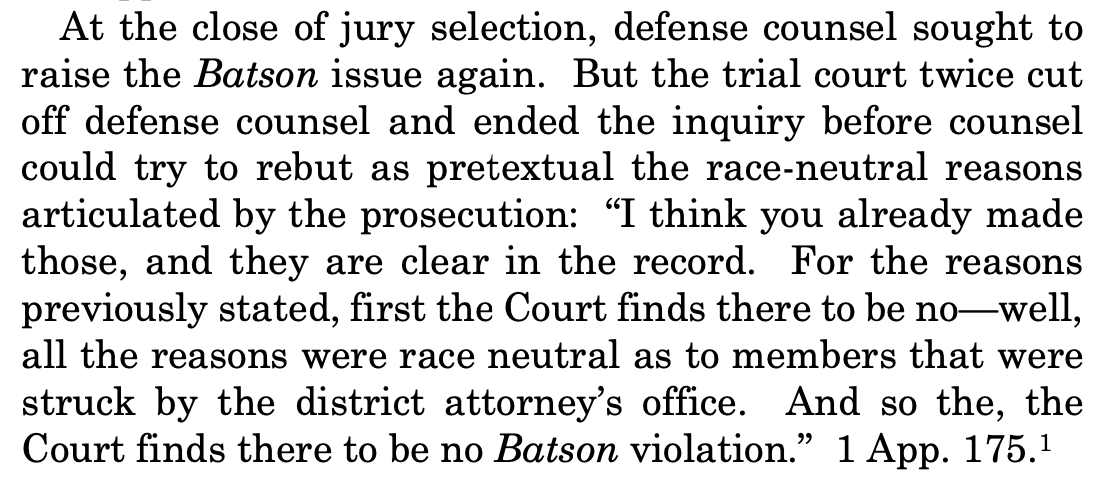
More generally, Kavanaugh wrote, “The bottom line: The State’s argument—that Pitchford preserved his Batson objection but nonetheless somehow waived his Batson pretext argument—does not make much sense and is not a reasonable reading of this record.“
There are two other points that I would like to highlight — signaling Gorsuch’s continued lockstep movement with Thomas and Alito on capital punishment.
In describing the case, Gorsuch wrote:
In 2004, Terry Pitchford and an accomplice robbed a store in Mississippi. At the end of it, the store’s owner, Reuben Britt, lay dead. Pitchford v. State, 45 So. 3d 216, 222–223 (Miss. 2010) (en banc).
At the Fifth Circuit, one of the country’s most far-right judges, Judge Kyle Duncan, wrote the opinion that was overturned on Thursday. Even he was less disingenuous in his characterization of the case:
A Mississippi jury convicted Pitchford of capital murder in 2006 for participating in an armed robbery during which the store owner, Reuben Britt, was shot to death by Pitchford’s accomplice. Pitchford v. State, 45 So. 3d 216, 222–23 (Miss. 2010).
They are literally citing to the same pages of the same opinion. Even the state, in its Supreme Court brief, admitted that Pitchford’s accomplice “kill[ed]” the shop owner.
Finally, at the conclusion of Gorsuch’s dissent, he claimed, “the Court issues a narrow judgment, holding only that Mr. Pitchford did not waive a step three Batson argument without dictating what further proceedings may be appropriate on remand consistent with §2254.“
This is false.
Kavanaugh — for the court — wrote much more in the penultimate paragraph of the opinion:
In light of the entire record in this case, we agree with the U. S. District Court that the Mississippi Supreme Court unreasonably applied the clearly established Batson precedents and unreasonably determined that Pitchford waived his opportunity to rebut the prosecutor’s asserted race-neutral reasons for the peremptory strikes of four black prospective jurors. 28 U. S. C. §§2254(d)(1), (2).
That is, as Kavanaugh stated earlier, the precise standard to obtain relief under AEDPA. And the district court here concluded its decision as follows:
Pitchford's petition for a writ of habeas corpus as to this claim is GRANTED. Pitchford's capital murder conviction and death sentence are hereby vacated, and the matter is remanded to the State of Mississippi for further proceedings not inconsistent with this opinion. The State of Mississippi must afford Pitchford a new trial within 180 days of the date of this order, otherwise it must release Pitchford from custody.
The majority held that the district court — not the Mississippi Supreme Court or the Fifth Circuit — was correct, and that result is where Pitchford’s case is directed to go from here, regardless of Gorsuch’s comment in closing his dissent.
I applaud Kavanaugh. This is not soft-on-crime sentimentality. It is proportionality, due process, and common sense. The actual shooter took a plea and got 20 years. Pitchford sat under a death sentence for decades after a jury-selection process the Supreme Court now says was constitutionally broken. At some point, the system has extracted every lawful pound of flesh it can justify. A retrial now means stale evidence, dead memories, vanished witnesses, old transcripts, and a state trying to recreate a case from another lifetime. If Mississippi wants to try again, fine. But the death case is over. Enough. Let law be law, not vengeance.
Amazing. I'm glad they got it right.