


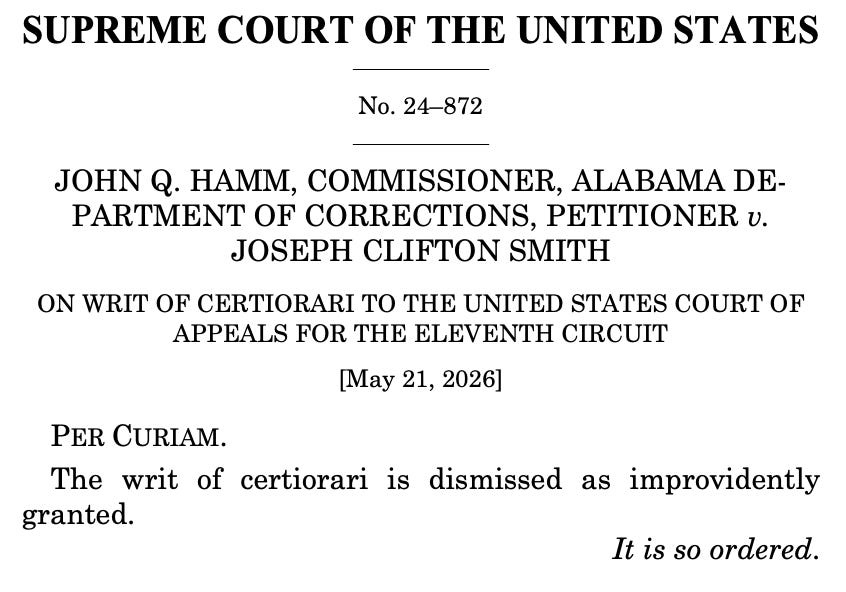
Joseph Clifton Smith will no longer face execution in Alabama following a 5-4 decision from the U.S. Supreme Court on Thursday that followed years of back and forth in the courts and the nearly three decades that Smith has spent on death row for a 1997 murder.
The high court let stand rulings from two lower courts that ordered Smith’s death sentence to be vacated because the district court found him to be intellectually disabled and, as such, ineligible for the death penalty.
Justices Sonia Sotomayor, Elena Kagan, and Ketanji Brown Jackson — the three Democratic appointees on the court — were joined by Justices Brett Kavanaugh and Amy Coney Barrett — appointed to the court by President Donald Trump in his first term — in allowing the lower court rulings to stand and Smith’s death sentence to be vacated.
Alabama had asked the Supreme Court to reverse those lower court decisions, and though the court took up the matter, it dismissed the appeal on Thursday as having been “improvidently granted.”
Referred to as a DIG — dismissed as improvidently granted — the ruling from the high court means the U.S. Court of Appeals for the Eleventh Circuit decision affirming the district court’s ruling stands. As U.S. District Judge Callie Granade concluded nearly five years ago, “[T]he Court finds that the Petitioner is intellectually disabled. Accordingly, Petitioner’s Writ of Habeas Corpus will be granted, and his death sentence will be vacated.“
Ordinarily, that would be the end of the matter. On Thursday, however, there were three opinions written in conjunction with the DIG. Each told us a bit about where things stand with the death penalty in the United States.
First, we learned the vote of the DIG because Justice Sam Alito’s dissent was joined in whole or part by Chief Justice John Roberts and Justices Clarence Thomas and Neil Gorsuch.
Referencing Atkins v. Virginia, the Supreme Court decision from 2002 barring the execution of the intellectually disabled, a portion of Alito’s dissent joined by the four justices stated:
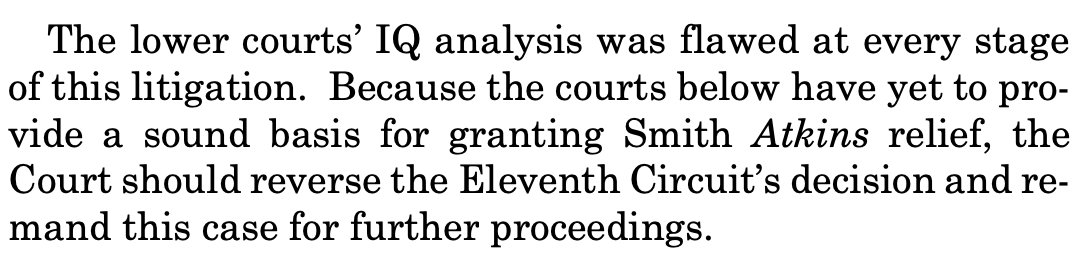
Elsewhere, and also joined by all four dissenting justices, Alito wrote about the question initially taken up in the case at the high court, noting that “this Court has never explained when courts may treat multiple [IQ] scores as cumulatively dispositive“ of intellectual disability. “Our silence on this issue leaves courts without direction on how to address a recurring situation.“
Alito went on to state an opinion of the four dissenting justices — so, not for the court — that “courts and legislatures may rely on any reasonably sound method of estimating a defendant’s ‘true’ IQ.” He then went on to highlight three approaches that “appear in the APA’s Handbook of Intellectual and Developmental Disabilities.“
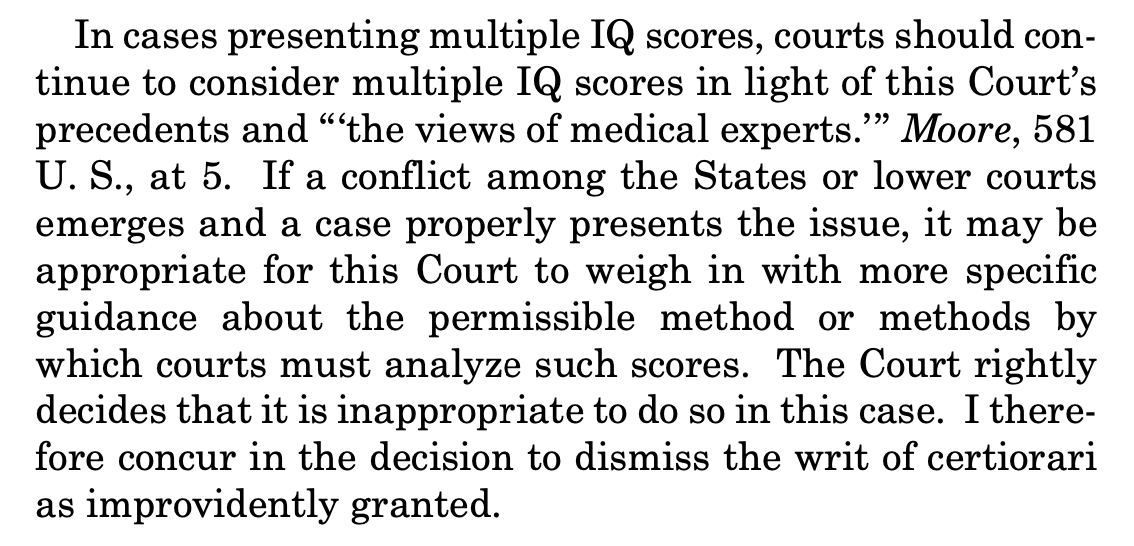
In an opinion concurring with the DIG on Thursday, however, Sotomayor, joined by Jackson, wrote, “The Court is not equipped in this case to provide any meaningful guidance on how courts should assess multiple IQ scores.“
Specifically, she explained why this was the wrong case to resolve these questions and why, in their view, the dissent’s discussion of “how courts should evaluate multiple IQ scores is incomplete and potentially misleading.“ Noting that “the litigation below did not focus on whether a precise methodology exists that courts must use,“ Sotomayor wrote that “this Court rightly concludes that it should not provide more detailed guidance beyond what this Court’s cases have previously said.“
Concluding for her and Jackson, as a counterpoint to Alito’s dissent, Sotomayor wrote:
Finally, not one to be left out, Thomas penned his own dissent on Thursday — in addition to having joined all of Alito’s dissent.
His primary reason for writing — joined by no other justice — was to complain about Atkins itself (or, really, any functional work being carried out by the Eighth Amendment’s prohibition on “cruel and unusual punishments).
“Nothing in the text or history of the Constitution supports Atkins,” he wrote. “It should be overruled.”
He went on to lay out the ordinary facts of death penalty litigation, then turns all of the rules and procedures involved in any complex litigation into, as Thomas characterized it, “the hopeless enterprise that this Court today shows it cannot control.” This is, simply put, Thomas’s imagination — not law. Nonetheless, he continued, laying out his case for why Atkins should be overruled and concluding with his hope that, “[i]n a future case,” the court should do so.
Despite that hope, though, Thomas was alone on that front on Thursday.
Atkins remains, and Granade’s 2021 decision granting Smith’s habeas corpus petition and vacating his death sentence because she found him to be intellectually disabled will stand.
At the same time, however, the reality of this process — the flip side of Thomas’s claimed concerns — should be noted.
Smith originally filed his habeas action before Granade, a George W. Bush appointee, more than 20 years ago, in her third year on the bench.
She has, at this point, been a senior status judge for a decade.
Two other executions before SCOTUS
Despite the action in the Alabama case, the U.S. Supreme Court denied requests to block executions scheduled for Thursday in Tennessee and Florida.
The Supreme Court denied multiple requests from Tony Carruthers to block his execution by Tennessee. There were no noted dissents.
Tennessee, however, botched the execution on Thursday morning — leading Gov. Bill Lee to issue him a one-year reprieve of execution.
According to the statement from the Tennessee Department of Correction, “the team was unable to immediately establish a backup [IV] line,” “could not find another suitable vein,“ and “was unsuccessful“ in an effort “to insert a central line.” (For more on what a central line is, read this from John Hopkins.)
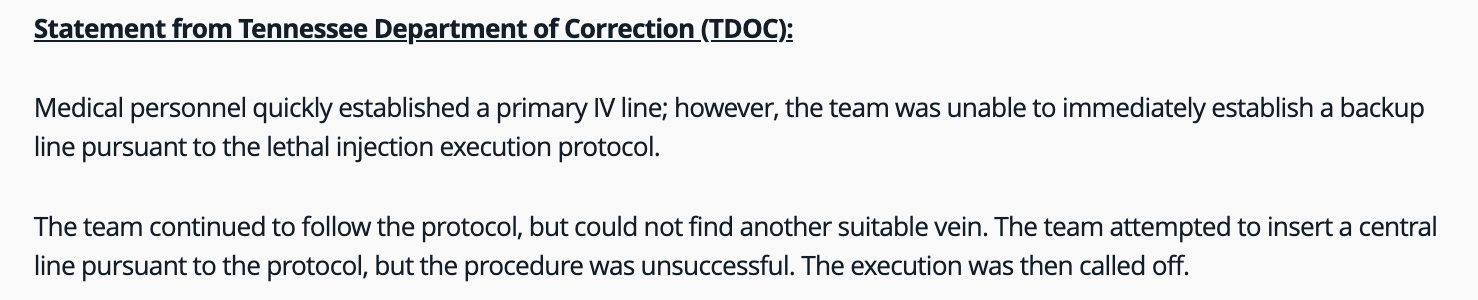
The Nashville Banner’s report from Mikeie Honda Reiland, Steven Hale, and Steve Cavendish provides a much more stark — and likely more accurate — description of what actually happened Thursday morning:
“This was a tortured, botched execution. I mean, there’s no question about it,” Carruthers’ ACLU attorney Maria DeLiberato told the media. “By the grace of God, he’s still alive. But they tortured him, trying to find a vein.”
Shortly thereafter, the Supreme Court, with no noted dissents, denied Richard Knight’s requests to block Florida from trying to kill him later Thursday.
Knight’s execution is set for 6:00 p.m. Thursday.
Abolish the death penalty in all cases.
Thomas & Alito - the Sclerotic Duo - what propels them? Like Trump, those two seems dissatisfied with their elite life (propped up by Leo’s Billionaire Boyz Fund) and want nothing but the worst for the rest of us. Sour peeled grapes?