

SCOTUS likely to allow state trans sports bans, but a changed tone could signal a narrow ruling
Although a majority appeared unlikely to strike down West Virginia and Idaho's bans, there also seemed to be interest in avoiding a final decision on constitutional questions for now.

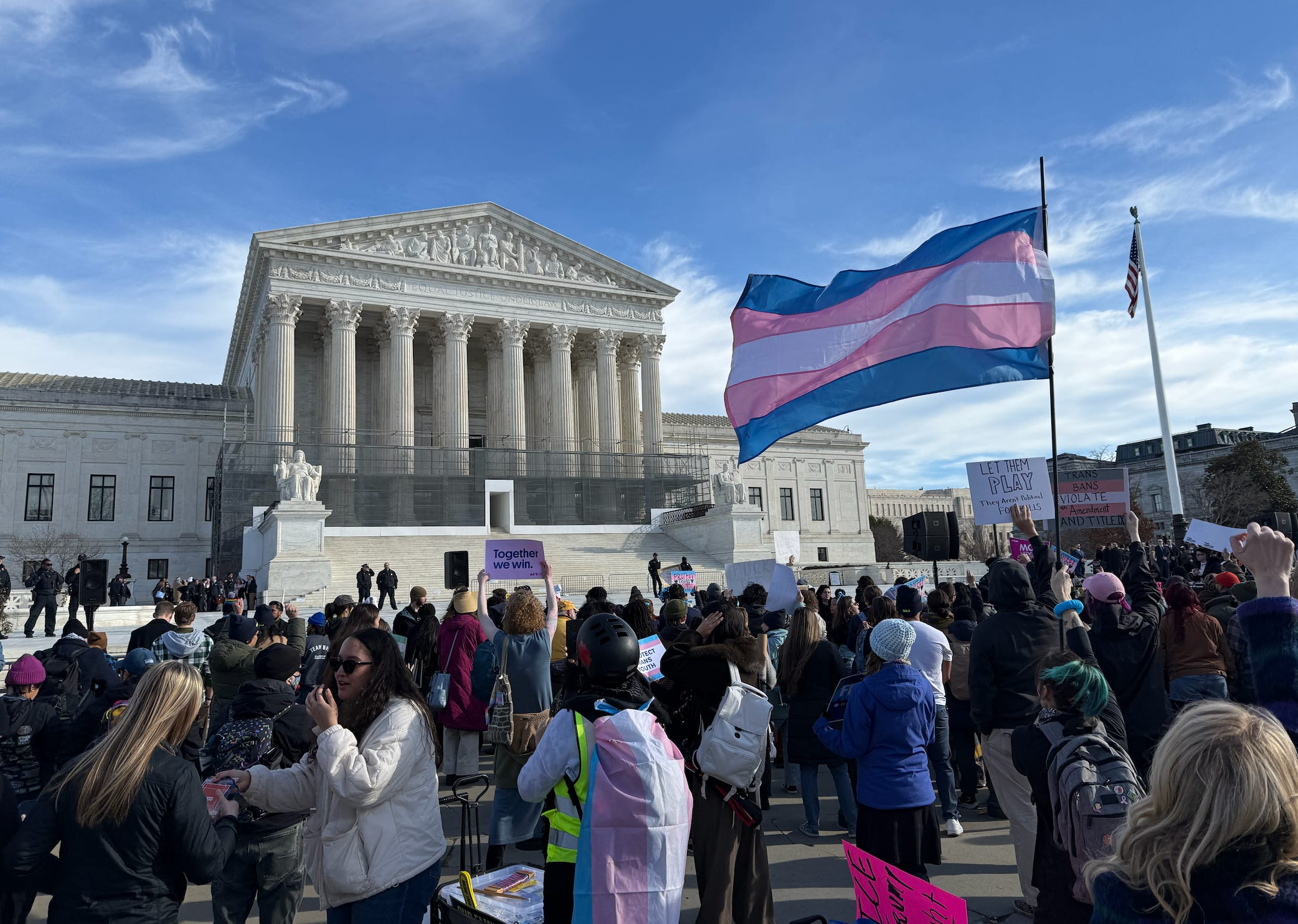
A majority of the U.S. Supreme Court on Tuesday appeared likely to rule that the federal education law known as Title IX allows Idaho and West Virginia to ban trans girls from girls sports teams.
Nonetheless, after nearly three-and-a-half hours of arguments between the Idaho and West Virginia cases, it seemed almost as likely that the court would issue a narrow ruling in the case — allowing those bans under Title IX of the Education Amendments Act of 1972 and a later amendment to the law but leaving open the questions of whether such bans violate constitutional equal protection guarantees and whether states that allow trans girls to participate in girls sports can do so under Title IX.
In such a scenario, all would stay as it is today — with no constitutional ruling.
Despite the high-profile case — so prominent in discussions about political “culture war” issues — the arguments were a much more low-key affair and less combative than other recent trans-related arguments.
They were a far cry from the high-intensity arguments in the challenge to Tennessee’s ban on gender-affirming medical care for trans minors, the challenge to a Maryland school district’s decision not to allow parents to opt their children out of reading time that including LGBTQ-related books, or even the recent arguments over conversion therapy bans. (The Tennessee law was upheld, and the Maryland policy was struck down.)
In addition to questions from Justices Sonia Sotomayor, Elena Kagan, and Ketanji Brown Jackson that were skeptical of the two states’ arguments (and the Justice Department’s arguments backing the state bans), questions from Justices Neil Gorsuch and Amy Coney Barrett — and, to a lesser extent, Justice Brett Kavanaugh — suggested that the court might not be ready to issue a final, definitive ruling on the matter despite having granted review of the cases this past July.
It’s dangerous to read too much into arguments, and (again) it did appear that a majority of the court would allow trans sports bans to remain in effect for now, but there was a different tone on Tuesday — particularly among the younger Republican appointees. As Kavanaugh put it at one point to Kathleen Hartnett, the Cooley partner representing Lindsay Hecox, a trans college student in Idaho, “I think one of the themes of your argument has been the more people learn, the more they’ll agree with you.“
As the justices have been hearing more cases involving more stories of more trans people — and maybe even have encountered trans people outside of the antiseptic confines of court cases — perhaps the statement was more than just a theme of Hartnett’s argument.
On the Title IX question, the ACLU’s Joshua Block — arguing for Becky Pepper-Jackson, the trans girl at the center of the West Virginia case — explained, West Virginia’s argument that the court should hold that “this Court’s reasoning in Bostock [v. Clayton Country]” — the 2020 decision holding that the sex discrimination ban in Title VII of the Civil Rights Act of 1964 includes discrimination based on sexual orientation and transgender status — “does not apply to Title IX“ would “take[] a wrecking ball to the text of Title IX and the structure of this Court’s anti-discrimination precedents.”
And though Chief Justice John Roberts — who joined the majority opinion in Bostock — attempted to distinguish the ruling in that case from West Virginia’s ban in a discussion with West Virginia Solicitor General Michael Williams, the issue appeared to fall to the wayside throughout the day’s arguments.
Instead, the 1974 Javits Amendment to Title IX — which specifically directed that “reasonable” sports-specific regulations be promulgated to advance Title IX — and those regulations loomed large in the arguments. Raised nearly two dozen times in the West Virginia arguments, Block explained that the Javits Amendment “provides extra breathing room for reasonable regulations that take into account sex-based differences in athletics to provide equal athletic opportunity for everyone.”
Although Block argued that West Virginia’s exclusion of Becky ran afoul of that “framework,” the amendment and regulations would provide a way to limit the decision and its impact to sports — a distinction that could be key following questioning from Barrett, later echoed by Kagan, about the effect of a decision upholding the bans on other educational activities, including academic instruction.
While Kavanaugh appeared willing to allow the laws to proceed under Title IX, a ruling that could affect similar bans in 27 states, he also was focused on whether and how the court could ensure that the decision in these cases does not resolve the question for those 23 states that allow trans girls to compete in girls sports. Kagan, likewise noting that, asked the Justice Department’s lawyer, Hashim Mooppan, and Block about that.
“[I]f we didn’t want to prevent a different state from making a different choice from West Virginia, what should we not say or what should we say to prevent that from happening?” she asked Block.
“Don’t give [a] definition of sex,” he said, earlier having noted that they weren’t challenging West Virginia’s definition of sex. “And I also … wouldn’t decide this by assuming that Title IX provides a right to single-sex teams,“ he added, noting that the regulations make clear that “single-sex teams are optional. They’re not mandatory.”
Multiple times, including by Kavanaugh, the point was raised that the further questions about how Title IX applies to the other states could be raised at a later time. Mooppan told Kavanuagh, for example, that, even if the state bans were deemed allowable under Title IX, the Javits Amendment, and the regulations, California — or another state in a similar position — would argue that those provisions still allow it to accommodate certain trans students by letting them compete.
The Equal Protection Clause arguments, meanwhile, quickly got into the weeds over whether an as-applied equal protection challenge — as opposed to a facial challenge — can be brought at all based on the plaintiffs’ sex discrimination claims. If so, the arguments continued to delve into what such challenges look like when considered by courts, whether subgroups or individuals can bring them, and how big those subgroups must be if they must be subgroups. After significant debate on those fronts, it appeared that several justices were open to a way out of deciding that question now.
Although Kathleen Hartnett, a partner at the Cooley law firm, did an excellent job of getting through all of those weeds with smart arguments about how the court could address the issue in a way that would allow “transgender women who do not have an athletic advantage“ — because they have not yet gone through puberty, stopped the onset of puberty with puberty blockers, or are on hormone therapy treatment to suppress their testosterone — to succeed in an equal protection claim against Idaho, it seemed like there were as many views on how the court should resolve those questions as there are justices.
There was also a secondary argument that transgender status is directly implicated, and — though it didn’t appear likely the court was ready to rule on the issue — Gorsuch raised the issue. Although framed in terms of the arguments made by the Idaho student, Lindsay Hecox, in a question to Hurst, it was notable that he did so at all — and how he said it:
There’s another way to think about the case that your friends on the other side posit, and that is that transgender status should be conceived of as a discrete and insular class subject to scrutiny, heightened scrutiny, in and of itself given the history of de jure discrimination against transgender individuals in this country over history in immigration and family law, cross-dressing statutes, they get a long laundry list.
Nonetheless, there was very little discussion of the transgender status claim overall — further suggesting the court isn’t ready to resolve the equal protection question. And, because of the specific procedural postures of the cases, there is a pathway out of deciding the equal protection question for now.
In the Idaho case, the student, Lindsay Hecox, told the Supreme Court that she will not be participating in sports subject to Idaho’s ban while finishing college. Her lawyers have argued that, as such, the case is moot, prompting Sotomayor to ask Idaho Solicitor General Alan Hurst, “Would you say that we have to force an unwilling plaintiff who has offered to dismiss with prejudice, promised not to incur this activity again, we would force that person to continue prosecuting this case?“ Although Hurst responded that Hecox faces a “formidable burden” to show that it is “absolutely clear” that she won’t try to play on banned sports teams again, the Supreme Court — because it still has the West Virginia case — could hold that the Idaho case is moot.1
In the West Virginia case, meanwhile, the U.S. Court of Appeals for the Fourth Circuit only fully decided the Title IX claim, so the Supreme Court could rule on the Title IX question and remand the case for further consideration of the equal protection claim before needing to resolve that question. Although that might not have seemed to be a likely outcome going into arguments on Tuesday, the nearly three-and-a-half hours of arguments left a real impression that the justices might be wanting to slow down the path toward “constitutionalizing” these matters.
And though he was talking with Hartnett when he said this, comments from Kavanaugh toward the end of the Idaho arguments exemplified this: “Given that half the states are allowing it, allowing transgender girls and women to participate, about half are not, why would we at this point — just the role of this Court — jump in and try to constitutionalize a rule for the whole country while there’s still, as you say, uncertainty and debate, while there’s still strong interest in the other side?”
Perhaps one of the most surprising distinctions in the tone on Tuesday was the result of the combination of Justice Clarence Thomas only asking a handful of basic questions but not really engaging much with the arguments and Justice Sam Alito largely getting sidelined.
At one point, Alito went down a long path with Hartnett about a hypothetical “student who has the genes and the reproductive system of a male and had those at birth and has never taken puberty blockers, never taken female hormones, never had any gender-altering or affirming surgery, says, ‘Nevertheless, I am a woman.’“
Whether he thought this was a gotcha question or not, it sounded more like the opening of a Fox News segment than a Supreme Court argument question.
When he asked Hartnett whether the school could say, “No, you cannot participate on the girls’ team?” she confirmed what he was asking, then said simply, “Yes, they can.“
He was astounded — or playing to the far-right talk-radio audience where he would better fit in these days — responding, “But that person — is that person not a woman in your understanding? If the person says, ‘I sincerely believe I am woman, I am, in fact, a woman,’ is that person not a woman?“
Showing how incredibly simple — and respectful — this could be, Hartnett replied bluntly and concisely.
“I would respect their self-identity in addressing the person, but in terms of the statute, I think the question is, does that person have a sex-based biological advantage that’s going to make it unfair for that person to be part of the women’s team,” she told him. “And that’s the rationale for the regulation, and so that’s the way we would be testing that hypothetical.”
The Supreme Court’s decisions are expected before the Fourth of July.
Alternatively, the Supreme Court could remand the Idaho case for more fact-finding on the equal protection question — even though the case very well could be moot due to Hecox’s graduation before that fact-finding could be completed. In short, it could be a way of ending up at mootness even if the court doesn’t want to directly find Hecox’s Supreme Court appeal moot.
Thanks Chris! It's been a hard day and I just didn't have it in me to listen to the arugments. I hate that realistic hope is on a narrow ruling, but it's better than the alternative.
Damn Roberts and his faux-Christian fascist justices.